A $3.2 billion developer just collapsed, freezing money that thousands of retail investors thought they could withdraw on demand. Roughly 40 private credit funds are now nursing the exposure, and the redemption gates have started to close.
One manager sat almost entirely outside the wreckage, holding $1 billion in institutional capital and looking for places to spend it.
That contrast is the story of Australian private credit right now. While peers wrestle with impaired loans and shrinking share prices, HMC Capital (ASX: HMC) has drawn a UBS buy rating built on a clean loan book and a valuation the market has heavily discounted alongside everyone else.
The problem for investors is telling the two groups apart. Suppressed price-to-earnings multiples across the sector make almost every private credit name look cheap, but cheap and safe are not the same thing.
This analysis lays out a framework for separating quality from contamination in a stressed market: how to read the sector-wide repricing, why capital structure decides survival during a credit event, and what HMC’s numbers actually imply once you strip out the noise.
The $3.2 billion Bathla fallout reshaping Australian private credit
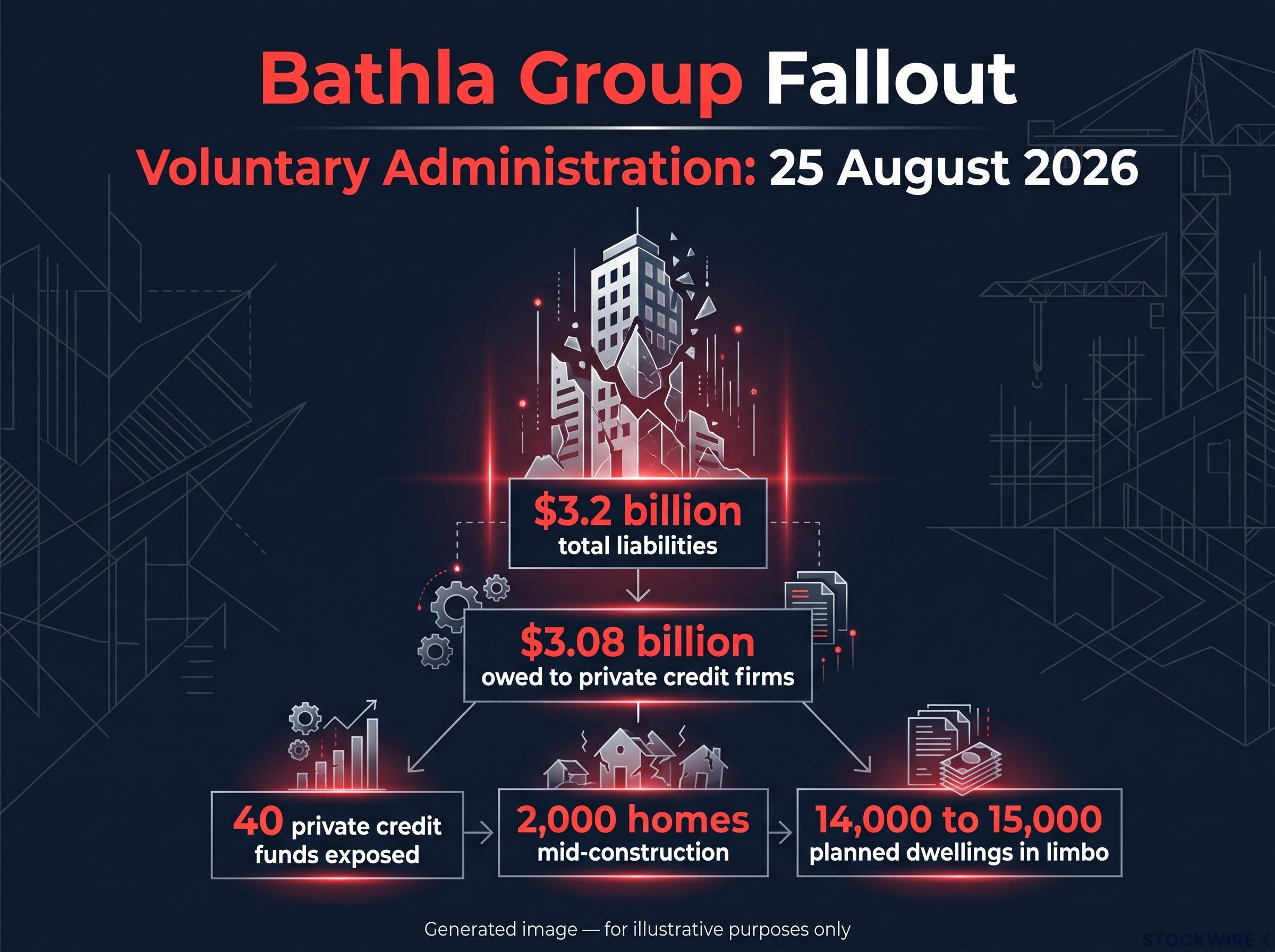
Bathla Group, a major New South Wales residential developer, entered voluntary administration on 25 August 2026, with advisory firm Teneo appointed to key entities including Universal Property Group and Raj & Jai Constructions. According to the administrators’ report, total liabilities stood at $3.2 billion, of which $3.08 billion was owed to private credit firms.
This is not a single-fund problem. Roughly 40 private credit funds carry exposure, and the physical fallout is enormous.
- Around 2,000 homes were mid-construction when administrators stepped in.
- Between 14,000 and 15,000 planned dwellings are now in limbo.
- Administrators indicated Bathla needed roughly $20 million in short-term funding just to keep some projects moving.
The market response separates this event from an ordinary corporate failure. ASX-listed real estate stocks with private credit exposure under UBS coverage fell an average of 28.9% year-to-date, against a 3.4% gain for the ASX 200 over the same period. Forward price-to-earnings multiples for that group contracted by 36%, arriving at an average of 11.1x.
The Bathla administration has crystallised retail private credit risks that ASIC’s REP 814 had already flagged in theory: infrequent or model-based loan valuations can mask borrower deterioration right up to the point formal losses are recognised, compressing the window investors have to act.
That severe multiple contraction is the signal that matters for you. The market is not discounting one bad loan; it is repricing development lending risk across the board, which means your task is to separate managers with clean books from those managing impaired assets.
Redemptions and liquidity constraints
The distress has already reached investors trying to get their money out. According to The Adviser, both Centuria Capital and CVS Lane have restricted redemptions at certain Bathla-exposed funds.
Centuria describes its direct balance-sheet exposure as a single $4.5 million loan facility, which it says is not material. CVS Lane’s position looks heavier, with its First Mortgage Fund and Property Finance Fund exposed across nine separate Bathla loans.
The wider fear is contagion. FinCap executive chairman Christian Ryan told ABC that a run on funds remains “possible” if more investors worry about retrieving their cash.
On 22 September 2026, ASIC commissioner Constant warned that the private credit sector’s rapid growth and complexity had outpaced industry standards. Bathla’s collapse, she said, “reinforces why strong governance, effective oversight, clear disclosure and accurate valuations are critical.”
ASIC’s private credit standards speech, delivered by Commissioner Constant on 22 September 2026, makes explicit that rapid sector growth and rising complexity have outpaced governance practices, framing the Bathla collapse as a case study in what weak oversight and inaccurate valuations produce in practice.
When big ASX news breaks, our subscribers know first
Mechanics of the freeze: retail liquidity versus institutional mandates
To understand why some funds froze and others did not, you need to understand a structural mismatch at the heart of retail private credit.
Private credit means lending money outside the traditional banking system, often to property developers, in exchange for interest income. A property development loan is inherently illiquid: you cannot sell it quickly, and it only pays out when the project completes or refinances.
The trouble starts when a fund promises daily or monthly withdrawals against those slow-moving loans. If enough investors ask for their money at once, there is no fast way to raise the cash, so the manager freezes redemptions to avoid dumping assets at fire-sale prices. That is precisely what has happened across several Bathla-exposed vehicles.
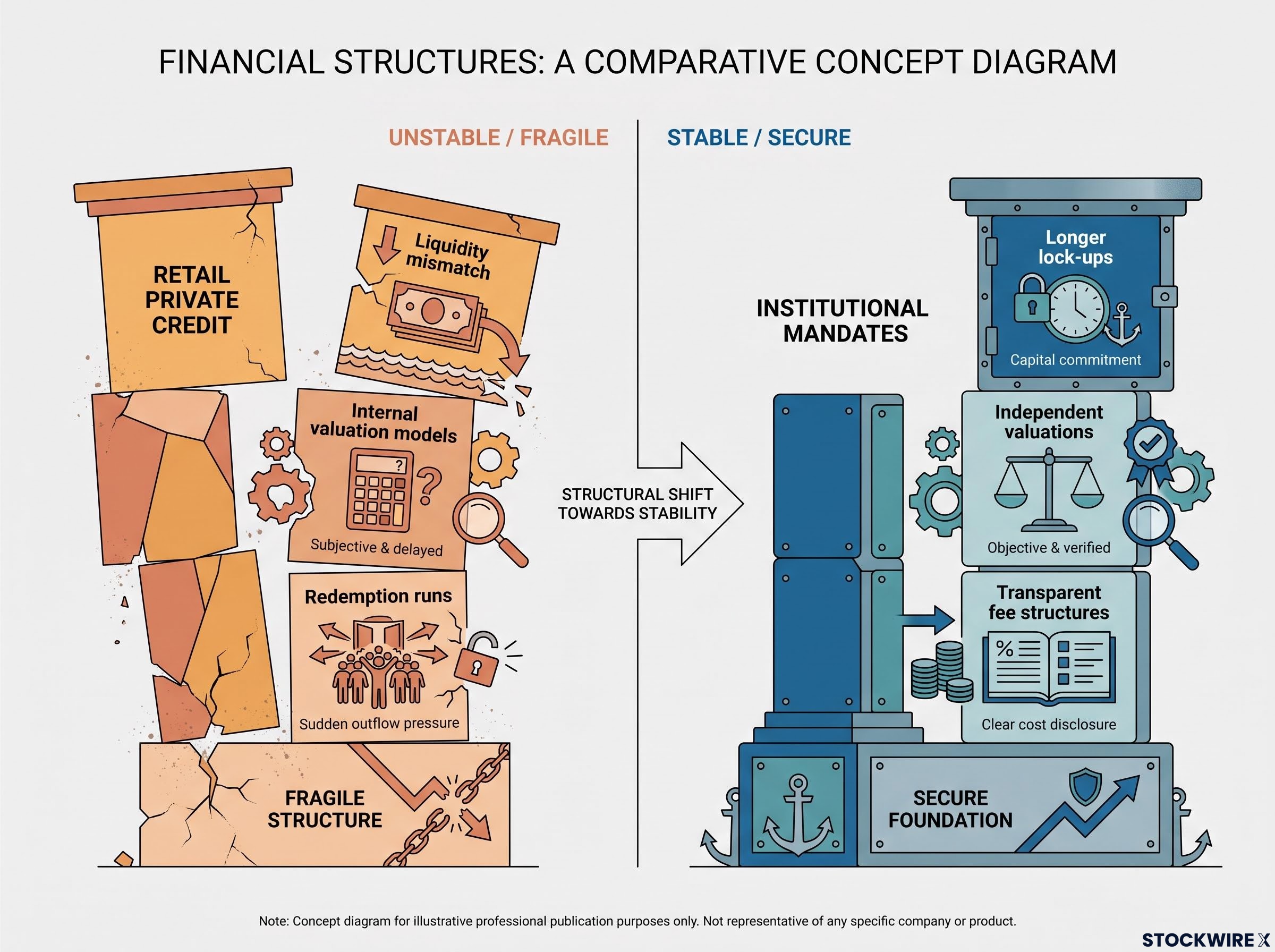
Three vulnerabilities repeat across retail-focused private credit:
- Liquidity mismatch. Frequent redemption terms sit on top of loans that take years to mature, creating a structural fault line that only appears under stress.
- Internal valuation models. ASIC has flagged unrealistic valuations as a sector-wide concern. When unit prices rely on optimistic internal assumptions rather than market-tested pricing, write-downs can arrive suddenly.
- Redemption runs. Once one fund gates withdrawals, nervous investors elsewhere try to exit first, turning a liquidity squeeze into a contagion risk.
Institutional mandates are built differently. Large institutional investors typically negotiate longer lock-ups or closed-end terms up front, which removes the sudden redemption wave that forces distressed selling.
They also demand independent valuations, clear methodologies and transparent fee structures, the exact standards ASIC has said the sector needs. Regulators have specifically warned that property development lending is vulnerable to inflation, cost increases and project delays, which makes valuation discipline more than a compliance exercise.
The takeaway for you is direct. A manager’s capital source dictates its survival during a credit event, so you should scrutinise a fund’s investor base as closely as its loan book. A clean book funded by flighty retail money is far more fragile than the same book funded by patient institutional capital.
HMC Capital’s clean book and the $1 billion deployment pipeline
This is where HMC separates itself from the pack. The company has no Bathla exposure, and it has spent the past two years deliberately rebuilding who its capital comes from.
HMC acquired private credit manager Payton Capital in May 2024 for $127.5 million. Since then, assets under management on the platform have grown from $1.5 billion at acquisition to $2.3 billion, and UBS now describes the operation as an institutional-grade business.
The FY26 numbers are not uniformly strong. Private credit EBIT (earnings before interest and tax) fell 28% to $13.3 million as loan origination slowed through a cautious market.
But the balance sheet tells a more forward-looking story. In June 2026, HMC raised $1.35 billion in institutional capital, leaving $1 billion available for deployment. That capital raise marks a deliberate shift away from wholesale and high-net-worth clients toward institutions.
The June 2026 institutional private credit mandates, totalling $1.35 billion across two global investors with $375 million already seeded at financial close, mark the structural pivot that separates HMC’s capital profile from the retail-funded vehicles now facing redemption pressure.
Capitalising on competitor distress
Credit-cycle experience points to a consistent pattern: managers with ample undrawn capital and disciplined underwriting tend to gain ground when rivals stumble. They can acquire loan portfolios from distressed peers at a discount, or offer rescue and construction-completion financing on tighter covenants and higher spreads.
HMC is positioned to do exactly that in the second half of 2026, while competitors manage impaired books and field redemption requests. UBS points to the platform’s record of zero principal losses in its primary first mortgage fund as evidence the underwriting discipline is real, not just marketed.
That $1 billion of undeployed institutional capital is the decisive detail for you. It means HMC can act as a liquidity provider at premium rates rather than a forced seller, which turns a sector crisis into a window for counter-cyclical growth and positions the platform to take share as weaker rivals retreat.
Deconstructing the UBS buy thesis and the 3.8x earnings multiple
The valuation is where the case gets concrete. UBS maintained its buy rating and $3.80 price target on 9 September 2026, and the reasoning rests on a mismatch between price and growth.
HMC shares trade at less than 10x forecast FY27 earnings while the company guides to underlying earnings per share growth of 16% for the same year. On its own, a growth business on a single-digit multiple looks cheap.
The picture sharpens when you adjust for the balance sheet. UBS estimates HMC’s net tangible assets (the value of physical and financial assets minus liabilities) at $2.22 per share after marking listed co-investments to market, below the reported $2.95 at 30 June 2026.
Strip out that asset value from the share price, and the market is valuing HMC’s funds management operations at just 3.8x earnings.
| Metric | Figure | What it signals |
|---|---|---|
| Private credit EBIT (FY26) | $13.3M, down 28% | Origination slowed in a cautious market |
| Underlying EPS growth guidance (FY27) | 16% | Forward growth still intact |
| UBS net tangible asset estimate | $2.22 per share | Marked-to-market asset backing |
| Implied funds management multiple | 3.8x earnings | Steep discount to growth profile |
Here is what that combination tells you. When a business guiding to 16% earnings growth trades at an implied multiple under 4x, the market is discounting the entire sector rather than the individual company. For uncontaminated players like HMC, that indiscriminate repricing is where a margin of safety appears.
The HMC Capital FY26 results also revealed that management has identified $25-50 million per annum of additional underlying earnings potential from optimising $1.4 billion in balance sheet investments, upside that is explicitly excluded from the 16% FY27 EPS guidance the market is already discounting.
Past performance does not guarantee future results, and these projections are subject to market conditions and various risk factors.
Weighing growth against sector concentration risks
The tension in this stock is genuine. HMC is positioning aggressively for growth at the same moment ASIC is signalling a crackdown on the broader $224 billion private credit market.
Dodging Bathla does not make HMC immune. Systemic weakness in property development lending remains a headwind for the whole sector, and tighter regulation of fees, valuations and product design could reshape the economics for every manager operating in this space.
Systemic private credit risk in Australia also operates through transmission channels domestic stress tests were not designed to capture: geopolitical disruptions, offshore wholesale funding costs, and the growing cross-border linkages created as Australian superannuation funds expand into global private credit at a late point in the credit cycle.
What the Bathla fallout has clarified is which qualities actually matter in a downturn. Institutional-grade governance, independent valuations, disciplined underwriting and patient capital are no longer nice-to-haves; they are the difference between deploying into a dislocation and freezing your investors out of theirs.
For investors weighing the UBS thesis, that is the real test. The valuation discount is available across the sector, but only a handful of managers can back it with a clean book and the balance sheet to act on it.
This article is for informational purposes only and should not be considered financial advice. Investors should conduct their own research and consult with financial professionals before making investment decisions.