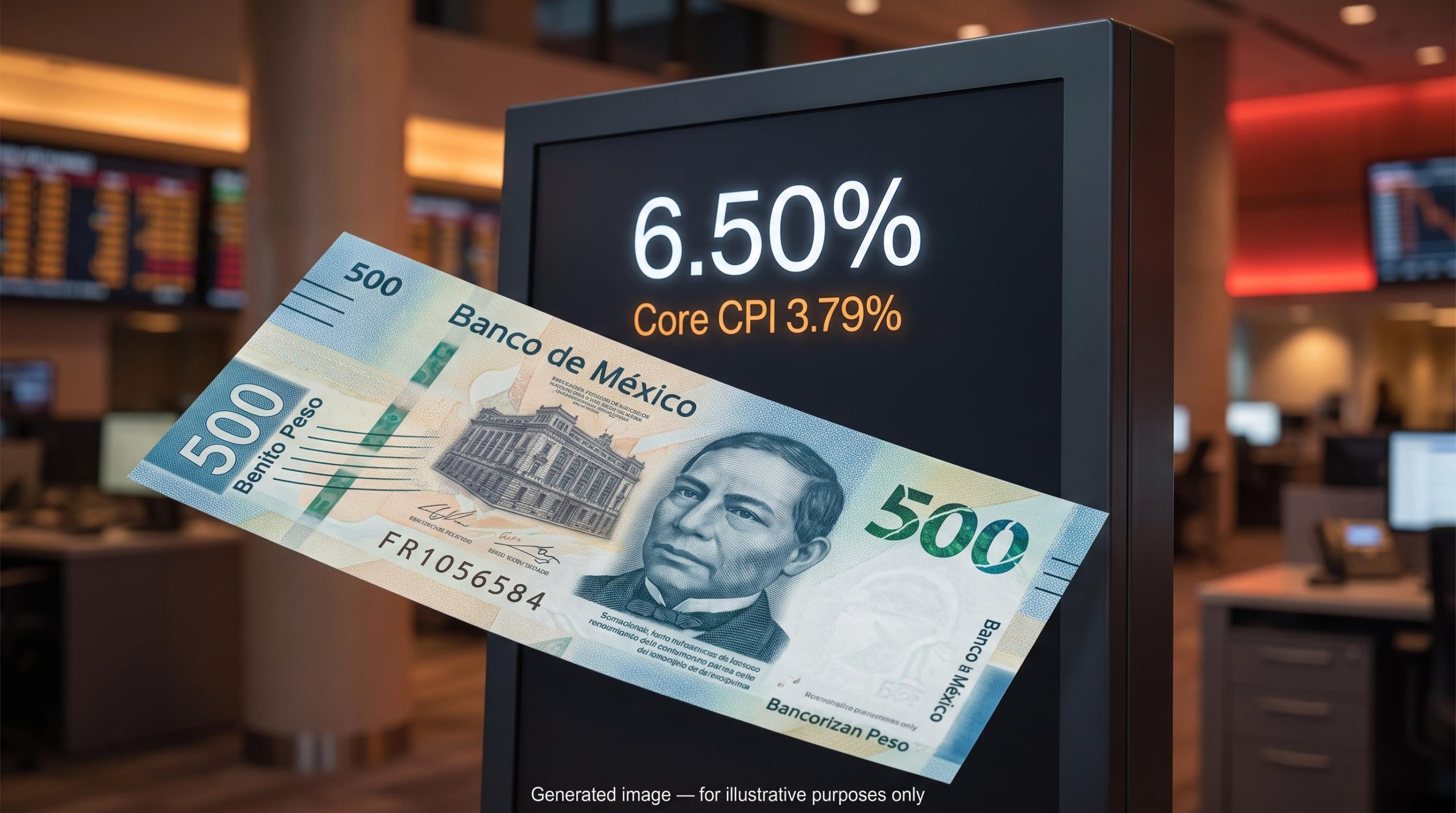
Mexico’s central bank kept its benchmark interest rate unchanged today, but the headline hold is not the real story. The story sits in the words the board chose to remove.
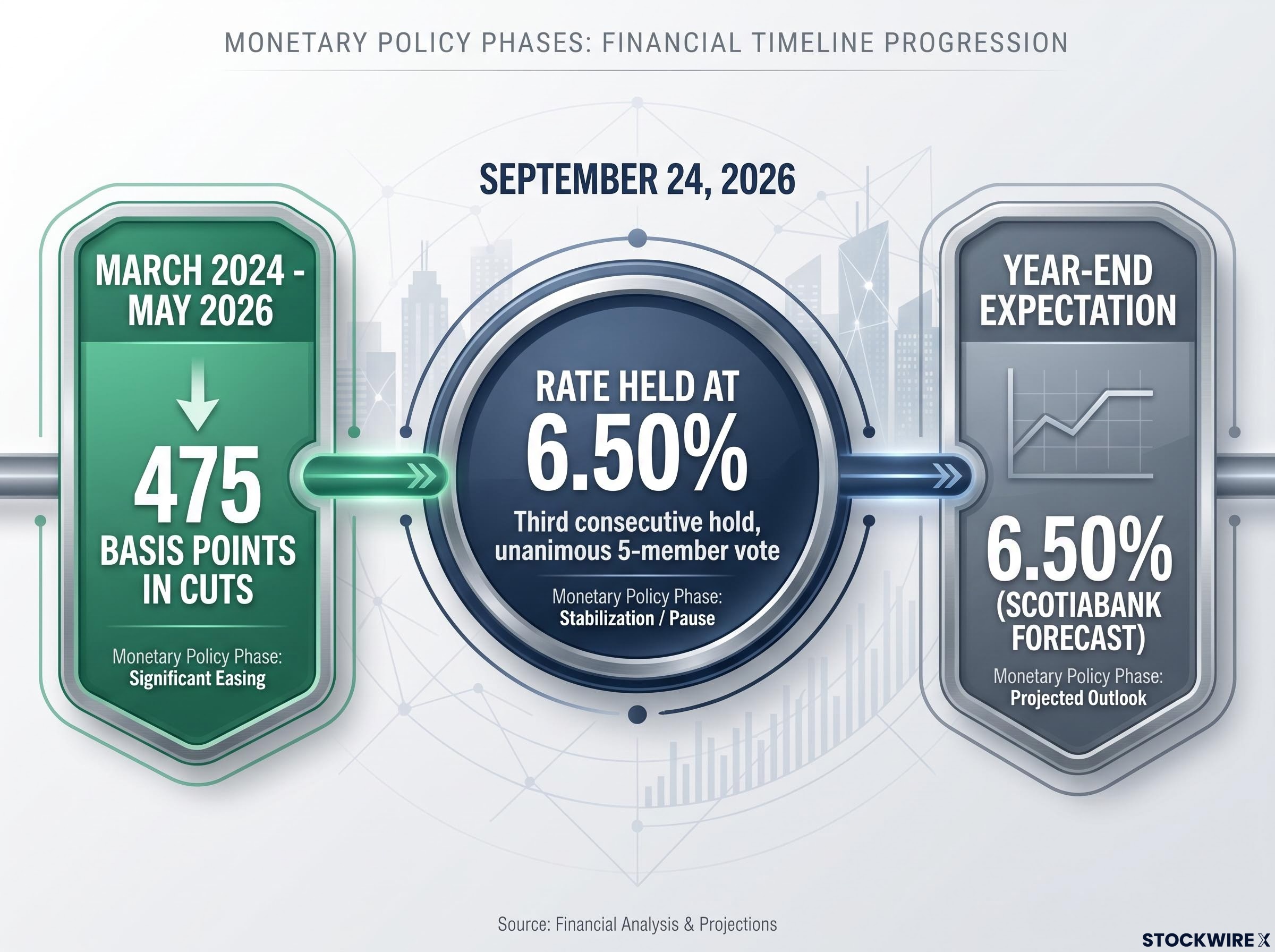
The Banxico interest rate decision on 24 September 2026 left the overnight rate at 6.50% for a third straight meeting, delivered by a unanimous board vote. What shifted was the guidance. Policymakers quietly stripped out their earlier promise to keep borrowing costs anchored, replacing it with a stance that keeps every option open as global trade risks and stubborn domestic inflation press against each other.
That change matters more than the rate itself. It signals a central bank preparing to move quickly in either direction rather than one committed to a script.
This piece breaks down the revised inflation trajectory driving the caution, and explains how Banxico’s deliberate refusal to follow the US Federal Reserve reshapes the outlook for the peso and for cross-border capital flows.
The pivot to policy flexibility at 6.50 percent
The vote was clean. All five members of the governing board backed holding the overnight interbank funding rate at 6.50%, extending the pause that began earlier this year.
This is the third consecutive hold, and it caps a period of extraordinary loosening. Between March 2024 and May 2026, Banxico slashed the benchmark by a cumulative 475 basis points, before parking it at 6.50% and stepping back to assess.
None of that surprised markets. The surprise came in the communication.
In previous statements, the board had signalled fairly explicitly that rates would stay put. This time, that language was gone. Banxico shifted toward strict data dependence, tying each future move to incoming figures rather than any pre-set path.
Read this carefully, because it is easy to misinterpret. Dropping the guidance is not a coded hint that cuts are coming soon. It is the opposite of a commitment. The board wants room to react, not a signal to decode.
Banxico framed its future decisions around a specific set of factors:
US rate transmission to EM currencies operates through three reinforcing channels simultaneously: capital flow reversals, dollar-denominated debt repricing, and FX pass-through to domestic inflation, with BIS research linking a 100-basis-point rise in the US term premium to roughly a 6% depreciation in emerging market currencies.
- The ongoing disinflation process and whether it holds
- Currency pass-through effects, meaning how a weaker or stronger peso feeds into consumer prices
- Economic slack, the gap between what the economy produces and what it could produce at full capacity
- Inflation expectations across households and firms
- External risks, particularly geopolitical conflict and US trade policy
For you as an investor, the removal of rigid guidance tells you that Banxico wants maximum manoeuvring room to absorb external shocks. The practical read is straightforward: prepare for higher monetary policy volatility heading into year end, because the board has deliberately unshackled itself from a fixed course.
Why core inflation forced an upward forecast revision
The inflation picture is where the caution earns its keep, and it is not as clean as the headline number suggests.
Data from Mexico’s statistics agency, published alongside the decision, put headline consumer price inflation at 3.42% year-on-year for the first half of September 2026. That figure actually ticked up. Core inflation, which strips out volatile items like fuel and food to show the underlying trend, sat higher at 3.79%, though it continued a slow decline.
That gap is the tension. Headline inflation looks close to target, but the core reading, the one central bankers watch most closely, is proving sticky. It is falling, but reluctantly.
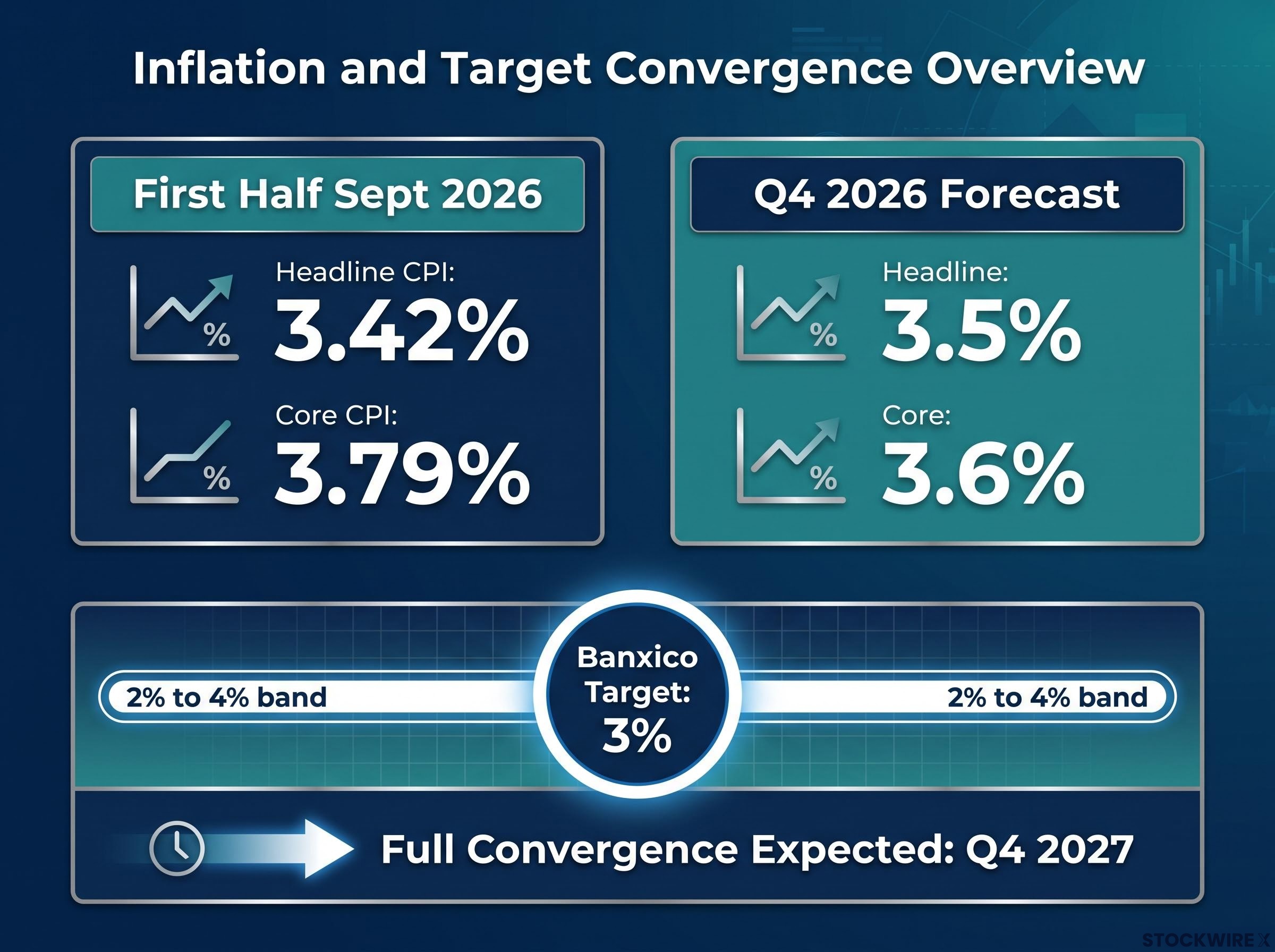
Banxico responded by nudging its own forecast in the direction the data pointed.
| Measure | Latest figure (first half September 2026) | Banxico Q4 2026 forecast |
|---|---|---|
| Headline CPI (y/y) | 3.42% | 3.5% (unchanged) |
| Core CPI (y/y) | 3.79% | 3.6% (revised up from 3.5%) |
The core forecast for the fourth quarter moved up to 3.6%, a small revision with a clear message: underlying price pressure is lingering longer than hoped. Banxico’s target remains 3%, at the midpoint of a 2% to 4% tolerance band, and the board does not expect full convergence to that target until Q4 2027.
External forces sharpen the worry. US tariff threats, supply chain bottlenecks, and volatility in energy and food prices all sit on the upside of the risk balance, capable of reigniting pressures Banxico is trying to tame.
Tariff-driven input inflation is already registering in Mexico’s manufacturing sector, with S&P Global citing input cost pressures running among the highest in over 15 years as the 10-50% duty band on auto parts creates a cost penalty that feeds directly into the consumer price categories Banxico is struggling to cool.
Here is what that means for your positioning. This core stickiness is the single biggest barrier to any near-term rate cut. It effectively locks fixed income and yield expectations into a higher-for-longer holding pattern, and it tells you which data point will trigger the next move: sustained progress on core, not the headline number.
The peso penalty and deliberate decoupling from the Fed
Now the global angle, because Mexico does not set policy in isolation. The gravitational pull of the US Federal Reserve is always in the room.
On the day of the decision, the peso traded at 17.5642 against the US dollar. The longer arc still favours the currency: over the past twelve months, the peso has appreciated 4.97% against the dollar, rewarded by Mexico’s high rates and its appeal to carry-trade investors chasing yield.
The compression of the US-Mexico rate differential to 250 basis points, its slimmest since 2015, sits directly behind the carry trade unwind that pushed USD/MXN from 16.98 to 17.50 in the weeks before today’s decision, framing the hold at 6.50% as much as a defensive manoeuvre as a neutral one.
The recent picture is less comfortable. Over the past month, the peso weakened 3.63%, a sharp reversal that reflects renewed global risk aversion and shifting expectations for the US-Mexico rate gap.
Against that backdrop, Banxico made its independence explicit. The board stated its decisions will not mechanically track the Fed, citing the different economic conditions on either side of the border. This is not new behaviour for Banxico; after the pandemic, it raised rates ahead of the Fed precisely to defend the peso and pre-empt capital flight.
Analysts largely accept the stance, with conditions attached. Scotiabank, in its post-decision note, characterised the outcome as delivering no surprises and reaffirmed its view that the rate closes the year at 6.50%, explicitly conditioning that call on the path of inflation, the exchange rate level, and the interest rate differential with the United States.
J.P. Morgan reads Banxico as walking a distinct, domestically driven path rather than shadowing the Fed, and expects guidance to turn gradually more cautious on inflation as energy, food, and weather risks cloud the 2027 outlook.
Both Scotiabank and J.P. Morgan frame the decoupling as viable only so long as the peso stays supported and the Mexico-US rate differential keeps drawing capital inward. A sharp narrowing of that gap, through aggressive Fed easing or overly generous Banxico cuts, could eventually force a realignment to avoid destabilising currency swings.
For you, the widening divergence between the two central banks lands directly on cross-border exposure. It makes the peso acutely sensitive to sudden shifts in global risk appetite, which is exactly the variable to monitor if you hold Mexican assets or run a carry position funded in dollars.
Navigating Mexican monetary policy into 2027
The takeaway from this hold is a central bank buying time. At 6.50%, Banxico is holding real interest rates high while it waits for core inflation to cooperate, and it has traded fixed guidance for flexibility precisely because the external picture is unsettled.
The next validation comes with the Q4 2026 data. Continued progress on core inflation strengthens the case for the current pause and eventually reopens the door to easing. A stall, driven by tariff pass-through or a weaker peso, keeps the door firmly shut.
The guiding principle running through all of it is clear: domestic inflation convergence, targeted for late 2027, takes precedence over aligning with the Fed. That is the lens through which to read every Banxico move from here.
For investors exploring how to express a view on Mexico’s higher-for-longer rate environment across asset classes, our deep-dive into EM local-currency debt positioning examines why local-currency bonds returned approximately 19% in 2025 and attracted $11.4 billion in Q1 2026 flows, with specific analysis of the carry yield and FX appreciation dynamics that make them a distinct instrument from broad EM equity exposure.
This article is for informational purposes only and should not be considered financial advice. Investors should conduct their own research and consult with financial professionals before making investment decisions.
Past performance does not guarantee future results. Financial projections are subject to market conditions and various risk factors, and forward-looking views from analysts are speculative and subject to change based on market developments.