UK inflation is projected to breach 4% in early 2027. The Bank of England just held rates for the sixth consecutive time. The Pound fell for a fourth straight session. These three facts are not coincidental; they describe a central bank pinned between two bad options, and a currency market pricing in that paralysis.
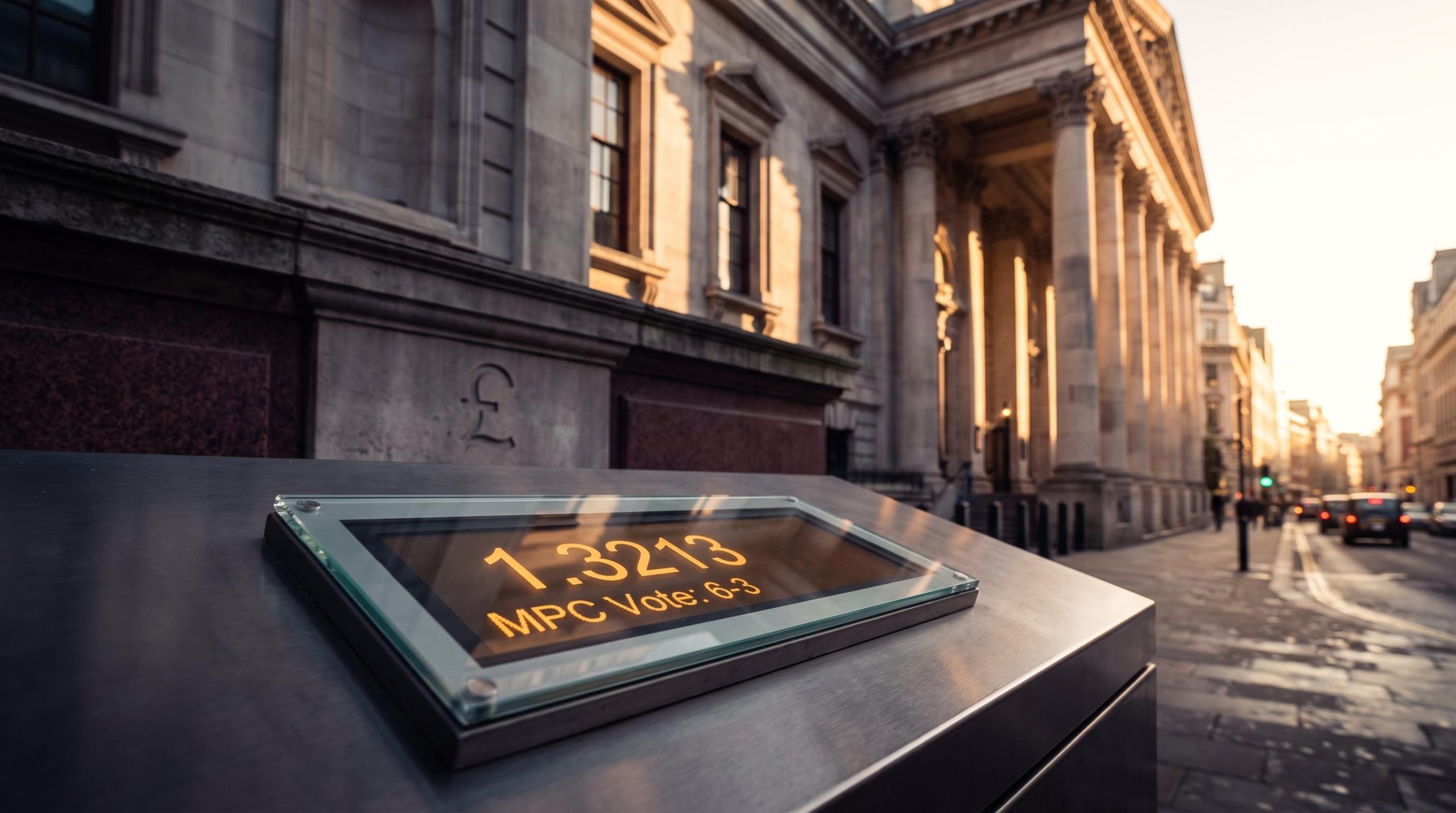
GBP/USD has traded under sustained selling pressure, touching 1.3213 on 24 September 2026 after a four-session losing streak. Sterling is not simply weak; it is losing ground on multiple fronts at once, sliding against the Dollar, Euro, and Yen in a single session.
The drivers run deeper than any one data release. They reflect a mismatch between where the UK economy sits and what the Bank of England can realistically do about it, compounded by a US Dollar growing more attractive by the week.
This piece maps the three forces pressing on sterling, explains the mechanism by which they interact, and sets out the conditions under which the pressure could plausibly ease. If you hold UK-exposed assets, follow currency markets, or simply want to understand what the Bank’s constrained stance means for the Pound, this gives you the framework to read the signals as they arrive.
Sterling’s four-day slide: what the price action is telling you
Start with the raw numbers, because they contain an argument. On 24 September 2026, GBP/USD closed near 1.3213, having reached a daily high of 1.3256 before giving up ground to finish down 0.21% on the session. A single down day is noise. A fourth consecutive down day is something else.
The more revealing detail sits in the cross-currency comparison. Sterling did not just fall against the Dollar; it fell against nearly everything.
- GBP/USD: down 0.21% on the session
- GBP/EUR: down 0.06%
- GBP/JPY: down approximately 0.19%
- DXY (US Dollar Index): up 0.19% to 101.30
That last line matters. The Dollar strengthened by 0.19% on the day, yet sterling fell by more than that against the Yen. If this were purely a Dollar-strength story, the Pound would be holding its ground against other majors while only the greenback climbed. It is not.
Four consecutive sessions of decline is not a random walk. It is a directional pattern, and a pattern demands a structural explanation rather than a shrug.
Here is what that cross-currency underperformance tells you. When a currency weakens against multiple counterparts simultaneously, the source of the weakness is domestic, not imported. Sterling is being sold on its own account, not merely swept along by a rising Dollar.
For anyone monitoring GBP/USD, that distinction is the whole game. It means you cannot fully explain the Pound’s slide by pointing across the Atlantic. There is a UK-specific vulnerability doing real work here, and the rest of this analysis isolates what it is.
When big ASX news breaks, our subscribers know first
What “boxed in” looks like: the Bank of England’s impossible position
The clearest evidence of the Bank’s predicament is not in any speech. It is in the vote.
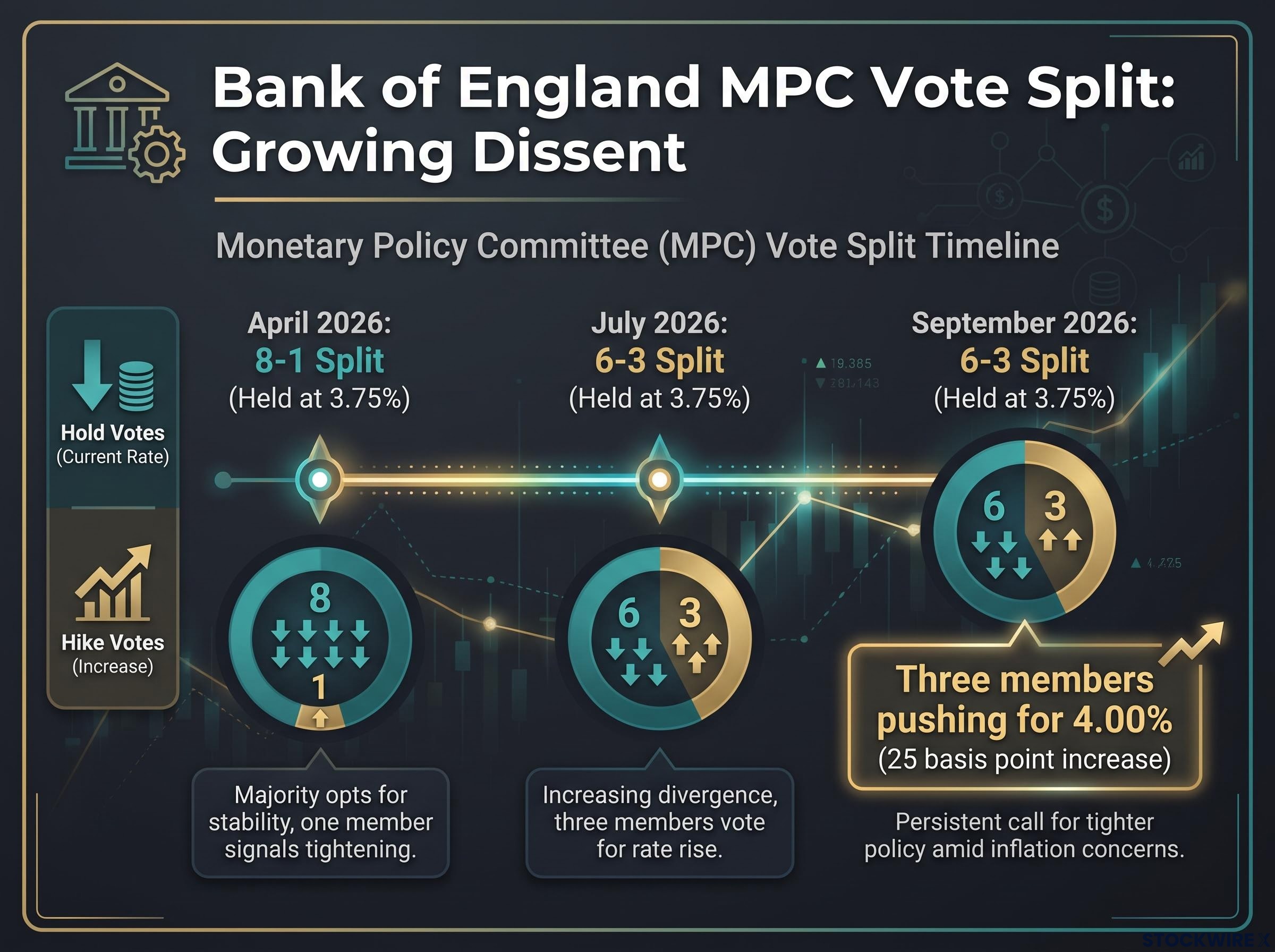
On 17 September 2026, the Monetary Policy Committee (MPC) held Bank Rate at 3.75%, but the decision split 6-3, with three members pushing for a 25 basis point increase to 4.00%. A three-vote minority on a nine-member committee is not a rounding error. It is an institution visibly arguing with itself.
That division did not appear overnight. Track the progression across three meetings and the pressure on the cautious majority becomes plain.
| Meeting | Bank Rate decision | Vote split |
|---|---|---|
| April 2026 | Held at 3.75% | 8-1 (one for a hike) |
| July 2026 | Held at 3.75% | 6-3 (three for a hike) |
| September 2026 | Held at 3.75% | 6-3 (three for a hike) |
The dissent has tripled since April. What created it is a genuinely awkward set of facts: the Bank is holding rates at 3.75% while projecting inflation slightly above 4% in early 2027. Governor Andrew Bailey captured the contradiction in a single breath.
Bailey has described rates as “about the right level” to return inflation to target over the medium term, while simultaneously warning they “might have to go up” if energy-price and geopolitical risks escalate.
Alongside the September decision, the Bank also announced a six-month pause on active gilt sales. Read together, the signals point one way. A central bank projecting above-target inflation, holding rates, and pausing asset sales is telling the market it values growth protection over inflation credibility. For anyone holding sterling, that trade-off does not stay abstract. It shows up as eroded real returns.
Why holding rates below inflation is a currency problem
Here is the mechanism in plain terms. A “real rate” is the return on an asset after you subtract inflation. When the interest rate on your currency’s assets does not keep pace with rising prices, the real return for a foreign investor shrinks, and can turn negative.
That comparison drives capital flow, not principle. An investor weighing UK assets against US assets is comparing real yields side by side, and the UK side currently looks unfavourable. When the numbers say hold Dollars, capital holds Dollars, and sterling pays the price.
The dollar’s pull: how Fed hawkishness widens the gap
Flip the trade around, because a currency pair has two sides. While the Bank of England hesitates, the Federal Reserve is leaning the other way, and the gap between them is where sterling loses altitude.
On the session, three senior Fed officials signalled that further tightening may be warranted: New York Fed President John Williams, Philadelphia Fed President Anna Paulson, and Cleveland Fed President Beth Hammack.
- John Williams (New York Fed) signalled scope for additional rate increases
- Anna Paulson (Philadelphia Fed) reinforced the hawkish message
- Beth Hammack (Cleveland Fed) added to the case for tighter policy
That rhetoric did not arrive in a vacuum. It landed alongside hard data: US Initial Jobless Claims for the week ending 19 September came in at 197,000, below both the prior week’s 198,000 and the consensus estimate of 201,000. A tight labour market gives the Fed room to stay hawkish, and the market heard it.
The result showed up in yields.
The US 10-year Treasury yield climbed 5 basis points to 5.162% on the session.
That figure is not just a number on a screen. It is the specific rate of return that Dollar assets are offering over UK alternatives, with the Fed signalling more to come while the Bank of England holds at 3.75%. CNBC framed the September Bank of England decision as the BoE “defying the Fed’s rate-hike lead,” which is a neat summary of the divergence: two central banks walking in opposite directions, with capital flowing toward the higher-yielding one.
The mechanism is straightforward. Higher US yields relative to UK yields pull global capital into Dollar assets. That buying bids up the Dollar and drags GBP/USD lower, and the wider the yield gap grows, the stronger the pull.
For anyone monitoring UK-exposed positions, the practical read is this. The Fed-side headwind will not ease until US rate expectations shift, which means the data points to watch are American, not British. Employment prints and inflation readings out of the US are your early-warning system for when this particular pressure might loosen.
The stagflationary bind: how high inflation and weak growth trap a currency
Pull the two central banks together and a deeper problem comes into view. Sterling’s predicament is not a bad week. It is structural, and the structure has a name: stagflation.
A stagflationary environment combines rising inflation with softening growth. It traps a central bank because the tool for fighting inflation, raising rates, is the same tool that risks deepening the growth slowdown. Every option makes one problem worse. That is precisely the corner the Bank of England is standing in.
What makes it harder is where the UK’s inflation is coming from. The Bank’s projection of inflation above 4% in early 2027 is driven in part by volatile energy prices linked to conflict in the Middle East and Iran war risks. Supply-side inflation of this kind is stubborn, because interest rates work by cooling demand, and rate hikes do very little to lower the price of imported energy. Meanwhile, UK business activity softened through September 2026, which is exactly the growth weakness that argues against hiking.
The Bank has warned that rates “might have to go up” if the Iran war drags on, even as its base case remains a hold. That single caveat anchors the geopolitical risk sitting underneath the entire currency picture.
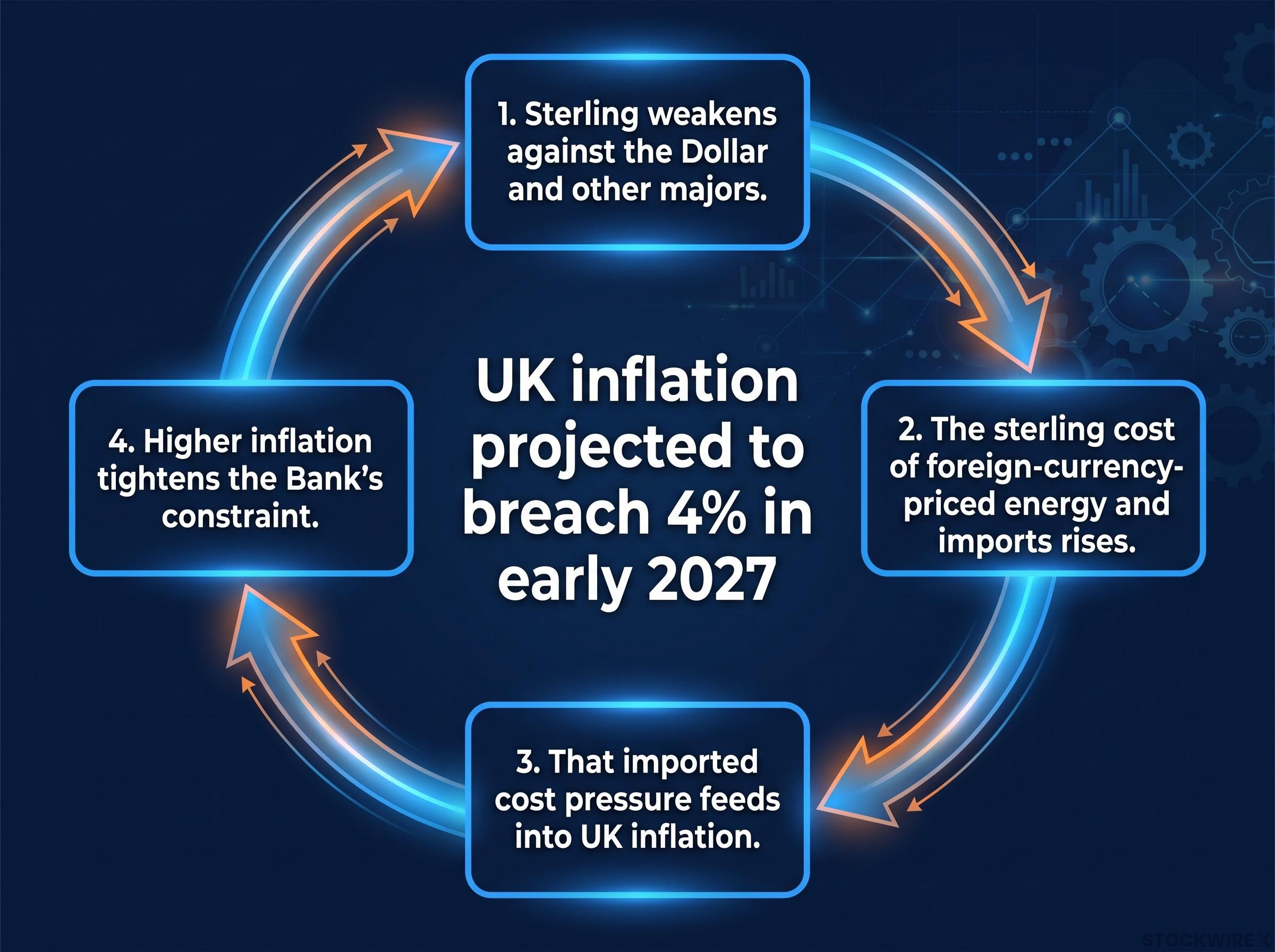
Now the loop closes on itself. A weaker pound raises the sterling cost of energy and raw materials priced in foreign currency, which feeds straight back into the inflation the Bank is already struggling to contain. The transmission runs in four steps.
- Sterling weakens against the Dollar and other majors.
- The sterling cost of foreign-currency-priced energy and imports rises.
- That imported cost pressure feeds into UK inflation.
- Higher inflation tightens the Bank’s constraint, making a decisive hike or cut even harder.
This is the structural argument for why the Pound’s slide is not a short-term correction. The currency headwind and the inflation headwind are not two separate risks. They are one risk expressing itself through two channels, and they reinforce each other. If you hold UK assets or watch consumer-facing UK sectors, that feedback loop is the thing to understand, because it means neither pressure resolves in isolation.
Two moments when sterling was here before
The pattern has precedent. In 1992, policy constraints and market doubts about UK competitiveness during the Exchange Rate Mechanism crisis culminated in a forced sterling devaluation. The lesson: when institutional constraint collides with market disbelief, the currency, not the policy, usually gives way first.
The 2016-2017 period after the Brexit referendum offers a second template. Political and structural uncertainty, concerns about the UK’s external position, and a Bank of England in easing mode combined to drive the Pound sharply lower and keep it undervalued for an extended stretch.
Neither episode is a forecast. Both are pattern recognition. What they share with today is the specific combination that pressures sterling most: a central bank boxed in by its own constraints, meeting an external shock it cannot control.
What has to change for sterling to recover
Diagnosis is only useful if it points to what to watch. Sterling’s recovery does not hinge on one event; it hinges on a combination of conditions across two tracks, one in the UK and one in the US.
Split them out, because you can monitor each independently.
| UK-side conditions | US-side conditions |
|---|---|
| Disinflation resuming toward 2% without severe damage to growth | A peak or dovish turn in the Fed’s tightening cycle, narrowing the yield gap |
| De-escalation of Middle East and Iran-related energy-price shocks | Reduced safe-haven Dollar demand as global risk appetite improves |
| An MPC shift toward the hawkish minority, followed by an actual rate increase | Reallocation from Dollars into undervalued currencies including sterling |
Two of these conditions are more trackable than the rest. On the UK side, the Bank Governor has flagged an upcoming consumer confidence survey as the next key indicator for the Pound, so that release is a near-term catalyst worth marking in the diary.
The other is the MPC vote itself. The current 6-3 split, with three members already voting for a hike, means a hawkish turn is not theoretical. It is institutionally live. Watch whether that minority grows.
Here is the honest read, though. None of these conditions look imminent given the current data environment. US yields are climbing, the Iran-linked energy risk is unresolved, and the Bank remains in wait-and-see mode.
That combination means the current GBP/USD level is best understood not as a dip to buy but as a structurally justified discount. Closing that discount requires a specific mix of catalysts, and until they arrive, the pressure has a floor under it. This section is your watchlist: named conditions, identified data points, and an institutional signal you can track in real time.
This article is for informational purposes only and should not be considered financial advice. Investors should conduct their own research and consult with financial professionals before making investment decisions. Past performance does not guarantee future results, and financial projections are subject to market conditions and various risk factors. Forward-looking statements about central bank policy and currency movements are speculative and subject to change based on market developments.
A currency discounting doubt, not predicting disaster
Three forces have pressed on the Pound throughout this analysis: UK macroeconomic fragility, a Bank of England boxed in by its own mandate, and a US Dollar pulling capital across the Atlantic on the strength of higher yields. They do not act in sequence. They compound each other, and sterling sits at the intersection.
Currency markets price expectations, not just the present. What GBP/USD is telling you right now is that the market doubts the conditions for a Bank of England pivot will arrive quickly. The Pound is discounting that doubt, not forecasting a collapse.
If you want a single leading indicator, watch the MPC vote split. The move from 8-1 in April to 6-3 in September is the clearest window into the internal deliberation that precedes any policy shift, and it is published in plain sight.
Knowing what to watch is worth more than any price target here. Track the MPC splits, the UK inflation trajectory, and the first genuine signal of a Fed pivot. Those three dials will tell you when the pressure is easing long before the exchange rate does.