
Engineered T-cells carrying a CD19-targeting receptor have delivered lasting remissions in patients with no remaining options, and the resulting product category now contributes meaningfully to oncology revenue each year. The question of whether engineered cell therapy can produce curative outcomes in blood cancer is no longer open. Within the field, it is treated as settled science.
The remaining challenge is not biological. It is structural. Every approved CD19 CAR-T product is made individually for each patient, and that patient-specific manufacturing model creates delays with measurable clinical consequences. The field has developed a direct answer to it: allogeneic CAR-T, made in advance from healthy donors and held ready before a patient is even identified.
This is a map of where the category stands today. It covers the science that is already working, the delivery problem the field is actually solving, the evidence emerging from programmes now executing on the allogeneic approach, and the questions that still sit unresolved. The story that follows is one of solved science and an unsolved logistics problem being closed in real time.
CD19 and the science that settled the question
CD19 is a surface protein found on the majority of B-cell cancers, and it ranks among the most thoroughly validated targets in hematologic oncology. That validation did not come from theory. It came from patients.
Approved CD19-directed CAR-T therapies have delivered durable remissions in people who had exhausted their other treatment options. In the relapsed or refractory setting, where a patient’s cancer has returned or stopped responding after prior lines of therapy, these are the hardest cases in blood cancer. Getting durable responses in that group is the strongest possible evidence a therapy can generate.
The category has also reached commercial scale. Multiple CD19-directed CAR-T products carry regulatory approval per FDA records, and the segment produces meaningful annual revenue. That combination, clinical durability plus commercial adoption, is what “validated target” actually means in practice.
Here is why that matters for how you read the rest of this piece. There are two very different kinds of uncertainty in a therapy like this: uncertainty about whether the biology works, and uncertainty about whether it can be delivered to patients efficiently. The first has effectively been answered for CD19. What remains is a delivery question.
So treat the sections that follow not as an evaluation of whether CAR-T works. Treat them as an explanation of where the remaining work sits.
When big ASX news breaks, our subscribers know first
Why the manufacturing model became the constraint
Every currently approved CD19 CAR-T product is autologous, meaning a distinct product must be manufactured from each individual patient’s own cells. The sequence is more involved than the word “manufacturing” suggests.
- Cells are collected from the patient.
- Those cells are shipped to a manufacturing facility.
- The cells are genetically engineered to recognise CD19.
- The engineered cells are expanded to a therapeutic dose.
- The product undergoes release testing.
- The finished product is shipped back to the treatment centre.
Each step adds time, and the time compounds. Published reviews cite an average vein-to-vein time, the interval from cell collection to infusion, of three to six weeks. That clock does not even start until a manufacturing slot opens, and waiting for a slot adds further delay before collection begins.
For a patient with aggressive, fast-moving disease, that delay is not an administrative inconvenience. The elapsed manufacturing time is treated in the literature as a component of clinical outcome in its own right.
The as-treated framing that dominates CAR-T trial reporting obscures the CAR-T delivery gap entirely, because patients who never reached infusion are excluded from the denominator before response rates are calculated, making headline figures a measure of those who survived the wait rather than all who needed treatment.
The most striking evidence sits in the attrition data. A 2024 Lancet Haematology review noted that roughly one-third of large B-cell lymphoma patients who completed cell collection never received their infusion. Their disease outran the manufacturing timeline.
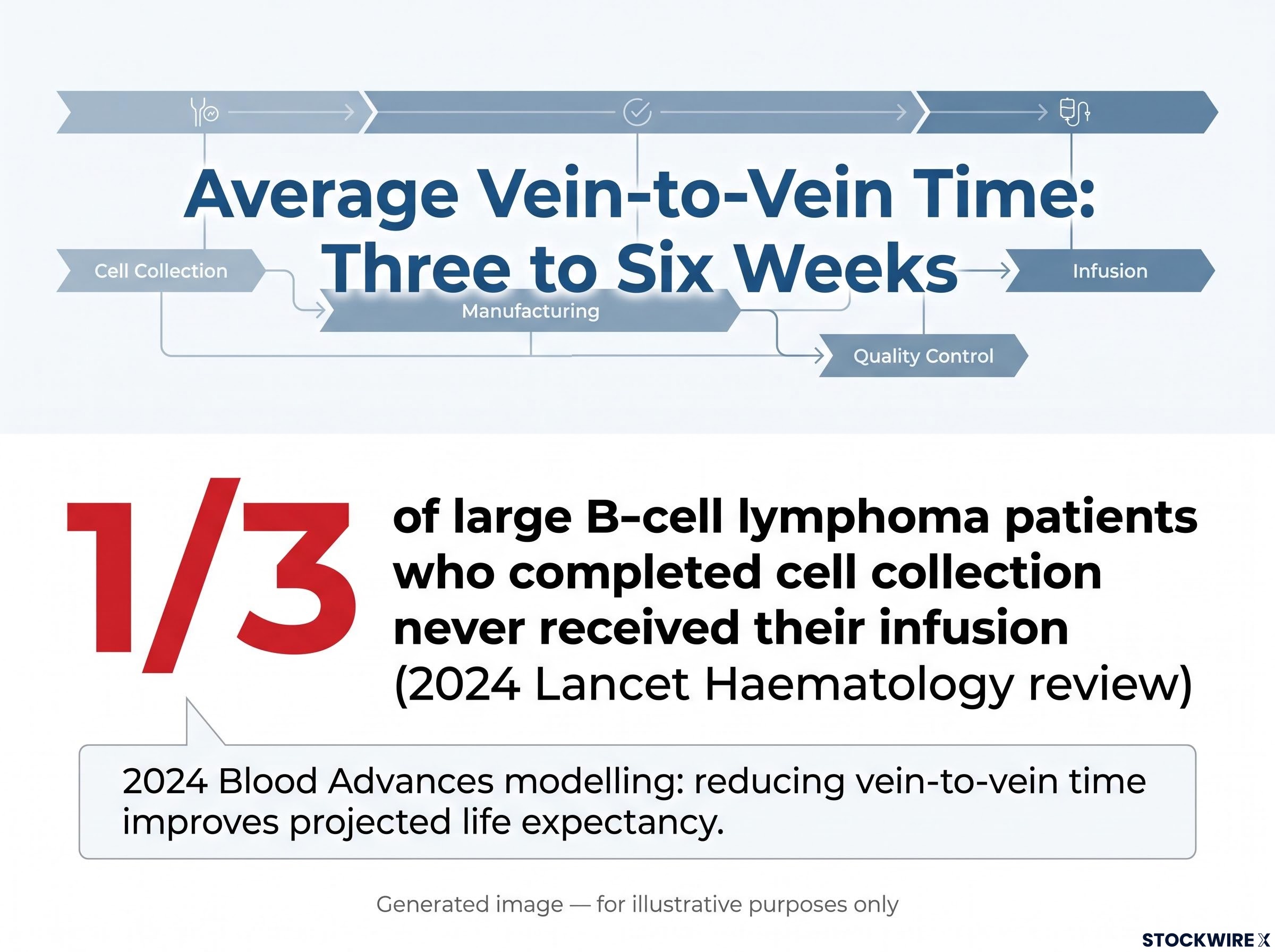
Modelling published in Blood Advances in 2024 found that reducing vein-to-vein time improves projected life expectancy in later-line large B-cell lymphoma. Speed, in other words, is not a convenience metric. It is an outcome metric.
Read those two findings together and the conclusion is uncomfortable but clear. For a meaningful share of eligible patients, the manufacturing model, not the therapy, is the reason treatment never arrives. That specific problem is what the rest of this article is about solving.
How allogeneic manufacturing removes the wait
Allogeneic CAR-T inverts the entire premise. Instead of building a bespoke product from each patient, cells are manufactured in advance from healthy donors and held in inventory. The product exists before the patient is identified.
That single change removes the largest and least controllable delays in the autologous model: the individual collection, the shipment of a patient’s own cells to a facility, and the wait for a manufacturing slot. The product is already made.
It is worth being precise about what “off-the-shelf” does and does not mean. It does not mean instant treatment. Patients still need to pass eligibility assessment, and they still receive lymphodepleting chemotherapy, a course of drugs that suppresses the immune system to help the infused cells take hold, before infusion. What disappears is the single biggest bottleneck, not every step.
The clearest sign that this is a serious answer rather than a speculative one is where the field’s capital and talent have gone. Multiple well-resourced programmes are converging on the same structural solution.
| Company | Programme | Trial / Stage |
|---|---|---|
| Allogene Therapeutics | ALLO-501A (cema-cel) | ALPHA-2 Phase 1/2, relapsed/refractory LBCL |
| Caribou Biosciences | CB-010 (vispacabtagene regedleucel) | ANTLER Phase 1/2, relapsed/refractory B-NHL |
| Field-wide outlook | Four allogeneic candidates expected to enter Phase III or pivotal trials in 2025-2026 | |
Allogene’s ALLO-501A uses TALEN gene editing to disrupt the receptor that would otherwise let donor cells attack the recipient. Caribou’s CB-010 uses Cas12b editing and adds a PD-1 knockout, a modification designed to reduce the exhaustion that can blunt engineered cells over time. Analyst and clinical expectations point to potential first approvals in 2027-2028.
Here is what that convergence tells you. When the field’s most capable actors independently arrive at the same manufacturing answer, category risk is low. The relevant question shifts to program-specific risk: does any individual therapy actually work once infused? That distinction is what matters for anyone following this space, and it is the frame for the next section.
What azer-cel’s data shows in a hard-to-treat population
Azer-cel is Imugene’s investigational allogeneic CD19-directed CAR-T therapy, in Phase 1/1b trials across US and Australian sites, targeting relapsed and refractory B-cell malignancies. It is not approved in any jurisdiction. What makes its early data worth reading is not just the response rates. It is who the responses came from.
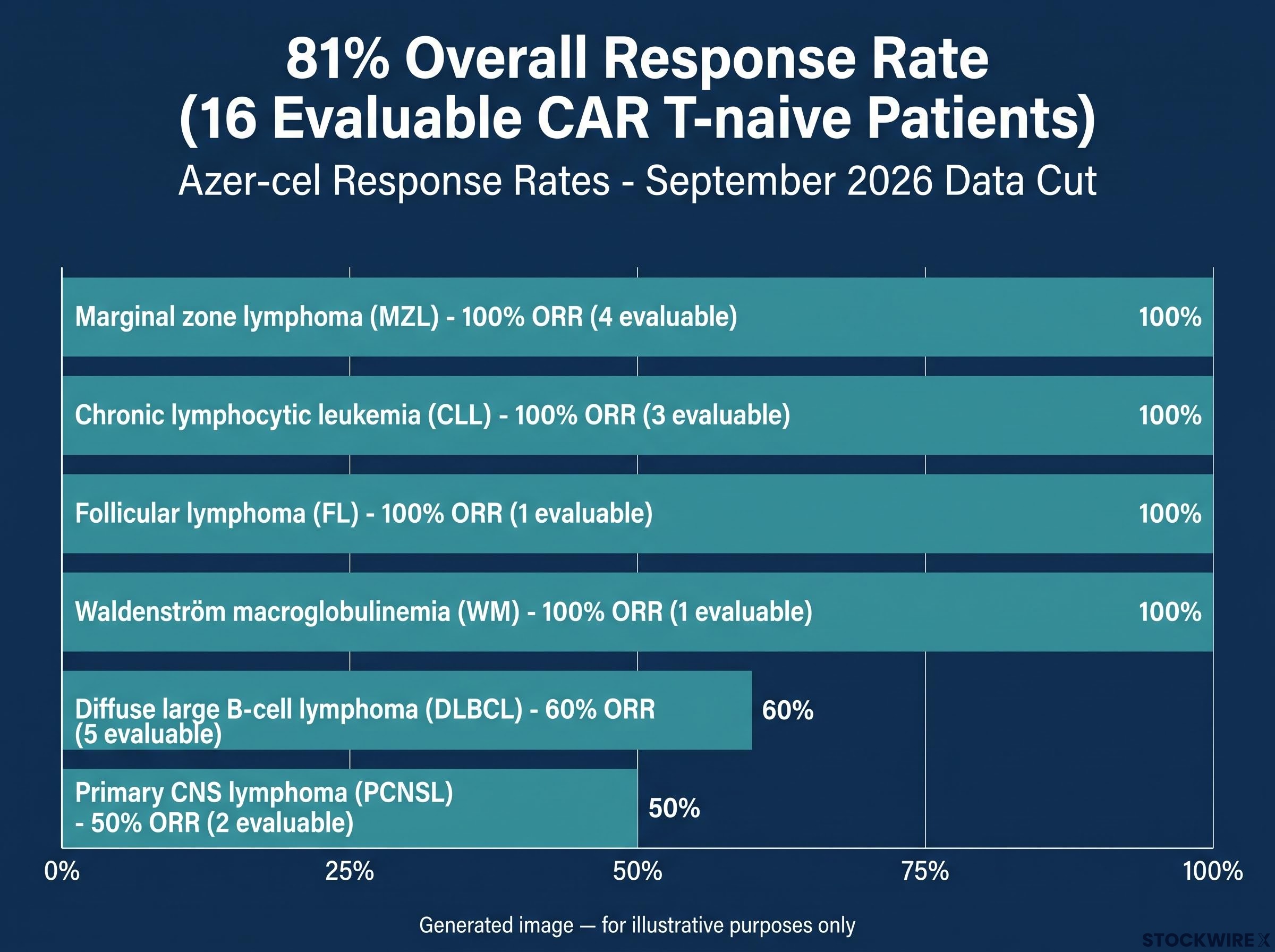
The September 2026 data cut, reported by BiotechDispatch on 23 September 2026, showed an 81% overall response rate across six B-cell malignancy subtypes in CAR T-naive patients, among 16 evaluable patients. Four indications reached a 100% response rate.
The CLL and MZL cohort results from March 2026 established the early efficacy signal that the September data cut extended, with all four evaluable CLL patients achieving partial responses and three of five MZL patients achieving complete responses in a heavily pre-treated population.
| Subtype | Evaluable | ORR | CR | PR |
|---|---|---|---|---|
| Marginal zone lymphoma (MZL) | 4 | 100% | 3 | 1 |
| Chronic lymphocytic leukemia (CLL) | 3 | 100% | 0 | 3 |
| Follicular lymphoma (FL) | 1 | 100% | 1 | 0 |
| Waldenström macroglobulinemia (WM) | 1 | 100% | 0 | 1 |
| Diffuse large B-cell lymphoma (DLBCL) | 5 | 60% | 1 | 2 |
| Primary CNS lymphoma (PCNSL) | 2 | 50% | 0 | 1 |
The DLBCL signal is corroborated across earlier reads. A January 2026 ASX update reported an 82% ORR in the DLBCL Phase 1b cohort (14 of 17 evaluable patients, 7 complete responses and 7 partial responses). Earlier data from July to August 2025 showed a 75% ORR and a 55% complete response rate in DLBCL.
Now the context that makes those numbers meaningful. Many of these patients were heavily pre-treated, having already failed multiple prior lines including autologous CAR-T.
The data comes from patients who had already failed autologous CAR-T. That places them among the hardest to treat in all of blood cancer, and responses in that group carry particular clinical weight.
This is the point where biology meets delivery. A therapy that removes the manufacturing wait only matters clinically if it works once infused. Responses in patients who have already exhausted autologous CAR-T are among the most meaningful signals an early-phase programme can produce, because they suggest the delivery advantage is a real clinical lever, not a theoretical one.
Regulatory position and combination programme
The programme is also expanding beyond monotherapy. The Phase 1b protocol was amended to add a Bruton’s tyrosine kinase inhibitor (BTKi) combination arm and include mantle cell lymphoma, with the first patient in that cohort dosed in June 2026; the July analysis covers this thread in detail.
The BTKi combination arm targets a patient population for whom the dominant drug class in B-cell malignancy has already failed, a group that had no established escalation pathway until allogeneic CAR-T candidates began showing activity in that setting.
What the data does not yet answer
Strong early data does not close every question, and honest accounting means naming the ones that remain open. None of these are reasons to doubt the category premise. They are the variables to track.
- Durability. Early response rates do not establish long-term outcomes. Whether allogeneic products can match the durability of autologous therapy over extended follow-up is unresolved across the entire field, not specific to any one programme.
- Graft-versus-host disease. This is the safety consideration unique to donor-derived cells, where infused cells can attack the recipient’s tissue. It is an active area of gene-editing research and risk management across all allogeneic programmes.
- Eligibility and fitness. Patients still need adequate organ function and performance status, and still undergo lymphodepleting chemotherapy. Removing the manufacturing wait does not remove these gates.
- Geographic and institutional concentration. CAR-T delivery remains concentrated at specialised centres with intensive toxicity management. Current programmes, azer-cel included, recruit patients able to reach those centres, and initial allogeneic approvals are expected to use that existing network rather than deploy straight into community settings.
The distinction to hold onto is this. None of these questions undermine the core category claim, that removing the manufacturing wait expands access. They are the readouts to watch as programmes mature.
What the next generation of data is designed to answer
You now know enough to read future results properly. The central question for the next wave of allogeneic trial data is a single one: does removing the manufacturing wait measurably increase the proportion of eligible patients who actually receive treatment?
That is not an abstract hope. The Blood Advances modelling gives it a metric, linking faster vein-to-vein time to improved projected life expectancy. Access expansion becomes something the data can actually demonstrate rather than merely assert.
The underlying wager here is not on biology that has yet to be proven. CD19 is settled science. What is being tested is whether a recognised, quantified delivery problem can be solved at scale through manufacturing approaches that multiple well-capitalised programmes are now actively pursuing.
Azer-cel is part of that broader effort, bringing published response data from a heavily pre-treated population to bear on the question, while the BTKi combination and additional cohorts expand the evidence base. It is one programme among four allogeneic candidates expected to reach Phase III or pivotal trials in 2025-2026, with first approvals potentially in 2027-2028. Readers wanting depth on specific threads can follow the coverage on T-cell exhaustion, the BTKi analysis, the marginal zone lymphoma piece, and the Phase 1b basket study.
This article is for informational purposes only and should not be considered financial advice. Investors should conduct their own research and consult with financial professionals before making investment decisions. Azer-cel is investigational and not approved in any jurisdiction; early-phase results are preliminary and subject to change with further follow-up.
So the question worth carrying forward is not whether the biology works. It is whether the next readouts show more of the right patients getting treated in time.