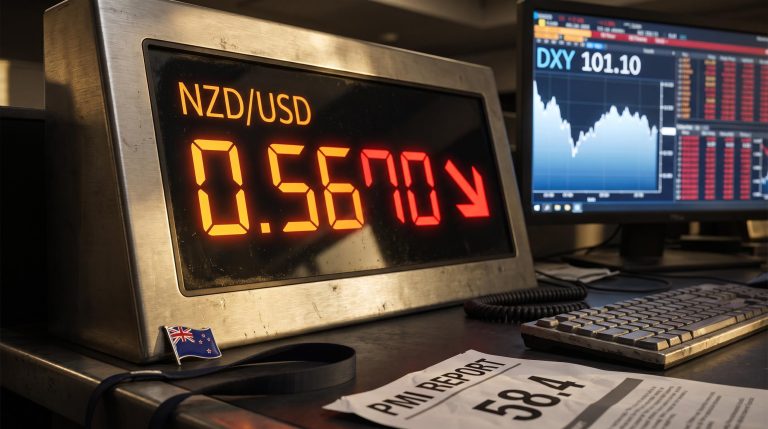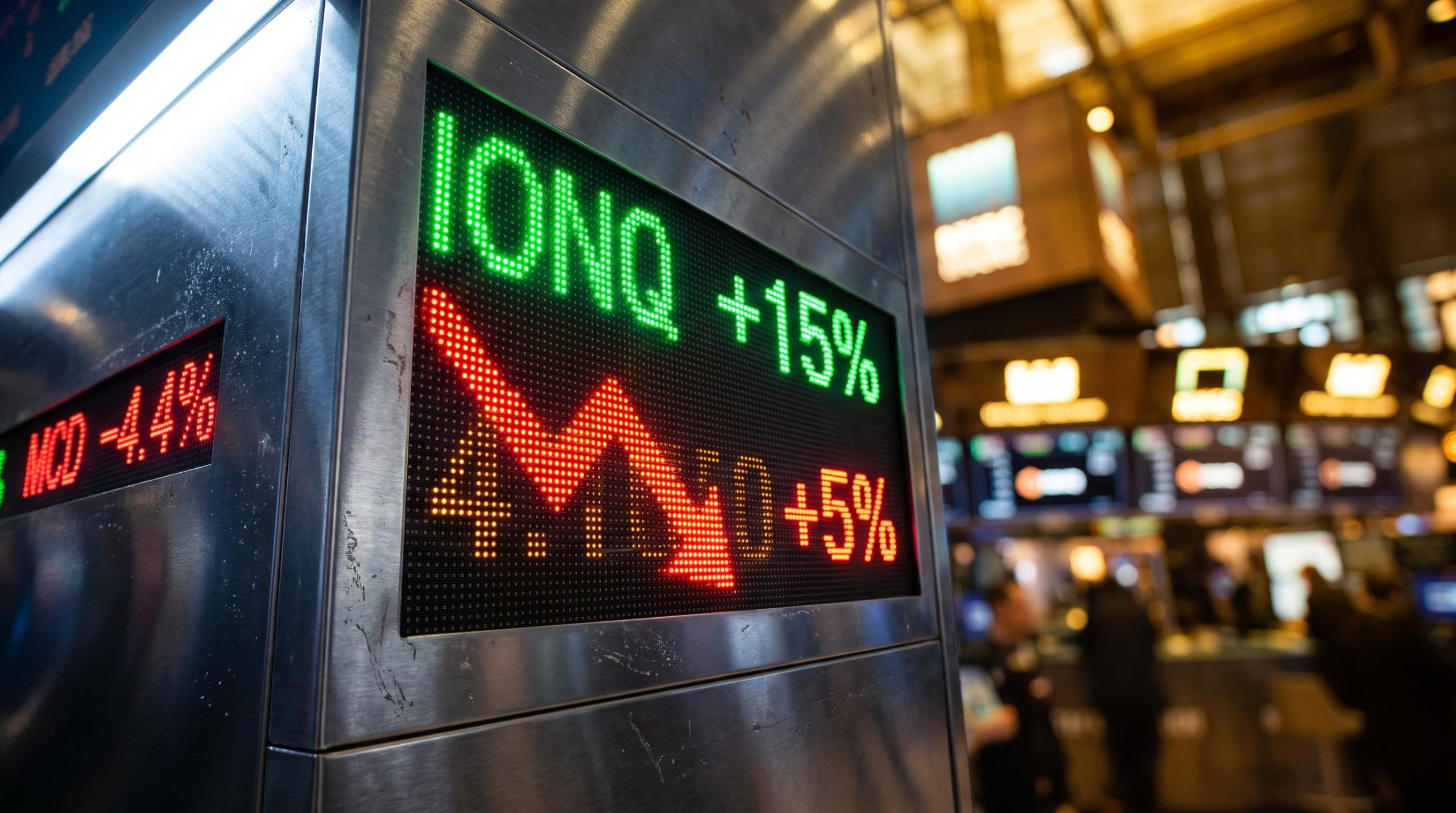
Two pieces of genuinely good news landed within days of each other in September 2026. A burger chain older than most of its shareholders pledged billions to help its franchisees. A quantum computing company announced a hardware breakthrough it called an industry first. Neither headline was bad. Both stocks fell.
That contradiction sits at the centre of one of the most reliable patterns in markets. Prices do not move on news; they move on the gap between what actually happens and what the crowd already expected. By the time a headline confirms good news, the buyers who anticipated it have often already bought, and the confirmation becomes their cue to leave.
This is the mechanism behind “buy the rumor, sell the news,” and after reading this you will understand not just the phrase but what it looks like in two very different sectors. You will also see how to avoid being the last buyer standing right before the reversal.
Why markets sell good news: the expectation gap explained
Markets are forward-looking machines. A share price today is not a record of what a company has done; it is a running bet on what it will do next. That single fact explains almost everything about why good news can sink a stock.
The same logic applies every earnings season: the expectations gap between what analysts forecast and what management actually delivers determines price direction far more reliably than whether the reported number is a record or a miss in absolute terms.
When an event is widely anticipated, traders position for it in advance. They buy in the weeks or months before the catalyst, pushing the price up as the story builds. By the time the announcement actually arrives, most of the expected upside has already been paid for. The confirmation adds no new information the market can use to re-rate the stock higher.
So what happens next is not irrational. It is the rational unwinding of a position that has already done its job.
Markets price expectations, not events. By the time an event is confirmed, the surprise that would have moved the price is usually gone.
The exit becomes self-reinforcing. Traders who bought in anticipation treat confirmation as their sell signal, and when enough of them act at the same moment, the selling creates its own pressure regardless of how good the news actually was. Behavioural research calls the underlying instinct the disposition effect: investors tend to realise gains quickly the moment their thesis is confirmed, locking in profit rather than waiting for more. Add herding, where a crowd piles into a narrative before an event and rushes for the door once it is validated, and the reversal accelerates.
The disposition effect is one of the most extensively documented sell-side biases in behavioural finance, with University of Chicago research finding that randomly selected exit decisions outperformed those of professional managers by up to 150 basis points annually, precisely because professionals systematically truncate winners the moment a thesis is confirmed.
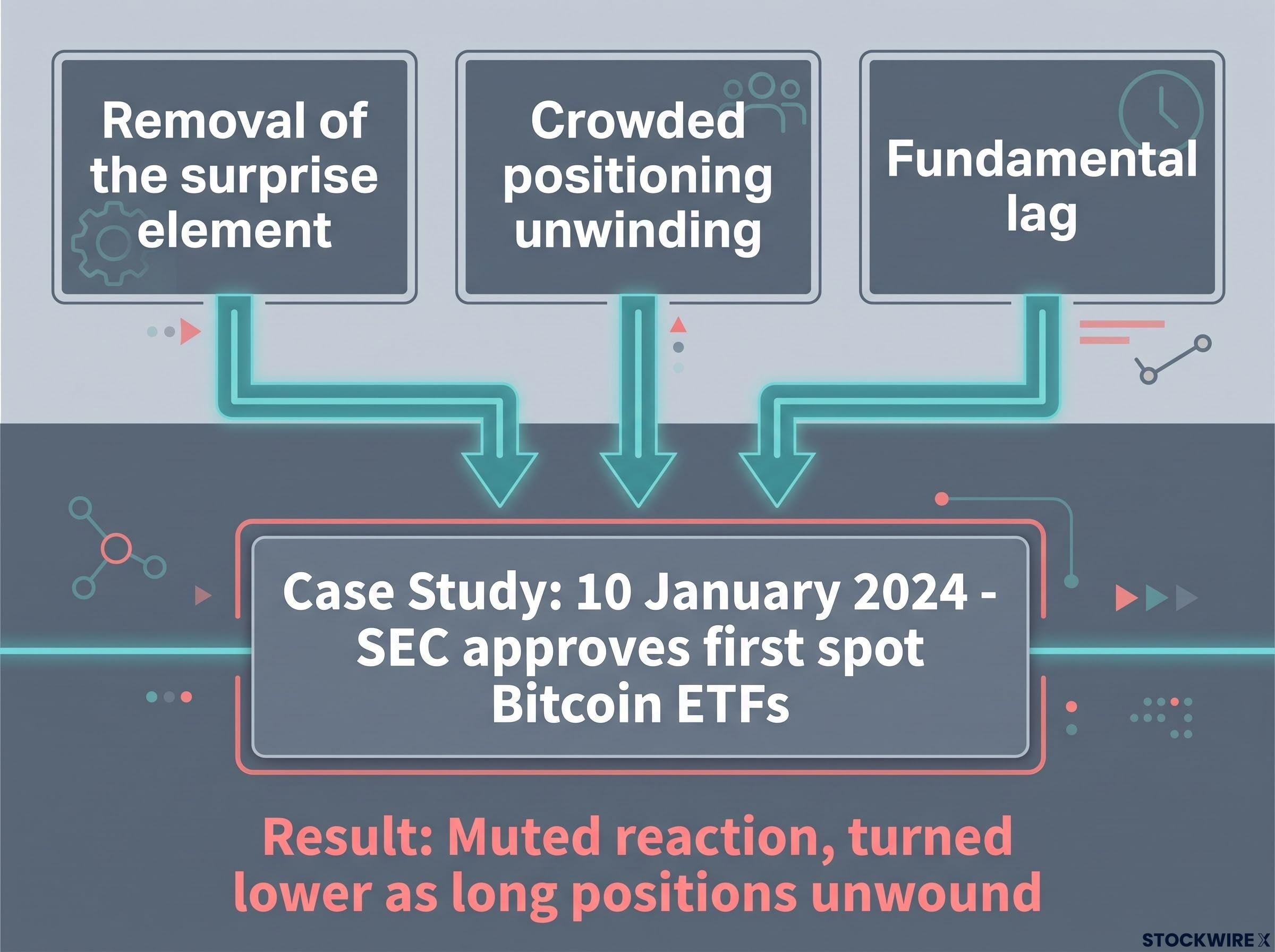
Three accelerants tend to deepen these post-news selloffs:
- Removal of the surprise element. Once the event is confirmed, there is no fresh catalyst to push the price higher.
- Crowded positioning unwinding. When many investors hold the same trade, their simultaneous exit amplifies the drop.
- Fundamental lag. The actual benefit, whether revenue, adoption or margin improvement, arrives long after the price ramp implied it would.
The clearest illustration came in early 2024. After months of anticipation and a strong rally, the U.S. Securities and Exchange Commission approved the first spot Bitcoin ETFs on 10 January 2024. It was precisely the outcome the market had lobbied for. Bitcoin’s reaction was muted, then turned lower in the days that followed as crowded long positions unwound. The news was exactly as good as expected, which is another way of saying it delivered no reason to buy more.
The SEC’s accelerated approval of spot Bitcoin ETFs, published in the Federal Register on 17 January 2024 as Release No. 34-99306, granted exchanges permission to list Bitcoin-Based Commodity-Based Trust Shares, making the January confirmation event one of the most-anticipated regulatory outcomes in crypto market history.
When big ASX news breaks, our subscribers know first
McDonald’s $8.5 billion bet and the 31% that followed
Start with the numbers, because the scale of the reaction tells the story. McDonald’s shares have fallen roughly 31% from their March 2026 peak, dragging the price down to levels last seen in 2022. On 23 September 2026, the day its franchisee support strategy drew coverage, the stock dropped about 4.4% to around $239.43, according to ArabicTrader.
The plan the market chose to punish was, on paper, a statement of confidence. Branded “McDonald’s > NEXT,” it commits roughly $8.5 billion in support to franchisees through 2036, with a near-term tranche of about $5 billion through 2030 delivered via rent relief and direct capital contributions to franchise owners.
| Metric | Commitment | Target date |
|---|---|---|
| Total franchisee support | ~$8.5 billion | 2036 |
| Near-term tranche (rent relief and capital) | ~$5 billion | 2030 |
| Operating margin target | ~50% to low-to-mid-50s | 2030 |
| Chicken and beverage market-share gain | +1.5 percentage points each | 2030 |
The two decline figures describe different dimensions of the same selling pressure: the 4.4% move captures the announcement day, while the 31% captures the cumulative slide from the March peak. Together they show a stock under sustained strain, not a one-day wobble.
None of this reads like bad news. The margin targets are ambitious, the market-share goals are specific, and the timeline is disciplined. So why did the market sell?
The concern was not the destination. It was the front-loaded cost of getting there.
Here is the insight worth carrying: long-term targets set for 2030 offer no protection against short-term repricing. The market discounts the cost of the journey, not the prize at the end.
What investors actually objected to
The selloff was a repricing of the path, not a rejection of the plan. Three worries did the work.
First, near-term margin and cash-flow pressure. McDonald’s is committing billions before its 2030 margin targets are met, and investors focused on the next few years may reasonably expect reported margins and free cash flow to soften while the spending lands ahead of the payoff.
Second, execution risk. A multi-year overhaul spanning restaurant modernisation, technology upgrades and operational change carries the usual hazards: cost overruns, uneven adoption and disruption to a business that already works.
Third, and most structurally, the “cash cow” tension unique to mature consumer staples. Investors buy a company like McDonald’s for stable, predictable cash generation. Aggressive reinvestment shifts that profile toward a long-duration growth project, and if the market doubts the returns on all that capital, it will pay a lower multiple for the same shares. That, more than any single number, is what large capex commitments can do to a stock prized for its steadiness.
IonQ’s quantum breakthrough and the intraday reversal
Now watch the same pattern play out in hours instead of months. IonQ announced the industry’s first real-time quantum error-correction decoder, a device that consolidates what was previously a multi-step process into a single integrated component, producing a smaller and more efficient machine. It was a genuine technical advance.
IonQ’s real-time quantum error decoder press release, published 22 September 2026, details how the integrated decoder consolidates previously separate correction steps into a single component, the specific technical claim that triggered the premarket surge and subsequent intraday reversal the article examines.
The market’s response was textbook rumour-to-news, compressed. IonQ shares jumped 12% to 13% on the news, with premarket gains reaching roughly 15%, according to the original coverage; Yahoo Finance put the confirmed move at more than 11%. Then the reversal began. By the time commentators weighed in, the gain had narrowed to around 5%. Peers moved in sympathy and faded too, with Rigetti rising about 6.7% before retreating.
That single day sat inside a far larger arc. Across summer 2026, the entire quantum sector inflated and then collapsed.
Why the sector keeps repeating the pattern
| Stock | Peak price | Peak date | Trough price | Decline |
|---|---|---|---|---|
| IonQ (IONQ) | $73.65 | 3 June 2026 | $31.81 (29 Jul 2026) | ~57% |
| Rigetti (RGTI) | $28.06 | 3 June 2026 | $13.13 (29 Jul 2026) | ~53% |
Both stocks lost more than half their value in under two months. The damage did not stop there: in the three months to around 22 September 2026, IonQ was down 30.9%, Quantinuum down 24.9%, Rigetti down 23.5% and D-Wave down 29%, according to MarketWatch and Morningstar. Barchart described the episode as a “belly-flop,” noting the sector had briefly “looked like Nvidia in 2019” before the fall.
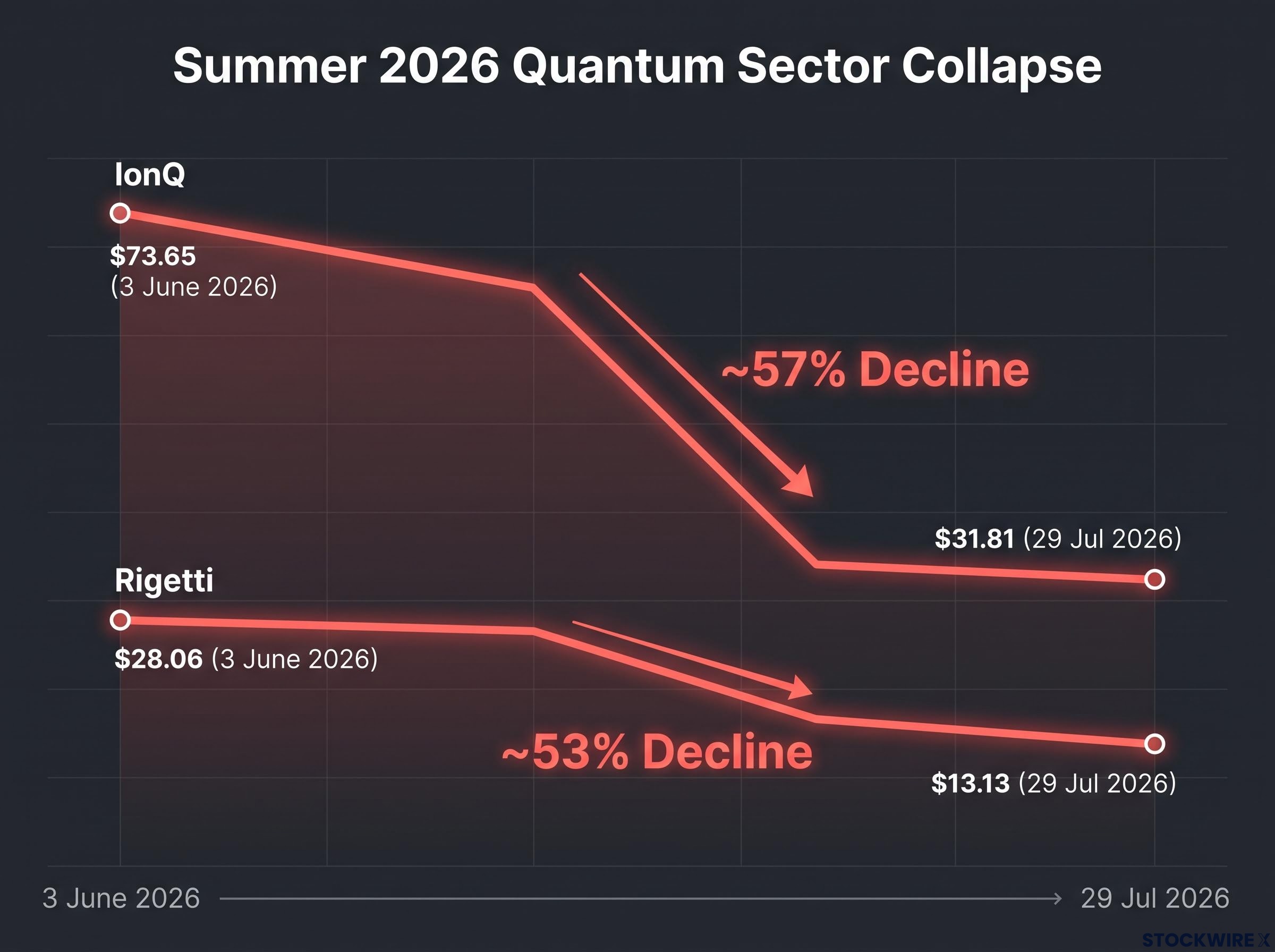
That framing matters because it explains the mechanism. When a theme gets crowded, everyone owns the same story for the same reason, and each new announcement inflates the narrative further until there is no one left to buy. The reversal is then as violent as the rally that preceded it.
The mechanism is even more visible in micro-cap situations where narrative scarcity and thin float concentrate all speculative demand into the few tickers carrying a recognisable label, producing surges that reverse before most buyers can exit.
Three structural reasons make breakthrough announcements in early-stage technology especially vulnerable:
- The commercialisation gap. A hardware advance confirms progress but does not generate near-term revenue. The distance between the milestone and paying customers stays wide.
- Deep ongoing losses. These companies burn cash and continue to post significant operating losses even as they announce genuine advances.
- Crowded thematic positioning. Speculative flows push prices well above fundamentals, amplifying both the rally and the collapse.
A partial rebound underlined the point. IonQ closed at $40.34 on 19 September 2026, up 9.5%, staging a recovery after six weak sessions.
The gain came “while losses remain deep,” as Foreign Policy Journal put it, a reminder that a rising share price and a healthy business are not the same thing.
Here is the read to take away. A hardware milestone confirms a company is on the right technical path. It does not answer the questions that actually set valuation: when does this become a product, who pays for it, and how much cash does the company burn before it gets there. Until those are resolved, a breakthrough can be a sell signal rather than a buy signal, and it is the same mechanism as McDonald’s, just running at ten times the speed.
Six things to do differently before the next big announcement
Pattern recognition is only useful if it changes what you do. These six adjustments work across both archetypes you have just seen: the mature company making a strategic pivot and the early-stage company making a breakthrough claim.
- Assume the announcement is already priced in. The Bitcoin ETF approval and IonQ’s 15% premarket surge both confirmed what the crowd expected. Confirmation is not new bullish information; it is the removal of uncertainty. Treat a fully telegraphed catalyst as a resolution, not a fresh reason to buy.
- Do not chase last-minute hype. IonQ’s premarket gain of roughly 15% had shrunk to about 5% by mid-session. Buying into the top of that spike meant buying from the very people the confirmation had already satisfied. If you are late to the story, the risk is heavily skewed against you.
- Separate near-term cash flow from long-term targets. McDonald’s set a 50% margin target for 2030, but the market fixated on the front-loaded $5 billion it must spend to get there. When a plan promises benefits years out but costs land now, expect the price to discount the cost first.
- Respect the violence of crowded trades. IonQ and Rigetti both fell more than 50% from peak to trough in under two months. When an asset has run hard into a high-profile event, prepare for volatility in both directions, because the same crowd that inflated it can deflate it just as fast.
- Treat breakthroughs in early-stage tech as necessary but not sufficient. IonQ’s error-correction decoder was a real advance, yet its losses remained deep. A technical milestone confirms the company is on the right path without resolving the commercial timeline, and valuation lives on the commercial timeline.
- Know where in the expectation cycle you are entering. This is the principle that ties McDonald’s and IonQ together. Before any major catalyst, the useful question is not “is this good news?” but “how much of this is already in the price?” Everything else follows from your honest answer.
The goal here is not to avoid buying before announcements, nor to reflexively sell into them. It is to understand your position on the expectation curve and price your decision accordingly.
This article is for informational purposes only and should not be considered financial advice. Investors should conduct their own research and consult with financial professionals before making investment decisions. Past performance does not guarantee future results.
Pattern recognition is only the first step
The lesson that connects a burger chain and a quantum computing firm is that “buy the rumor, sell the news” is not a quirk of either sector. It is a feature of how expectation-driven markets work, which is why it surfaces in consumer staples and emerging technology alike.
Spotting the pattern after the fact is the easy part. McDonald’s fell 31% from its peak and IonQ fell 57% peak to trough, and both look obvious in hindsight. Acting on the pattern in real time is harder, because judging when positioning has become genuinely crowded is one of the toughest calls in investing.
So carry one habit out of this. The next time a stock you hold or watch approaches a major catalyst, ask where it sits on the expectation curve before you ask whether the news is good. That single question is the practical output of everything above, and getting into the habit of asking it is the skill worth building from here.
For readers wanting to understand how loss aversion and herd behaviour interact during the violent unwinds described above, our full explainer on cognitive biases at market extremes covers the six interlocking biases that intensify at peaks and troughs, with concrete disciplines for managing them before they activate.