Australia has never run an offshore wind auction. The first one is now live, and it arrives with a projected AU$20 billion investment figure attached to it.
That number is not incremental policy tinkering. It is a deliberate reorientation of capital toward the Gippsland coast, a region that has produced Victoria’s energy from coal for decades and is now being positioned to generate it from wind instead.
The reorientation runs on two parallel tracks: a generation procurement process targeting 2 GW of capacity, and a separate transmission public-private partnership (PPP) worth up to AU$1.5 billion. Behind both sits AU$3.1 billion in modelled community economic benefit for Gippsland alone.
Victoria offshore wind investment has moved from ambition to procurement, but the auction is a starting gun, not a finish line. What follows here maps where capital is actually flowing, examines the transmission infrastructure that determines whether the auction works, tests Victoria’s design against the markets that went first, and identifies where the real risk sits, so you can form a grounded view before the sector moves from auction phase to financial close.
What AU$20 billion actually buys: the capital map behind Victoria’s 2 GW target
The AU$20 billion headline is easy to misread as a single pool of committed money. It is not. It is a projection that only materialises if a sequence of separate procurement decisions each clears the one before it.
Start with the generation side. The auction targets 2 GW of capacity, enough to power roughly 1.5 million Victorian homes according to government estimates. Bids do not close until August 2027, and contracts are not awarded until 2028. No generation developers have publicly confirmed participation, which tells you this is early-stage capital mobilisation rather than money in motion.
Australia’s offshore wind sector carried zero operational capacity against an announced pipeline of roughly 86 GW as of 2025-2026, a gap that places Victorian ambition in context; floating wind investment activity, including PolarBlue’s AU$1.5 billion Bell Bay commitment, reflects private capital moving ahead of regulatory certainty rather than behind it.
The transmission layer is further along. VicGrid’s onshore connection hub is being procured through a PPP with an expected value of AU$700 million to AU$1.5 billion. Three consortia have been shortlisted, and a development partner appointment is anticipated during 2026, though none has been confirmed as of September 2026.
Then there is the enabling infrastructure: the transmission corridor itself, plus the ports and logistics capacity that any offshore build depends on. This layer is the least defined in current disclosures.
AU$20 billion Total projected Victorian investment from offshore wind development, per Victorian Government modelling released September 2026. The figure encompasses a modelled AU$4.6 billion uplift to Gross State Product, which itself includes the AU$3.1 billion Gippsland community boost.
Those community and GSP figures are modelling outputs, not guaranteed outcomes. They assume the auction delivers, the transmission connects, and projects reach financial close. Each of those is a condition, not a certainty.
| Capital Layer | Description | Estimated Value | Status | Next Milestone |
|---|---|---|---|---|
| Generation auction | 2 GW procurement, ~1.5M homes | Bulk of AU$20B projection | Bids open, no confirmed developers | Bids close Aug 2027 |
| Transmission PPP | Onshore connection hub, 2 GW | AU$700M – AU$1.5B | Three consortia shortlisted | Partner appointment 2026 |
| Enabling infrastructure | Transmission corridor, ports | Not separately disclosed | Corridor in EES process | EES exhibition early 2027 |
The read for anyone assessing entry timing: you are not buying exposure to AU$20 billion in motion today. You are buying exposure to a sequenced set of procurement decisions extending to 2028 and beyond, and the transmission PPP is the layer closest to a concrete near-term catalyst.
When big ASX news breaks, our subscribers know first
VicGrid’s transmission corridor and why shared infrastructure changes the investment calculus
The single design choice that most distinguishes Victoria’s auction from offshore wind attempts elsewhere is that developers will not have to negotiate their own grid connections one project at a time.
The corridor design and why it matters
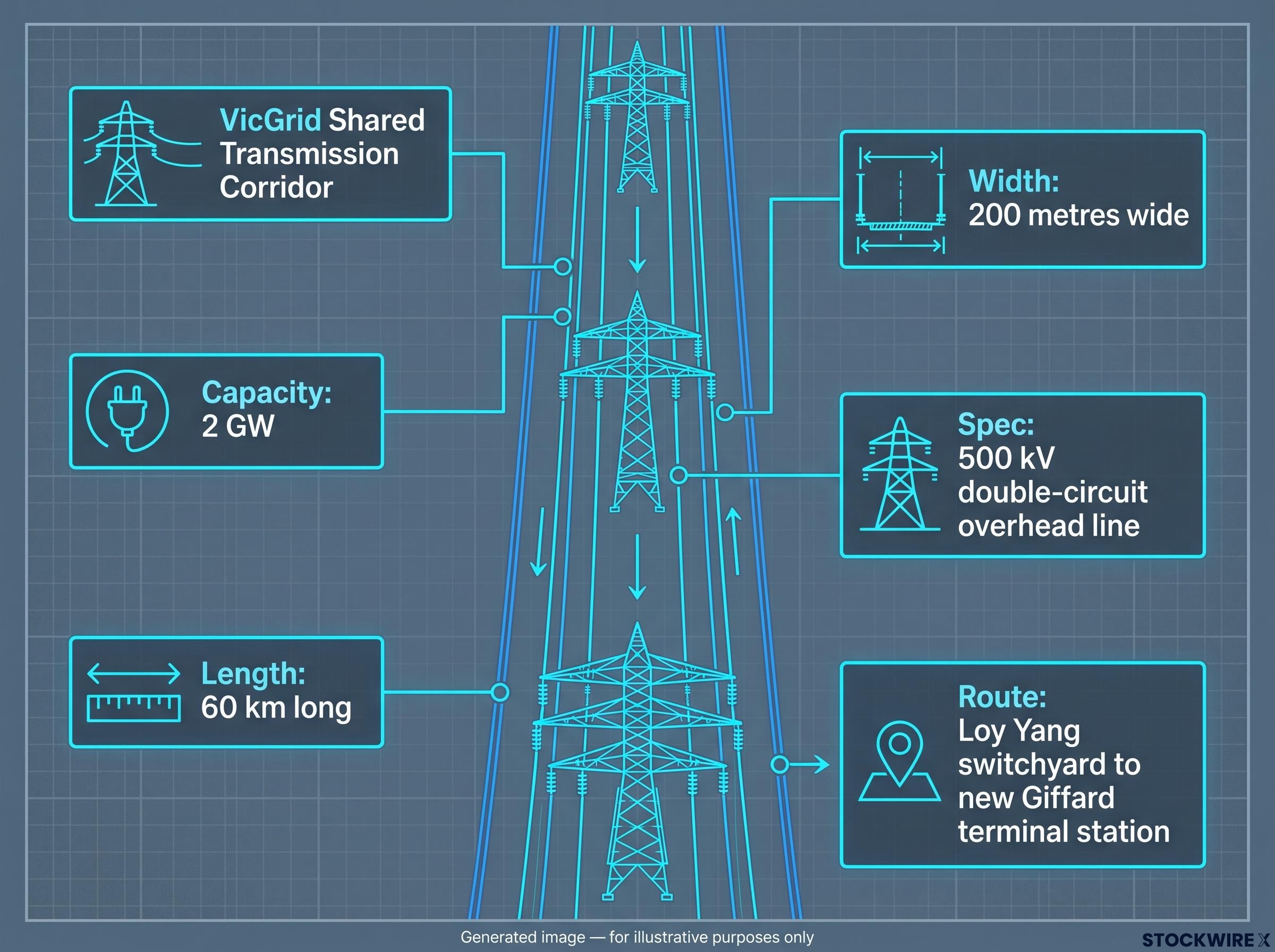
VicGrid is building a shared transmission corridor: roughly 60 km long and 200 metres wide, carrying a 500 kV double-circuit overhead line from the Loy Yang switchyard to a new terminal station at Giffard. Its designed capacity is 2 GW, matching the auction target.
That shared model is a deliberate decision to socialise grid-connection risk across multiple developers rather than leaving each one to strike a bespoke deal. In markets without centralised offshore grid planning, project-by-project connection negotiations have been one of the most reliable sources of delay.
Australia’s electricity network was engineered for large centralised coal stations, and the grid bottleneck that strands approved renewable projects is the same structural constraint VicGrid’s shared corridor is designed to pre-empt for Gippsland developers.
VicGrid’s preferred route was selected to reduce impact on homes and sensitive environmental areas, including the Mullungdung State Forest and Giffard Flora Reserve. For an auction participant, a pre-planned shared line removes the biggest single connection uncertainty before bids are even lodged.
EES timeline and what it means for the auction window
The enabling thesis is strong. The infrastructure, however, has not yet cleared its environmental approvals, and the timeline is where the gap between promise and delivery becomes visible.
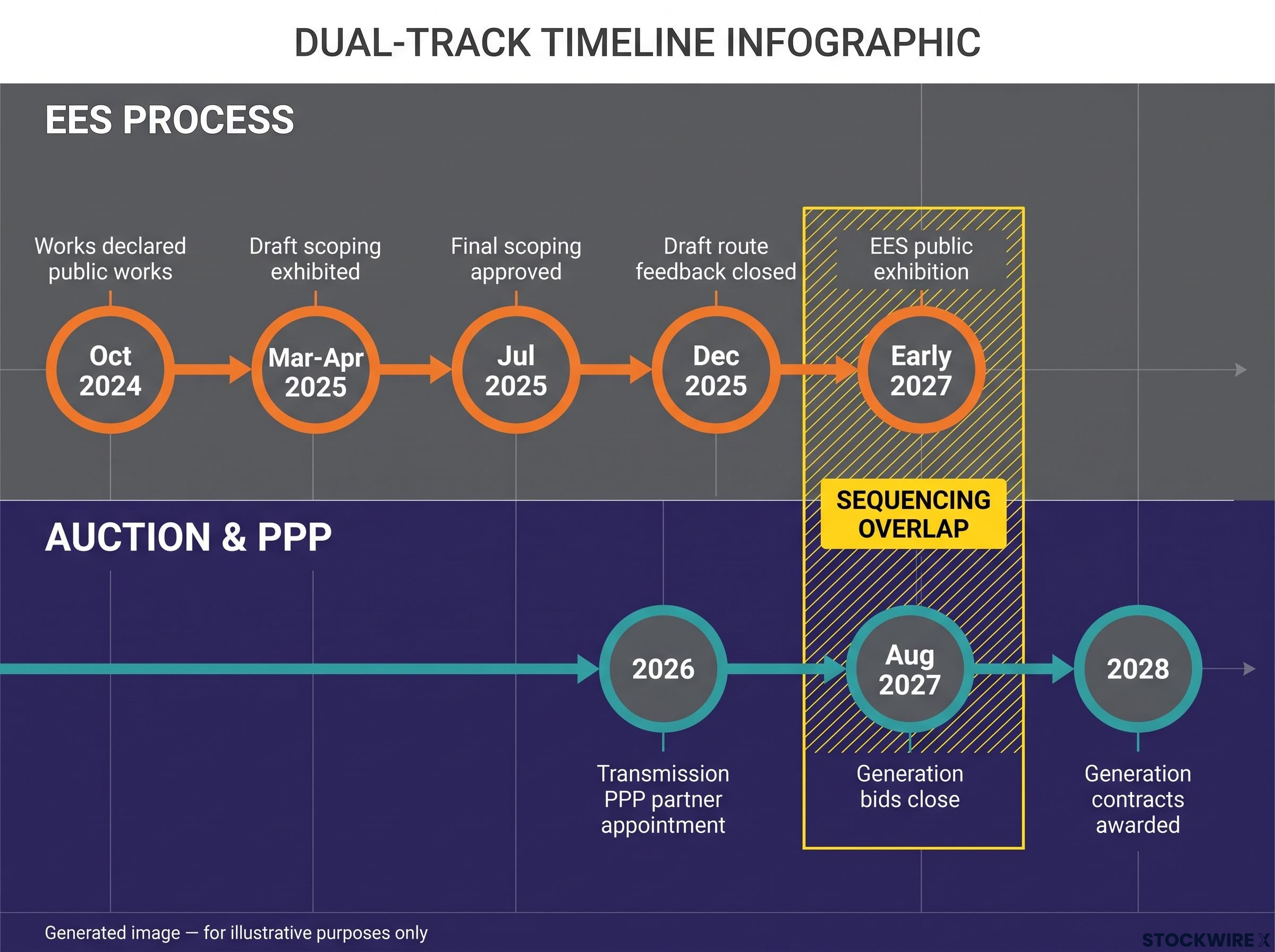
The Environment Effects Statement (EES) is the Victorian environmental assessment process the corridor must pass. Its milestones run as follows:
- October 2024: Works declared “public works” under the Environment Effects Act 1978, triggering the EES requirement.
- 20 March to 10 April 2025: Draft scoping requirements publicly exhibited for feedback.
- July 2025: Final scoping requirements approved by the Victorian Minister for Planning.
- 14 December 2025: Feedback on the draft preferred route formally closed.
- Early 2027: EES public exhibition scheduled, the next major approvals milestone.
Here is the sequencing problem. The EES public exhibition in early 2027 falls inside the bid submission window that closes in August 2027, and before the 2028 contract awards. Developers evaluating whether to bid will be doing so before the transmission corridor has finished its major environmental process.
That is a material risk factor to fold into any underwriting assumption. The one point of reassurance is route certainty: landholder engagement has run since 2023, and no material design changes to the 60 km preferred route have been reported since mid-2026. The route looks settled even if the formal clearance is not.
How Victoria’s auction compares with offshore wind markets that have gone before it
International precedent is most useful here not as a scoreboard Victoria is losing on, but as a diagnostic. The markets that went first show exactly which failure modes recur, and you can test Victoria’s design against each one.
Across the UK’s Contract for Difference rounds, Taiwan’s zone development framework, and US Bureau of Ocean Energy Management lease auctions, four failure modes appear again and again in the gap between tender award and financial close: revenue and cost shocks, regulatory and grid-connection timing risk, supply-chain bottlenecks, and port and vessel access constraints.
The Clean Energy Council’s “Winds of opportunity” report frames the Australian version of these as four investment barriers worth applying to Victoria’s auction directly:
- Revenue uncertainty: whether auctions will offer firm, bankable offtake contracts.
- Pipeline visibility: whether developers can see future auction rounds to justify long-term investment.
- Critical infrastructure availability: ports, transmission, and manufacturing capacity.
- Regulatory complexity: overlapping and misaligned approval processes.
On revenue certainty, Victoria sits behind mature markets. The UK, Denmark and Taiwan built long-standing contract-for-difference or equivalent frameworks with visible multi-round pipelines. Victoria has not yet confirmed a firm bankable offtake framework for its contracts, which is the barrier that most directly determines whether a winning bid can reach financial close.
On grid connection, Victoria has a genuine differentiator. AECOM describes Australia’s grid as long, isolated, low-density and relatively unmeshed, which makes large connections complex and often requires additional stabilising systems and batteries. VicGrid’s shared line and hub is the clearest structural answer to that problem, removing the bespoke-negotiation risk that has slowed developers elsewhere.
Australia’s clean energy investment reached a record AU$12.7 billion in 2024 before a roughly 20% slump in 2025 caused specifically by grid connection bottlenecks, a trajectory that frames the Victorian auction as a policy response to a documented capital withdrawal rather than a greenfield ambition.
AECOM characterises Australia’s approval environment as a “frustrating mix of challenges,” pointing to complex and misaligned federal and state pathways that developers must reconcile.
Geographic remoteness compounds everything. Australia sits far from established vessel supply hubs and major shipyards, a cost amplifier that European projects simply do not carry.
The lesson for you is direct: winning an auction contract in 2028 does not equal a bankable project. The award-to-close window is where projects in mature markets have most often come unstuck, and Victoria enters that window with its revenue framework still unresolved.
The structural risk factors that will determine whether the AU$20 billion projection holds
From diagnosis to synthesis. Four variables will decide whether Victoria’s projection is realised or joins the international list of auctions that underdelivered between award and financial close.
- Revenue framework design: whether 2028 contracts are structured to remain bankable when costs and markets shift between award and close. This is the single most consequential unmade decision.
- EES and regulatory sequencing: whether the EES, Commonwealth approvals, and grid-connection processes align with the auction timeline rather than lagging it.
- Supply-chain access: whether vessels, ports, and manufacturing capacity develop in parallel with the auction.
- Pipeline visibility: whether Victoria commits to subsequent auction rounds, which supply-chain investors need before committing capital.
The regulatory alignment problem
Revenue framework design is the pivot point. A fixed-revenue contract awarded in 2028 can become uneconomic if the framework offers no room to adjust for cost or market changes before financial close, which is precisely how projects unravelled in comparable markets.
Sequencing is the second-order risk. The AEMC found limited harmonisation between state and Commonwealth frameworks and unclear onshore/offshore regulatory boundaries. If the EES (public exhibition due early 2027), Commonwealth approvals, or grid-connection terms fall behind the auction timeline, the financial-close window for 2028 winners extends materially.
Why supply-chain access is the variable governments cannot solve alone
The other three variables respond to policy decisions. This one does not, at least not quickly.
Securing installation vessels is a global constraint, with demand exceeding supply worldwide, and Australia’s distance from established supply hubs amplifies both cost and lead time. No regulatory decision resolves that in the short term.
What helps is coordinated port and manufacturing investment developing alongside the auction rather than after contracts are awarded. Available sources do not confirm that this parallel development is underway, which leaves it an open question rather than a settled enabler.
The framework matters more than a binary verdict. Treat 2026 to 2028 as the de-risking window, and track these variables as they resolve. The outcome is not predetermined; it turns on identifiable decisions unfolding over the next 18 to 24 months.
What the 2026-to-2028 window means for investors positioned in this sector now
The decision you are actually making is not whether offshore wind in Gippsland is good or bad. It is where in the capital stack, and at what stage of the de-risking sequence, exposure makes sense.
At one end sits the transmission PPP, the layer closest to commitment. A development partner appointment is anticipated during 2026, and once made, it becomes the first concrete procurement event in the entire sector. That appointment will give you the clearest early read on how the broader stack is likely to sequence.
The shift toward treating climate tech as infrastructure rather than speculative venture capital is directly relevant to the transmission PPP layer: the AU$700 million to AU$1.5 billion onshore connection hub carries the cash flow and contract structure of an infrastructure asset, not a generation development bet.
At the other end sits generation-side financial close, the furthest from certainty. It depends on 2028 contract awards, followed by revenue framework resolution, EES clearance, and supply-chain contracting, each a separate hurdle.
Three milestones are worth monitoring across the window:
- Transmission PPP partner appointment (anticipated 2026): the earliest concrete signal of how the capital stack is sequencing.
- EES public exhibition (early 2027): the next major public approvals milestone, and a test of whether the transmission corridor is on schedule.
- Generation contract awards (2028): the start of the critical award-to-close risk window, not the end of it.
Gippsland is the geographic concentration point for all of this, which makes regional exposure a proxy for the sector’s trajectory.
The most important forward-looking signal sits beyond the current round. Whether Victoria confirms subsequent auction rounds will determine whether this justifies structural exposure or only opportunistic positioning, because single-round auctions cannot support the supply-chain investment the sector needs.
This article is for informational purposes only and should not be considered financial advice. Investors should conduct their own research and consult with financial professionals before making investment decisions. Financial projections are subject to market conditions and various risk factors, and these statements are speculative and subject to change based on market and policy developments.
Reading the de-risking sequence before the sector moves past its earliest catalysts
The core thread running through all of this is straightforward. The AU$20 billion projection is achievable but contingent, and the 2026 to 2028 milestones are the observable evidence base for whether the conditions behind it are resolving.
The bid window closing in August 2027 and contract awards in 2028 mark the outer boundary of the current de-risking period. Inside that boundary, the transmission PPP partner appointment anticipated during 2026 is the earliest hard signal available to you.
The most forward-looking question is the pipeline one. As of September 2026, no subsequent auction rounds have been announced. A confirmed second round would materially change the investment thesis, because it would demonstrate the long-term policy commitment that supply-chain investors require and that a single auction cannot provide.
Whether this fulfils its projection or becomes another case study in the gap between announced and realised offshore wind investment depends on decisions that are mostly still unmade. Investors tracking those decisions now are working with a genuine information advantage over those waiting for construction to begin.