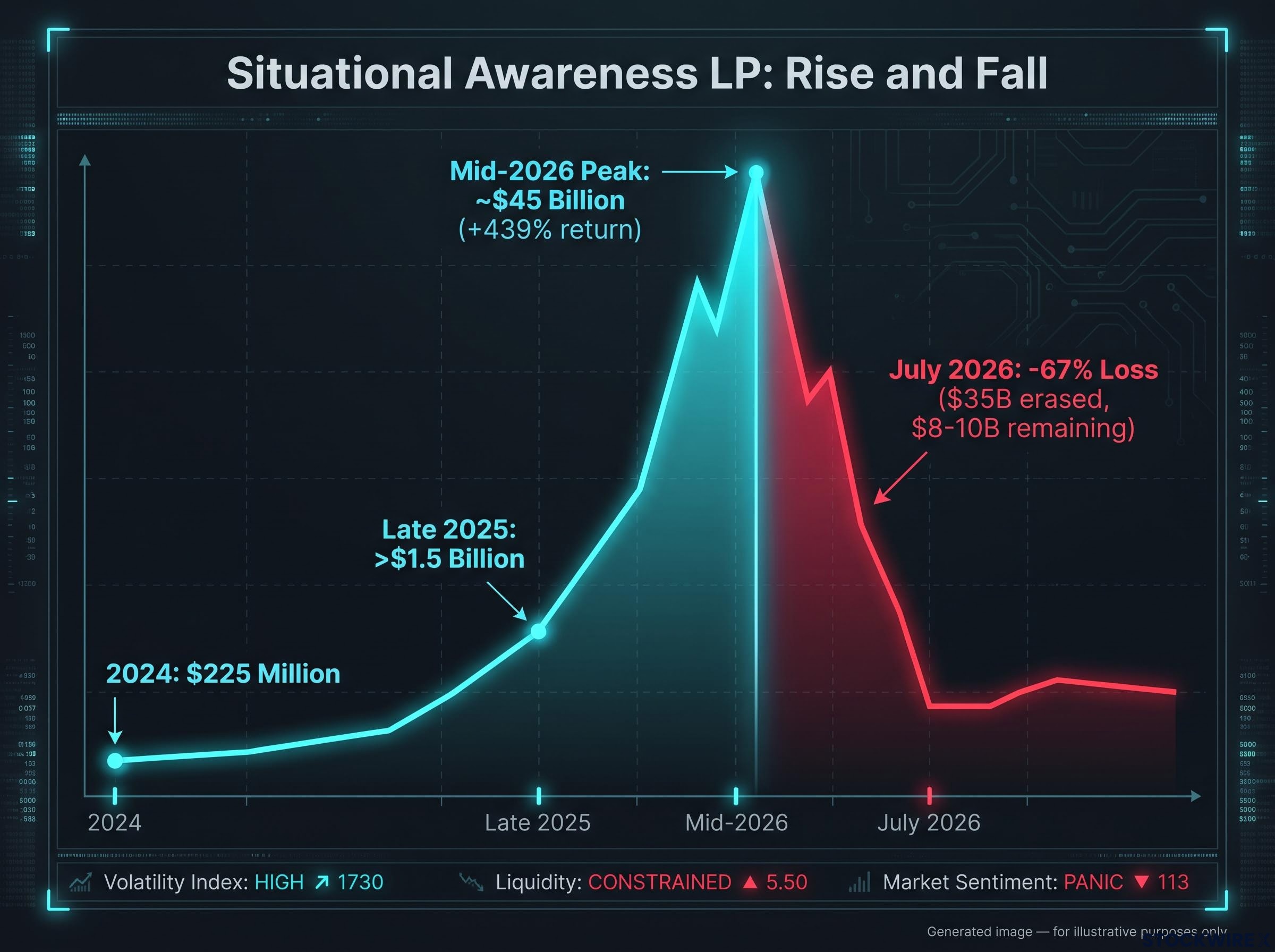
In just over two years, a portfolio grew from roughly $225 million to approximately $45 billion. Then, in a single month, it incinerated around $35 billion.
That is the arc of Situational Awareness LP, the AI infrastructure fund run by former OpenAI researcher Leopold Aschenbrenner. Its rise and collapse in mid-2026 is not merely a story about a young manager and hubris.
It is a case study in market structure, correlation risk, and the mechanical forces that push asset prices away from fundamental value. The thesis was arguably right. The execution nearly ended in permanent capital impairment.
Understanding this episode gives you a working framework for three things that matter to any investor in a crowded theme: how thematic mega-funds transmit systemic risk across a sector, how forced liquidations manufacture tradeable bottom signals, and how to position yourself when institutional capital blows up around you.
The anatomy of a 400% leveraged thematic trade
Start with the thesis, because the thesis was sound. Aschenbrenner built the fund on a conviction articulated in his own published essay: that artificial intelligence would be the dominant driver of global market returns over the next decade, generating sustained demand for semiconductors, data centres, and electricity while gutting the sectors it disrupts.
Rigorous thematic investment evaluation separates the trend from the vehicle: a structurally sound AI infrastructure thesis can coexist with dangerously overpriced or overleveraged exposure to it, and a five-question framework covering problem size, realistic addressable market, long-term durability, valuation, and competitive moat gives individual investors a repeatable filter that Situational Awareness’s construction conspicuously lacked.
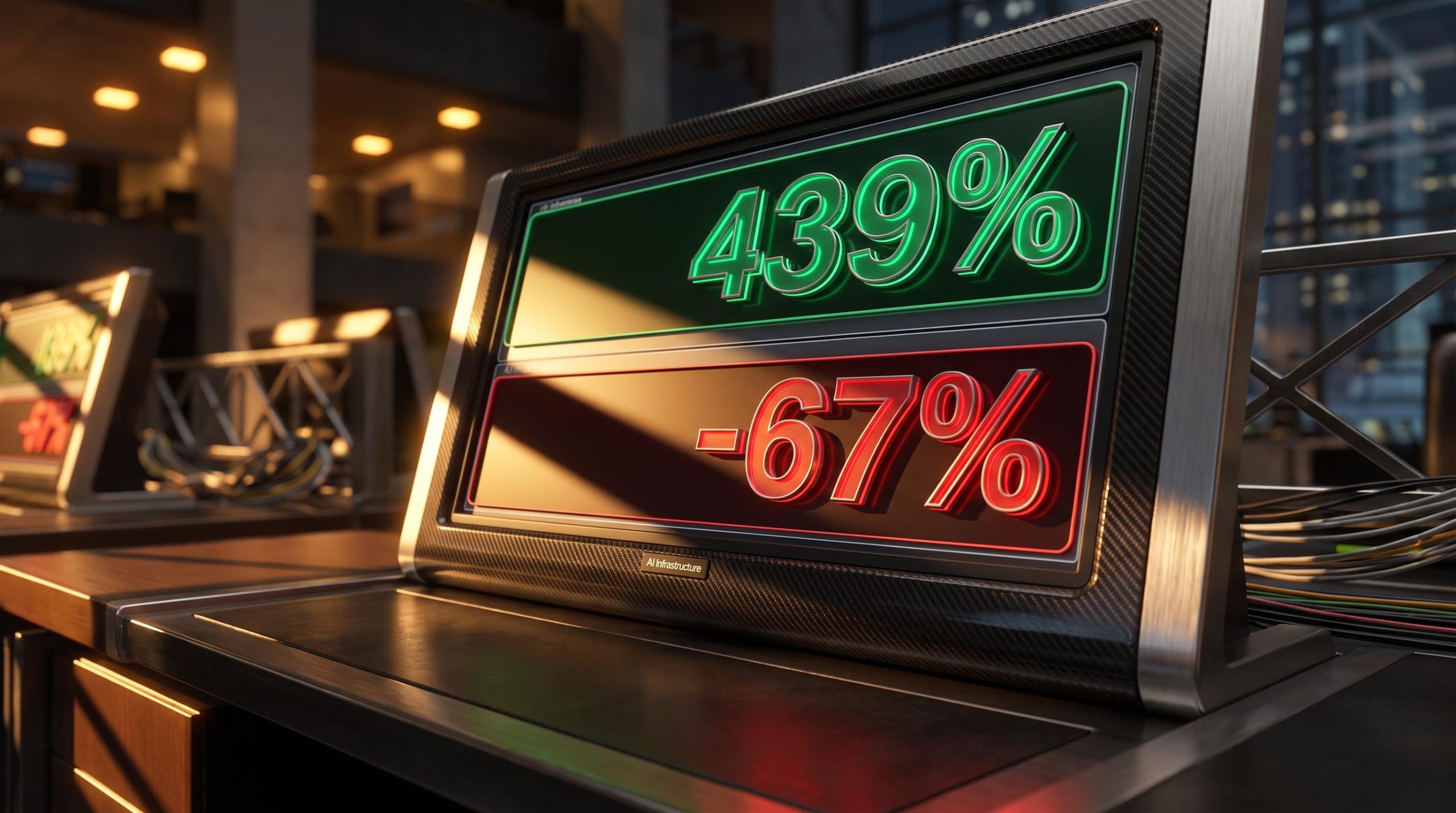
Seeded with roughly $225 million in 2024 from backers including Stripe’s Patrick and John Collison and former GitHub chief Nat Friedman, the fund scaled with astonishing speed. Fortune reported assets above $1.5 billion by late 2025. By mid-2026, peak assets reached approximately $45 billion, with reported net returns of 439% through 26 June 2026.
The implementation was concentrated and directional. Long positions clustered in semiconductors such as SK Hynix, data-centre plays including CoreWeave, and power companies. Short positions targeted software sectors expected to lag AI adoption.
Here is where a good idea met a fragile structure. According to CNBC, the fund applied leverage of up to 400% to these AI-related positions, financed largely through prime-broker margin. Prime-broker margin is borrowed money extended by an investment bank against the value of a fund’s holdings; when those holdings fall, the bank demands more collateral or forces sales.
Analysts including NYU finance professor Aswath Damodaran have identified three risk mechanisms that made this structure combustible:
- Leverage magnification: borrowing amplifies both gains and losses, so a modest sector drawdown becomes a fund-level disaster through mark-to-market losses and margin calls.
- Prime-broker dependency: financing can be withdrawn quickly once losses mount, forcing fire-sale liquidations regardless of underlying fundamentals.
- Correlation risk: concentration in a single theme removes the diversification that normally cushions a portfolio.
When correlation replaces diversification
The third mechanism is the one most investors underestimate. Diversification only protects you when your holdings move independently. When your entire book is AI chips, data centres, and power, those names rise and fall together.
The software short positions were meant to hedge this. They did not. CNBC described the wager against software as a “bad bet” that added to margin pressure rather than relieving it, because both sides of the trade moved against the fund at once.
What this tells you is direct. When your portfolio holds highly correlated assets under margin pressure, standard diversification rules fail entirely, and ordinary sector volatility becomes an existential threat. Being right about a decade-long trend is worthless if position sizing leaves no room to survive a normal drawdown.
When big ASX news breaks, our subscribers know first
Margin calls and the Citadel liquidation event
Then July arrived. AI-infrastructure names sold off sharply, semiconductor prices fell, and the software shorts kept bleeding. The leverage that had produced a 439% gain now worked in reverse, at four times the speed.
Multiple outlets including CNBC, Reuters, and Zacks place the July 2026 loss at approximately 67%, equivalent to roughly $35 billion in value erased. Assets collapsed from about $45 billion to around $8-10 billion.
The mechanics here are the point. Margin calls do not wait for a thesis to play out. Prime brokers forced the fund to sell the bulk of its leveraged public equity book, including SK Hynix and CoreWeave, at a discount to Ken Griffin’s Citadel, which stepped in as a deep-pocketed buyer.
The Situational Awareness blowup did not occur in isolation: margin debt dynamics across the broader market had reached historically dangerous levels by mid-2026, with US margin borrowers collectively owing nearly $1 trillion more than their available cash buffers, a configuration that makes any sector-level shock transmit faster and deeper than the underlying fundamentals alone would justify.
The SEC guidance on margin borrowing risks makes explicit what prime-broker arrangements obscure in practice: brokerage firms can sell a fund’s securities without prior notice to satisfy a margin call, meaning financing terms, not fundamental value, dictate the timing and price of liquidation.
Damodaran’s August 2026 account confirms Citadel absorbed “almost all” of the fund’s public equity holdings during a short window when the positions had already fallen heavily. This is the hidden plumbing of modern markets: in the short run, asset prices are dictated by the financing terms of the largest players, not by underlying corporate earnings.
When leverage meets volatility Zacks Investment Research framed the episode under exactly that heading, arguing that up to 400% leverage on a narrow AI-infrastructure basket allowed the fund to post more than 400% gains early in the year, then left it exposed to a 67% loss in a single month once the sector corrected.
Not everything died. The fund’s private holdings, including a reported stake in Anthropic, survived the public-book liquidation and were never transferred to Citadel. The destruction was concentrated entirely in the leveraged, publicly traded positions.
The lesson for your own portfolio is uncomfortable. Holding fundamentally strong stocks offers no protection if a deeply leveraged whale in the same sector faces a sudden margin call and dumps the identical names you own.
Decoding the mechanical bottom in AI infrastructure stocks
Now flip the disaster over, because a forced liquidation of this size does something predictable to prices. A distressed seller must exit regardless of price, dumping enormous blocks into thin liquidity and driving prices below any level fundamentals would justify.
That overshoot is a mispricing, not a verdict on the businesses. Once Citadel absorbed the blocks and the financing pressure eased, the mechanical selling simply stopped. With no further forced supply hitting the market, even modest new demand or short covering was enough to spark a rebound.
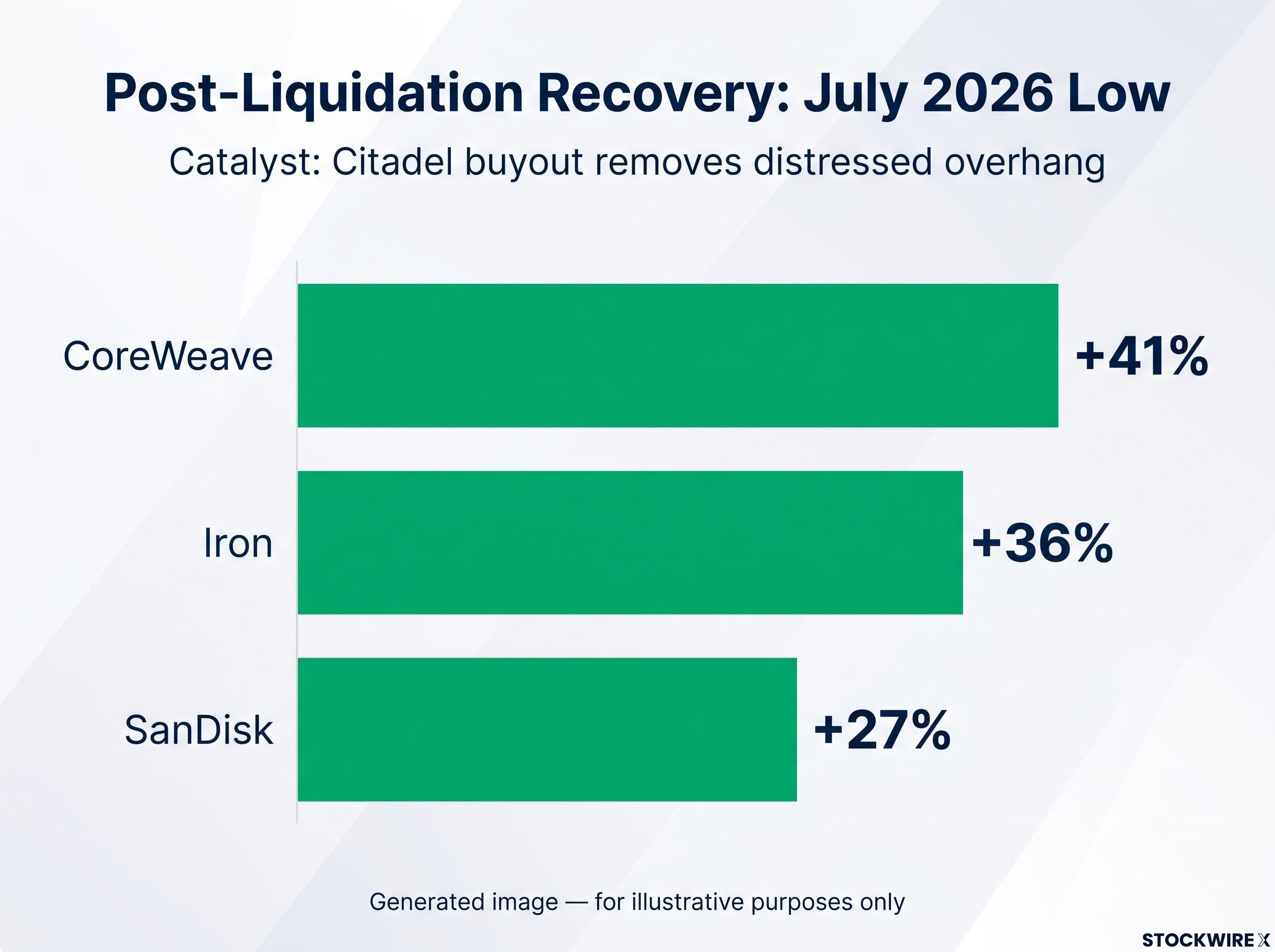
The recoveries that followed the July trough support the pattern. Several names tied to the fund’s former book bounced sharply within a short window once the distressed overhang was removed.
| Asset | Catalyst | Recovery from July 2026 low |
|---|---|---|
| CoreWeave | Citadel buyout removes distressed overhang | Approx. +41% |
| Iron | Citadel buyout removes distressed overhang | Approx. +36% |
| SanDisk | Citadel buyout removes distressed overhang | Approx. +27% |
This is not a new phenomenon. The 1998 unwind of Long-Term Capital Management and the 2021 collapse of Archegos followed the same sequence: highly levered, concentrated positions liquidated under pressure, prices overshooting on the downside, then re-equilibrating once stronger balance sheets stepped in to buy.
Forced selling cascades are not confined to individual fund disasters: by late June 2026, Citi strategist David Chew had identified that roughly 80% of Nasdaq-100 long positions were already loss-making, a structural shift that turns crowded bulls into potential forced sellers across the entire index and makes a single large liquidation event the spark for a broader chain reaction.
Here is the framework it hands you. When a sector sells off, distinguish between a fundamental decline and a mechanical liquidity event. A fundamental decline reflects deteriorating businesses. A mechanical event reflects a single forced seller, and once that seller is cleared, the artificial pressure lifts and the strongest names tend to recover first.
The signal to watch is the clearing event itself. The transfer of the public book to a well-capitalised buyer like Citadel is what marks the end of forced supply, and that is the moment agile, unlevered capital has historically found its entry.
Options market reentry and the persistence of the AI thesis
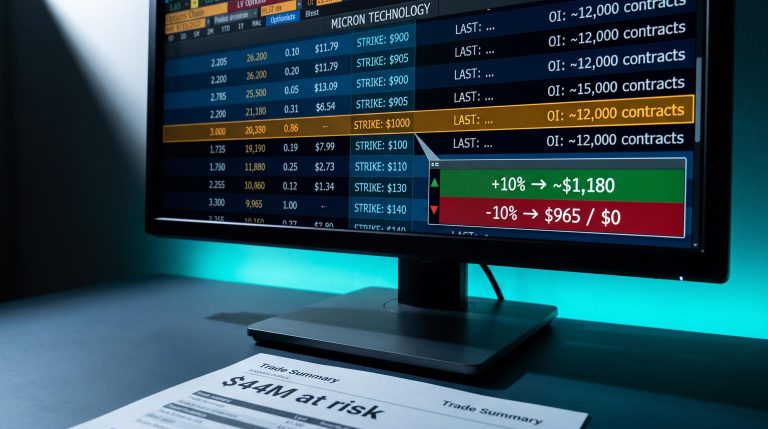
Eight weeks later, Aschenbrenner was back. By 11 September 2026, CNBC reported that the fund which had “virtually collapsed over the summer” was active again in the market, this time accumulating positions through options rather than leveraged cash equities.
The new target basket was familiar: Advanced Micro Devices (AMD), Bloom Energy, CoreWeave, and SanDisk. The financing arrangement had shifted. JPMorgan terminated its lending relationship after the AI-related losses, while Goldman Sachs, Citigroup, and Bank of America remained, and the fund added boutique broker Clear Street to a reduced, restructured prime-broker roster.
The pivot itself carries the signal. Options let a fund establish large exposure while mathematically capping the maximum downside at the premium paid, which is a structurally different risk profile from the leveraged equity book that nearly destroyed the firm.
What this tells you is that the underlying conviction in the physical backbone of AI, chips, data centres, and power, remains fully intact. The thesis was never the problem. The method of execution has changed to prevent a second forced liquidation.
The institutional read on this return splits three ways:
- Rational conviction: CryptoBriefing framed the renewed activity as evidence Aschenbrenner is “far from done betting on the physical backbone of artificial intelligence,” consistent with a structural thesis that survived the blow-up.
- Reckless repetition: Zacks treated the collapse as a cautionary tale, and JPMorgan’s decision to cut financing reads as a concrete institutional judgment that continued aggressive trading carries unacceptable counterparty risk.
- Structurally significant market signal: the combination of Citadel absorbing the liquidated book and Aschenbrenner re-entering through options suggests the AI-infrastructure theme keeps attracting sophisticated capital even after high-profile failures.
For you, reading these derivatives footprints matters. When a fund returns to a theme through options after a public disaster, it signals that institutional belief in the sector’s long-term direction is strong enough to rebuild, just through instruments that contain the risk.
Navigating volatility in the next phase of AI capital allocation
The core lesson of the 2026 AI infrastructure cycle is that immense capital flows guarantee extreme volatility. Thematic selection is only half the discipline. Risk management, specifically leverage control and position sizing, is the half that determines whether you survive the drawdowns that a crowded theme delivers on schedule.
The physical build-out of artificial intelligence remains a genuine, generational demand story. That does not exempt it from routinely punishing over-leveraged participants, and prime-broker dynamics mean the largest players can dislocate prices for everyone else without warning.
The AI infrastructure investment thesis rests on a structural constraint that neither a fund blowup nor a single sector correction can remove: US grid interconnection wait times now average five years, with nearly 2,300 GW already queued, meaning the physical supply of power for data centres is structurally limited regardless of how capital is allocated or misallocated above it.
For individual investors, the practical takeaway is separation. You can hold the AI infrastructure theme through un-levered positions sized to withstand a 67% sector shock, without inheriting the institutional crowding and margin fragility that define mega-fund operations. When the next whale blows up, the cleared, forced-selling bottom is an opportunity rather than a threat, provided you are not levered into the same trade.
This article is for informational purposes only and should not be considered financial advice. Investors should conduct their own research and consult with financial professionals before making investment decisions. Past performance does not guarantee future results, and forward-looking interpretations are speculative and subject to change based on market developments.