A security agreement between three governments barely moved the price of oil, gold, or any major index last week. It sent two obscure micro-cap tickers vertical.
On 18 September 2026, the United States, Denmark, and Greenland announced a pact expanding US military access across the Arctic island. The deal reaffirms Greenland as a self-governing Danish territory, transfers no sovereignty, and restricts non-allied investment in critical minerals. It is, by any measure, a substantial geopolitical development.
Yet the sharpest market reaction did not appear in energy or defence heavyweights. It showed up in a cluster of thinly traded Greenland stocks, where a handful of pure-play names spiked violently on almost no underlying change.
This is a map of how those spikes form, why they fade, and where the exhaustion signals appear. Here is the framework for reading news-driven micro-cap surges before you mistake a liquidity event for a lasting breakout.
When global strategy meets a microscopic investable universe
The scale of the resource story is genuinely large. According to Benchmark Minerals Intelligence, 43 of the 50 minerals considered critical to US national security and economic stability may be present in Greenland. The island ranks eighth globally for rare-earth reserves.
The mineral significance of Greenland sits within a broader structural context: commodity supercycle dynamics driven by the energy transition, reshoring mandates, and supply underinvestment are the macro backdrop that makes Arctic resource stories credible at the thesis level, even when the listed vehicles cannot yet deliver that thesis to shareholders.
The problem for anyone trying to trade that story is the shortage of listed vehicles. Greenland’s mining sector remains early-stage, with few producing mines and many key deposits controlled through private or non-Western joint ventures.
So when a headline lands, demand cannot spread across a broad sector the way it might in oil or copper. It funnels into the two or three tickers that carry an obvious Greenland label.
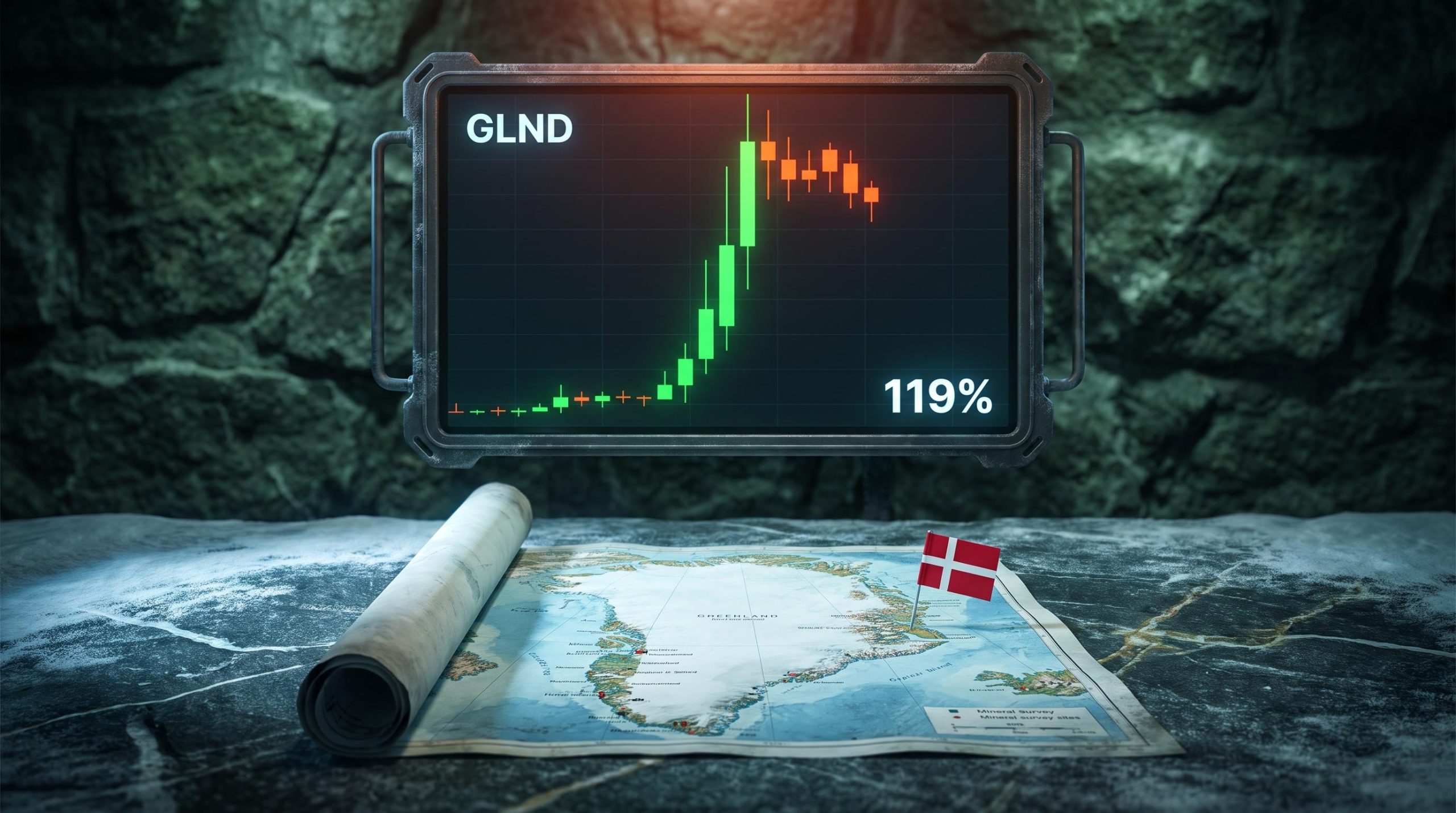
The confirmed move belongs to Greenland Energy (GLND), which jumped 119% after-hours following the announcement, as reported by Seeking Alpha on 20 September 2026. Alongside it, tastylive analyst commentary reported an approximately 160% surge in Greenland Mines (GRML) in the Monday session, though that figure is not independently confirmed in wider market data or corporate filings.
Both are micro-caps with limited float and thin liquidity. Other names with genuine Greenland exposure, such as Amaroq Minerals and Anglo American, carried no discrete treaty-linked trading reaction at all.
| Entity | Exposure type | Post-treaty market reaction |
|---|---|---|
| Greenland Energy (GLND) | Perceived pure-play beneficiary | 119% after-hours jump (Seeking Alpha, 20 September 2026) |
| Greenland Mines (GRML) | Rare-earths and critical-minerals developer | ~160% Monday surge reported by tastylive; not independently confirmed |
| Amaroq Minerals | Mt. Nalunaq gold mine, southern Greenland | No documented treaty-linked reaction |
| Anglo American | Western Greenland copper and nickel licences | No documented treaty-linked reaction |
Here is the read you should take from that table. When you buy GLND or GRML on a headline, you are not buying the geopolitical event or the mineral resource. You are buying a market structure bottleneck, the narrow point where a large story collides with a tiny pool of shares.
When big ASX news breaks, our subscribers know first
The mechanics of narrative scarcity and algorithmic flows
The price action is not a business revaluation. It is order flow physics, and understanding the difference is what keeps you from buying the top.
Start with float. When a stock has a thin float and a shallow order book, meaning few shares available to trade and few standing buy and sell orders, even modest demand moves the price disproportionately. There is simply not enough supply to absorb a rush of buyers without a sharp jump.
Now add speed. News-scanning algorithms parse headlines in milliseconds and fire orders into the obvious “Greenland” tickers before most humans have finished reading the story. That creates extreme order imbalances and the large opening gaps that define these events.
The timeline matters here. The agreement was announced on Friday 18 September 2026, giving the narrative a full weekend to circulate before the Monday session opened into a frenzy of pent-up demand.
Corporate communications pour fuel on the fire. GRML, which was trading in the low single-digit dollar range in mid-September and had only rebranded from Klotho Neurosciences in March 2026, issued releases publicly applauding the security agreement and stressing its critical-minerals strategy.
GRML’s rapid rebrand from Klotho Neurosciences to a critical-minerals identity in March 2026 is precisely the kind of flag that small-cap management quality frameworks are designed to surface: per-share return analysis and transparency signals reveal whether a corporate pivot reflects genuine strategic repositioning or opportunistic narrative capture.
Nothing in those releases changed the company’s asset base, jurisdictional risk, or financing outlook. The story changed. The fundamentals did not.
The danger of narrative scarcity When a large geopolitical story has almost no listed vehicles to absorb it, speculative demand concentrates into a few micro-caps and manufactures a price that reflects attention, not cash flow. The number on the screen is a temporary illusion of value, not a new baseline. Once the fast money leaves, there is no institutional sponsorship left to hold the level.
That is why these moves fade so fast. The surge is driven by attention and scarcity rather than new earnings, so once early buyers take profits, prices drift back toward where they started.
How information asymmetry traps latecomers
The unfair part of this is speed. Institutional news-analytics firms react to a headline in a fraction of a second, entering and exiting positions before most retail participants have opened their trading app.
By the time a narrative reaches social media and feels like a consensus opportunity, the fast money is frequently already selling into the crowd it helped attract. If you are reading about the trade rather than being alerted to it algorithmically, you are almost certainly a latecomer, and latecomers are the exit liquidity.
Spotting the exhaustion gap before the collapse
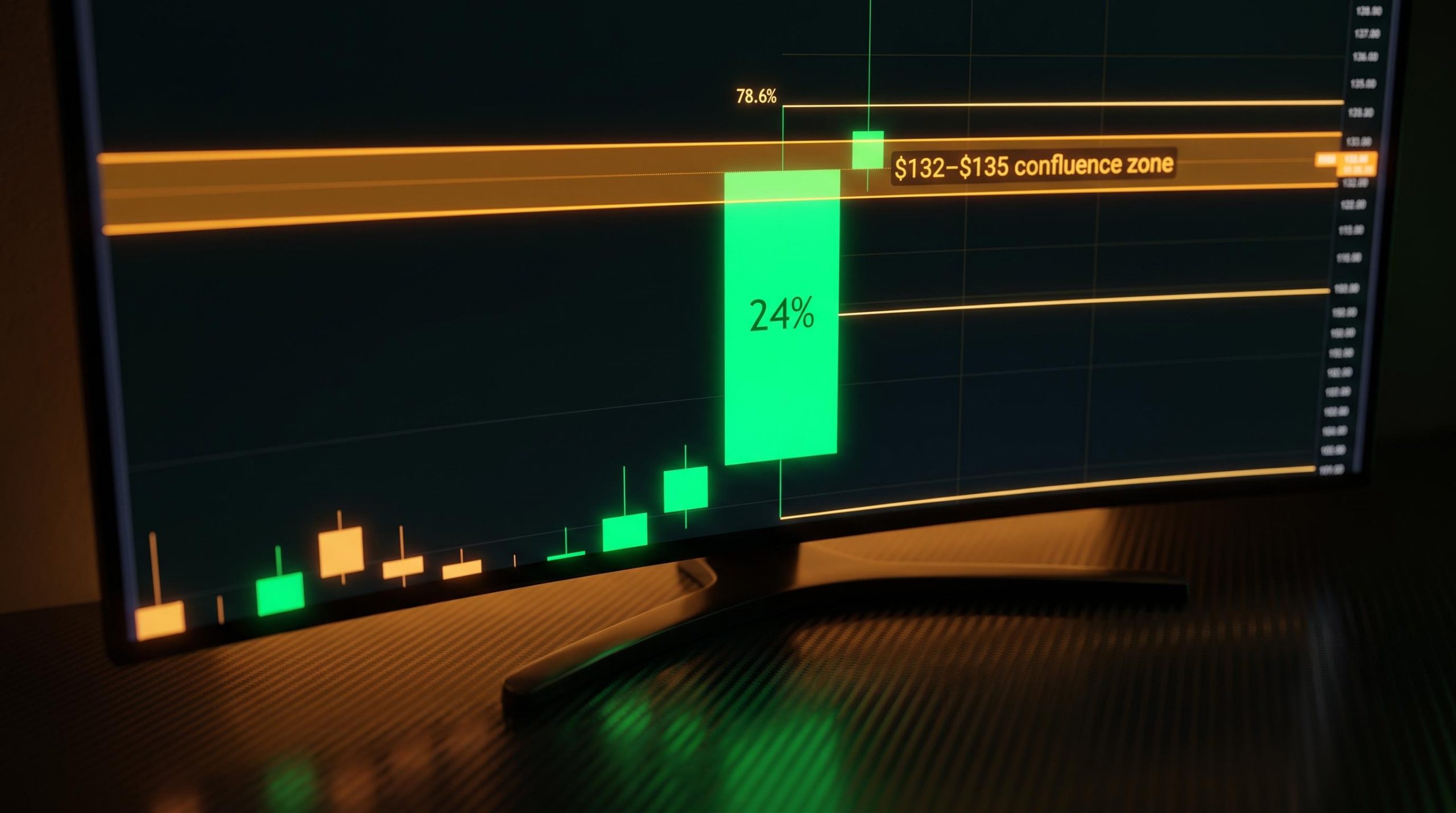
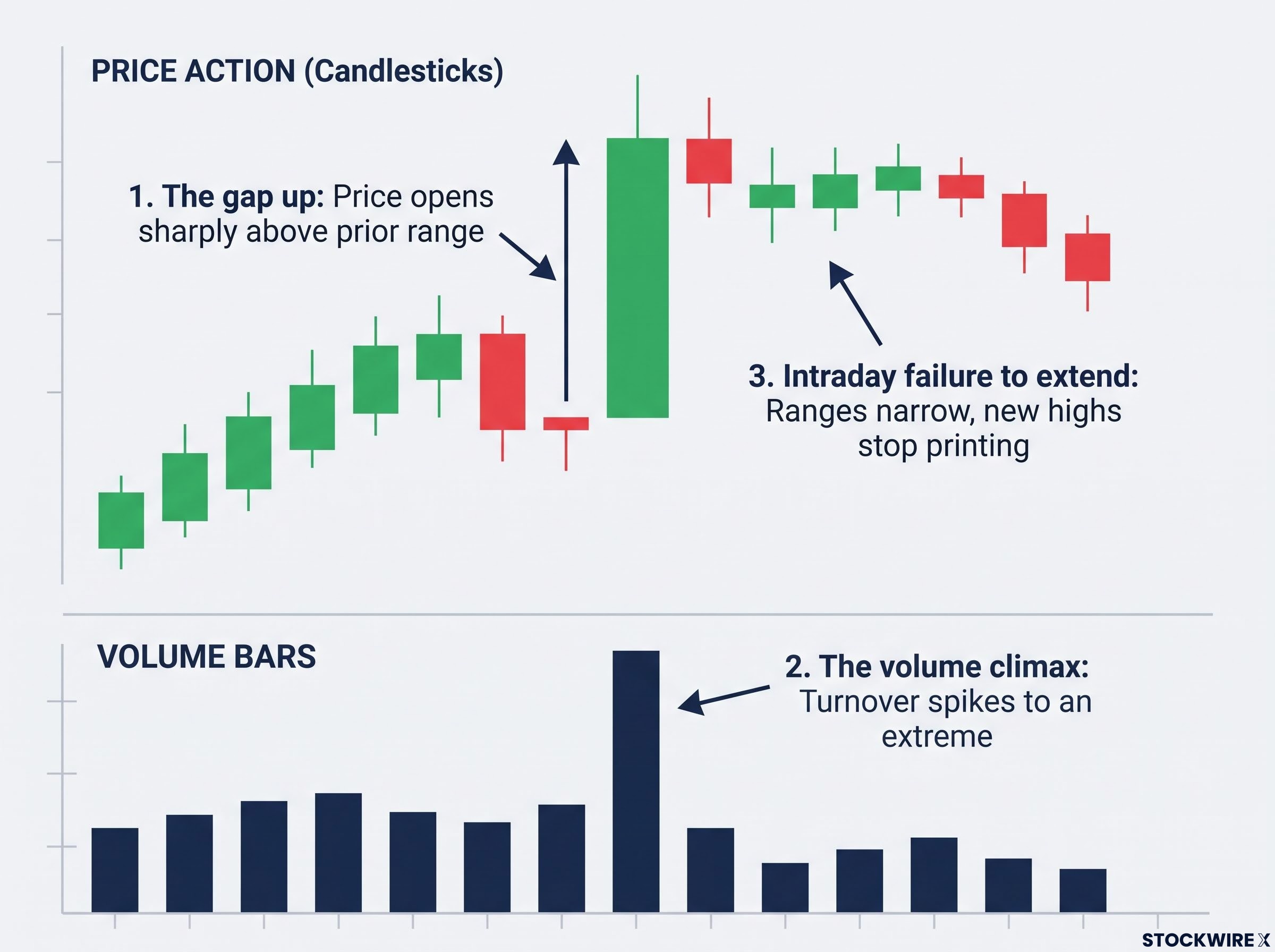
The chart usually tells you the rally is dying before the news does. The specific footprint to look for is an exhaustion gap.
An exhaustion gap is a sharp price gap that appears late in a move, on heavy volume, then fails to extend. It signals that the last wave of aggressive buyers has already committed, leaving no fresh demand to push the price higher.
The tastylive commentary flagged exactly this pattern in GRML, identifying a large price gap on the chart as a sign the rally was likely near exhaustion. That reasoning holds regardless of whether the 160% figure is confirmed, because the technical logic does not depend on the exact percentage.
Here is what the pattern looks like in practice:
- The gap up: Price opens sharply above the prior range on a fresh headline, driven by concentrated speculative buying.
- The volume climax: Turnover spikes to an extreme as algorithms and fast retail flows pile in simultaneously.
- The intraday failure to extend: After the open, ranges narrow, new highs stop printing, and the price cannot build on the gap.
When those three conditions line up, the reversal usually follows a predictable shape. Early buyers begin selling into the late-arriving retail traders still chasing the headline, and the price drifts back toward the pre-gap zone, partially or fully closing the gap over the following sessions.
The reversal that typically follows an exhaustion gap is not random: gap-filling analysis documents fill rates as high as 93.1% under specific conditions, meaning the price void created by the opening surge becomes one of the more statistically reliable near-term price targets once the exhaustion signal appears.
So when you see a massive morning gap that stalls on heavy volume, do not read it as a safe entry. Read it as evidence that latecomers are being trapped at the top, which is the opposite of a breakout.
Navigating the structural traps of story stocks
The exhaustion gap tells you the rally is ending. The market structure tells you how expensive it will be to get out.
Trading a low-float geopolitical story stock exposes you to a set of execution problems that barely register in liquid large-caps. These are the traps that turn a losing idea into a much larger loss.
- Slippage: Wide bid-ask spreads and shallow order books mean the price you see is rarely the price you get. A market order into thin liquidity can fill materially worse than expected, on both entry and exit.
- Volatility halts: Exchanges can impose trading pauses when a stock moves too violently. A halt can freeze your position while the price resets far lower, leaving no way to exit until trading resumes.
- Mean reversion: Once marginal buyers disappear and sober analysis concludes the event changed no fundamentals, prices tend to revert toward pre-announcement levels. This is the statistically more likely outcome, not the exception.
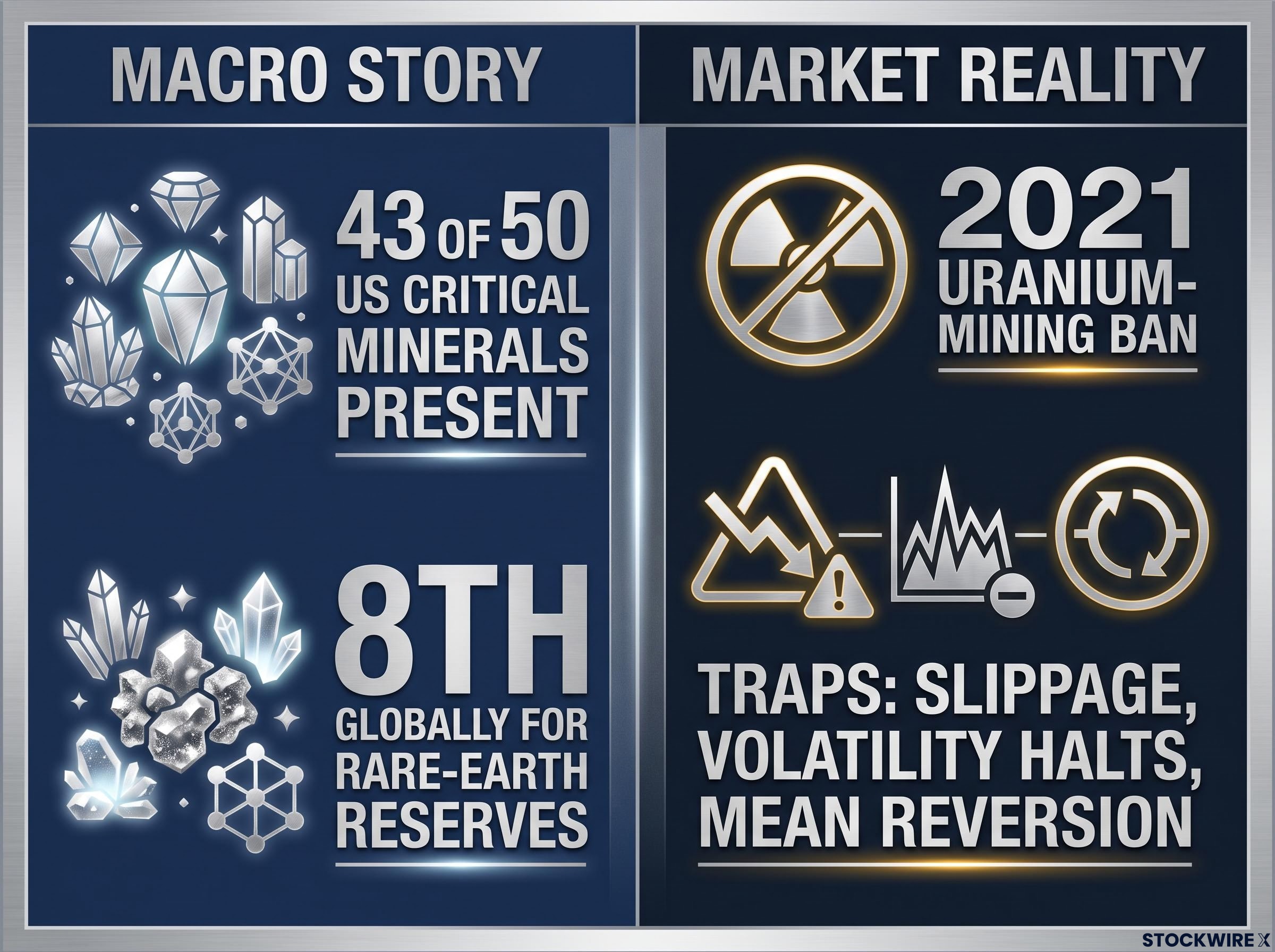
Regulatory reality often contradicts the trading narrative outright. Greenland’s 2021 uranium-mining ban effectively halted some mixed rare-earth and uranium projects, including work affecting the Kvanefjeld deposit, a reminder that a supportive treaty headline does not clear the on-the-ground obstacles a project actually faces.
Before you commit capital to a headline spike, weigh the high probability of slippage, halts, and rapid mean reversion against the slim chance of a sustained gain. The maths rarely favours the chaser.
This article is for informational purposes only and should not be considered financial advice. Investors should conduct their own research and consult with financial professionals before making investment decisions. Past performance does not guarantee future results, and rapid reversals in thinly traded equities can produce significant losses.
Building a defensive posture for the next geopolitical catalyst
Greenland’s strategic and mineral significance is real, but a great macro story does not automatically become a viable public market trade. The September agreement changed the narrative around GLND and GRML far more than it changed anything on their balance sheets.
That gap is the whole lesson. Geopolitical treaties rarely translate into immediate fundamental value for thinly traded micro-caps, which is precisely why the price spikes tend to unwind.
When the next Arctic, critical-minerals, or defence headline sends an obscure ticker vertical, run the same checks before reacting. Look for the exhaustion gap, measure the liquidity, and ask whether anything in the actual business has changed. If the answer is only the story, you already know how these moves usually end.
For investors wanting a research-backed framework for staying disciplined when the next Arctic or critical-minerals headline arrives, our dedicated guide to geopolitical risk investing documents why reactive trades during high-attention events consistently underperform, and what systematic alternatives look like in practice.