The dollar has been doing something that should not, by most historical playbooks, be happening. Slower US growth is on the horizon, fiscal worries are stacking up, and questions about the Federal Reserve’s independence keep circling. Conditions like these usually pull a currency lower. Instead, the dollar has held firm.
That tension sits at the heart of ING’s current thinking. The bank is bearish on the dollar over the longer run, yet it argues the currency is genuinely supported in the near term. Both things are true at once, and understanding why is the whole point.
Francesco Pesole at ING has boiled the direction of the greenback down to two macro variables doing most of the heavy lifting right now: where the market thinks the Fed is heading, and where oil prices go next. Watch those two, and you get a cleaner read than tracking every stray data point, especially with major institutions openly disagreeing on the Fed’s path.
Here is what this covers: the two signals that actually move the dollar under ING’s framework, why the bank’s Fed view sits well below where markets are pricing, and what a fourth-quarter drop in oil would mean for how you think about dollar exposure heading into 2026.
ING’s two-speed dollar view: bullish near term, bearish by year-end
ING is holding two positions that look, at first glance, like they contradict each other. Near term, the bank sees the dollar supported and capable of grinding higher. Longer term, it expects the currency to weaken through 2026. The resolution lies in what ING treats as temporary versus what it treats as structural.
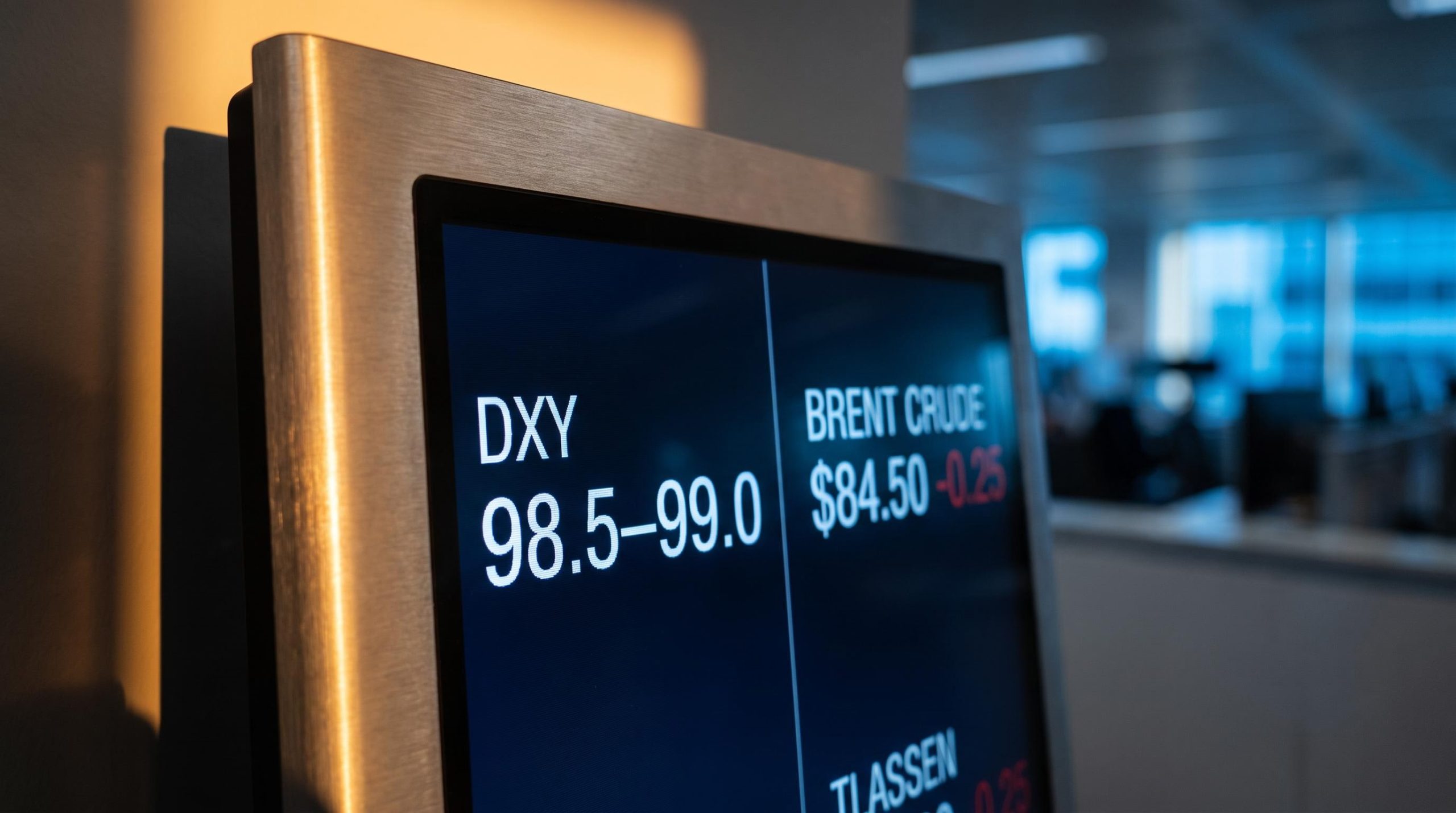
The near-term support rests on two pillars: hawkish Fed pricing after the September FOMC meeting, and elevated oil prices. Pesole expects the US Dollar Index (DXY, a gauge of the dollar against a basket of major currencies) to keep consolidating around 98.5-99.0, with room to push higher as long as those two conditions hold.
The Federal Reserve dual mandate, price stability and maximum employment, is the formal framework shaping every rate decision the FOMC makes, and when the two objectives pull in opposite directions, as they do when inflation sits above target while unemployment rises, the Fed’s communication becomes harder to interpret and market pricing diverges sharply.
ING’s near-term DXY call Pesole sees consolidation around 98.5-99.0, with 100.0 a realistic destination in the near term as the dollar re-establishes a positive correlation with long-end US yields and higher oil.
The catch is that ING views both of those pillars as temporary rather than permanent features of the landscape. As the drivers shift away from event-driven volatility toward slower-burning structural forces, the bank expects the dollar to gradually depreciate. Its baseline strategic outlook from 10 November 2025 has the easing cycle completing by March 2026, with the policy rate reaching a terminal 3.25% and settling into a neutral 3.0-3.5% range for an extended stretch.
The structural drivers ING points to for a weaker dollar in 2026 are:
- Slower US economic growth
- Fiscal concerns as deficits stay elevated
- Debt sustainability questions
- Doubts over Federal Reserve independence
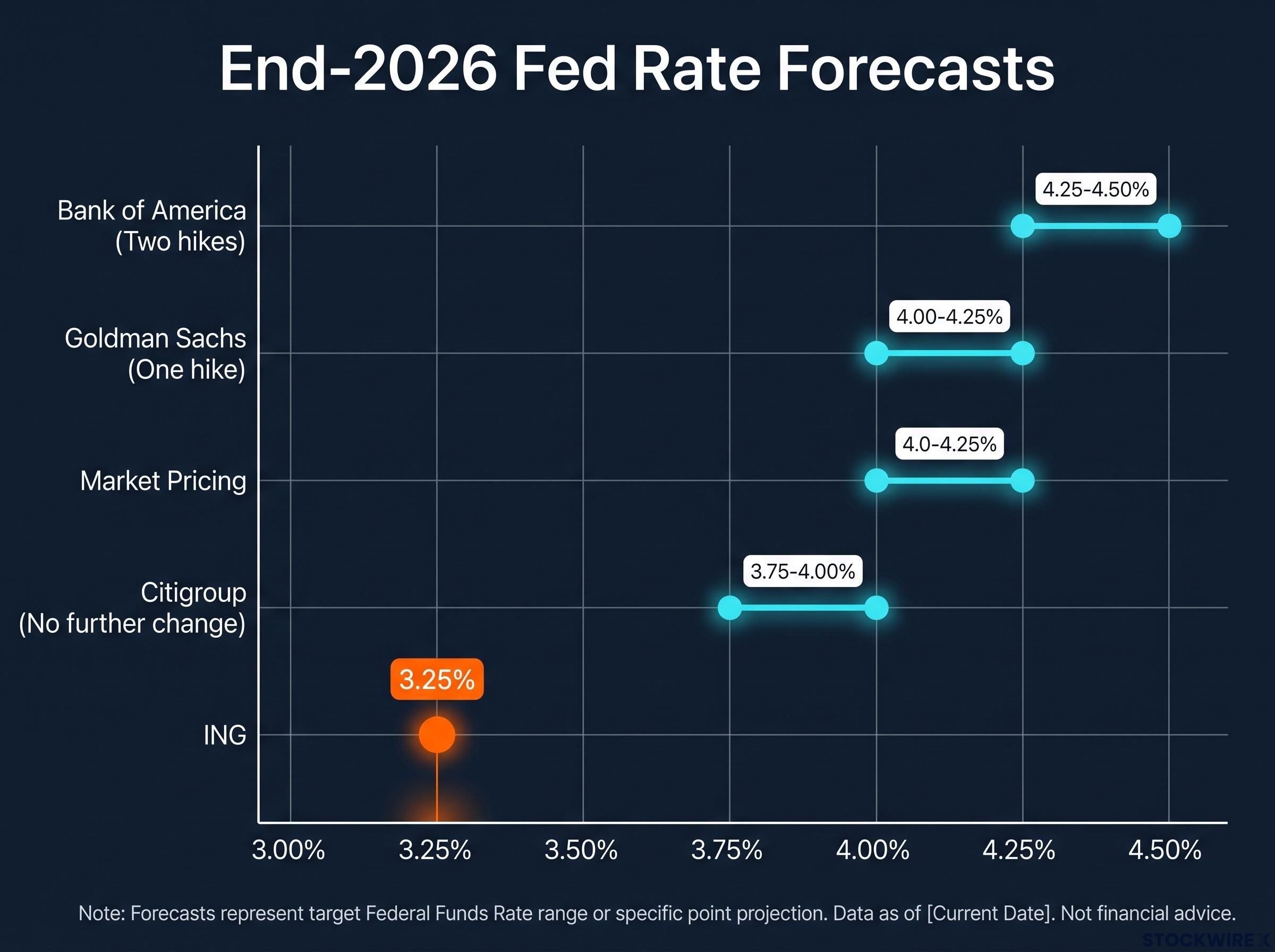
Here is the number that matters most for you. ING’s terminal rate view of 3.25% sits far below where markets are pricing the Fed, which is broadly centred in the 4.0-4.25% range with roughly a 90% probability of another 25-basis-point hike by end-2026. If ING is right and markets are wrong, the dollar’s near-term support does not just fade; it disappears faster than the market is braced for.
So the practical takeaway is this: do not read current dollar strength as confirmation of a new lasting uptrend. ING’s tactical and strategic signals point in opposite directions. Knowing which timeframe your own positioning is built around is what tells you which signal to weight.
When big ASX news breaks, our subscribers know first
Why the Fed’s next move matters more than the calendar says it should
The Fed’s next hike is not really a scheduling question. It is a feedback loop between what traders expect and what the central bank feels it can afford to do, and that loop is where the dollar’s near-term support is won or lost.
ING’s specific call is one more hike before year-end, with December favoured over October. The reasoning is partly about timing: the October meeting sits uncomfortably close to the midterm election cycle, making December the cleaner vehicle for a move. Markets currently price only around 13 basis points for October, with December seen as more probable.
The more interesting part of ING’s argument is about pressure. Once traders collectively price a hike above the two-thirds probability threshold before the decision, the Fed faces strong pressure to follow through rather than risk rattling the long end of the yield curve with an unexpected hold. In that scenario, the market’s own expectation becomes close to self-fulfilling.
The CPI trigger to watch Pesole notes that only a marginal upside surprise in US CPI would be needed to fully price further hikes.
That is a low bar. It means a single hotter-than-expected inflation print could tip market pricing over the two-thirds line, at which point the Fed inherits a communication problem if it holds. For dollar positioning, that reframes what you should be watching: not the meeting date itself, but the trajectory of market-implied hike probability in the weeks beforehand. That number tells you whether the Fed still has optionality or has already been cornered.
The asymmetry in how a CPI surprise moves the dollar depends heavily on where hike probabilities already sit: when the Fed funds rate is above the neutral rate, a hot print carries less dollar upside than a soft print carries downside, because the market’s repricing room is unequal on the two sides of the distribution.
The disagreement among major brokerages shows just how uncertain the path is.
| Institution | Rate forecast (end-2026) | Implied hikes from current level |
|---|---|---|
| Bank of America | 4.25-4.50% | Two hikes |
| Goldman Sachs | 4.00-4.25% | One hike |
| Citigroup | 3.75-4.00% | No further change |
That spread is the point. When Bank of America sees two more hikes and Citigroup sees none, the Fed’s path is genuinely contested, and ING’s dovish terminal rate view of 3.25% sits below every one of these forecasts. The dollar’s near-term support depends on the more hawkish camps being right, at least for now.
What oil prices actually do to the dollar, and why the relationship keeps flipping
Recently the pattern has looked simple: oil up, dollar up. But that surface observation hides a more complicated truth. The relationship between crude and the greenback is not a fixed rule; it is regime-dependent, and which way it points depends entirely on which channel is doing the work at any given moment.
This is the foundation for understanding why ING treats a fourth-quarter oil decline as a genuine bearish catalyst for the dollar, not just another data point. To get there, you need to know the four mechanisms that govern how oil moves the currency.
- Terms-of-trade channel: With the US now a net energy exporter rather than importer, higher oil prices improve the US trade balance, which supports the dollar. Deutsche Bank argues this shift has flipped the correlation from historically negative to positive.
- Inflation and interest-rate channel: Higher oil feeds headline inflation, lifting inflation expectations and nominal yields. If the Fed looks more hawkish than other central banks in response, the dollar strengthens. Market estimates suggest a $5/bbl rise in oil can add roughly 10 basis points to US 10-year breakevens (the market’s implied inflation rate).
- Safe-haven channel: When high oil prices threaten global growth, the resulting risk-off mood can paradoxically push flows into the dollar as a haven, even as oil itself rises.
- Purchasing-power channel: Because oil is priced in dollars globally, a stronger dollar raises local-currency costs for non-US buyers, which tends to dampen demand and reinforce oil price declines.
The direction of the relationship, in other words, depends on which of these four is dominant. That is why ING’s oil call comes with a condition attached, and the condition is everything.
The oil-dollar correlation is not a stable coefficient; it fluctuated sharply through mid-2026, with the 30-day reading compressing to roughly -0.15 even as Brent prices climbed, because structural forces including Bank of Japan rate normalisation and shifting reserve allocation patterns were doing more currency work than the energy channel alone.
For now, the official baseline still points lower over time. The US Energy Information Administration (EIA) forecasts Brent crude drifting toward the upper $60s in 2025 and the high $50s to around $66 in 2026, driven by strong non-OPEC supply and softer demand. Yet spot prices in late September remain far above that, with Brent settling around $104.87/bbl and WTI around $100.30/bbl on 19 September 2026, propped up by near-term geopolitics.
The 2014-2015 case study and what it tells you about today
The last great oil collapse is the clearest illustration of why the supply-versus-demand distinction matters so much. From mid-2014 to April 2016, global oil prices fell 62.5%. If the oil-dollar link were a simple inverse rule, the dollar should have soared, and it did rise, but not for the reason you might assume.
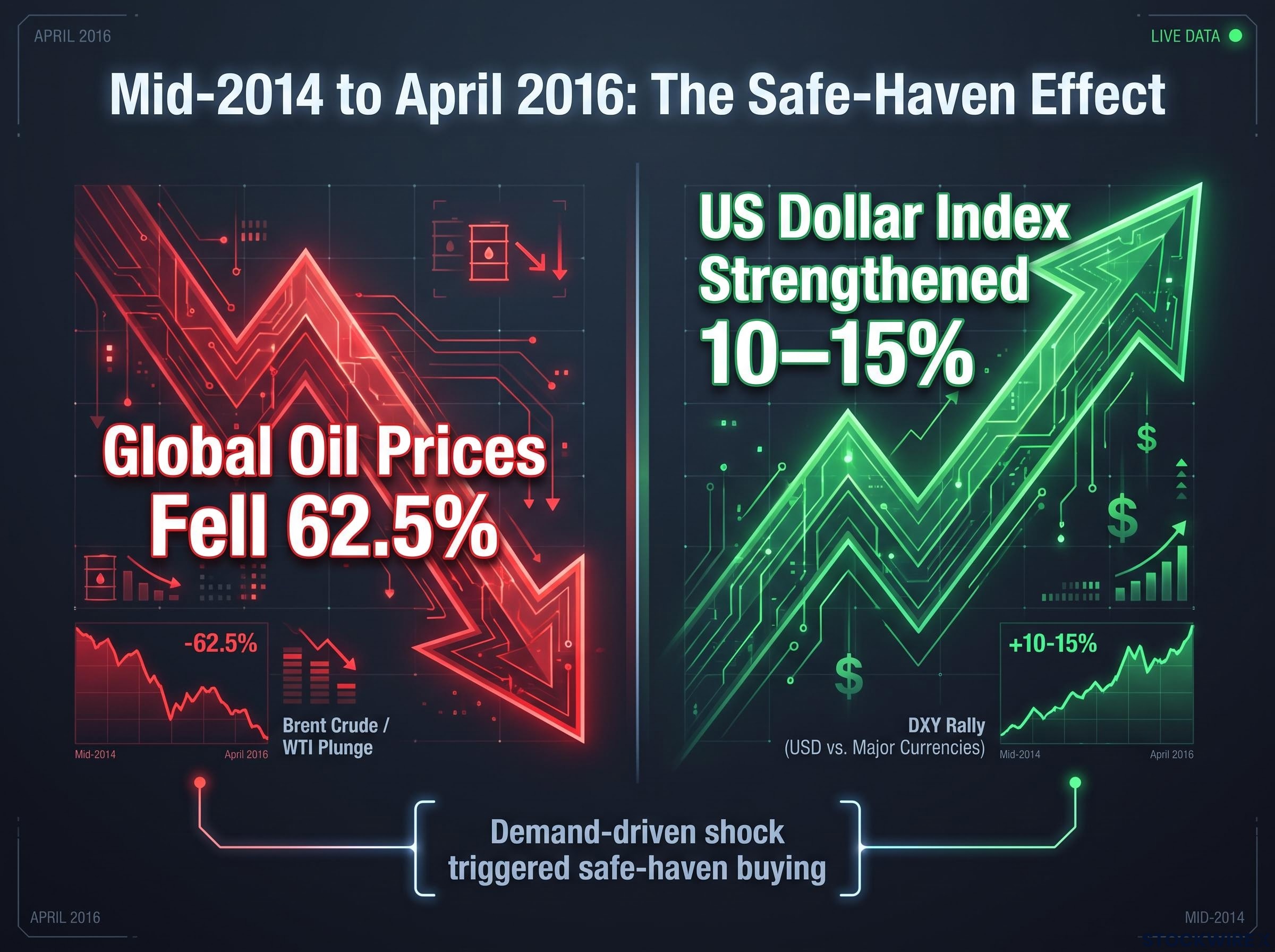
Over that same window, the US Dollar Index strengthened by 10-15%. The reason the dollar climbed even as oil crashed was that the shock was partly demand-driven, and a growth scare triggers safe-haven buying of the dollar. The safe-haven channel overwhelmed everything else.
Here is why that history is directly relevant to ING’s framework. The bank’s bearish dollar call only holds if a fourth-quarter oil decline is supply-driven and benign, the kind that eases US inflation and takes pressure off the Fed. A benign, supply-led drop weakens the dollar through the inflation and rate channel.
But if oil instead falls because global growth is cracking, the safe-haven channel takes over and the dollar strengthens, exactly as it did in 2014-2015. So when ING says a Q4 oil decline supports its bearish view, it is betting on a specific scenario: falling supply-driven prices, not a demand collapse. That distinction is the analytical tool worth keeping. It tells you whether to read any given oil move as dollar-bullish or dollar-bearish.
Secondary signals: what diplomatic meetings and BoJ moves add to the picture
Not every headline that moves the dollar for an afternoon deserves a place in your framework. The value here is knowing which secondary catalysts genuinely matter and which are background noise, so a flurry of diplomatic activity does not pull your attention away from the two drivers that actually count.
ING flagged three secondary catalysts, each carrying a different weight:
- Trump meetings with Gulf state representatives: Held alongside the UN General Assembly in New York, these matter mainly for their potential impact on global oil supply and pricing. Signal, because they feed directly into the oil channel.
- Trump-Xi meeting in Washington: The summit is unlikely to shift markets significantly on its own, though any constructive trade announcements could provide a degree of support to the dollar. Mostly background, with limited upside.
- Bank of Japan rate check: Contributed to modest dollar weakness on one Friday, but ING assessed it did not fundamentally change the picture. Noise for positioning purposes.
The way to use this list is to run every diplomatic headline through a single question: does this development shift the near-term oil supply outlook, or change the Fed’s probability calculus? If the answer is no, it is noise as far as your dollar positioning is concerned.
ING on the BoJ move The rate check contributed to modest USD weakness on a Friday, but ING assessed it did not fundamentally undermine the dollar’s broader supported position.
The hierarchy is what matters. Oil and Fed expectations are the load-bearing pillars of the whole framework. Diplomatic developments can stir short-term volatility, but they only carry real weight when they feed back into one of those two channels. Everything else is a filter you can apply rather than a list you have to memorise.
What ING’s framework means for dollar positioning over the next quarter
Pull the threads together and ING’s view resolves into a single practical read. Near-term dollar strength is likely to persist as long as oil prices stay elevated and Fed hike probability holds above two-thirds. The DXY 100.0 level is the upside reference point before any trend reversal. But the clock is running on both conditions, and the bank expects them to give way through 2026.
That leaves two variables worth watching more closely than anything else this quarter:
- Oil price trajectory: A supply-driven, benign decline toward the EIA’s directional forecast of around $66 Brent in 2026 would confirm ING’s bearish dollar scenario. A demand-collapse-driven fall would undermine it by triggering safe-haven buying.
- CPI surprises: A marginal upside surprise in US inflation could fully price further hikes and make either the October or December meeting the live vehicle, extending the dollar’s near-term support.
Be honest about the risk to this view. ING’s dovish terminal rate call of 3.25% is an outlier against Bank of America’s two-hike forecast and market pricing near 4.0-4.25%. If the hawkish camp proves right, the bearish dollar thesis for 2026 would need revisiting entirely. That divergence is the single number to keep testing.
For investors wanting broader institutional context on why the DXY reached a 13-month peak of 101.8 before the current consolidation phase, our full explainer on the 2026 DXY rebound examines Morningstar’s 15% overvaluation estimate and the rate-differential pillar that has been doing the heaviest lifting in the dollar’s recent gains.
The key data releases to watch before year-end
Within ING’s framework, two data sources carry the highest signal in the next six to eight weeks. US CPI prints tell you whether inflation is tipping the Fed toward a hike, and the weekly EIA petroleum status reports tell you whether the supply-driven oil decline is actually materialising. Watch those, not every macro headline.
The wild card is the Trump-Gulf state diplomatic track. A significant supply announcement from that channel would shift the oil trajectory directly and could compress the timeline on ING’s bearish dollar scenario, pulling the currency’s turn forward.
This article is for informational purposes only and should not be considered financial advice. Investors should conduct their own research and consult with financial professionals before making investment decisions.
Past performance does not guarantee future results, and these forecasts are speculative and subject to change based on market developments, inflation data, and oil supply dynamics.