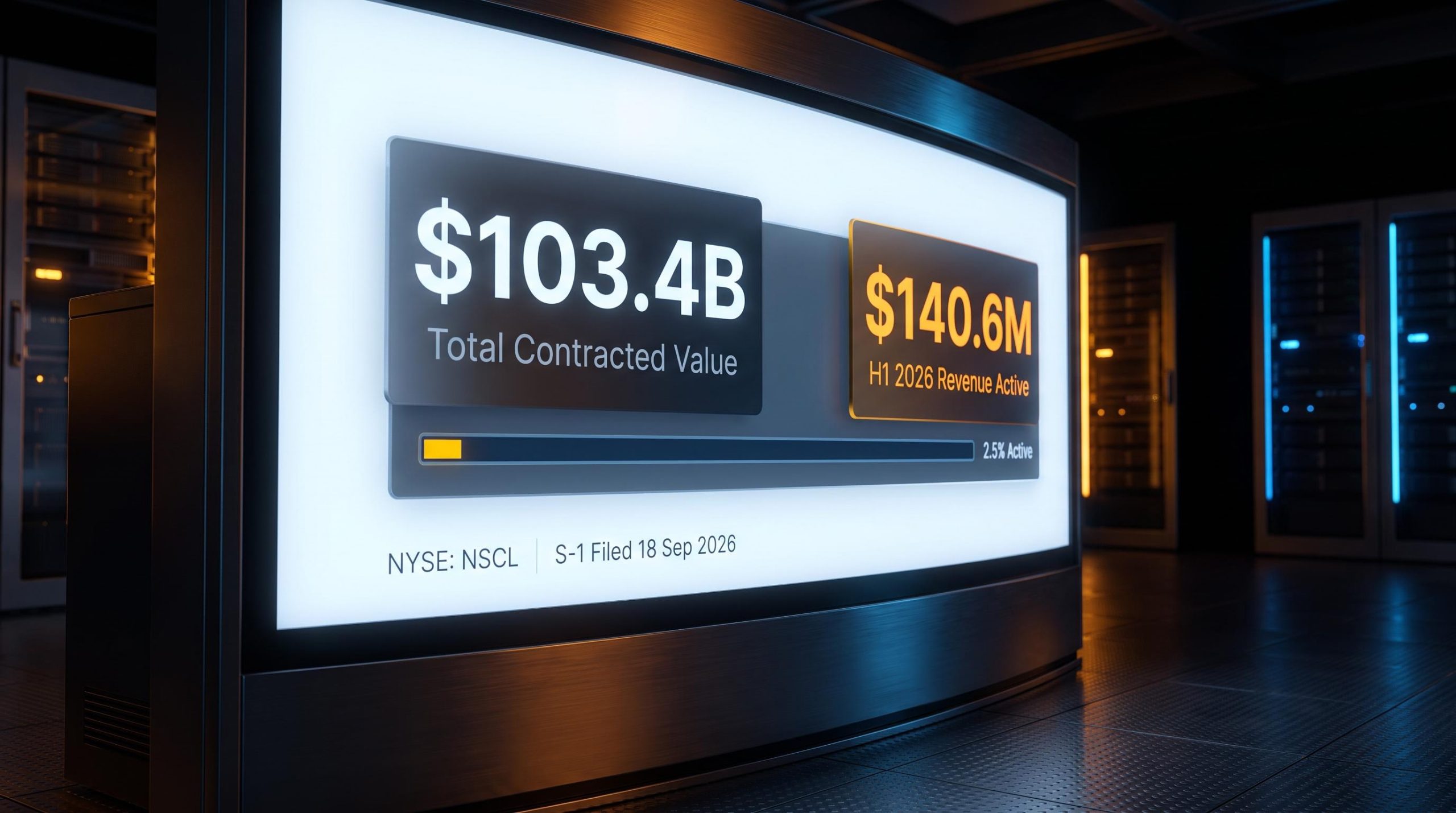
Nscale has signed $103.4 billion in take-or-pay contracts. It generated $140.6 million in revenue in the first half of 2026. That gap is not a rounding error; it is the entire investment thesis, and either the most compelling or the most dangerous thing about this offering.
The UK-based AI data centre developer filed its Form S-1 with the SEC on 18 September 2026, targeting a New York Stock Exchange listing under the ticker NSCL. Secondary reporting from outlets including the Financial Times places the implied valuation at $30-35 billion. The company is backed by Nvidia, has signed contracts with Microsoft and Anthropic covering the bulk of that $103.4 billion, and is planning one of the largest AI infrastructure campuses ever attempted, in West Virginia. None of that infrastructure is financed yet.
What follows below is a structured breakdown of whether the numbers in this S-1 justify the valuation being asked, and what a prospective investor needs to settle before the offering prices. Each section addresses a specific dimension of the risk-reward equation so you can form your own view.
The $103 billion headline and what it actually means
Start with the number that anchors the entire filing: $103.4 billion in signed take-or-pay contracts. Take-or-pay simply means the customer commits to paying for capacity whether or not they use it, which is what makes a backlog of this size look like locked-in future revenue. On paper, it dwarfs the current market caps of most listed data centre operators.
Then look at what is actually switched on.
As of 31 August 2026, only about $2.6 billion of that portfolio was active, roughly 2.5% of total contracted value. The remaining 97.5% is conditional on Nscale meeting specified delivery and availability requirements. In plain terms, contracted value and recognised revenue are two categorically different things, and the S-1 leads with the larger of the two.
The number that reframes the headline Only 2.5% of Nscale’s $103.4 billion contract book was active as of 31 August 2026. The rest is a promise contingent on infrastructure that does not yet exist.
The current operating reality is smaller and harder. Revenue of $140.6 million in the first half of 2026 was up from $10.4 million a year earlier, growth of more than 1,250%, but the net loss widened from $368.9 million in H1 2025 to roughly $1.02 billion in H1 2026.
| Metric | Value | Investor significance |
|---|---|---|
| Total contracted value | $103.4B | S-1 headline figure |
| Active contracts (31 Aug 2026) | $2.6B (~2.5%) | Revenue-generating today |
| H1 2026 revenue | $140.6M | Actual recognised revenue |
| H1 2026 net loss | $1.02B | Operating reality |
Microsoft accounts for up to $43.8 billion through December 2033, and Anthropic up to $44.6 billion through 2033, together roughly 85% of the total. The distinction between total and active contracted value is the single most important move you can make when reading this offering. The 97.5% that has not yet activated is both the entire growth story and the entire execution risk.
The distinction between contract binding versus conditional commitment is one of the most consistently mispriced variables in technology infrastructure investing; the same announcement that drives a 300% market cap re-rating in a small-cap operator can represent no contracted revenue certainty at all if the underlying agreement is explicitly terminable.
When big ASX news breaks, our subscribers know first
What Nvidia’s involvement really looks like from the inside
Nvidia’s name on the cap table reads as validation. Look closer, and it is something more structural than an endorsement.
Start with the obvious role: Nvidia is Nscale’s primary GPU supplier. The company’s data centres are built entirely around Nvidia hardware, which is standard for this class of operator.
The second role is equity. Nvidia already holds more than 5% of Nscale’s ordinary shares on a non-voting basis, reflecting warrants and earlier funding rounds.
The third role is creditor. Under a minimum $3.1 billion Subscription Agreement dated 15 September 2026, Nvidia is allocated $1.0 billion, structured as either convertible notes or non-voting shares depending on timing, with the remaining $2.1 billion going to other investors. That portion is expected to settle on or around 16 November 2026.
The fourth role is guarantor. Nvidia is backstopping approximately $860 million in lease obligations at a Texas data centre facility.
Put those together and Nvidia’s four hats look like this:
- GPU supplier: the hardware every contract depends on
- Equity holder: more than 5% of ordinary shares, non-voting
- Convertible note creditor: $1.0 billion of the $3.1 billion package
- Lease guarantor: approximately $860 million at the Texas facility
There is one more figure that sits beneath the headline. Nscale has authorised Nvidia to receive up to $10 billion in further notes or shares over time. That deepens the entanglement well beyond the $1 billion most coverage cites.
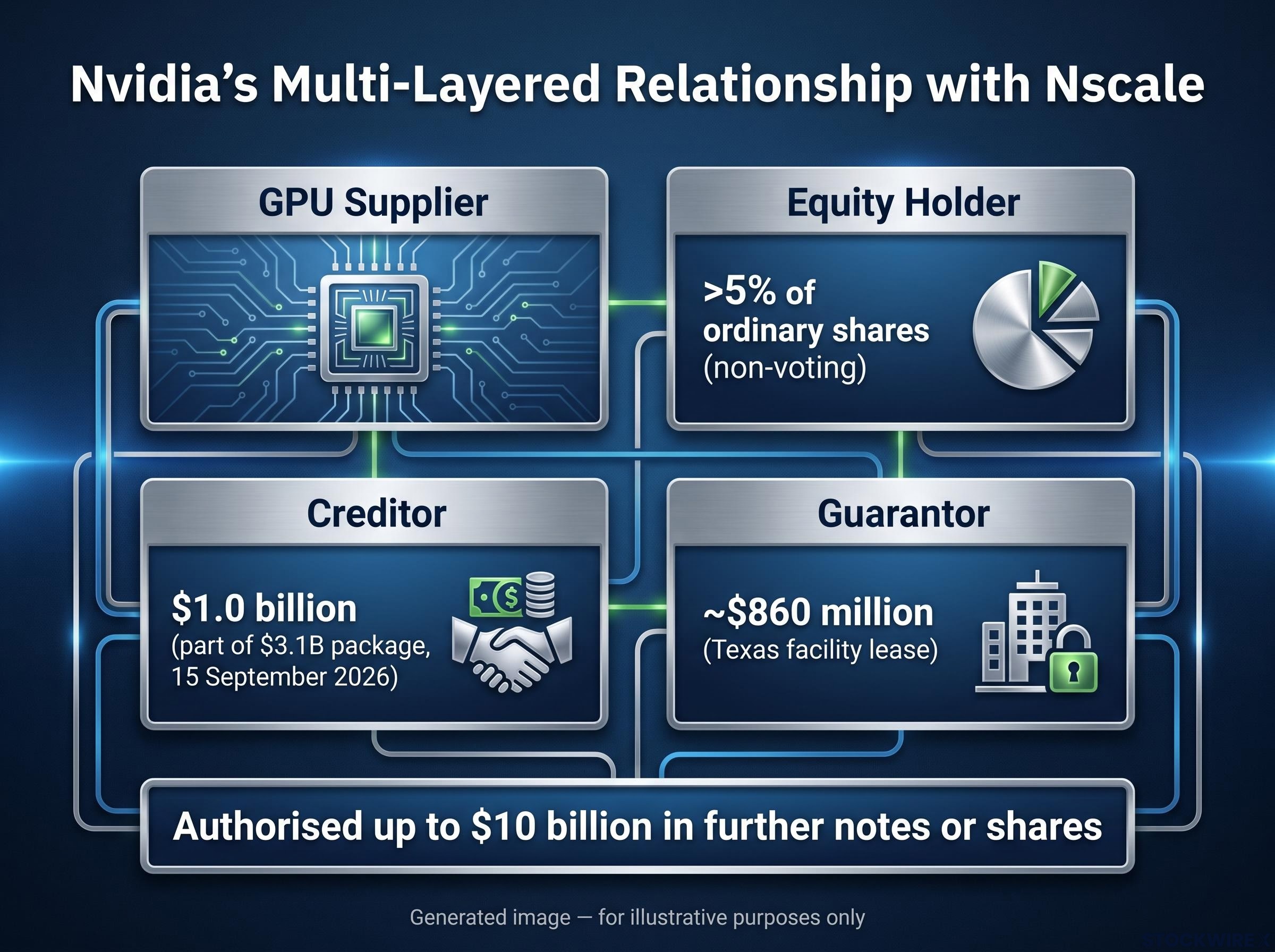
Nvidia’s financial interest in Nscale’s success now spans equity, debt, guarantees, and chip revenue. For a public investor, that means the relationship should be priced as a structural feature of the company, not a marquee endorsement. It supplies genuine supply-chain certainty and credibility, but it also creates related-party dynamics around pricing, governance, and strategic flexibility that ordinary shareholders will not control.
NeoCloud backstop programmes, through which Nvidia underwrites GPU demand from independent data centre operators, carry an estimated $175 billion in contingent liability by 2028, a structural feature that gives Nvidia strong incentive to ensure operators like Nscale succeed while simultaneously creating concentrated exposure across its portfolio of backed operators.
How this compares to Nvidia’s CoreWeave playbook
This is not a first attempt. Nvidia used a near-identical structure at CoreWeave ahead of its March 2025 IPO: an equity stake, a GPU supply anchor, and financial backing rolled into the offering.
The same template has since appeared across Nvidia-aligned neocloud operators including Nebius, Lambda, and Crusoe, where similar lease-backstop and supply arrangements have become common.
The existence of a template makes Nscale’s structure legible; you know what you are looking at. It does not make the related-party risks disappear. A familiar structure is still a concentrated one.
Why the Anthropic deal is the offering’s biggest single variable
The scale of what Nscale is promising to build is difficult to overstate. The Monarch Compute Campus in Mason County, West Virginia, spans 2,250 acres with planned capacity exceeding 8 gigawatts, of which Forbes reports roughly 6.7 GW is earmarked for computing.
Anthropic’s slice is approximately 460 megawatts of dedicated capacity, under the agreement worth up to roughly $44.6 billion signed on 25 August 2026. That single deal is the most valuable item in the entire contract book.
Here is the milestone sequence Nscale is working toward:
- Anthropic Services Agreement signed 25 August 2026
- First 2 GW targeted to come online in H1 2028
- Full 8 GW build-out planned for 2031
Now the fact that sits underneath all of it.
The most consequential line in the filing As of the S-1, no binding financing is committed for the Monarch build-out. Nscale must still arrange the debt or equity to fund it.
Who bears the risk when a multi-gigawatt campus has no financing
“No binding financing committed” means what it says: before revenue can flow from Monarch, Nscale must secure funding for equipment procurement and construction that could run into tens of billions of dollars, much of it chip purchases. QuantLogix rates “Anthropic financing not committed” as a High-severity risk in its IPO assessment.
The risk structure is asymmetric. Anthropic can terminate affected deployments without liability if Nscale misses delivery deadlines or fails to maintain performance standards, while Nscale carries the full construction and financing burden.
Power procurement for AI campuses of Monarch’s scale is itself a financing and logistics challenge that rivals chip acquisition: AI accelerator racks draw 3-5 times more power per rack than traditional cloud workloads, and securing firm, long-duration power supply for an 8 GW build-out requires utility agreements and grid infrastructure commitments that run parallel to, and independent of, the compute financing Nscale still needs to arrange.
That asymmetry compounds with every dollar of pre-financing capital deployed. Anthropic’s optionality is protected; Nscale’s exposure grows. The Anthropic deal is both the ceiling on Nscale’s upside and the floor on its downside: finance and build it on schedule and the revenue trajectory changes materially, fall short and the asset base supporting $44.6 billion of commitments simply does not yet exist.
Understanding the neocloud model Nscale is betting on
To judge these numbers fairly, you need the model behind them. Nscale is a neocloud, or GPU cloud operator, and the label explains almost everything about its financial shape.
A neocloud does three things:
- Procures large volumes of GPU capacity at scale, primarily Nvidia hardware
- Deploys that capacity in purpose-built data centres
- Leases the compute to AI companies on long-term take-or-pay contracts
The order matters. Infrastructure has to be built and financed before revenue can be recognised, which structurally produces exactly the profile Nscale shows: a mountain of contracts, a trickle of active revenue. The gap between signed and active is a feature of the model, not a defect, but only if execution follows the contracts.
That framing changes the right question. It is not why revenue is low relative to the backlog. It is whether Nscale can finance and build fast enough to activate contracts before counterparty termination windows open.
The most direct comparable is CoreWeave, which runs a similarly Nvidia-anchored structure with a large contracted backlog, but sits on materially higher current revenue.
| Metric | Nscale | CoreWeave |
|---|---|---|
| Recent revenue | $140.6M (H1 2026) | Materially higher (figure unverified) |
| Contracted backlog | $103.4B total, $2.6B active | Large contracted backlog |
| Primary GPU supplier | Nvidia | Nvidia |
| Nvidia equity stake | Yes (>5%, non-voting) | Yes |
| Customer concentration | Two counterparties, ~85% of TCV | More distributed |
CoreWeave’s precise recent revenue figure could not be independently verified for this analysis and has been left qualitative accordingly.
Nscale’s profile is not unusual for an early-stage neocloud. What raises the variance is the combination of extreme customer concentration, two counterparties at 85% of contracted value, and a single unfunded megaproject. Understanding the model lets you evaluate the numbers on the right terms rather than dismissing them as simply thin.
The customer concentration risk that most headlines miss
The easy version of the concentration story is that Nscale has two big customers. The version that matters is what happens operationally and financially if either one shifts its timeline or requirements.
The precision is worth sitting with. Microsoft’s up to $43.8 billion represents roughly 42% of the $103.4 billion book, Anthropic’s up to $44.6 billion roughly 43%, together about 85%. The single largest customer contributed 52% of H1 2026 revenue and 73% of full-year 2025 revenue.
The concentration figure in one line Two customers account for approximately 85% of Nscale’s $103.4 billion in contracted value.
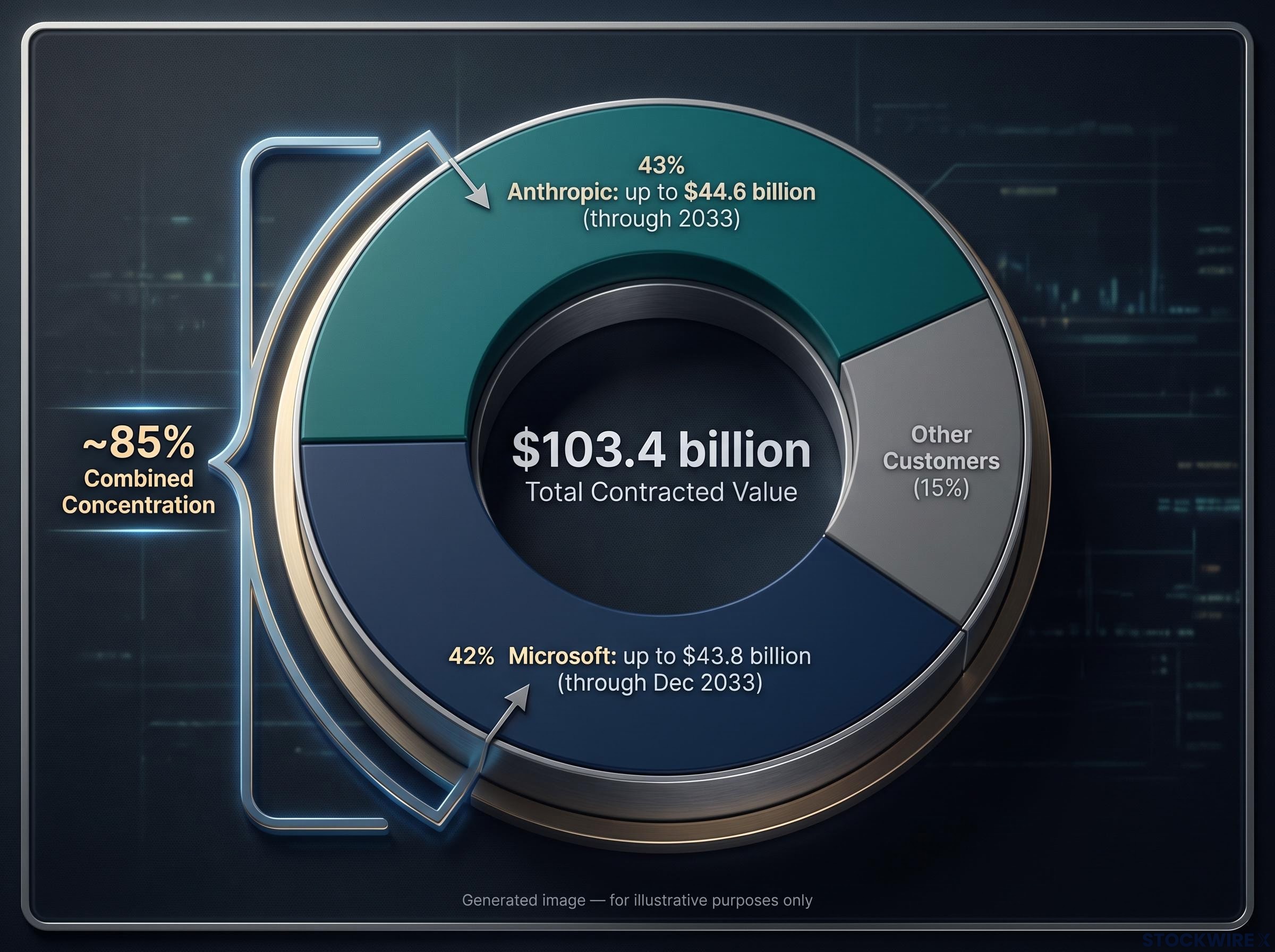
Both major agreements are conditional on delivery and availability, and Anthropic’s terms specifically permit termination without liability for missed deadlines or performance standards. The three termination-related risks worth watching are:
- Failure to hit a delivery deadline
- Failure to maintain performance standards for consistent compute
- Renegotiation as the AI capital spending environment shifts
Both QuantLogix and TrendingTopics.eu categorise customer concentration here as High. The asymmetry is the point: Microsoft and Anthropic hold the termination rights, Nscale holds the construction and financing obligation.
Read that way, the valuation question sharpens. A $30-35 billion implied market cap is not resting on a diversified revenue base. It rests on the assumption that two specific counterparties keep prioritising and expanding their compute procurement, on Nscale’s timeline, without renegotiation, for the next seven years.
What the numbers require you to believe before this valuation makes sense
Pull the five threads together and the offering resolves into a set of conditions rather than a single verdict. For the $30-35 billion valuation to make sense, three things have to hold at once.
Nscale has to finance and build multi-gigawatt infrastructure on schedule. Microsoft and Anthropic have to refrain from renegotiating or terminating. And the company has to travel from $140.6 million in half-year revenue to a trajectory consistent with a $103.4 billion backlog, while currently absorbing a $1.02 billion half-year net loss.
The Nvidia relationship helps with some of that and resolves none of the hardest part. Nvidia’s stake, convertible notes, and lease guarantee deliver chip supply certainty and credibility. They do not replace the committed financing Nscale still needs for Monarch, where none is in place as of the S-1.
CoreWeave is the most useful market reference here. If it trades at a discount to Nscale’s implied valuation despite materially higher current revenue, that is a meaningful data point for how public markets price execution risk in this cohort.
This article is for informational purposes only and should not be considered financial advice. Investors should conduct their own research and consult with financial professionals before making investment decisions. Past performance does not guarantee future results, and forward-looking projections are subject to market conditions and various risk factors. Statements about future financing, construction, and revenue are speculative and subject to change based on company performance and market developments.
Three variables to watch before the offering prices
- Monarch financing commitment. No binding financing is committed as of the S-1. A concrete debt or equity announcement would shift the risk profile substantially; its absence by pricing day keeps the construction and funding risk on the public investor’s balance sheet, given that meaningful Monarch revenue is not expected until late 2027 at the earliest.
- Activation rate of the $2.6 billion base. Only about 2.5% of contracted value is currently active. Watching how quickly that active base grows tells you whether the contract-to-revenue gap is closing on schedule; stalled activation is the clearest early warning that execution is lagging the backlog.
- H2 2026 revenue trajectory. The next revenue figures, once disclosed, are the first read on whether the 1,250% year-on-year growth in H1 was the start of a curve or a low base flattered by comparison. Acceleration supports the thesis; a plateau against a $1.02 billion loss run rate does not.
Priced on current earnings, this is not a conventional infrastructure investment. It is a bet on a specific execution scenario, and the gap between the two is where the risk sits. The Nvidia settlement targeted for 16 November 2026 and any Monarch financing news between now and pricing are the events that will tell you which one you are actually buying.
For investors evaluating entry timing on NSCL, our comprehensive walkthrough of US IPO lock-up mechanics covers the float expansion event at 90-180 days post-listing and how calendar-driven supply shocks have historically affected high-profile technology offerings.