
Most people buy a fixed or indexed annuity for one reason: they want to stop worrying about their money. The pitch is simple. Hand over a lump sum, and a large insurance company promises to pay you a guaranteed income, no market swings, no sleepless nights.
That assumption is now being tested. A wave of Wall Street asset managers has quietly moved into the insurance business, using annuity premiums to fund complex, illiquid investments. The word for what they carry is counterparty risk: the chance that the institution on the other side of your contract cannot pay when the bill comes due.
The math changed when interest rates did. With the 10-year U.S. Treasury yield near 5% as of September 2026, the aggressive structures built during the near-zero-rate years of the 2010s no longer add up cleanly. Some carriers are now under real stress, and analysts including Chris Whan of Whan Global Advisors have warned that a handful may not be able to meet their obligations.
What follows gives you a clear framework for understanding how these managers are using your insurance premiums, why private credit insurance risk has become a live concern in 2026, and how to judge whether your own annuity carries hidden exposure.
How private credit operators rewrote the rules of life insurance
To see what changed, you first need to see how insurance is supposed to work.
A traditional insurer runs a matching game. It takes in premiums, then buys safe, liquid assets, mostly investment-grade bonds, whose payment dates line up with the long-dated promises it has made to policyholders. This discipline is called asset-liability management: pairing what you own with what you owe so that cash is available exactly when it is needed. Done well, it produces steady equity returns in the range of 12% to 15% a year.
Insurance float mechanics, in which an insurer earns investment returns on policyholder premiums before any claims or surrenders are paid, are the same engine that private credit managers have repurposed by substituting illiquid higher-yielding assets for the liquid bonds that underpin a disciplined asset-liability match.
Private credit managers play a different game with the same balance sheet.
Instead of parking premiums in tradable bonds, they treat annuity money as quasi-permanent capital and deploy it into higher-yielding, thinly traded assets: real estate loans, infrastructure debt, and asset-based finance. According to a Harvard Business School analysis of private-equity-backed insurers, the spread between what these assets earn and what the insurer owes policyholders flows straight to the manager’s bottom line.
The catch is liquidity. These loans are complex and multi-year, and they cannot be sold quickly without accepting a steep discount.
There is a second lever, too: offshore reinsurance. U.S. carriers commonly cede blocks of annuity business to affiliated reinsurers based in Bermuda, shifting the assets and reserves outside the reach of state regulators who would otherwise scrutinise them.
The numbers show how far this has travelled. By year-end 2024, private-equity-owned insurers held roughly $59 billion in collateralised loan obligations, bundled corporate loans repackaged as securities, accounting for about 21% of the entire U.S. insurance industry’s exposure to them, according to the NAIC Capital Markets Bureau.
Defenders point out that over 90% of these insurers’ bonds carry an NAIC-1 or NAIC-2 rating, the two highest quality bands used by state regulators. Critics counter that these ratings measure credit quality, not how fast an asset can be sold, and that headline ratings can mask serious illiquidity.
Here is what this means for you. Your retirement income is no longer sitting behind a wall of bonds that can be sold in an afternoon. It is backed by corporate loans that may take months to offload, and only at a loss if the insurer suddenly needs cash.
| Feature | Traditional insurer | Private credit-backed insurer |
|---|---|---|
| Primary asset types | Investment-grade bonds, listed equities | Private credit, real estate loans, asset-based finance, CLOs |
| Liquidity profile | High. Assets are tradable quickly | Low. Assets are thinly traded and slow to sell |
| Regulatory oversight | Direct state supervision | Often reduced via offshore Bermuda reinsurance affiliates |
When big ASX news breaks, our subscribers know first
The liquidity trap snapping shut inside your annuity contract
The design flaw sits at the seam between two things that should never be paired: illiquid assets and liabilities you can walk away from.
Your annuity liability is legally certain, but it is also accelerable. Fixed and indexed annuities carry surrender charges that step down over five to ten years, yet you retain the right to cash out. When you do, the insurer owes you real money, quickly.
Now add rising rates. With the 10-year Treasury yield near 5% as of September 2026, an older annuity paying a lower guaranteed rate suddenly looks like a poor deal. And with U.S. CPI inflation running at 3.4% year-over-year as of August 2026, per the Bureau of Labor Statistics, there is no quick return to the cheap-money conditions that let these structures run without visible strain.
So policyholders start to leave, chasing better yields elsewhere. That is where the trap closes.
When you and thousands of others decide to surrender at the same moment, you unintentionally set off a run on a company that does not hold enough liquid cash to pay everyone. Under NAIC liquidity rules, an insurer that runs short must sell its longer-term holdings. But its private loans can only be dumped at a discount, turning paper positions into realised losses.
The private credit liquidity mismatch that regulators at the Federal Reserve, IMF, and BIS have formally flagged operates through exactly this mechanism: when redemption requests arrive faster than illiquid loans can be sold, the resulting fire-sale pressure cascades into broader market dislocations that affect investors with no direct private credit exposure.
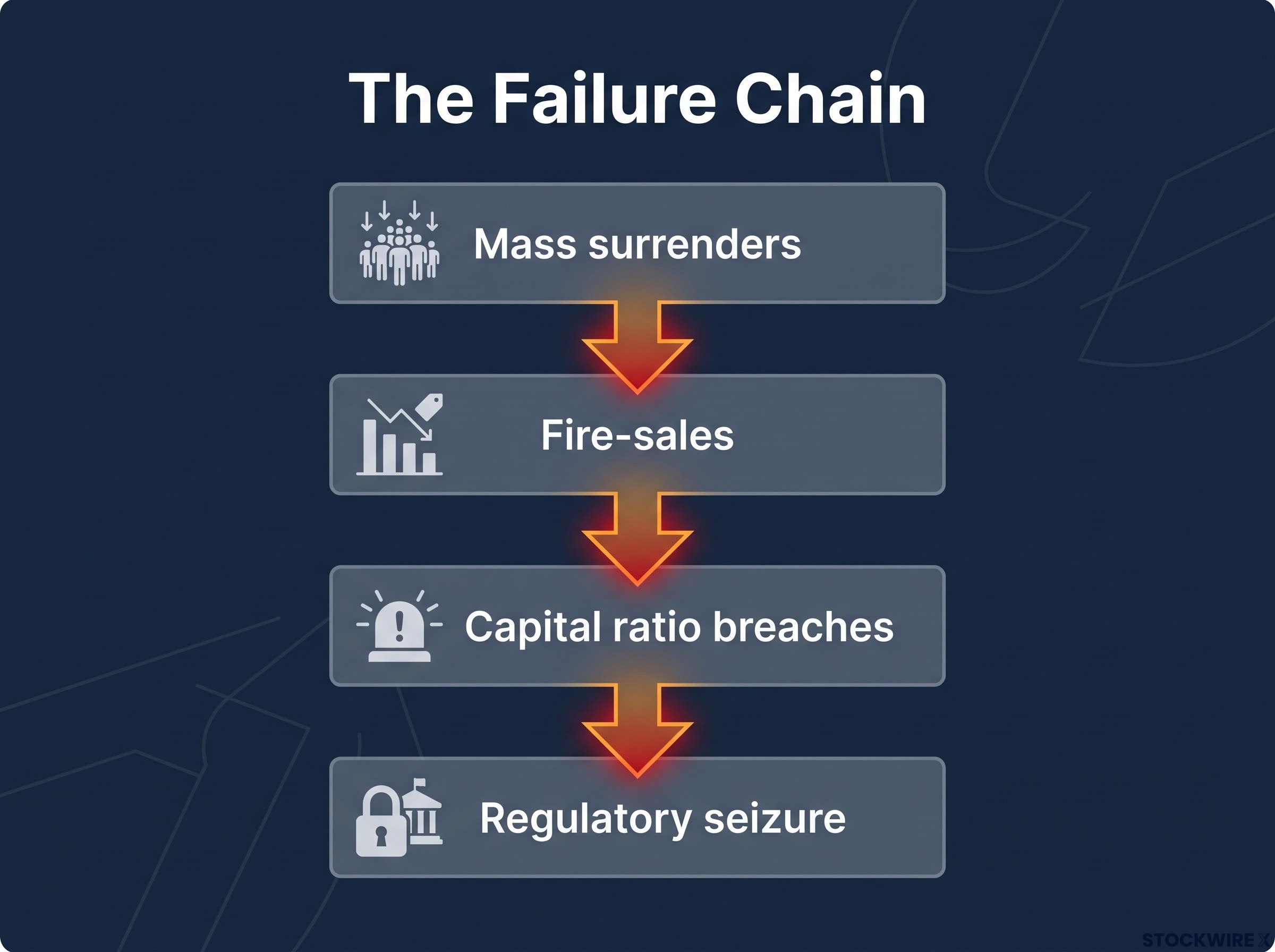
The failure chain runs in sequence:
- Mass surrenders drain the insurer’s available cash faster than expected.
- Fire-sales of illiquid private credit assets crystallise losses that illiquidity had previously hidden.
- Capital ratio breaches trip the risk-based capital thresholds regulators use to measure solvency.
- Regulatory seizure follows, with the carrier placed into rehabilitation or liquidation.
Bond investor Jeffrey Gundlach has put the systemic concern bluntly.
Gundlach has characterised private credit as the fuse and insurance companies as the bomb.
The point for you is timing. This is not a distant hypothetical. The specific trigger, high rates prompting mass surrenders against assets that cannot be sold in time, is present in the market right now, which is why the risk is accelerating rather than sitting quietly in a report.
The cracks emerging across the industry in 2026
The theory stopped being theoretical. Across 2025 and 2026, regulators have moved from warnings to seizures, and policyholders have moved to the courts.
The 777 Re fallout
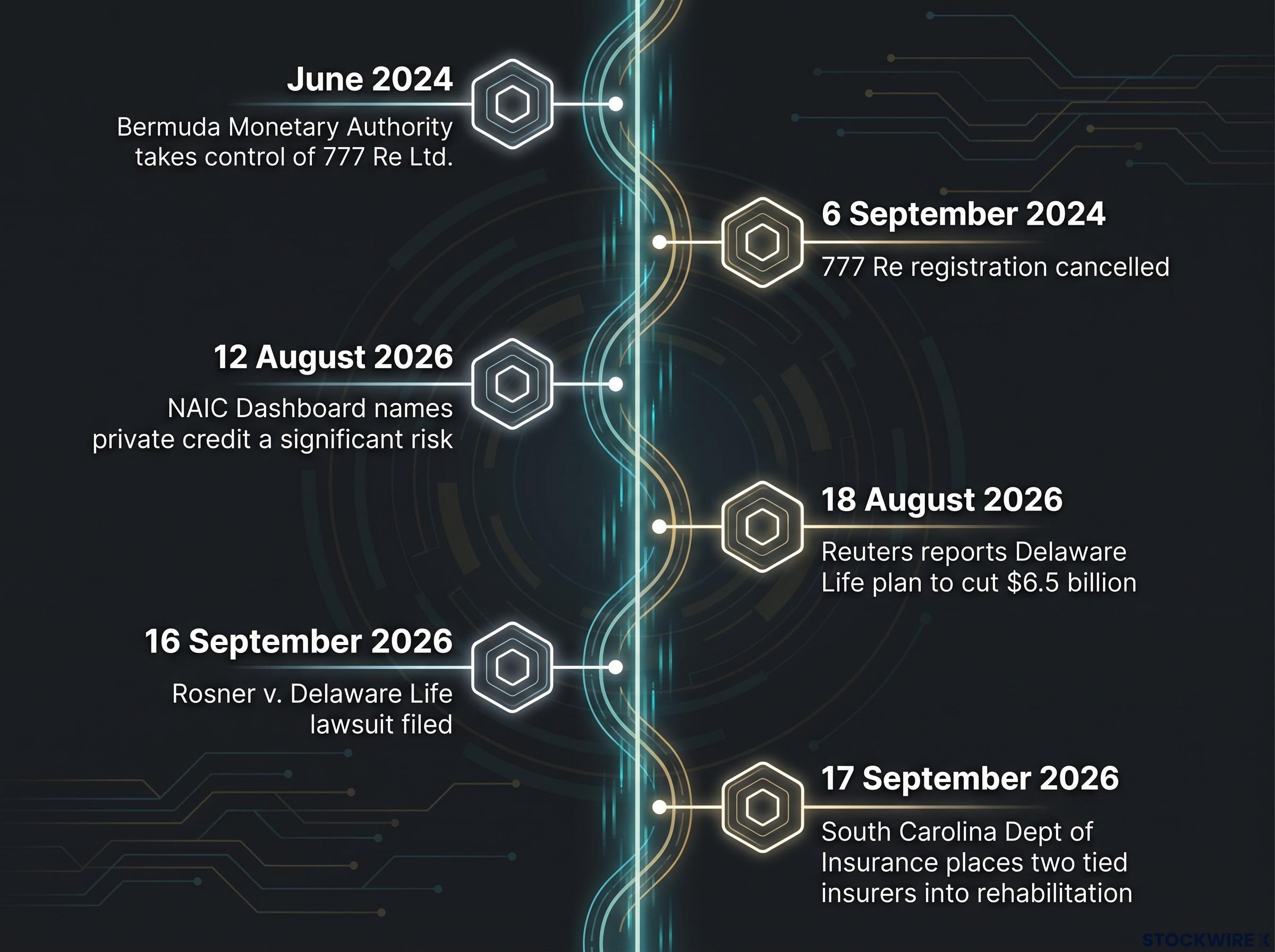
The clearest failure so far runs through 777 Re Ltd., a Bermuda-based reinsurer. The Bermuda Monetary Authority took administrative control of the firm in June 2024, then formally cancelled its insurer registration effective 6 September 2024, after concerns about its investments in connected parties.
The damage did not stay offshore. On 17 September 2026, the South Carolina Department of Insurance moved to place two U.S. insurers previously tied to 777 Re into rehabilitation, citing their financial condition and continuing exposure to 777 Partners.
That tells you the offshore reinsurance structure works both ways. It can move risk out of sight, but when the reinsurer fails, the exposure lands right back on the U.S. carriers, and their policyholders.
Class actions and forced divestitures
Pressure is also mounting on Guggenheim-affiliated insurers and billionaire Mark Walter.
A Reuters report dated 18 August 2026 stated that Delaware Life Insurance Co., controlled by Walter, planned to cut up to $6.5 billion of investments in Walter-related businesses after facing regulatory scrutiny over his financial dealings.
Then came the lawsuit. On 16 September 2026, a proposed federal class action, Rosner v. Delaware Life, was filed in the U.S. District Court for the Southern District of Florida. It names Walter, Delaware Life, Group 1001, TWG Global Holdings, and Guggenheim Partners, alleging fraudulent concealment over how insurer assets were allocated to affiliated entities.
Regulators have flagged exactly this pattern. The NAIC’s Macroprudential Risk Dashboard, presented on 12 August 2026, named private credit as a significant risk for the industry, while the Federal Insurance Office and IMF have repeatedly cited opacity and conflicts of interest as core dangers when the same firm both owns the insurer and originates its assets.
The flurry of state interventions and lawsuits in late 2026 tells you the posture has changed. Regulators are no longer just warning about this risk. They are actively working to contain fallout from carriers that have already stumbled.
The private credit stress now visible in BDC valuations, where public funds holding similar assets trade at discounts of 17-26% to stated net asset values, provides a market-based signal of what the illiquid loan portfolios inside insurance balance sheets may actually be worth if they had to be sold quickly.
Why state guaranty funds offer incomplete protection
Here is the belief that could hurt you most: the assumption that if your insurer fails, someone will simply make you whole.
There is no federal backstop for annuities. Bank deposits have the FDIC. Life insurance and annuities do not have an equivalent. What exists instead is a patchwork of state guaranty associations, funded by the surviving insurers in each state, that step in when a carrier collapses.
They help, but only up to a point. Coverage is set state by state, with hard dollar caps that vary by domicile and policy type. Anything above your state’s cap is not guaranteed.
To see how this plays out, look at Executive Life Insurance Company. It loaded nearly two-thirds of its portfolio into high-yield junk bonds to fund above-market annuity rates. When that market collapsed, policyholders withdrew roughly $4 billion in 1990, forcing the company into insolvency by April 1991.
Smaller annuity holders under the caps were largely protected. Larger policyholders were not: they faced 30% to 50% reductions in their monthly annuity payments and decades of litigation before partial recovery, according to GAO testimony and Chicago Fed analyses.
The critical limits to understand:
- State-by-state caps mean your protection depends entirely on where your policy is domiciled.
- No federal protection exists, so there is no bailout comparable to bank-deposit insurance.
- Reduced monthly payments are a real outcome for above-cap holders, not a worst-case abstraction.
The takeaway is personal. If your annuity value sits above your state’s guaranty cap, that excess is not safe. In a failure, it becomes an unsecured creditor claim, and you join a slow bankruptcy queue with no promise of full recovery.
This article is for informational purposes only and should not be considered financial advice. Investors should conduct their own research and consult with financial professionals before making investment decisions. Past performance does not guarantee future results.
Evaluating your exposure in a high-rate environment
The core reality is straightforward. As long as rates stay elevated, the pressure on private credit-backed insurers will not ease, and the strain now visible in a handful of carriers is expected to build rather than fade.
That makes two checks worth doing now.
First, investigate who actually owns your annuity provider. Look past the brand on the contract for a private equity firm or asset manager as the parent, and for any Bermuda reinsurance affiliate in the structure.
Second, know your exact limits. Confirm your state guaranty association’s coverage cap, and read the surrender terms on your own contract so you understand what leaving would cost and how quickly you could act.
The wider point is about the trade-off itself. Chasing a slightly higher annuity yield today can carry a hidden risk premium, a small extra return paid for by taking on structural danger that may not surface until it is too late to exit cleanly. In a high-rate environment, that premium deserves a hard second look before you commit.
For readers evaluating whether annuity rates still justify the structural risks described here, our full explainer on fixed income alternatives covers a four-tier framework that compares Treasury bills, FDIC-insured deposits, and other instruments against real inflation-adjusted returns, including a plain-English breakdown of what annuity headline payout rates actually include.