
Cash feels like the one place your money is truly safe. It sits in the account, the number never drops, and there is nothing to worry about. That comfort is an illusion.
With the Bank of Canada holding its overnight rate at 2.25% as of September 2026, a Canadian dollar left idle is quietly losing purchasing power to inflation every single month. Parking cash is no longer a passive default. It is an active decision with measurable trade-offs.
This matters especially if you are a US-based investor, a dual citizen, or an expat holding Canadian dollars you need to manage efficiently across borders. What you will get here is a clear framework for matching your cash to your exact timeline, your tolerance for risk, and the tax rules that apply to your specific situation. Three tiers, one decision-making process, and the cross-border traps you need to sidestep.
The hidden cost of cash and the 2026 rate reality
Holding cash is not risk-free. It carries the slow, persistent drag of inflation, which means the same dollar buys less next year than it does today. That is the trade-off you accept the moment you leave money sitting still.
The cost of idle cash compounds quietly over decades: Federal Reserve data shows middle-wealth households hold around 15% of total assets in cash, while households above $1 million hold just 6%, a gap that reflects a deliberate decision to assign cash a bounded role rather than treating it as a store of value.
You still hold cash for good reasons. Maybe you are building toward a property down payment, keeping dry powder ready for a market opportunity, or maintaining an emergency buffer that covers three to twelve months of expenses. The question is not whether to hold cash, but where.
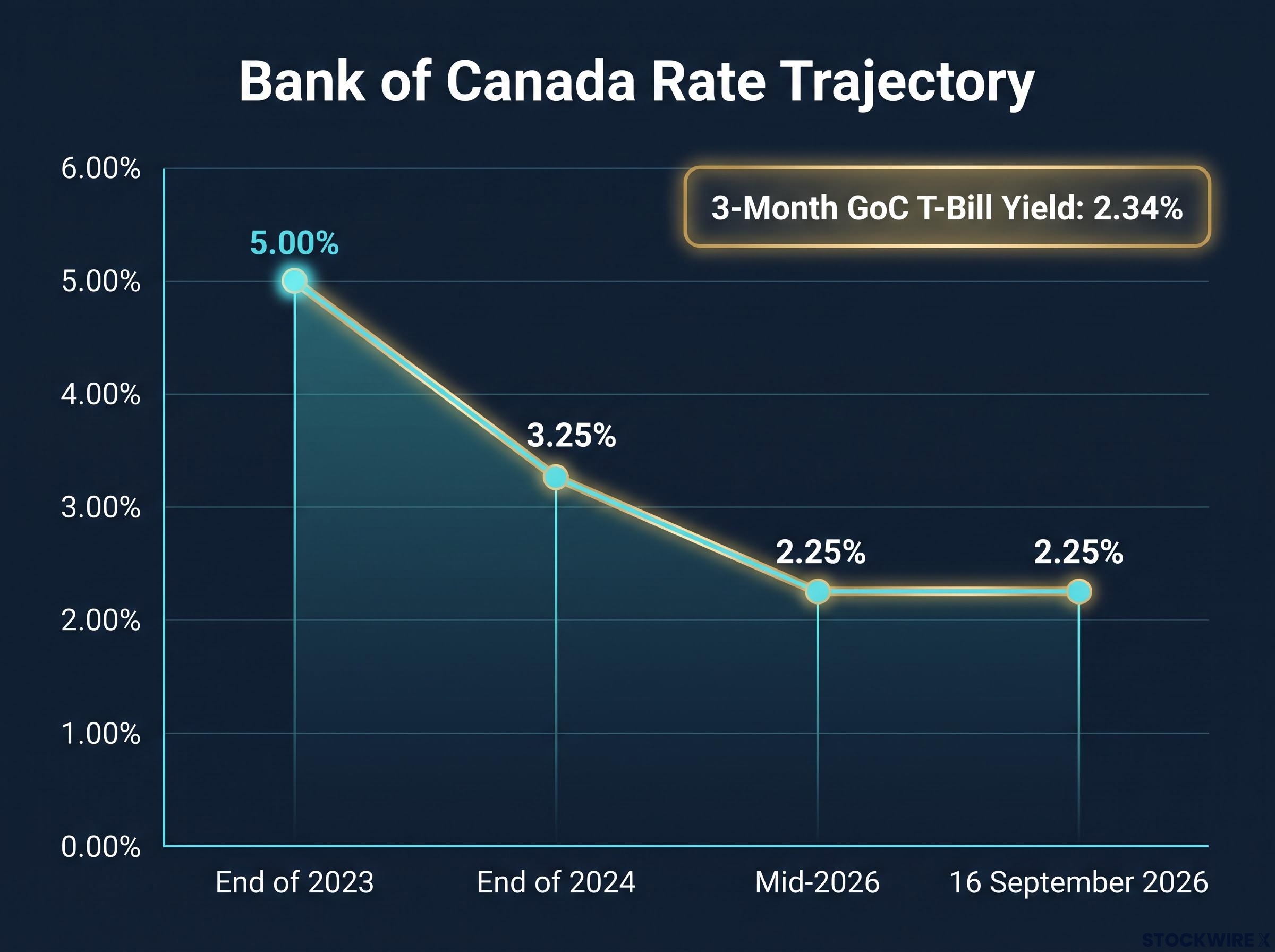
Here is the rate environment you are working in. The Bank of Canada has kept its overnight policy rate at 2.25% as of 16 September 2026, and it has held steady for six consecutive decisions. The 3-month Government of Canada Treasury Bill yield sits at 2.34%. That is a long way down from where rates were.
Consider the trajectory:
- End of 2023: 5.00%, the peak of the tightening cycle
- End of 2024: 3.25%, after significant easing through the year
- Mid-2026: 2.25%, held steady across six straight meetings
The message in that sustained 2.25% floor is direct. Your default cash position is barely keeping pace with, and often losing to, inflation. That forces you to actively choose a parking vehicle that defends your purchasing power rather than surrendering it.
This baseline matters because it sets the yield you are walking away from. Everything above roughly 2.25% comes with additional risk attached. Understanding that number tells you exactly what you are giving up when you decide to reach higher. The rest of this guide sorts your options into three tiers, running from near-zero risk to genuine equity exposure, so you can see the full spectrum of reward against risk.
When big ASX news breaks, our subscribers know first
Tier 1: zero-risk liquidity with HISA ETFs
Start at the safest possible point. High-interest savings account (HISA) ETFs and Treasury bill ETFs are near-direct substitutes for a high-interest savings account, offering almost no volatility while returning something close to prevailing interest rates.
Here is how they work. These funds hold high-interest deposit accounts with major Canadian banks and trust companies, then pass the interest through to you as monthly distributions. Unit prices cluster tightly around $10 or $50 with barely any day-to-day movement, which is exactly the point.
Yields currently sit in the 2-3% range, tracking the Bank of Canada rate closely. PSA, the Purpose High Interest Savings Fund, was yielding 2.18% net (2.35% gross) as of 17 September 2026.
The main options include:
- CASH: Global X High Interest Savings ETF
- PSA: Purpose High Interest Savings Fund, yielding 2.18% net as of mid-September 2026
- HISA: Evolve High Interest Savings Account ETF
- MCAD: Evolve Canadian High Interest Savings Account ETF
- T-Bill: Harvest Canadian T-Bill ETF, holding short-term government debt
There is one structural wrinkle you should know about. Guidance from the Office of the Superintendent of Financial Institutions (OSFI), Canada’s banking regulator, reclassified HISA ETF deposits as wholesale funding rather than retail deposits. That raises the regulatory capital and liquidity costs banks face on these arrangements.
OSFI’s liquidity guidance on HISA ETFs confirmed that these deposits are treated as wholesale funding rather than retail deposits, raising the regulatory capital and liquidity requirements banks must hold against HISA ETF arrangements, which is what set off the repricing and renegotiation cycle you now need to monitor.
The practical fallout has been real. Some banks have limited or renegotiated their relationships with HISA ETF providers, and some fund sponsors have adjusted product structures or capped fund sizes. This tells you that HISA ETF yields will not automatically track the overnight rate forever, so you need to monitor these products rather than treating them as set-and-forget.
One more caution. Despite holding bank deposits, these ETFs are not covered by the Canada Deposit Insurance Corporation (CDIC). They are cash-like, but they are investment securities, not guaranteed accounts.
Thorough ETF due diligence goes beyond the fund name: total cost extends past the MER to include bid-ask spreads, tracking difference versus the benchmark, and distribution tax drag, each of which affects the real yield your cash position actually delivers.
The right use for this tier is money you need within 0-12 months, or your emergency reserve. You get maximum principal stability and full liquidity, with your capital shielded from market fluctuations.
Tier 2: yield enhancement with short-term bond ETFs
Move up one step and you accept a little discomfort in exchange for a little more upside. Short-term government bond ETFs hold zero-to-three-month government debt, sometimes layered with options-based income strategies that generate incremental yield above the base bond return.
These funds have historically delivered marginally better total returns than pure cash equivalents while keeping volatility very low. Products in this category include SPAY (Global X Short Term US Treasury Premium), PAYE (Global X Canadian government short-term), H Bill (Hamilton US T-Bill Yield Maximizer), and ZTS (BMO Short-Term US Treasury Bond Index).
There is a mechanism working in your favour here. Bond prices move inversely to interest rates, so as rates have fallen since the 5.00% peak in 2023, short-term bonds have picked up modest price appreciation on top of their coupon income. That is the extra return HISA ETFs cannot offer.
Understanding mark-to-market risk
The trade-off is mark-to-market risk, which means the unit price can dip temporarily if yields rise or credit conditions worsen. Two forces drive this. Duration risk is the sensitivity of a bond’s price to changes in interest rates, and even short-term funds carry some of it. Credit spread risk is the danger that the extra yield demanded on corporate or lower-quality debt widens, pushing prices down.
Duration risk in bond funds scales predictably with maturity: a fund with a duration of 7 loses approximately 7% in price for every one percentage point rise in rates, compared to roughly 3% for a duration-3 fund, which is why short-term government bond ETFs have remained the preferred cash-management instrument as rates normalised from their 2023 peak.
Neither of these threatens you severely in a short-duration fund, but they are real. That is why money you might need for an immediate emergency does not belong here. If you are forced to sell on short notice during a bad week, you could realise a small loss, which defeats the purpose of a cash reserve.
This puts a firm condition on Tier 2: commit to your timeline before you move money in. The right horizon is roughly 1-3 years, where you can accept minor price movement in exchange for the chance at slightly higher yield and capital gains as rates drift lower.
Tier 3: navigating split share preferred ETFs
Now the risk curve steepens sharply, and the headline yields get genuinely attractive. Split share preferred ETFs typically yield around 5-6%, distributed monthly, which is more than double what Tier 1 offers. That gap should make you cautious, not just excited.
To understand the risk, you need to understand the structure. A split corporation holds a portfolio of common shares, often concentrated in Canadian blue-chip names like the major banks, insurers, and utilities. It then splits that portfolio into two classes: preferred shares and capital shares.
Preferred shares get priority. They receive a fixed or targeted distribution first, and they are designed to hold a stable net asset value near $10 per unit. Capital shares get whatever is left over, which gives them leveraged upside in good times and first exposure to losses in bad times.
That last point is your protection. Several structural features are built in to keep preferred shareholders safe:
- Distribution priority: preferred dividends are paid before any distribution reaches capital shares
- Asset coverage tests: the split corporation must maintain a minimum net asset value relative to the preferred par value
- First-loss buffer: capital shares absorb the initial losses before preferred holders are touched
- Redemption structure: at a scheduled termination date, the fund aims to repay preferred shares at par, subject to sufficient asset coverage
The two main ETFs are SPLT (Brompton Split Corp Preferred ETF), which pools preferred shares from most Canadian split share funds into one fund, and PREF (Quadravest Split Share Preferred ETF), which operates on a substantially identical basis. Both spread risk across many issuers.
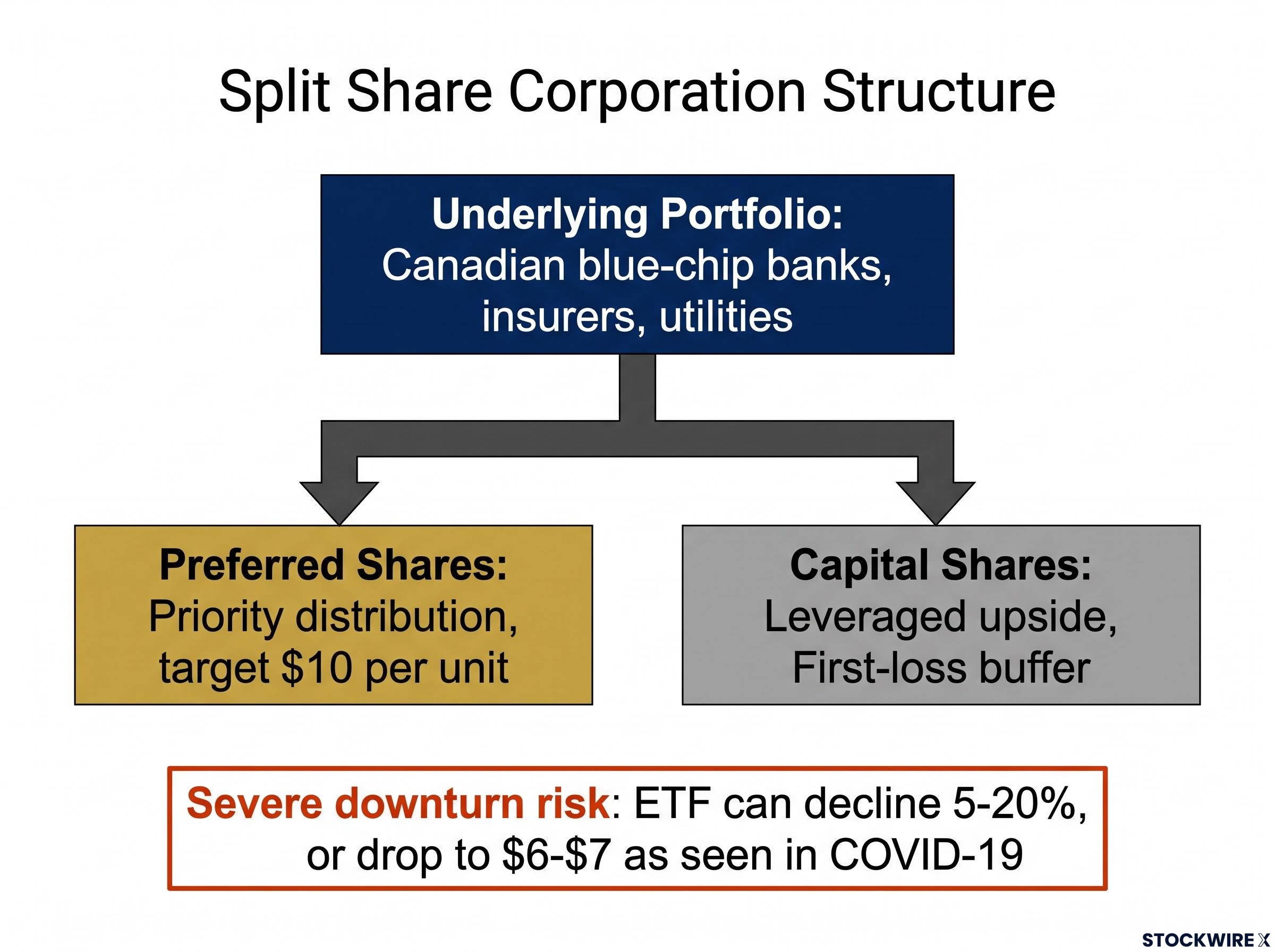
Here is where the protections can fail. In a severe and sustained equity downturn, the first-loss buffer from capital shares gets exhausted, and preferred holders face real capital losses. Dividend cuts from the underlying banks and insurers can also starve the fund of the income it needs to service distributions.
The historical evidence is instructive. During the COVID-19 crash, individual split share preferred prices fell from roughly $10 to as low as $6-$7 before recovering. In a severe downturn, an ETF like SPLT could decline by an estimated 5-20%, a world away from the near-zero volatility of a HISA ETF.
These are emphatically not cash instruments. Institutional and expert commentary consistently frames split share preferred ETFs as structurally sound when coverage ratios are high and the underlying issuers are stable, but explicitly warns that the protections are not guarantees and can be overwhelmed in a severe equity bear market. Investors who treat them as cash risk being caught off guard by drawdowns of 10-30% in the worst scenarios.
The read you should take is clear. That 5-6% yield is not free money. It is a premium you are paid for accepting equity-linked risk, so you must mentally file this allocation as an income investment, never as a guaranteed emergency fund.
Tax efficiency and cross-border portfolio construction
Now for the variable that changes everything: tax. The nominal yield on a product tells you almost nothing about what you actually keep, because the three tiers are taxed in completely different ways.
Interest income, which is what HISA ETFs and short-term bond ETFs pay, is fully taxable at your marginal rate. It is the least favourable treatment available. Canadian eligible dividends, which is how split share preferred ETFs classify most of their distributions, benefit from the dividend tax credit.
A single T3 distribution from a Canadian ETF can be split into up to five T3 distribution categories, each taxed at a different rate, meaning two funds with identical headline yields can produce materially different after-tax outcomes depending on how the fund classifies its income.
For a Canadian resident in a mid-to-high tax bracket, that credit typically lowers the effective tax rate on eligible dividends by 10-20 percentage points compared with interest income. The consequence is striking. A 5-6% eligible dividend yield can produce a similar or better after-tax return than a lower interest yield, even when the nominal gap between them is smaller than it appears.
Here is how the tiers compare on the variables that matter:
| Instrument type | Income classification | Typical volatility | Recommended horizon |
|---|---|---|---|
| HISA / T-bill ETFs | Interest income (fully taxable) | Near zero | 0-12 months |
| Short-term bond ETFs | Interest income (fully taxable) | Very low | 1-3 years |
| Split share preferred ETFs | Eligible dividends (dividend tax credit) | Low to moderate; severe in crises | Income allocation, not pure cash |
If you are a US tax resident, this is where you must tread carefully. The Canadian dividend tax credit is a domestic benefit, and it generally does not flow through to you. Holding Canadian ETFs from the United States can also trigger complex cross-border treatments, including passive foreign investment company (PFIC) rules and foreign tax credit calculations, all of which can erode or complicate your return.
The bottom line is that your optimal cash vehicle depends entirely on your tax bracket and your country of residence. You have to look past the nominal yield and calculate your actual take-home number. Given the complexity for US residents, professional cross-border tax advice is not optional here, it is a prerequisite.
This article is for informational purposes only and should not be considered financial advice. Investors should conduct their own research and consult with financial professionals before making investment decisions.
Building a cohesive cash management plan
Put the three tiers together and a simple structure emerges. Different pools of your capital serve different jobs. Money you need within a year sits in Tier 1 for stability. Money with a one-to-three-year horizon can accept the mild fluctuation of Tier 2 for a shot at extra return. And an income allocation you can genuinely leave alone might justify Tier 3, with its higher yield and its equity-linked risk fully acknowledged.
The one rule that holds across all of it: reaching for the 5-6% yield in Tier 3 defeats the entire purpose of a cash reserve if that money might be needed on short notice. Yield and immediate liquidity pull in opposite directions.
Your action from here is straightforward. Audit what you currently hold, match each pool of cash to its actual timeline, and move anything that is sitting in the wrong tier. If you are investing from the United States, book that conversation with a cross-border tax professional before you commit.
Past performance does not guarantee future results. Financial projections are subject to market conditions and various risk factors.