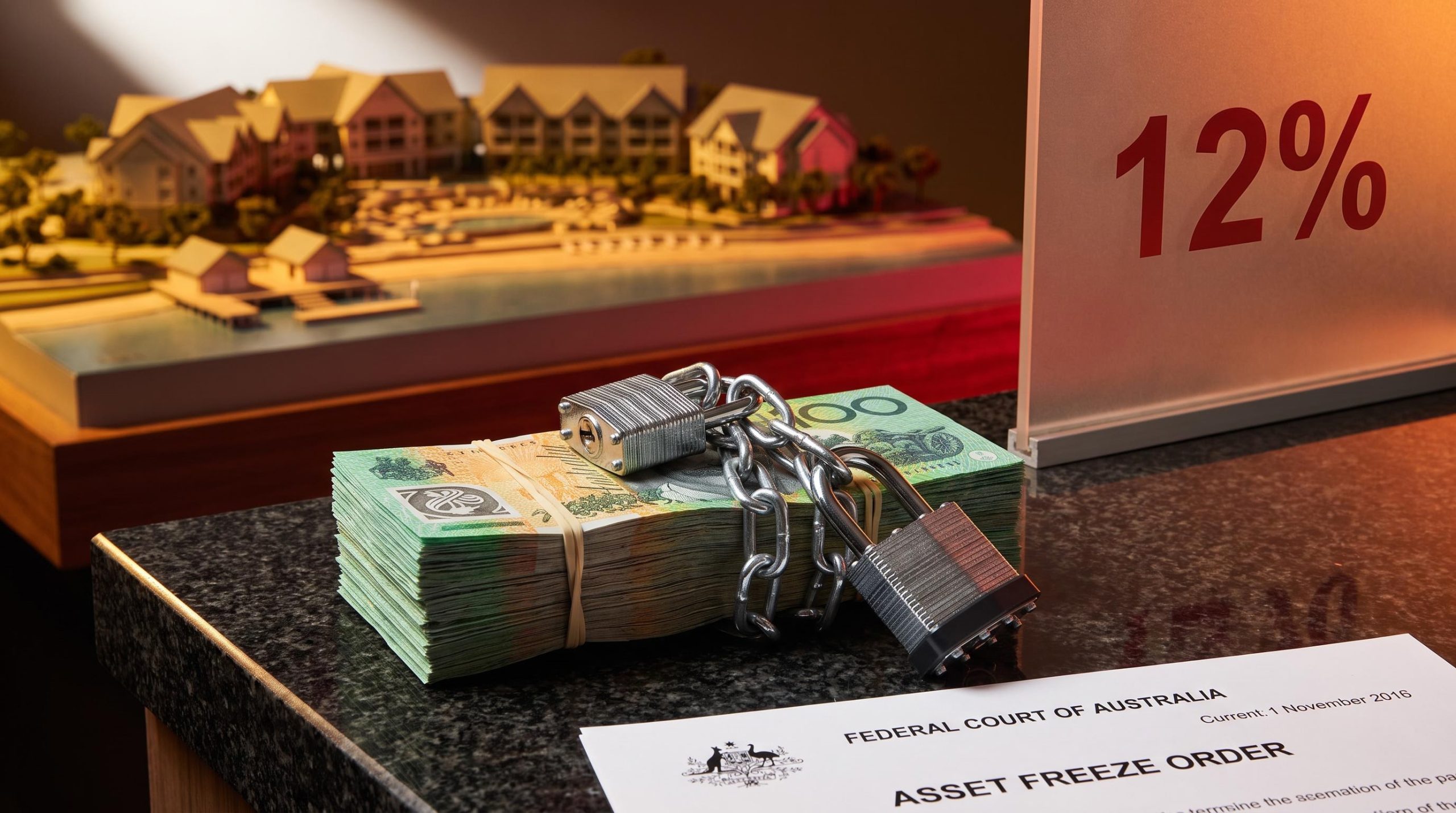
Australia’s corporate regulator has secured emergency Federal Court orders freezing the assets of two companies and their shared director, and banning that director from leaving the country, in connection with an alleged investment scheme tied to a Victorian resort development promising 12% annual returns.
The orders, granted on 15 September 2026, land squarely on investors in the Lake Narracan Resort development in Moe, Victoria. Many of them committed a minimum of $100,000 each on the promise of fixed monthly interest.
A further Federal Court hearing is listed for 23 September 2026, days away at the time of writing, and it could see receivers appointed to take control of the entities holding investor money.
This article sets out what the orders actually cover, what the scheme promised and where its own figures did not add up, what a freeze order does and does not do for the people who invested, and the concrete steps affected investors can take before the next hearing.
Federal Court steps in: what ASIC’s emergency orders actually cover
The Australian Securities and Investments Commission (ASIC) named three respondents in its application: Star Investment Group Australia Pty Ltd, Gondal Holdings Pty Ltd, and Ijaz Ahmad, the shared director of both companies. According to ASIC’s media release of 18 September 2026, the regulator brought the application on an ex parte basis, meaning the respondents were not present when the initial orders were granted.
That procedural detail matters. Filing ex parte tells you ASIC considered the risk of assets being moved or dissipated urgent enough that warning the respondents in advance was itself a danger. When a regulator asks a court to act before the other side can even be heard, it is signalling how it reads the threat level.
Ex parte enforcement action by ASIC, where the regulator moves in court before the respondents are notified, has featured in multiple 2026 matters, including the Capital Guard licence cancellation, where the regulator similarly assessed the risk of asset dissipation as too immediate to permit advance notice.
Justice Anderson of the Federal Court found reasonable grounds to suspect breaches of both the Corporations Act 2001 and the ASIC Act 2001. Mr Ahmad has not yet had the opportunity to respond to ASIC’s claims, and no findings of wrongdoing have been made against any respondent at this stage.
The orders themselves do three distinct things:
- Asset freeze: both companies and Mr Ahmad are prohibited from disposing of or otherwise dealing with their assets, subject to limited carve-outs.
- Disclosure obligations: the respondents must provide the court with details of their assets and liabilities.
- Travel ban: Mr Ahmad is barred from leaving Australia upon any return to the country.
For anyone who put money into the scheme, the practical takeaway is not simply that a freeze exists. It is that the entities holding funds linked to your investment are now legally restrained from moving those funds while the investigation runs.
The procedural clock is already ticking
The timeline is compressed. Interim orders were granted on 15 September 2026, ASIC published its media release on 18 September 2026, and the follow-up hearing is set for 23 September 2026. That hearing will decide whether the interim orders stay in force and whether additional remedies, including the appointment of receivers, should be pursued.
ASIC has also opened a direct line, inviting investors with relevant information to contact the regulator through a dedicated enquiries email address as the investigation continues.
When big ASX news breaks, our subscribers know first
Inside the Lake Narracan scheme: the investment terms that drew scrutiny
To understand why ASIC moved, it helps to see the scheme the way an investor would have first encountered it. The Lake Narracan Resort is marketed as a waterfront development spanning roughly 110 acres in Moe, Victoria, in the state’s Gippsland region, with plans for 350 dwellings and a community facility. It was promoted by Star Investment Group Australia in partnership with Mountain Assets.
The pitch was built around fixed returns. According to Star Investment Group’s own promotional materials, investors were offered 12% per annum interest paid monthly, plus an additional 10% capital growth over a five-year term. The instrument was a convertible note certificate, available on 2-year, 3-year, and 5-year terms, with a minimum investment of $100,000 and a maximum of $2 million, rising to $25 million for those wanting shareholder status.
The red flag in one number A fixed 12% annual return, paid monthly, from a single property development. Guaranteed double-digit income from one project is precisely the promise that has drawn ASIC’s attention in scheme after scheme.
Here is how the marketed terms compared across the available options.
| Term length | Annual return | Capital growth | Instrument | Minimum investment |
|---|---|---|---|---|
| 2 years | 12% p.a. paid monthly | Not stated for this term | Convertible note certificate | $100,000 |
| 3 years | 12% p.a. paid monthly | Not stated for this term | Convertible note certificate | $100,000 |
| 5 years | 12% p.a. paid monthly | 10% over the term | Convertible note certificate | $100,000 |
Then there are the numbers the company published about itself, none of which have been independently verified. Star Investment Group’s promotional materials claimed a projected Gross Development Value of $140 million and $15.5 million in investments raised as of April 2025.
The self-reported sales figures do not agree with each other. One company page cited $25 million in pre-sales with 60% of stages sold, while a separate promotional article from the same publisher put the figure at more than $20 million and 55% sold.
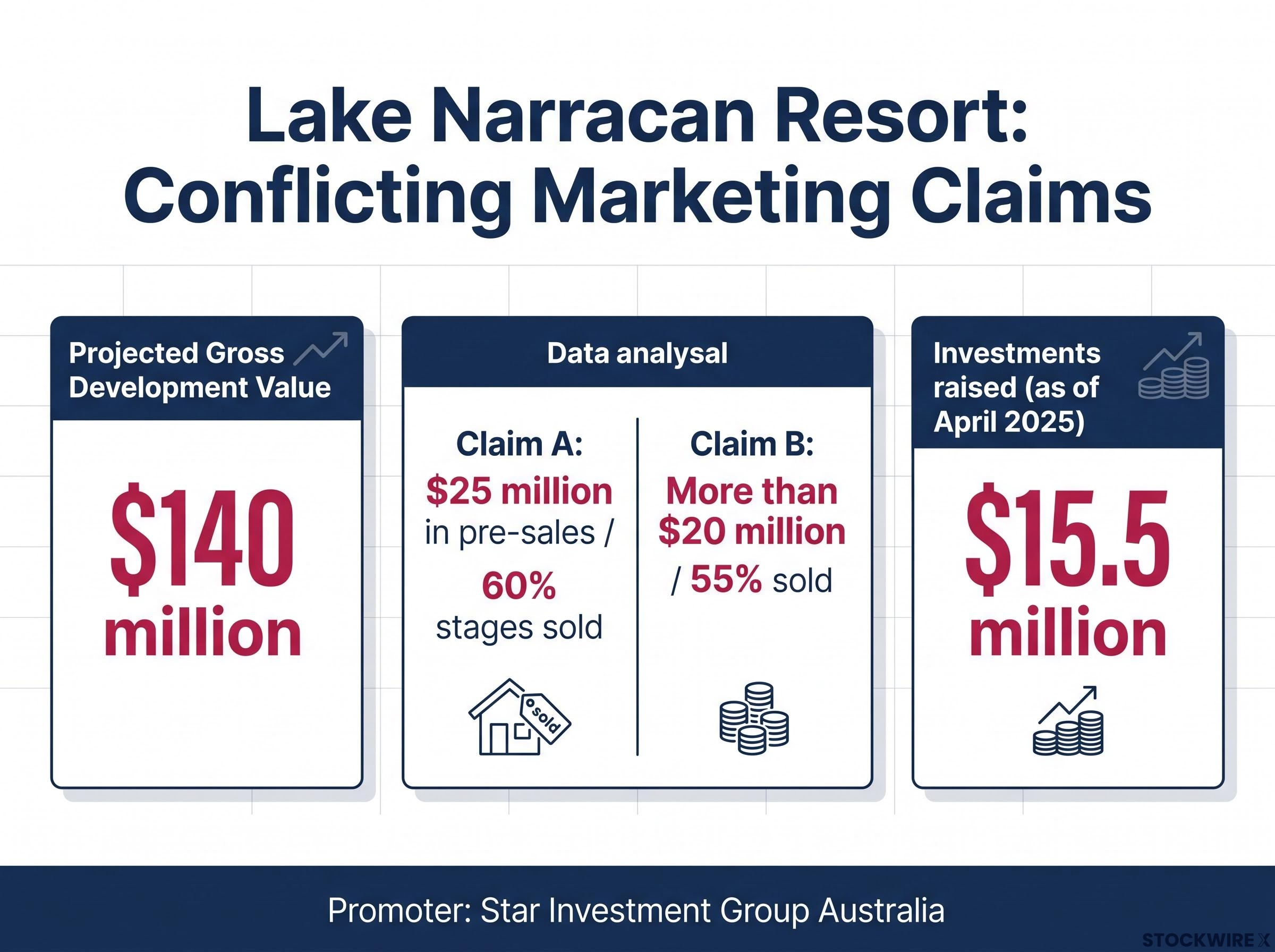
That contradiction, sitting alongside guaranteed high returns from a single development, is exactly the pattern ASIC’s enforcement history shows preceding regulatory intervention. A Reddit post dated 21 May 2026 setting up a private group for Star Investment Group investors points to a dispersed investor base, though no public source confirms how many people are affected. For investors, those discrepancies are not trivia: they bear directly on how the investigation may unfold and what recoverable assets actually exist.
What a freeze order means for investors, and what it does not
If you invested and the word “frozen” made you exhale in relief, this is the section to read carefully. A freeze order is not a refund, and it is not a guarantee that your money is safe.
Freeze orders are interim, protective measures made under section 12GN of the ASIC Act 2001. Their job is to stop respondents from dealing with or disposing of assets while an investigation proceeds. They do not establish liability, they do not allocate assets to investors, and they do not guarantee recovery.
Here is the distinction laid out plainly.
What freeze orders do:
- Preserve assets by preventing the respondents from moving or disposing of them
- Impose disclosure obligations, forcing the respondents to reveal their assets and liabilities
- Prevent travel, in this case keeping Mr Ahmad in the country on any return
What freeze orders do not do:
- Establish that any respondent is liable or has done anything wrong
- Guarantee that investors will get their money back
- Override the priority of secured creditors in an insolvency
Ex parte orders under section 12GN cannot run for more than 30 days unless renewed once proceedings are properly on foot. That is why the 23 September 2026 hearing matters so much: it will decide whether the interim orders are extended and whether receivers should be appointed.
What happens if receivers are appointed, and the risks that follow
A receiver is an independent officer empowered to secure assets, trace the flow of investor funds, and report back to the court. On paper that sounds reassuring. In practice, it introduces a set of risks investors need to price in.
Competing creditor claims can shrink the pool available to retail investors, because funds are distributed according to insolvency priorities, with secured creditors and administration expenses often ranking ahead. The costs of a receivership investigation, securing property and tracing funds, are typically paid out of that same asset pool. And orders can be varied or discharged if circumstances change.
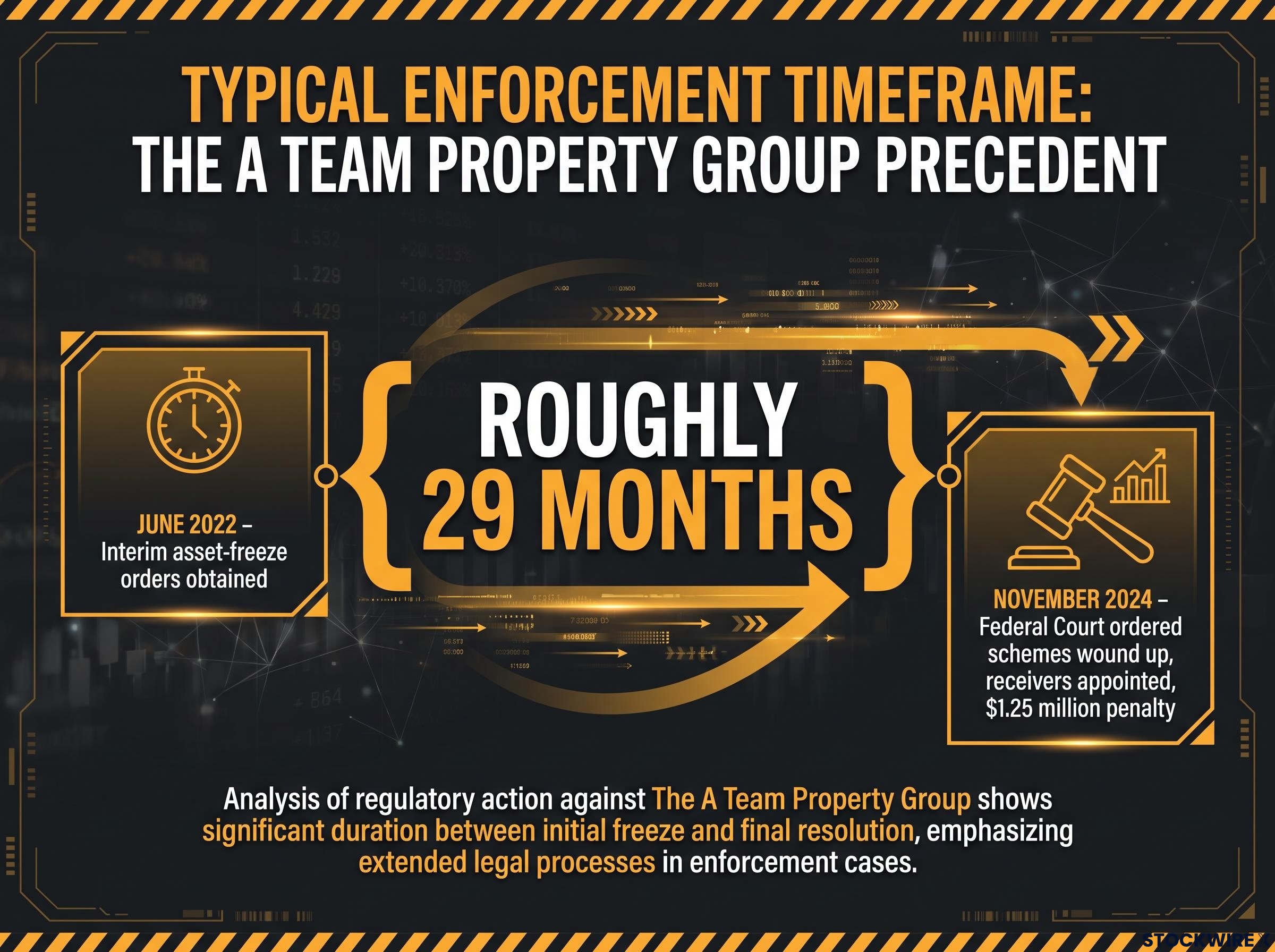
How these matters typically develop In the A Team Property Group case, ASIC obtained interim asset-freeze orders in June 2022. The Federal Court later ordered the schemes wound up, appointed receivers, and imposed a $1.25 million penalty in November 2024. Roughly 29 months separated the freeze from the penalty.
For someone who committed $100,000 or more, the single most important thing to absorb is this: frozen does not mean returned. Understanding that gap now is what prepares you for the long, multi-stage process that usually follows.
Red flags ASIC targets in property-linked investment schemes
Star Investment Group is not an isolated curiosity. It fits a pattern ASIC’s enforcement record has repeatedly targeted, and learning that pattern gives you a filter for the next scheme that lands in your inbox.
Four structural red flags show up again and again across ASIC’s property-scheme actions, listed here by enforcement frequency and visibility:
The Moneysmart investment scams guidance published by ASIC identifies guaranteed high returns with little or no risk as one of the most consistent warning signs in property-linked schemes, placing promises like the Lake Narracan 12% fixed return squarely within the documented risk profile.
- Fixed or guaranteed high returns from a property development, marketed as low-risk income.
- No visible Australian Financial Services Licence (AFSL) held by the promoters.
- Investments issued through unregistered managed investment schemes that should have been registered.
- Opaque fund flows across multiple related entities, making it hard to trace where money actually goes.
Unregistered managed investment schemes have drawn consistent Federal Court intervention across 2025 and 2026, with the First Mutual Private Equity matter resulting in a winding-up order and Deloitte liquidators overseeing approximately $53 million in investor funds through a statutory claims process.
The Lake Narracan scheme, as described in its own promotional materials, ticks several of these boxes. It offered fixed 12% returns, ran through multiple corporate entities in Star Investment Group Australia and Gondal Holdings, and used convertible note instruments.
The “guaranteed high return” flag in practice Fixed 12% per annum paid monthly, plus 10% capital growth over five years, from a single resort development. This is the archetype of the promise ASIC scrutinises, not the exception.
These are not abstract warnings. ASIC media release 21-214MR covered the MKS Property matter, where an unregistered scheme was wound up and receivers appointed. Release 24-261MR covered the A Team Property Group, which ended in a $1.25 million penalty and winding-up. Both show how the pattern typically ends.
For your own protection, ASIC recommends three concrete checks. Verify any promoter’s AFSL through the ASIC Connect Professional Registers. Confirm whether a scheme is actually a registered managed investment scheme. And contact ASIC directly if you have invested in, or been approached by, a scheme like this one.
What the 23 September hearing could change, and what investors should do now
Everything about this case is still provisional, and one date will start to resolve it. The 23 September 2026 hearing will determine whether the interim freeze orders continue, whether additional remedies including receiver appointments are granted, and the trajectory the investigation takes from here. As of publication on 18 September 2026, the outcome is not publicly confirmed.
Comparable property-scheme cases suggest what the road ahead may look like. The typical enforcement pathway runs through several stages:
- Interim asset freeze
- Receivership and asset investigation
- Civil proceedings
- Potential winding-up of the schemes
- Civil penalties
None of that is guaranteed in this matter, and the process rarely moves quickly. The A Team Property Group timeline is the honest reference point: an interim freeze in June 2022, and a civil penalty and winding-up in November 2024, roughly 29 months apart.
The gap between today’s freeze and any eventual recovery is measured in months or years, not days. Investors who act now are in a materially stronger position than those who wait.
If you are affected, three steps are worth taking before the hearing:
- Contact ASIC through the dedicated investor enquiries address for the Star Investment Group matter.
- Document everything, including investment records, certificates, statements, and communications with the promoters.
- Seek independent legal advice before taking any other action.
This article is for informational purposes only and should not be considered financial advice. Investors should conduct their own research and consult with financial professionals before making investment decisions.
What the Star Investment Group case signals about ASIC’s property-scheme enforcement posture
Step back from this single matter and a clear enforcement posture comes into view. Across the period from 2021 to 2026, from the MKS Property action through to Australian Fiduciaries and now Star Investment Group, ASIC has consistently reached for the same tools: ex parte freeze orders, receivership appointments, and civil penalties in property-linked scheme cases.
The Star Investment Group action fits that template almost exactly. A multi-entity structure, high fixed returns, convertible note instruments, and six-figure minimum investment thresholds place it squarely within ASIC’s documented focus areas.
ASIC’s civil penalty framework has produced increasingly severe outcomes in recent years, with Australian courts ordering a record $830 million in penalties connected to ASIC enforcement in FY2025-26, a figure that reflects courts pricing systemic financial harm at a fundamentally higher level than in prior years.
The scale ASIC brings to complex cases In its “Forward together” speech on financial services misconduct, ASIC described complex scheme investigations involving more than 40 investigators and over 40 court appearances. That is the weight the regulator can put behind matters of this kind.
The immediate next event is the 23 September 2026 hearing. Beyond it, comparable cases point to a multi-year enforcement process, and the regulator’s invitation for investor contact typically forms part of its evidence-gathering for the next phase.
The read for anyone weighing a property-linked investment today is straightforward. The 2021 to 2026 record shows ASIC is actively watching this space and will move fast once its threshold of suspicion is crossed. Past enforcement outcomes do not guarantee how this particular matter will resolve, and its progress remains subject to the court process.