

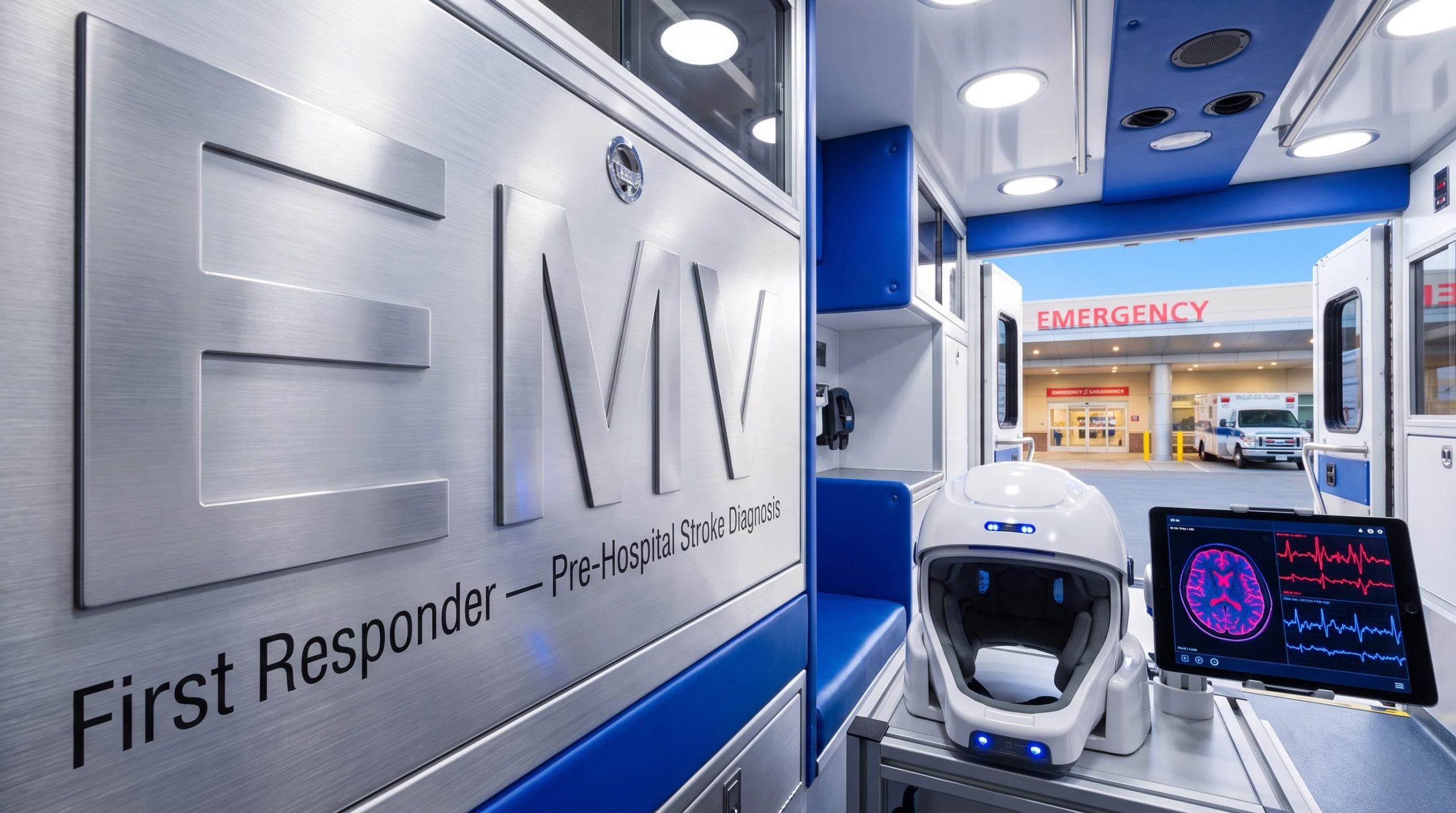
First Responder brain scanner clears key real-world hurdle
EMVision Medical Devices Limited has announced the successful completion of Stage 1 of its pre-hospital Mobile Stroke Unit (MSU) study, a single-site usability and workflow evaluation (non-diagnostic) that met its primary objectives. Conducted with the Melbourne Mobile Stroke Unit at the Royal Melbourne Hospital, Australia’s first mobile stroke unit, the study confirms the First Responder brain scanner has now been successfully operated in both air and road environments with real patients in real emergency conditions.
The announcement also covers three further developments: progress on the next-generation production-equivalent device, receipt of a non-dilutive grant payment, and a new strategic Memorandum of Understanding (MoU) signed with the Australian Stroke Alliance (ASA).
The MSU study completes a two-environment validation sequence: the First Responder had already passed an aeromedical feasibility study with the Royal Flying Doctor Service earlier in 2026, confirming scan data quality held up through real-world flight conditions before the device was brought into road and residential settings.
When big ASX news breaks, our subscribers know first
MSU study results — what the data shows
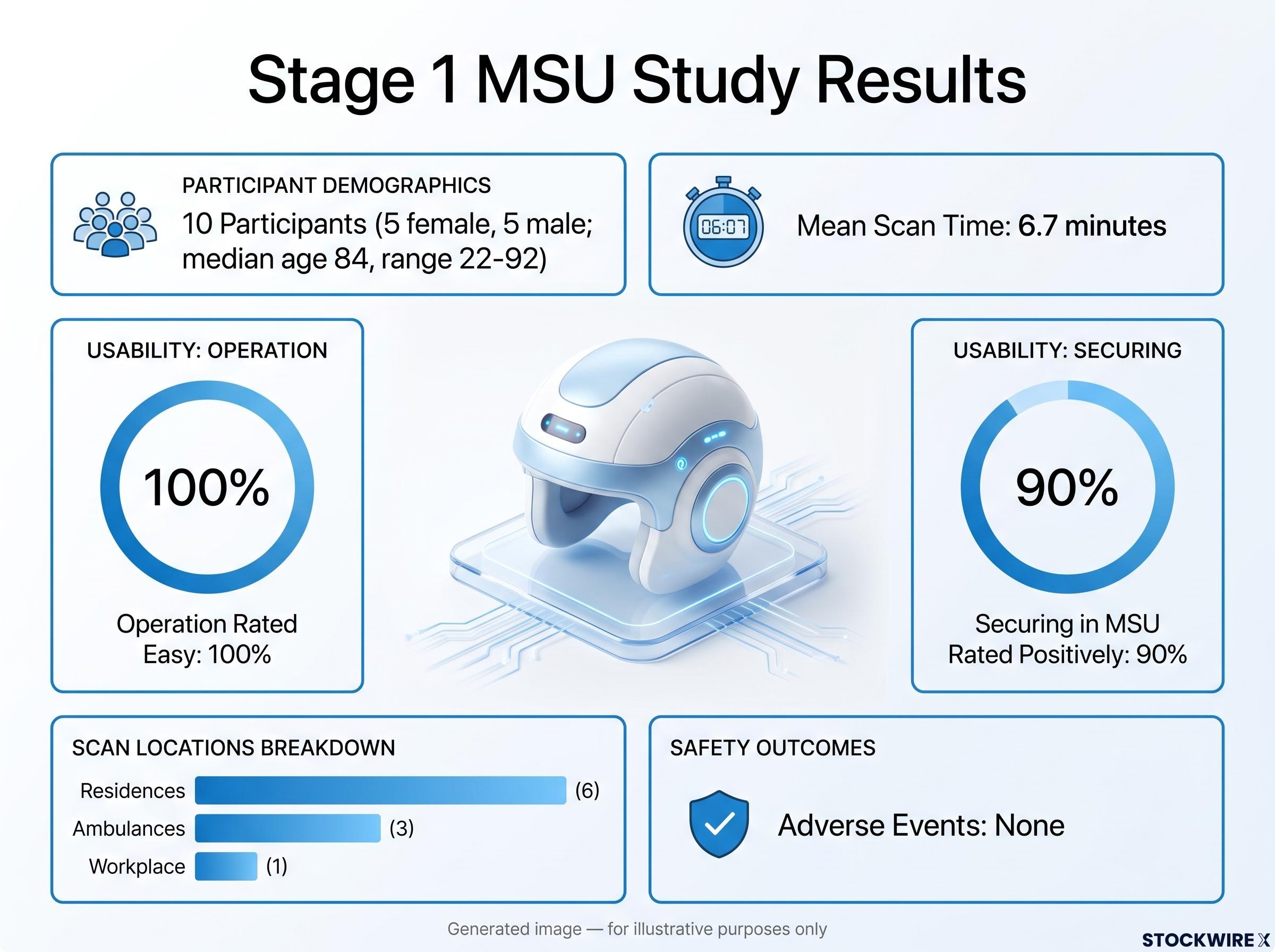
Ten participants were enrolled across the Melbourne MSU catchment (5 female, 5 male; median age 84, range 22–92). Scans were performed across a variety of real-world environments, with participants on a stretcher, bed or couch, or the ground.
| Metric | Detail |
|---|---|
| Total participants | 10 (5 female, 5 male; median age 84, range 22–92) |
| Scan locations | Residences (n=6), ambulances (n=3), workplace (n=1) |
| Mean scan time | 6.7 minutes |
| Scanner operation rated easy | 100% of operator responses |
| Securing in MSU rated positively | 90% of cases |
| Packing and preparation rated positively | 80% of cases |
| Device-related adverse events | None reported |
Operator feedback was strong across the metrics that matter most for clinical deployment. Participant preparation, head-size assessment, start-up and tablet connection were all rated positively. Operators did identify opportunities for improvement in moving and loading the scanner, which EMVision has designated as a prioritised engineering target for the production-equivalent device — framing this as actionable data rather than a shortcoming.
Patient feedback (n=6) was highly positive. All respondents reported feeling calm during the scan, found the instructions clear, and said they would be comfortable with the scanner being used on a family member. For an emergency medical device, that level of acceptance in a live pre-hospital setting represents a strong endorsement of the First Responder’s non-invasive, non-ionising design.
Why pre-hospital stroke diagnosis changes patient outcomes
Stroke occurs when blood flow to part of the brain is interrupted, either by a blocked vessel (ischaemic stroke) or bleeding into the brain (haemorrhagic stroke). Critically, the two types require different treatments. Ischaemic stroke patients may benefit from thrombolysis (clot-dissolving drugs), while haemorrhagic patients require blood pressure management and, where relevant, anticoagulation reversal. Administering the wrong treatment can cause serious harm, which means identifying stroke type early is clinically urgent.
Landmark MSU trials in Melbourne, Berlin, and the United States have established the case for pre-hospital stroke diagnosis, demonstrating that treating patients before they reach hospital delivers dramatically better outcomes. These include earlier thrombolysis and faster, more accurate triage of patients to hospitals capable of performing thrombectomy, a highly effective clot-retrieval procedure for large vessel occlusion strokes.
The INTERACT4 trial further underscored the stakes: early intensive blood pressure lowering in the ambulance significantly improves outcomes for haemorrhagic stroke patients but is harmful in ischaemic stroke. Knowing stroke type before hospital arrival is therefore the key to unlocking that treatment.
Current CT-equipped MSUs already deliver this capability in cities like Melbourne and Berlin, but they cost millions of dollars, require specialist crews, and are not widely deployed. EMVision’s First Responder is designed to change that equation. Helmet-sized and ultra-lightweight, it is intended to bring stroke-type identification into any road or air ambulance at a fraction of the cost and complexity of existing CT-equipped MSUs.
Next-gen device, funding secured, and a new strategic alliance
Three additional developments were disclosed alongside the MSU study results:
- Next-generation First Responder (expected H1 CY27): Production-equivalent units are lighter than the prototypes used in field studies, incorporate fewer components, and are engineered to surpass the emu™ in diagnostic performance, drawing on learnings from both the emu™ and First Responder programmes. International collaborations with leading centres are already underway. Stage 2 of the MSU study, which will collect paired diagnostic data for algorithm advancement, is expected to commence as soon as the production-equivalent units are available.
The diagnostic performance benchmark the next-generation device is targeting is grounded in EMVision’s AI stroke detection models, which achieved 95% sensitivity for ischaemic stroke and 92% for haemorrhagic stroke on unseen data in a study published in npj Digital Medicine, a Nature-portfolio peer-reviewed journal.
-
IGP grant payment received ($650,437): EMVision received a progress payment of $650,437 under its Industry Growth Program (IGP) non-dilutive grant. The total IGP grant of $5.0 million was awarded in June 2025 to support and accelerate development and commercialisation of the First Responder scanner. A further $2.2 million is expected to be received over the remaining life of the programme.
-
ASA MoU (joint non-dilutive funding pursuit): EMVision has signed a non-binding MoU with Australian Stroke Alliance Ltd to work together on securing non-dilutive research and translational funding for pre-hospital stroke diagnosis. The MoU builds on the parties’ existing collaboration under the MRFF Stage 2 “golden hour” programme, a five-year $40 million MRFF Frontiers initiative led by ASA. EMVision has received $8 million in non-dilutive funding under that programme to date. The MoU is a two-year, non-exclusive framework that either party can end on 30 days’ notice, does not commit either party to any particular application, and does not guarantee funding success.
Scott Kirkland, CEO and Managing Director
“This study shows the First Responder scanner can be easily deployed where strokes occur, at the scene, and via the road. Operators found it easy to use and patients found it unobtrusive. What we learned has already shaped the next-generation production equivalent First Responder which is even lighter, simple to operate and engineered to better the diagnostic performance of the emu™, and we’re excited to move them into the studies that take us toward market. Our MoU with the Australian Stroke Alliance builds on a partnership that has already delivered the golden hour program. Together we bring clinical networks, ambulance partners and technology to pursue non-dilutive funding that will help make pre-hospital stroke diagnosis routine care…”
Investment case — de-risking through evidence and non-dilutive capital
The four developments disclosed in this announcement each address a distinct category of risk, collectively strengthening the investment case for EMVision at this stage of development.
The successful MSU study addresses clinical risk: the First Responder has now been validated in both air (RFDS) and road environments with real patients, confirming device versatility and usability across diverse conditions. Technical risk is being addressed through the production-equivalent device programme, which incorporates MSU study learnings, reduces component count, lowers weight, and targets diagnostic performance surpassing the emu™.
On the financial side, non-dilutive capital continues to fund development without shareholder dilution. EMVision has received $650,437 from the IGP grant, with a further $2.2 million anticipated under that programme. Combined with the $8 million received under the MRFF “golden hour” programme, the company has drawn substantially on grant funding to support its development pathway.
Strategic risk is reduced by the ASA MoU, which combines clinical networks, air and road ambulance partners, and EMVision’s technology platform in pursuit of large-scale non-dilutive funding. The ASA partnership has a demonstrated track record, having already delivered the golden hour programme. While the MoU is non-binding and funding outcomes are not guaranteed, the framework is backed by a partnership with proven ability to secure competitive government grants.
The production-equivalent First Responder units, expected in H1 CY27, represent the next catalytic milestone for investors to watch.
Don’t Miss the Next Healthcare Breakthrough in Your Inbox
Big News Blast delivers FREE breaking ASX healthcare news directly to your inbox within minutes of release, complete with in-depth analysis already done. Join 20,000+ investors who stay ahead of the market the moment announcements hit. Click the “Free Alerts” button at Big News Blast to get started today.