
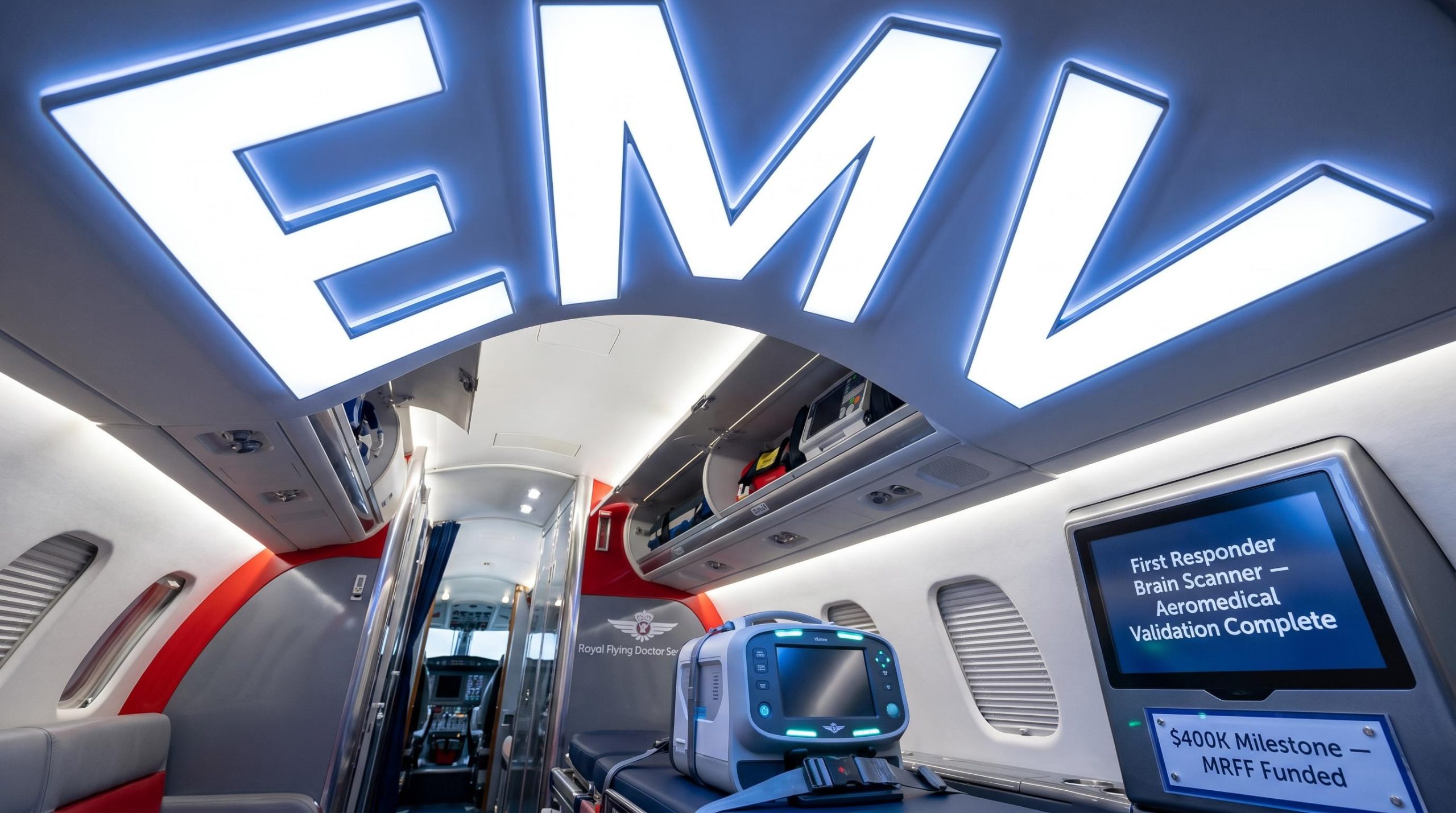
RFDS aeromedical study validates First Responder Brain Scanner in real-world conditions
EMVision Medical Devices (ASX: EMV) has announced the successful completion of an aeromedical feasibility and usability study evaluating its First Responder Brain Scanner, conducted in collaboration with the Royal Flying Doctor Service (RFDS), Australian Stroke Alliance (ASA), and South Australian Ambulance Service (SAAS). The study confirmed the device can be deployed and operated effectively across real-world aeromedical environments, with scan data quality unaffected by flight conditions. Alongside the clinical results, EMVision has received the final $400,000 non-dilutive milestone payment under its Australian Stroke Alliance Project Agreement, funded by the Medical Research Future Fund (MRFF).
When big ASX news breaks, our subscribers know first
What the study found — and why it matters for stroke care
Study design and reach
The study was a single-arm, workflow integration study enrolling 17 adult participants undergoing aeromedical transport. Key logistical metrics from the study include:
- 15 transfers dispatched
- 13 scans conducted
- 12 unique airstrips utilised
- Distances ranging from 125km to 371km from Adelaide Airport
- Environments covered: tarmac, on-board stationary aircraft, and clinic settings
Operator and patient results
RFDS flight nurses rated the First Responder positively across all three usability domains assessed: device preparation, participant set-up, and scanner operation. Ratings were collected via a five-point Likert scale, with “Strongly Agree” or “Agree” responses aggregated per domain.
The median scan time was 5 minutes and 7 seconds, which included a 3-minute built-in redundant scan sequence. Scan duration is expected to be significantly shorter on the production equivalent commercial device. Patient experience metrics were also favourable: 92% of participants indicated they felt calm during the scan, and 100% indicated they would be comfortable seeing the scanner used on a family member.
Scan data quality was comparable with scans conducted at EMVision’s own facility and was not materially impacted by aeromedical conditions.
Dr Zoe Schofield, Head of Research Strategic Projects and Principal Investigator (RFDS)
“For our flight crews, any new technology has to earn its place on the aircraft. The First Responder integrated smoothly into our retrieval workflow, our flight nurses found it intuitive to set up and operate, and importantly the scanner held up under the realities of flight.”
The rural stroke gap — and EMVision’s role in closing it
Rural and remote patients consistently wait longer for the definitive neuroimaging that determines stroke treatment, and are far less likely to receive time-critical care within the treatment window. That disparity in access has long shaped stroke outcomes across Australia.
The two main stroke types require distinct treatment approaches. Ischaemic stroke (caused by a blocked blood vessel) is treated with thrombolysis or endovascular thrombectomy, a procedure that mechanically removes the clot. Haemorrhagic stroke (caused by bleeding in the brain) requires urgent blood pressure management and, in some cases, neurosurgical intervention. Accurate, early diagnosis is essential to direct patients toward the correct pathway promptly.
The aeromedical retrieval window represents a critical intervention point in this process. Neurodiagnostic capability at the point of patient contact has the potential to support earlier triage, transfer, and treatment decisions, and the First Responder Brain Scanner is being developed specifically to address this gap.
Professor Stephen Davis AO, Co-chair of the Australian Stroke Alliance
“This is an important step forward in providing stroke diagnosis and treatment for Australians in remote locations, flying in the ultra-lightweight and portable First Responder device from EMVision.”
What comes next — building the evidence base toward regulatory clearance
Production equivalent commercial units are currently in development, engineered to surpass the first-generation emu™ Brain Scanner across performance, usability, and manufacturability. These units will underpin subsequent data collection, diagnostic performance testing, and substantial equivalence testing to progress along the regulatory pathway.
EMVision’s active pre-hospital evidence pipeline currently comprises three studies:
- RFDS Aeromedical Study — now complete (this announcement)
- Mobile Stroke Unit (MSU) Study, Stage 1 — nearing conclusion for subsequent reporting
- Road Ambulance Study — preparations well advanced, upcoming
Beyond the study pipeline, EMVision’s technology (including the First Responder) was featured in presentations at the European Stroke Organisation Conference 2026 and the PRESTO satellite meeting, reflecting growing engagement from the international clinical community.
Each completed study reduces uncertainty around the commercial pathway and expands the real-world evidence base required for regulatory clearance. This announcement confirms the aeromedical use case is operationally viable, removing a key uncertainty for investors tracking the device’s progress toward commercialisation.
| Study | Setting | Status | Significance |
|---|---|---|---|
| RFDS Aeromedical Study | Aeromedical retrieval | Complete | De-risks rural/remote use case |
| Mobile Stroke Unit Study (Stage 1) | Specialised road vehicle | Nearing conclusion | Urban/peri-urban pre-hospital evidence |
| Road Ambulance Study | Standard ambulance | Preparations advanced | Broadens pre-hospital applicability |
Don’t Miss the Next ASX Healthcare Breakthrough
Big News Blast delivers FREE breaking ASX healthcare news directly to your inbox within minutes of release, complete with in-depth analysis already done for you. Join 20,000+ subscribers staying ahead of market-moving announcements the moment they drop. Click the “Free Alerts” button at Big News Blast to start receiving real-time coverage across ASX healthcare and beyond.