
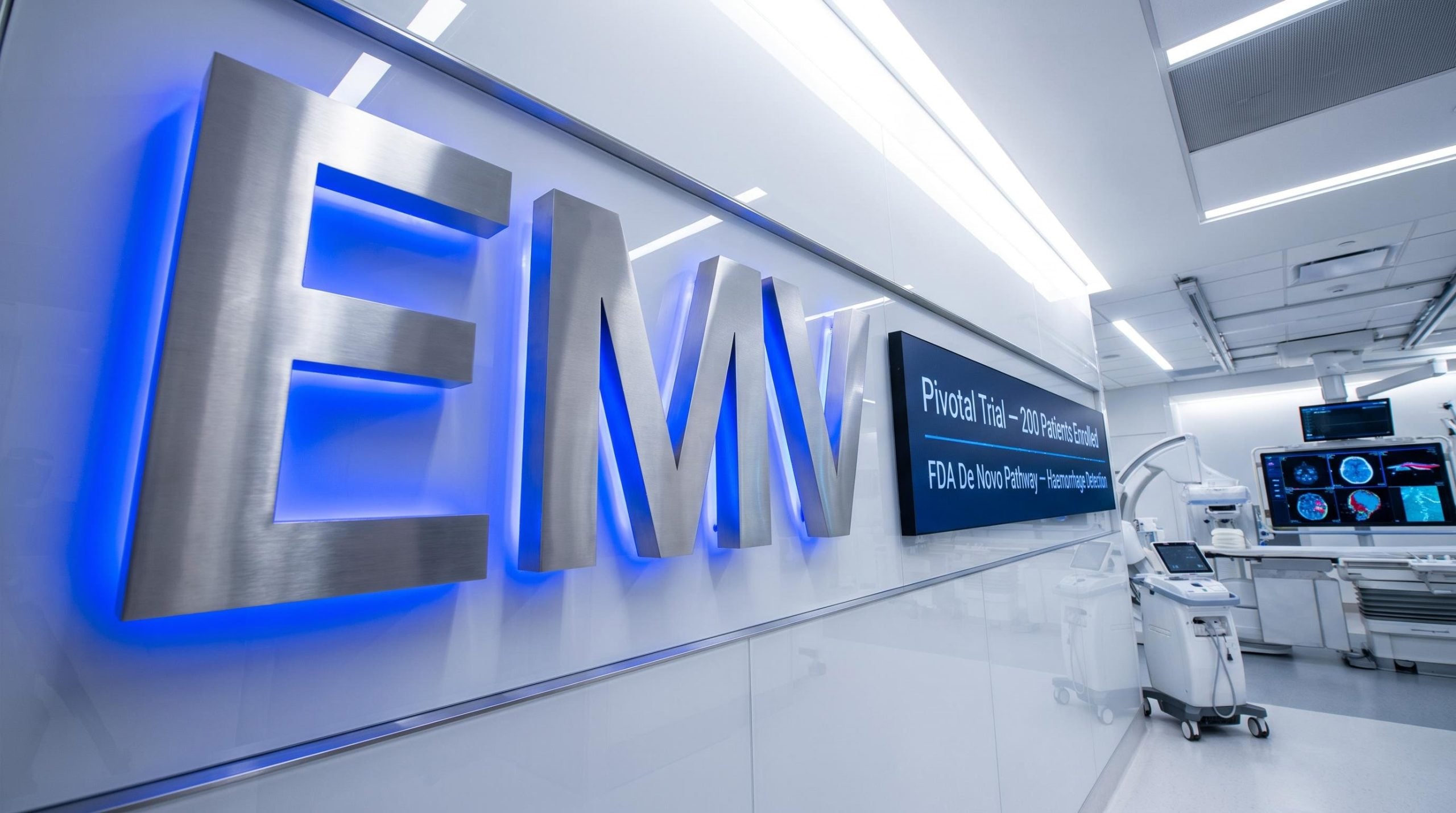
emu™ Pivotal Trial recruitment surpasses 200 patients
EMVision Medical Devices (ASX:EMV) has confirmed that recruitment for its emu™ Pivotal (Validation) Trial has surpassed 200 patients across training and primary analysis cohorts, with record recruitment recorded in July.
The company reported no device-related adverse events to date, with the emu™ point-of-care Brain Scanner integrating into “code stroke” pathways at participating hospitals. Mayo Clinic clinicians will present an “Early Experience” paper on the device at Amelia Island, Florida, in October 2026.
The milestone supports the company’s planned FDA De Novo clearance pathway, with full enrolment targeted for early CY2027. For investors, crossing the 200-patient mark provides a tangible signal that the trial ramp-up is translating into accelerating enrolment ahead of a regulatory submission.
When big ASX news breaks, our subscribers know first
Recruitment momentum builds across US and Australian sites
Recruitment has accelerated on the back of trial ramp-up initiatives, protocol enhancements and expanded hours of coverage at participating sites. EMVision described these measures as key contributors to the recent uplift in enrolment.
Additional US academic medical centres referred into the study are in the process of being added to the trial, expanding recruitment capacity and deepening engagement with the US stroke community ahead of planned commercialisation.
Recruiting sites currently include:
-
Mayo Clinic (Jacksonville, Florida)
-
Mount Sinai Hospital and Mount Sinai West (New York)
-
Ronald Reagan UCLA Medical Center (California)
-
Memorial Hermann (Texas Medical Center and Memorial City, Texas)
-
Royal Melbourne Hospital (Victoria) and Liverpool Hospital (New South Wales)
-
Princess Alexandra Hospital (Queensland), transitioning in from the Continuous Innovation Study
CEO Commentary
“Crossing 200 patients is an important milestone that demonstrates our recruitment initiatives are contributing to enrolment acceleration. We are also excited to see the Mayo Clinic clinicians share their early experience with the emu™ at the Stroke and Cerebrovascular Disease Review at Amelia Island this October, where our team will be on site showcasing EMVision technology to the US stroke community,” said Scott Kirkland, CEO and Co-Founder.

Understanding the Pivotal (Validation) Trial and FDA De Novo pathway
The emu™ is EMVision’s 1st generation point-of-care Brain Scanner, designed to enable earlier triage, transfer or treatment decisions at the bedside for time-sensitive medical emergencies such as stroke. It is the precursor and predicate to the company’s 2nd generation portable Brain Scanner, the First Responder, designed for pre-hospital environments.
Stroke occurs when blood flow to part of the brain is interrupted. This can happen through a blocked vessel (ischaemic stroke) or bleeding into the brain (haemorrhagic stroke). Because different stroke types require different care, fast and accurate diagnosis is critical to improving patient outcomes.
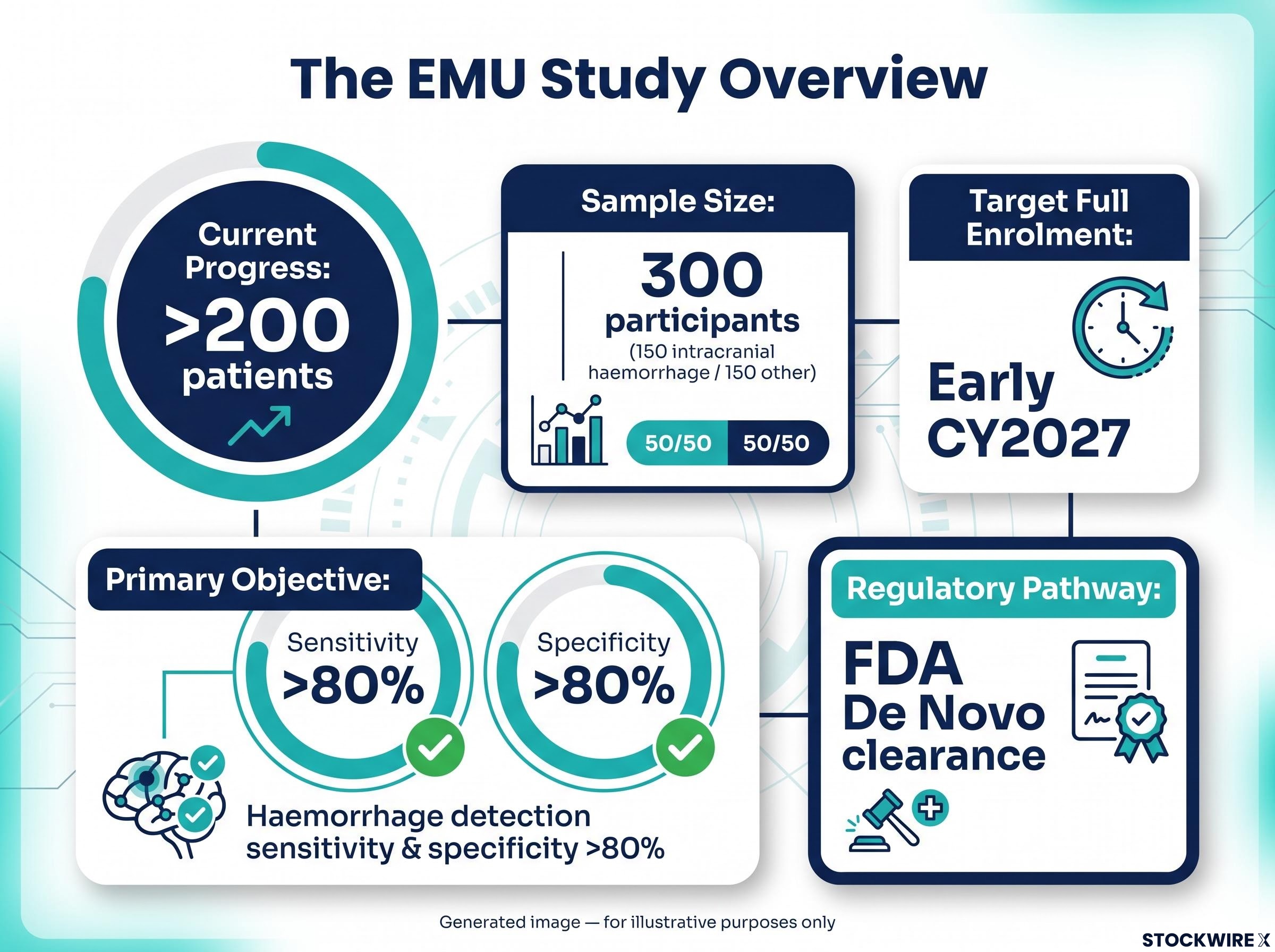
The trial is a multi-centre, prospective, blinded diagnostic study designed to support FDA De Novo clearance of the emu™. The primary objective is to demonstrate haemorrhage detection sensitivity and specificity of greater than 80%.
| Parameter | Detail |
|---|---|
| Study title | The EMU Study |
| Design | Multi-centre, prospective, consecutive, paired diagnosis, diagnostic performance study |
| Primary objective | Haemorrhage detection sensitivity & specificity >80% |
| Sample size | 300 participants (150 intracranial haemorrhage / 150 other) |
| Target full enrolment | Early CY2027 |
Dual-endpoint strategy could save up to two years and multimillion dollars
Preparations to add an acute ischaemia detection endpoint to the trial, alongside haemorrhage detection, continue to advance. Rather than conducting a separate validation program for ischaemia detection in the future, this approach leverages the same patient cohort, trial infrastructure and regulatory pathway already in place.
The ischaemia detection endpoint expansion was first announced in May 2026, when EMVision outlined how integrating the endpoint into the existing trial could avoid a standalone supplementary program and extend the addressable stroke population to approximately 80% of all presentations.
According to EMVision, this could potentially save up to two years and multimillion-dollar costs compared with a standalone program. Critically, simultaneous validation would enable the emu™ to address both major stroke types from its first release, expanding the device’s clinical utility and addressable patient population.
FDA pre-submission (Q-Sub) engagement on the proposed ischaemia endpoint is planned in the coming months, building on the company’s active and ongoing engagement with the FDA regarding the De Novo pathway. EMVision noted that the addition may require a modest adjustment to the sample size, with the final design subject to the planned Q-Sub engagement.
Growing clinical engagement and scientific validation
Mayo Clinic clinicians will present preliminary findings from an “Early Experience” paper on the emu™ Brain Scanner at the 18th Annual Mayo Clinic Stroke and Cerebrovascular Disease Review, Amelia Island, Florida, in October 2026. EMVision is also participating in a technology showcase at the conference, engaging directly with the US stroke community.
The company’s technology also featured this month at the Australia and New Zealand Stroke Organisation Conference 2026 in Brisbane, including:
-
Dr Angela Dos Santos on the pivotal validation of the emu™ device in suspected stroke
-
Dr Michael Devlin on interpretable AI algorithms for stroke assessment using the bedside scanner
EMVision noted that clinician-led presentations at leading scientific forums continue to build awareness and advocacy for its technology ahead of commercialisation.
The interpretable AI algorithms underpinning the emu™ have received peer-reviewed AI stroke detection validation in npj Digital Medicine, a Nature-portfolio journal, with the published models achieving 95% sensitivity for ischaemic stroke and 92% for haemorrhagic stroke on unseen data.
Continuous Innovation Study feeding AI model development
Alongside the Pivotal (Validation) Trial, EMVision is running a parallel Continuous Innovation Study, which has recruited more than 150 patients across multiple Australian sites, including John Hunter Hospital, Box Hill Hospital and Princess Alexandra Hospital. The study provides cost-effective training data to support the ongoing development of the AI diagnostic models for the emu™.
Under the Pivotal Trial protocol, EMVision is only required to provide the AI diagnostic model at the conclusion of patient enrolment. This means the team can continue to refine the models, including incorporating additional patient training data as enrolment progresses, until the algorithm freeze ahead of the trial’s blinded performance analysis.
What’s next for EMVision investors
EMVision has outlined the following upcoming milestones for the emu™ program:
-
Continued site activations and enrolment milestones
-
FDA pre-submission (Q-Sub) engagement on the ischaemia endpoint
-
Full trial enrolment targeted for early CY2027
-
Sequential cohort readouts to follow shortly thereafter
-
FDA De Novo submission for the first-generation emu™ device
Each milestone works to de-risk the path toward FDA clearance and commercialisation. The dual-endpoint strategy, if progressed as planned through the Q-Sub process, could widen the addressable market by positioning the emu™ to address both major stroke types from its first release.
Don’t Miss the Next Healthcare Breakthrough on the ASX
Big News Blast delivers FREE breaking ASX healthcare news directly to your inbox within minutes of release, complete with in-depth analysis already done for you. Join 20,000+ subscribers who stay ahead of the market on stock-moving announcements. Click the “Free Alerts” button at StockWire X to start receiving alerts the moment news breaks.