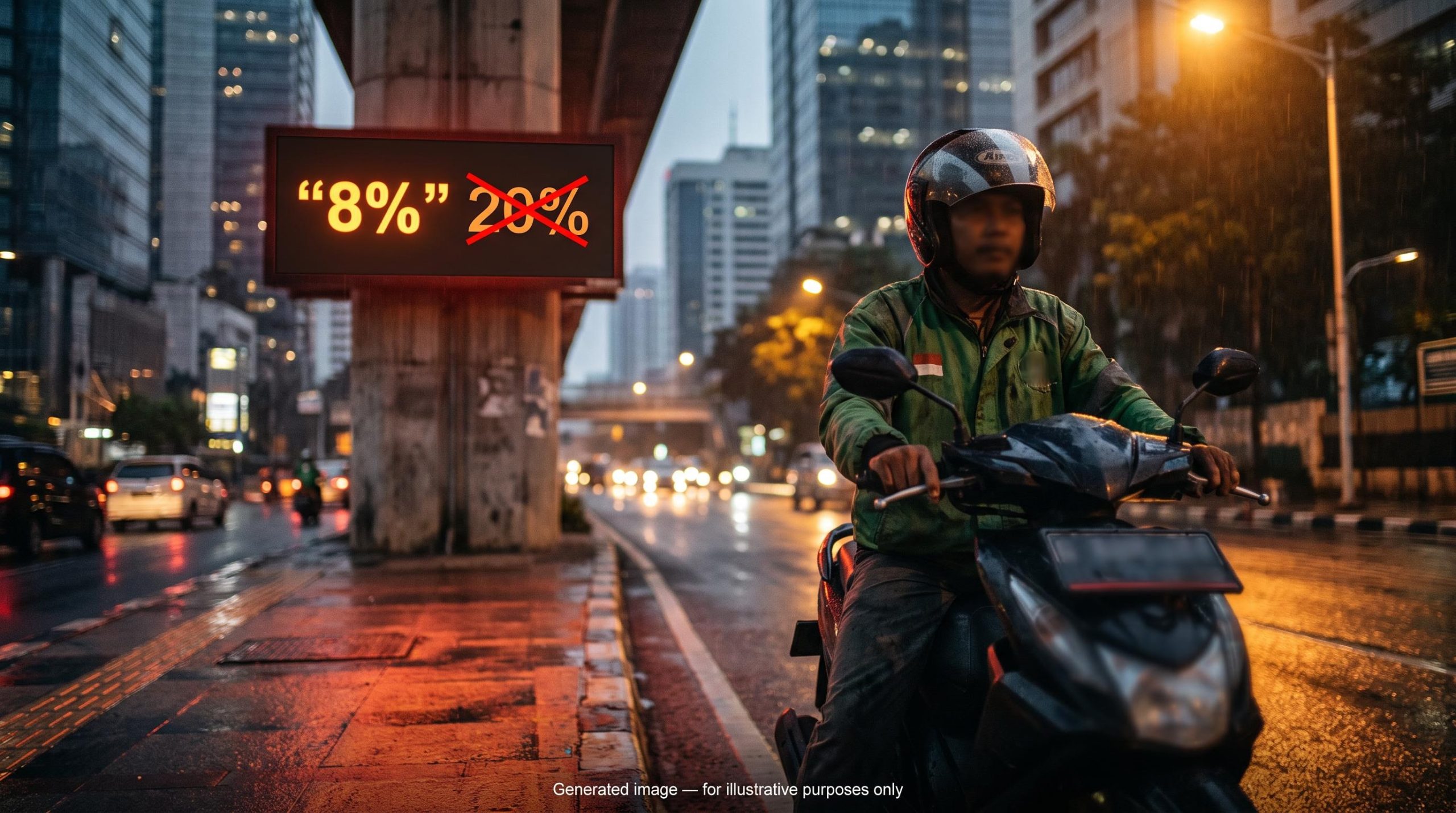
Overnight, the arithmetic of Indonesia’s ride-hailing economy changed. Platforms that once took roughly 20% of every fare now take 8%, a 60% reduction in their cut, imposed by presidential decree with drivers guaranteed at least 92% of what they earn. That is not a gradual renegotiation. It is a revenue model rewritten by law.
This is not an isolated policy experiment. In Vietnam, Grab drivers staged a two-day app boycott over falling earnings and rising fuel costs. Grab’s own Q2 2026 disclosures tie climbing driver incentive spending directly to fuel-price shocks across the region. Regulatory pressure from above and organised labour pressure from below are converging on the same thin-margin business model.
For anyone weighing gig economy stocks in emerging markets, what happened in Indonesia in July 2026 is a working proof-of-concept for how fast platform economics can be reshaped. After reading this, you will have a framework for treating regulatory risk and labour risk as distinct, measurable investment factors, not just for Grab in Indonesia, but for any gig platform operating where worker welfare has become a political priority.
How a 60% cut in platform take-rates became law in Indonesia
The commission cut arrived on a political calendar, not an administrative one. President Prabowo Subianto announced the 8% cap on 1 May 2026 as part of a package of May Day policies, framed explicitly around driver welfare and the rising cost of living. The timing was the point: a populist government signalling to millions of gig workers that it was on their side.
From announcement to enforcement took roughly two months. Here is the sequence that turned a May Day pledge into an operational rule:
The Business Times reporting on the commission cut confirmed that GoTo and Grab Indonesia would implement the 8% cap effective 1 July 2026, with company executives on record acknowledging the change, providing independent journalistic verification of a policy that moved from presidential announcement to operational rule in under two months.
- 1 May 2026: President Prabowo announces the 8% commission cap as a May Day welfare measure.
- 23 June 2026: Reuters reports that GoTo and Grab Indonesia will lower per-trip commissions for two-wheeled drivers to 8% from 20%, effective 1 July.
- 1 July 2026: The cap takes effect.
- 29 July 2026: Indonesian state broadcaster RRI confirms the scheme has been operational since 1 July.
- 2-4 September 2026: Coverage confirms the cap is scoped to motorcycle (“ojol”) services, leaving four-wheeled vehicles unaddressed.
The economic logic sits in a single number.
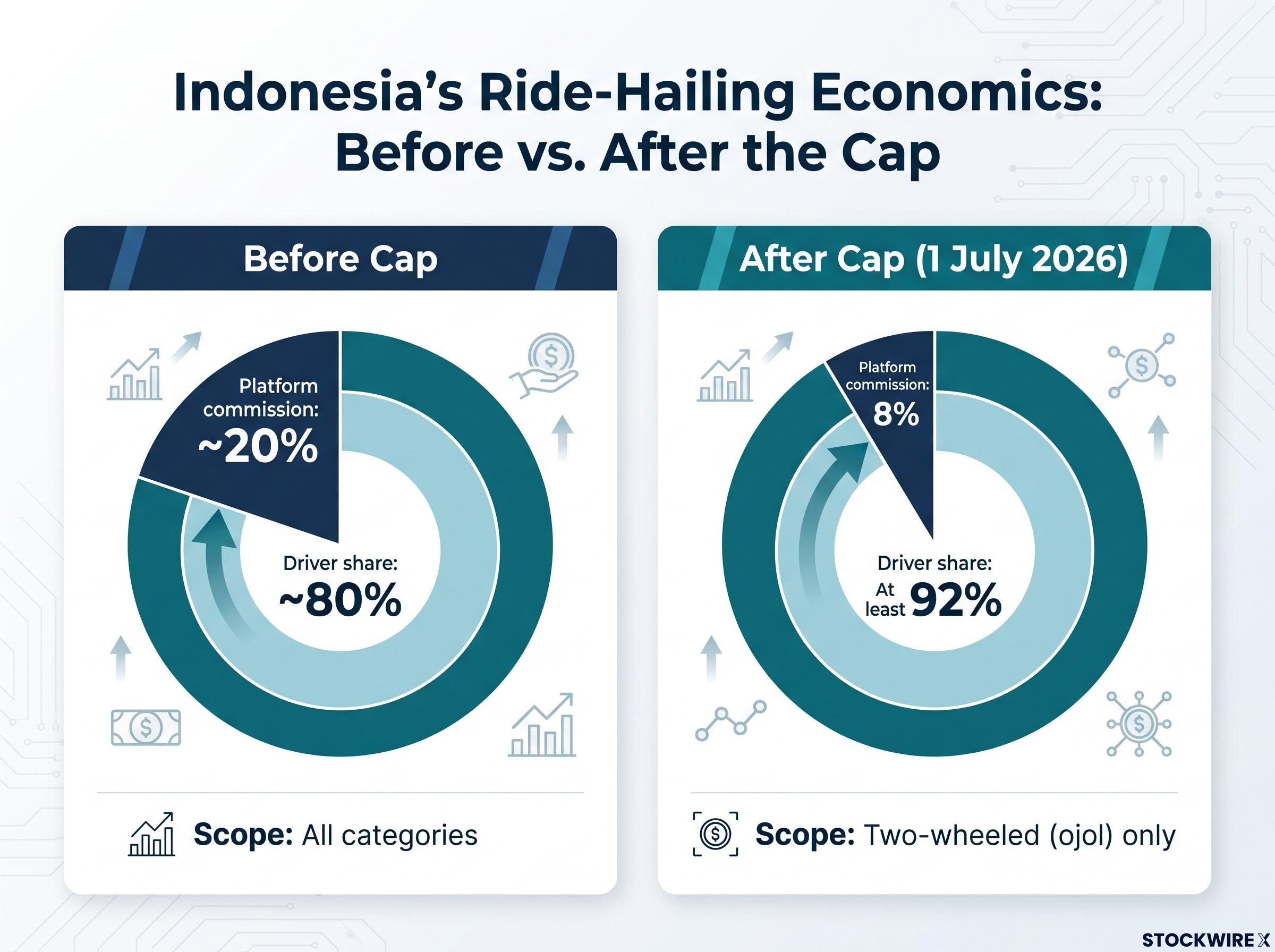
The core shift: Drivers are now guaranteed at least 92% of each fare, up from an 80:20 split that handed platforms roughly one fifth of revenue.
Here is the before-and-after in full.
| Metric | Before cap | After cap |
|---|---|---|
| Platform commission rate | ~20% | 8% |
| Driver earnings share | ~80% | At least 92% |
| Effective date | Prior structure | 1 July 2026 |
| Vehicle scope | All categories | Two-wheeled (ojol) only |
Indonesia’s two-wheel business is only about 6% of Grab’s total Mobility gross merchandise value (GMV), the total value of transactions flowing through the platform. That figure will tempt you to file this away as immaterial. Do not. The number to price in is not the sliver of revenue affected today; it is the precedent of a government unilaterally cutting a platform’s take-rate by 60% in two months, with no drawn-out consultation. That speed tells you how much runway to expect before a similar move lands elsewhere.
When big ASX news breaks, our subscribers know first
What Grab’s financials reveal about the margin math of gig platform economics
On the surface, Grab looks like a company with nothing to worry about. On-demand GMV rose 21% year-on-year to US$6.5 billion in Q2 2026. Adjusted EBITDA, a measure of core operating profit before interest, tax, and non-cash items, grew 54% to US$168 million, the 18th consecutive quarter of growth. Monthly transacting users hit a record 54 million, and EBITDA margin expanded to 16.9% of revenue from 13.3% a year earlier.
That is the headline. The tension sits one line down.
The incentive line tells a different story
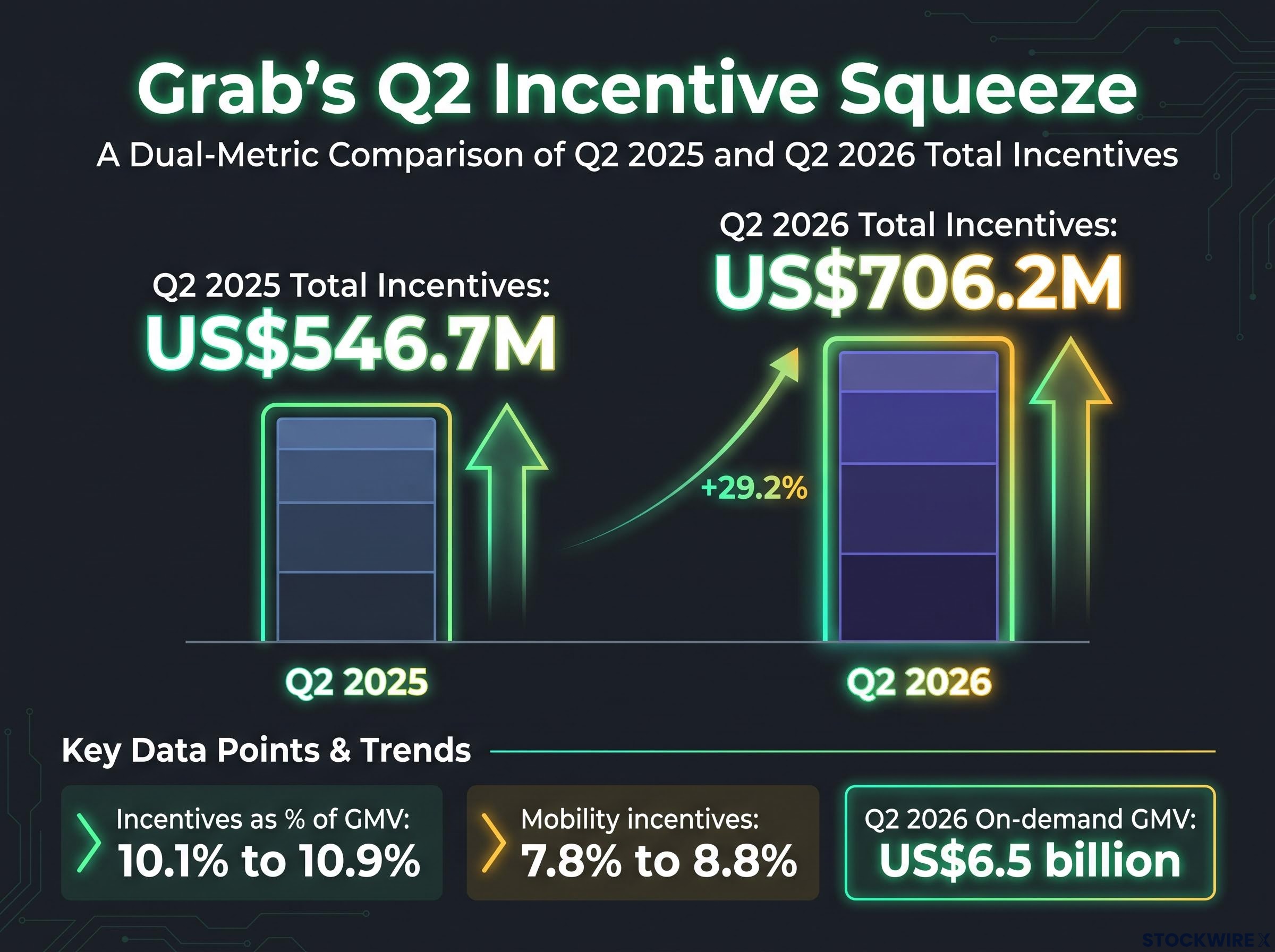
To keep drivers on the platform, Grab pays incentives, and those payments are climbing. Total incentives reached US$706.2 million in Q2 2026, up from US$546.7 million a year earlier, a rise of roughly US$159.5 million. As a share of on-demand GMV, incentives climbed from 10.1% to 10.9%.
| Metric | On-demand GMV | Adjusted EBITDA | Total incentives | Incentives (% GMV) |
|---|---|---|---|---|
| Q2 2026 | US$6.5B (+21%) | US$168M (+54%) | US$706.2M | 10.9% |
| Q2 2025 | Base period | Base period | US$546.7M | 10.1% |
| EBITDA margin (% revenue) | 16.9% (Q2 2026) | 13.3% (Q2 2025) | +360bps |
The pressure is not confined to one segment. Mobility incentives rose from 7.8% to 8.8% of GMV, while Deliveries incentives climbed too. Grab has been explicit about why.
Grab’s Q1 and Q2 2026 disclosures link higher partner incentives directly to the need to support driver earnings “in light of increased fuel costs across the region.”
The significance lands in the Mobility margin. That segment’s adjusted EBITDA came in at roughly 8.6% of GMV, sitting just inside management’s guided range of 8.5-9%. There is no cushion. The margin buffer that makes profitability durable is already thin before any regulatory commission cap fully works its way through the results.
The incentive ratio as a leading indicator of margin pressure
When you assess a gig platform, the incentive ratio matters more than the headline EBITDA figure. Absolute profit tells you where the company is today. The ratio tells you how expensive it is getting to stay there.
An 80 basis point rise in that ratio, across both Mobility and Deliveries at once, signals the squeeze is platform-wide, not a quirk of one business line. Grab is already spending more to hold driver supply in place before the full effect of Indonesia’s cap shows up.
That matters because of how the two sides of the equation move. If regulators cap the revenue side while fuel costs push up the cost side, the incentive ratio is the exact line that shows how much room is left before a segment tips from thin profit into loss. Current guidance assumes a cost floor that both regulators and fuel prices can breach.
The regulatory and labour risk framework for gig economy investors
The Grab case is useful precisely because it separates cleanly into two risks investors habitually blur together. Regulatory risk and labour risk have different triggers, different timelines, and different implications for a position. Treating them as one generic “emerging market” concern leaves money on the table.
The structural risks visible in Indonesia sit within a broader pattern that shapes emerging market investing across the region: political cycles, thin institutional guardrails, and rapid policy shifts compress the timeline between announcement and enforcement in ways that developed-market investors routinely underestimate.
What distinguishes regulatory risk from labour risk in platform companies
Regulatory risk is externally imposed and binary. A commission cap either applies or it does not. When it lands, as Indonesia’s did, it is primarily a margin risk: the platform’s revenue share is legislated down, and there is no phased adjustment period to soften the hit.
Labour risk is internally negotiated and incremental. It is primarily a supply risk. Before any regulator acts, drivers can withdraw, as Vietnamese Grab drivers did with their two-day app boycott over declining earnings and fuel costs. That thins driver availability and forces the platform to raise incentives to keep cars and bikes on the road.
The two interact, and the direction of causation matters. Driver boycotts in Vietnam preceded and may have shaped the political environment that produced Indonesia’s cap. In the same region, labour risk can be a leading indicator of regulatory risk.
Watch these signals for regulatory risk before a cap is announced:
- Political cycle timing, especially populist governments seeking worker-friendly wins
- Cost-of-living pressure that makes gig worker income a live political issue
- Driver earnings share measured against regional wage benchmarks
- Analyst commentary flagging contagion, as Barclays did on the Q2 earnings call
- Policy announcements in adjacent markets
And these for labour risk:
- Driver boycott or organised action activity
- Fuel price trajectory, the single biggest input into driver economics
- The earnings gap between platform rates and alternative employment
- Union or collective action signals
The Barclays question is the signal to take most seriously. When a major institutional analyst is publicly asking management about regulatory contagion on a live earnings call, the market is already pricing uncertainty. Grab COO Alex Hungate acknowledged that fuel-price volatility and driver-support programmes are now embedded in guidance, reducing operational flexibility. If you have not built these two risks into your model, you are behind the analysts who have.
Regional contagion and the limits of the super-app hedge
This brings the hardest question the evidence raises. Does Grab’s super-app structure genuinely insulate it from regulatory contagion, or does it create the illusion of diversification while concentrating risk in the same underlying political economy?
The bull case and bear case sit in direct opposition.
The bull case:
- Diversification across markets and services means any single cap affects a limited share of GMV
- The ojol business is only about 6% of Mobility GMV and remains adjusted-EBITDA positive under the cap
- Mobility margin stays within guidance, and Grab lifted its annual revenue forecast on 3 August 2026, citing AI-driven efficiencies
The bear case:
- The super-app operates in the same regional regulatory environment, and a precedent set in Indonesia is visible to every government in Southeast Asia
- Uber has already exited the region, leaving Grab with no major market to retreat to
- Incentive ratios are rising before caps have fully landed
Management’s arithmetic on the 6% is correct as far as it goes. The ojol segment is small and still profitable under the new rules. But that arithmetic rests on an assumption: that caps stay scoped to two-wheeled services and do not spread to four-wheeled or delivery categories. Indonesia’s own regulatory focus has not been formally confirmed as fixed at two wheels.
Barclays raised regulatory contagion directly on Grab’s Q2 2026 earnings call, questioning the risk of other markets adopting comparable commission caps.
As of September 2026, Thailand, the Philippines, Malaysia, and Vietnam have not enacted comparable caps. The absence of a formal announcement is not the same as the absence of risk, particularly given the political economy already visible in Indonesia and the driver unrest already visible in Vietnam.
Here is the detail that makes this structurally different from a global platform absorbing a localised shock. Because Uber left, Grab has no major Southeast Asian market it can exit if regional pressure intensifies. The diversification benefit of the super-app model has a geographic ceiling. It hedges against any single cap; it does not hedge against the whole region moving in the same direction.
Platform exit dynamics in Southeast Asia matter here because Uber’s withdrawal from the region removed the competitive counterweight that would otherwise constrain Grab’s exposure to any single regulatory environment, leaving Grab with no comparable market to absorb the impact if regional caps multiply.
Pricing regulatory and labour risk before the next policy announcement
Three pressures run through this analysis, and they are best read as a single cluster rather than three separate events. Government-imposed commission caps compress the revenue side. Organised labour action threatens driver supply. Fuel-price-driven incentive costs push up the expense side. Each amplifies the others, and all three land on the same thin margin.
The Mobility segment’s roughly 8.6% EBITDA margin, with no stated buffer, is where they converge. The US$706.2 million Q2 incentive bill is the baseline cost of holding driver supply today, before any new regulatory requirement. And Indonesia’s two-month window from announcement to enforcement is the benchmark for how fast a margin assumption can be invalidated.
Three forward-looking variables will decide whether the pressure accelerates or stabilises:
- Whether Indonesia’s cap expands from two-wheeled to four-wheeled services.
- Whether Thailand, the Philippines, Malaysia, or Vietnam enact comparable measures.
- Whether fuel costs normalise or stay elevated, and which way the incentive ratio moves next.
The takeaway is a framework you can apply to any gig platform in an emerging market. Assess three factors separately rather than collapsing them into a generic risk discount:
A probability-based risk framework clarifies why monitoring signals matter more than reacting to announcements: assigning explicit likelihoods to regulatory cap expansion, contagion across Vietnam or Thailand, and fuel-cost trajectories forces the kind of Bayesian updating that separates a priced-in position from one that absorbs a shock after it lands.
- Regulatory risk: the chance a government intervenes on take-rates, imposed suddenly and primarily hitting margin.
- Labour risk: the chance driver action disrupts supply, incremental and often a leading indicator of the regulatory move that follows.
- Macro sensitivity: exposure of incentive obligations to fuel prices and cost-of-living pressure.
The Indonesian case shows this is not vague uncertainty. It is a specific, measurable mechanism with a defined timeline and a clear channel to the income statement. Price it as such, and you are ahead of the next announcement rather than reacting to it.
This article is for informational purposes only and should not be considered financial advice. Investors should conduct their own research and consult with financial professionals before making investment decisions. Past performance does not guarantee future results, and forward-looking statements are speculative and subject to change based on market developments and company performance.