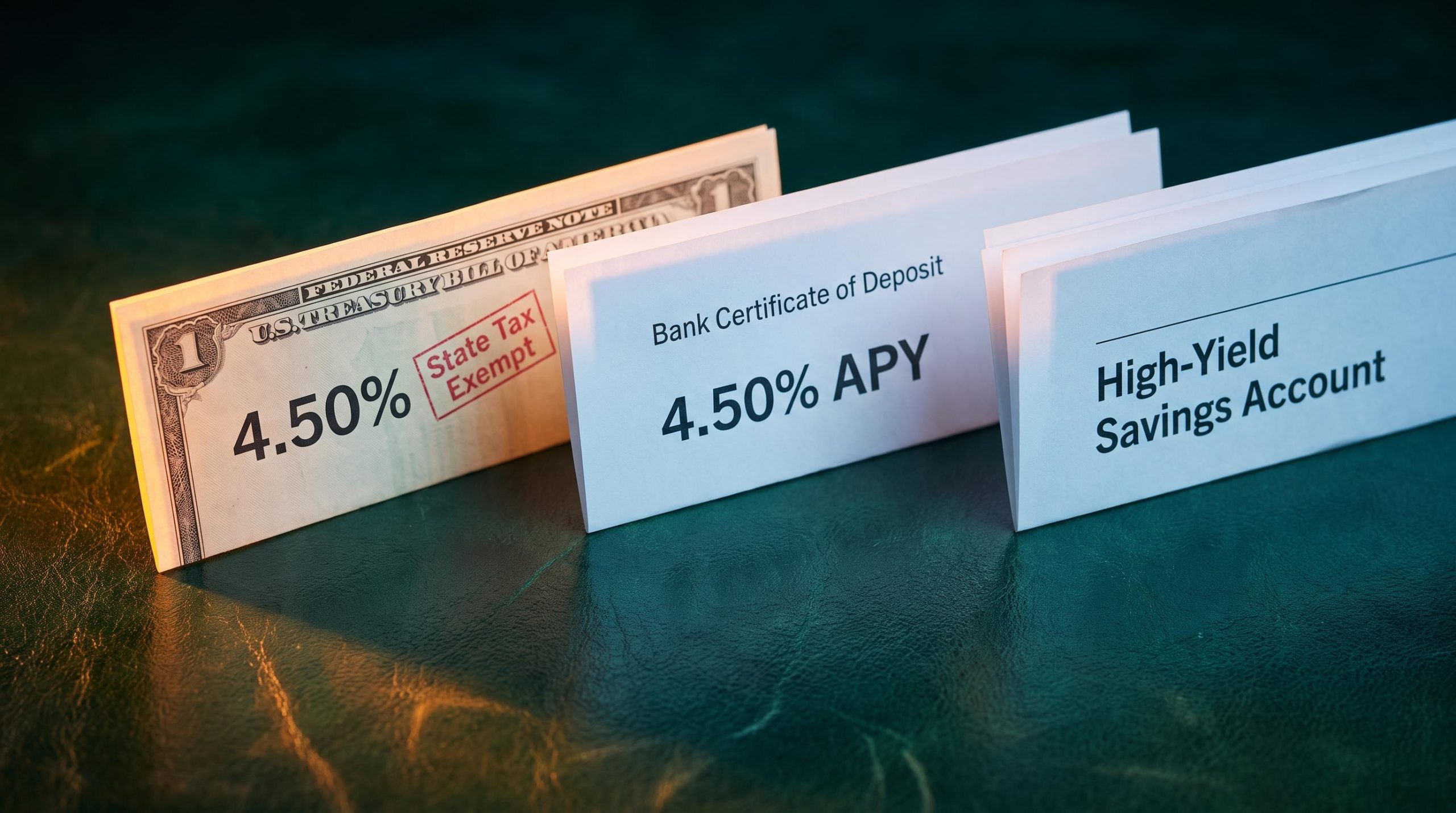
Three years ago, a typical bank savings account paid you almost nothing, often a fraction of a percent. Today, the best high-yield savings accounts, certificates of deposit, and Treasury bills are paying between roughly 3.7% and 4.5%. If your cash is still sitting in an old savings arrangement, it is quietly earning far less than it could.
This matters right now because the window is dateable. The Federal Reserve is holding its target rate at 3.50%-3.75% as of September 2026, with projections pointing toward gradual easing toward 3.25% by 2027-2028. Savers who have not optimised their short-term cash are leaving yield on the table, and that opportunity will not stay this generous forever.
The problem is that these three vehicles are not interchangeable. Each carries its own tax treatment, liquidity profile, and risk. The right choice for a retiree in California is the wrong choice for a saver in Texas.
Here is the practical sorting tool. After reading, you will know which of these three vehicles fits your tax situation, your liquidity needs, and your time horizon, and why the answer genuinely differs from person to person.
What each vehicle actually offers right now
Start with the headline numbers, because they set up everything that follows. The three options are close enough that the winner is rarely the one with the biggest advertised rate.
Treasury bills, which are short-term debt issued by the US government, currently yield roughly 3.7% to 3.9% depending on the term. The 4-week T-bill yields about 3.72% on the interbank market (3.66% on a discount basis), while the 13-week T-bill yields around 3.90% on a coupon-equivalent basis. That aligns with the CBOE 13-Week Treasury Bill Yield Index (^IRX), trading near 3.84%.
Certificates of deposit, or CDs, lock your money away for a fixed term in exchange for a fixed rate. Top nationally available 6- and 12-month CDs currently run between roughly 4.30% and 4.50% APY.
Here are some of the competitive issuers grounding that range:
- Quorum Federal Credit Union: top 6-month CD at 4.30% APY
- Happen Bank: 4.20% APY
- Accordia Bank and Popular Direct: 4.15% APY
- Synchrony Bank: 4.10% APY
- Suncoast Credit Union: top 12-month CD at 4.50% APY, with broadly available 1-year CDs in the 4.00%-4.27% APY range
High-yield savings accounts (HYSAs) round out the trio, offering up to roughly 4.50% APY at leading online institutions such as GO2bank and St. Mary’s Credit Union. Most online banks sit in the 4.01%-4.34% range, with CIT Bank near 4.10%. The catch is the rate type: HYSA rates are variable, so today’s headline number is not guaranteed tomorrow.
Series I bonds represent one of the less-discussed savings account alternatives in this environment, offering a 4.26% composite rate for the May-October 2026 window along with the same state-tax exemption as T-bills, though the $10,000 annual cap and 12-month minimum hold make them a complement to the three main vehicles rather than a direct substitute.
| Vehicle | Current Yield Range | Rate Type | Backing | Minimum to Open |
|---|---|---|---|---|
| T-Bills | ~3.7%-3.9% | Fixed to maturity | US government (no cap) | Via TreasuryDirect |
| CDs | ~4.30%-4.50% APY | Fixed | FDIC insured | Varies by issuer |
| HYSAs | ~4.01%-4.50% APY | Variable | FDIC insured | Often $0 |
Notice how tight that spread is. The gap between the best CD and the best T-bill is well under one percentage point. That narrowness is the whole point: because the raw yields sit so close together, your decision should turn on tax treatment and liquidity fit, not on chasing the highest advertised number.
When big ASX news breaks, our subscribers know first
The tax edge that changes the math for many savers
This is where the comparison stops being simple, and where a lower advertised rate can quietly win. T-bill interest is federally taxable as ordinary income but fully exempt from state and local income taxes (per IRS Topic 403 and Publication 550). CD and HYSA interest is taxable at every level, with no exemptions.
For savers in high-tax states, that exemption is not a footnote. It is a yield reversal.
Consider a 9% state bracket. A 4.50% CD drops to a 4.09% after-tax yield once the state takes its cut. A 4.50% T-bill keeps the full 4.50%. Same headline rate, meaningfully different result in your pocket.
The formula that makes this concrete is worth keeping.
The break-even rule: The CD yield you need to match a T-bill equals the T-bill yield divided by (1 minus your state tax rate).
Run it for California, in a 24% federal and 9.3% state bracket. A 1-year CD at 4.10% yields roughly 2.73% after tax. A 1-year T-bill at 4.05%, despite the lower headline, yields about 3.08% after tax. The lower-rate instrument comes out ahead.

The dollar impact scales quickly. A California top-bracket retiree with $250,000 in T-bills at 4.15% saves roughly $1,381 annually in state taxes. A top-bracket saver in New York avoids more than $1,100 per year on the same Treasury income. Under California’s 13.3% top bracket, a 4.40% CD delivers effectively 3.81% after state tax, meaning T-bills at 4.70% outperform CDs yielding under roughly 5.42%.
The practical takeaway is direct: if you live in a high-tax state, the vehicle with the smaller advertised rate may put more money in your hand after you file. Knowing your state bracket is a prerequisite for any honest comparison here.
Choosing the right vehicle for short-term cash is one layer of a broader tax-efficient portfolio structure that also covers which account types hold which assets: placing T-bill income inside a tax-advantaged account, for instance, forfeits the state-tax exemption entirely, making account location a variable that cuts across all three vehicles in this comparison.
When the exemption disappears: no-income-tax states
The picture flips entirely for savers in US states with no income tax, such as Texas, Florida, and Washington.
If you live in one of these states, the T-bill exemption confers no benefit whatsoever. A 4.50% CD and a 4.50% T-bill deliver identical after-tax yields.
| State Tax Rate | After-Tax CD/HYSA Yield (on 4.50%) | After-Tax T-Bill Yield (on 4.50%) | T-Bill Advantage |
|---|---|---|---|
| 0% | 4.50% | 4.50% | 0 bps |
For no-tax-state savers, the comparison shifts to pure yield, liquidity, and the question of FDIC insurance versus government backing. There is no tax arbitrage to chase, so the highest reliable headline rate simply wins.
Liquidity, penalties, and how to think about the right fit
Getting your money out means something different depending on which product you hold. Liquidity is not a simple yes-or-no; it runs along a spectrum, and where each vehicle sits determines whether your yield advantage survives contact with a real cash need.
- HYSAs (liquidity-first): No penalties, no market risk on exit, funds accessible on short notice. Best fit for emergency funds and goals under six months. The trade-off is exposure to unannounced, bank-initiated rate cuts at any time.
- CDs (the lock-in vehicle): Best for known horizons of roughly six months to two years. The fixed rate shields you from bank-initiated cuts if the Fed eases, but early withdrawal penalties can wipe out the rate advantage, making CDs unsuitable for money you might need suddenly.
- T-bills (conditional liquidity): No formal early withdrawal penalty, but accessing principal before maturity means selling on the secondary market. Because bond prices and yields move inversely, an early sale after rates have risen can produce a loss. Hold to maturity and your rate is locked; exit early and you are exposed.
There is a second timing risk worth naming. Because T-bills and short-term CDs mature quickly, they carry reinvestment risk, the chance you roll maturing funds into lower-yielding instruments if the Fed cuts. With projections pointing toward easing toward 3.25% by 2027-2028, that is a live concern.
The opposite risk also applies. Financial planners Kody Sherlund and Marguerita Cheng have warned that locking into fixed 4%-5% yields creates duration risk: if inflation expectations settle higher, you carry an opportunity cost against newer, higher-yielding issues.
So the right vehicle depends less on which rate is highest and more on when you realistically need the money. Buy a CD for your emergency fund, or sell a T-bill early in a rising-rate market, and you erode the very advantage these products exist to deliver.
The distinction between a right-sized emergency reserve and idle surplus capital matters here: Federal Reserve data shows middle-wealth households hold roughly 15% of total assets in cash, far above the 3-6 month essential-expenses threshold that financial planning benchmarks identify as the functional ceiling for penalty-free liquidity.
FDIC insurance vs. US government backing: does it matter?
For most savers, both protections are equally reassuring, but the distinction sharpens at higher balances.
CDs and HYSAs carry FDIC insurance up to applicable limits. T-bills carry no dollar cap at all, because they are direct obligations of the US government.
The FDIC deposit insurance coverage rules cap protection at $250,000 per depositor, per insured institution, per ownership category, meaning a saver with $400,000 at a single bank holds $150,000 outside the insurance umbrella regardless of whether it sits in a CD or a high-yield savings account.
If your cash exceeds FDIC limits, this becomes a genuine safety consideration. T-bills resolve the coverage gap in one step, without forcing you to spread money across multiple bank relationships just to stay insured.
Treasury accounts and automated ladders: the emerging middle ground
The historical objection to T-bills was never the yield or the tax treatment. It was the friction. Buying, tracking, and rolling bills at auction felt like work compared with opening a savings account. That friction is now largely automated.
An emerging product category, often called a “treasury account,” functions like an online savings account but automatically directs your cash into T-bills. You capture government yields and the state-tax exemption with savings-account-level simplicity.
Automated reinvestment now takes three main forms, ordered here by how directly a retail saver can access them:
- TreasuryDirect self-scheduled reinvestment: You can schedule maturing bills to roll into new bills of the same term, up to four business days before the relevant auction. If the new bill’s price exceeds your maturing proceeds, the system draws the difference from a linked bank account or cancels the reinvestment.
- Brokerage auto-roll programs: Services such as Fidelity’s Auto Roll cover 4-, 6-, 13-, and 26-week bills. Maturing principal rolls into new issues automatically, while the interest generated sweeps into your core cash or money market position.
- Fintech and corporate platforms: Platforms like Meow let businesses and individuals buy, ladder, and auto-roll Treasury bills. These operate outside FDIC insurance because funds are held in US government credit rather than bank deposits.
That last point deserves a clear flag.
Read this before you switch: Treasury account platforms hold your money in US government securities, not bank deposits, so they are not FDIC-insured. For savers above coverage limits, that is a feature. For anyone who prioritises deposit insurance, it is a consideration to weigh.
Here is why this changes the calculus. If you previously chose a HYSA purely for convenience, automation has collapsed the main reason to avoid T-bills. The choice between them is now sharper than it has ever been.
Matching your situation to the right vehicle
Enough theory. The correct vehicle depends on who you are, so work from your own profile rather than an abstract ranking.
| Profile | Best Vehicle | Key Reason | Watch Out For |
|---|---|---|---|
| Liquidity-first saver (emergency fund, under 6 months) | HYSA | No penalties, instant access, no market risk on exit | Variable rate can be cut without notice |
| High-tax-state saver, known horizon | T-Bills | State-tax exemption lifts after-tax yield above CDs | Secondary-market price risk if sold early |
| Rate-lock seeker, low/no-tax state, known horizon | CDs | Highest headline yield, fixed and protected from cuts | Early withdrawal penalties |
| Saver above FDIC limits | T-Bills | Unlimited government backing plus tax edge | Not FDIC-insured (backed by government instead) |
For the high-tax-state saver, the break-even formula from earlier is your working tool: divide the T-bill yield by (1 minus your state rate) to see the CD yield you would actually need to match it.
Now layer in timing. The Fed funds rate sits at 3.50%-3.75%, with a projected year-end 2026 level near 3.75% and a path stepping toward 3.25% by 2027-2028. Short-duration vehicles mature into that lower-rate environment if the easing arrives on schedule.
That is the cost of staying put. Choosing a variable-rate HYSA by default is itself a decision, and it carries a real price if the Fed begins cutting before you lock in a term instrument for a horizon you already know.
This article is for informational purposes only and should not be considered financial advice. Investors should conduct their own research and consult with financial professionals before making investment decisions. Past performance does not guarantee future results. Financial projections are subject to market conditions and various risk factors.
Locking in now before the window narrows
The current environment rewards an active choice, and rewards it across all three vehicles. Yields in the 4% range on genuinely low-risk cash are unusual after 15 years of near-zero returns, and the Fed’s projected easing path gives that window a rough expiry date.
The Federal Reserve June 2026 projections show the median federal funds rate path stepping from the current 3.50%-3.75% target range toward 3.25% by 2027-2028, the timeline that gives short-duration savers their clearest signal for when today’s yields are likely to compress.
Two variables settle your answer: your state income tax rate and your realistic access timeline for the funds. Everything in this comparison flows from those two numbers.
Rather than defer another quarter, take three steps:
- Liquidity-first: Move idle cash into a top HYSA today for penalty-free access, and accept the variable rate as the price of flexibility.
- High-tax state, known horizon: Run the break-even formula, then lock a T-bill term that captures the state-tax exemption before yields compress.
- Rate-lock seeker in a low- or no-tax state: Secure a competitive 6- or 12-month CD now while headline rates remain elevated.
The rate environment is handing you a decision. The only wrong move is to keep leaving it unmade.
For readers wanting to stress-test whether any of these three vehicles actually grows purchasing power after taxes and inflation, our full explainer on fixed income alternatives that outpace inflation applies a four-tier framework showing which instruments close the gap without abandoning capital safety.