The Chancellor has already told you what is coming: tax rises, spending cuts, and a Budget framed around fiscal discipline. But the more unsettling question for anyone holding sterling is not what Rachel Reeves will announce on 28 October. It is how little room she has before markets decide the outcome for her.
That constraint is not abstract. With 30-year gilt yields having touched 5.22 percent in early 2025, their highest since 1998, and fiscal headroom compressed at times to roughly £1 billion, the UK’s fiscal position has become a live input into sterling’s price. Headroom has since partially recovered, with the Office for Budget Responsibility (OBR) projecting around £22-23 billion in the medium term, but near-term uncertainty remains high.
What follows here maps the specific mechanism by which Budget decisions feed through to the pound, drawing on the data trail from the OBR, Capital Economics, and Brown Brothers Harriman. The aim is to let you read sterling’s direction with more than a Budget-day headline in hand.
How a shrinking fiscal cushion becomes a sterling problem
Start with the arithmetic, because the arithmetic is where the pressure actually lives. After the October 2024 Budget, the OBR calculated that Reeves had £9.9 billion of headroom against her current budget rule, the gap between her plans and the point at which she would breach her own fiscal limits.
That cushion did not last. By January 2025, Capital Economics assessed that the rise in government borrowing costs had wiped out roughly £8.9 billion of it, leaving only about £1 billion intact. The number had collapsed not because of any new policy, but because gilt yields had moved against the assumptions the OBR built its forecast on.
Just how fragile that made the position is best captured by the OBR’s own sensitivity work.
OBR official Tom Josephs told lawmakers in November 2024 that a 0.3 percentage-point rise in government borrowing costs would eliminate the entire £9.9 billion of headroom under Reeves’ current budget rule.
Capital Economics then showed how thin the remaining margin was: a further 0.06 percentage-point rise beyond January levels would have cleared the last £1 billion as well. To put that in perspective, a rounding error in the bond market was enough to breach the rules.
This is the point that matters for the pound. The fiscal cushion is not a fixed figure the Treasury controls; it is a function of gilt market behaviour, which means sterling is exposed to bond market moves even when no minister has changed a single line of policy. If you are evaluating GBP, that tells you to watch gilt yields as a leading indicator of fiscal stress, not simply wait for Budget announcements.
The sensitivity of the fiscal headroom figure to borrowing cost changes is rooted in gilt yield mechanics: the UK’s approximately 14-year average debt maturity means a yield spike does not immediately translate into higher interest bills, but it reprices the OBR’s forward assumptions almost instantly, which is where the fiscal cushion erosion actually happens.
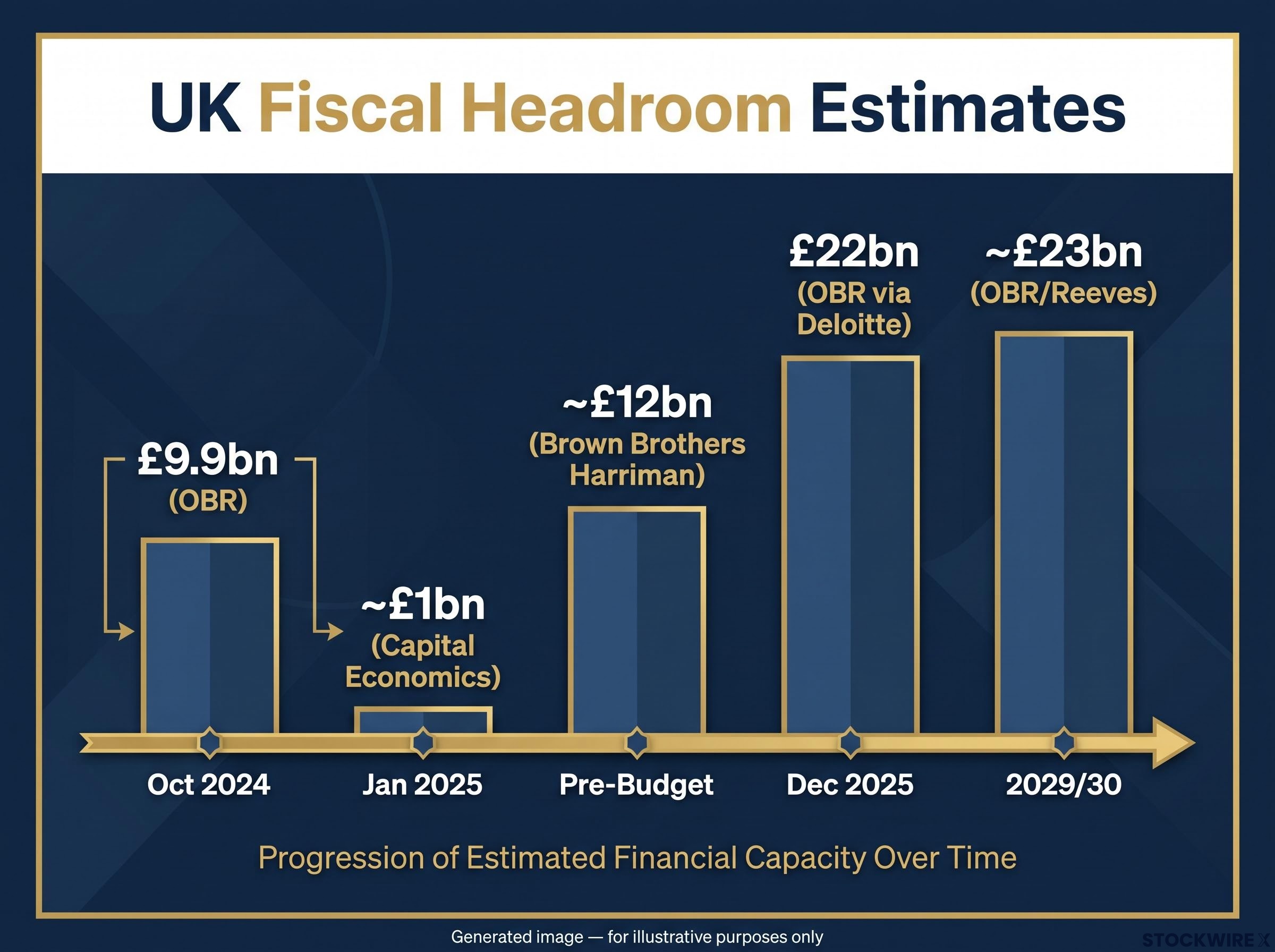
| Date | Headroom figure | Source | Context |
|---|---|---|---|
| Nov 2024 | £9.9bn | OBR | Post-Budget baseline against current budget rule |
| Jan 2025 | ~£1bn | Capital Economics | After borrowing cost rises eroded the cushion |
| Pre-Budget | ~£12bn | Brown Brothers Harriman | Point-in-time snapshot between extremes |
| Dec 2025 | £22bn | OBR via Deloitte | Revision against debt-reduction target |
| 2029/30 | ~£23bn | OBR/Reeves via Reuters | Medium-term projection |
What persistent high yields do to the long-term picture
The near-term squeeze is one story. Persistence is another, and it is arguably the more serious one for sterling.
Economist Andrew Goodwin estimated in January 2025 that if borrowing costs stayed elevated, Reeves’ headroom against her targets could fall to just £3.5 billion by 2030. That is the scenario where high yields are not a temporary spike but the structural condition the Treasury has to plan around.
The 5.22 percent peak on 30-year gilts, the highest since 1998, is why persistence carries weight. Sustained elevation at those levels compounds debt service costs year after year, steadily narrowing the fiscal space that gives sterling its credibility floor.
When big ASX news breaks, our subscribers know first
Why credible fiscal rules matter more than the headline numbers
Here is where the raw arithmetic gives way to the variable markets actually price. A bigger headroom number looks reassuring, but the number alone is not what investors buy or sell sterling on. They price the probability that the number holds.
Deloitte’s analysis of the December 2025 OBR revision makes this concrete. Even after headroom against the debt-reduction target rose from £10 billion to £22 billion, that larger figure still translated to only a 59 percent probability of meeting Reeves’ fiscal rules.
Even £22 billion of headroom gives just a 59 percent probability of meeting the fiscal rules, according to Deloitte’s December 2025 analysis.
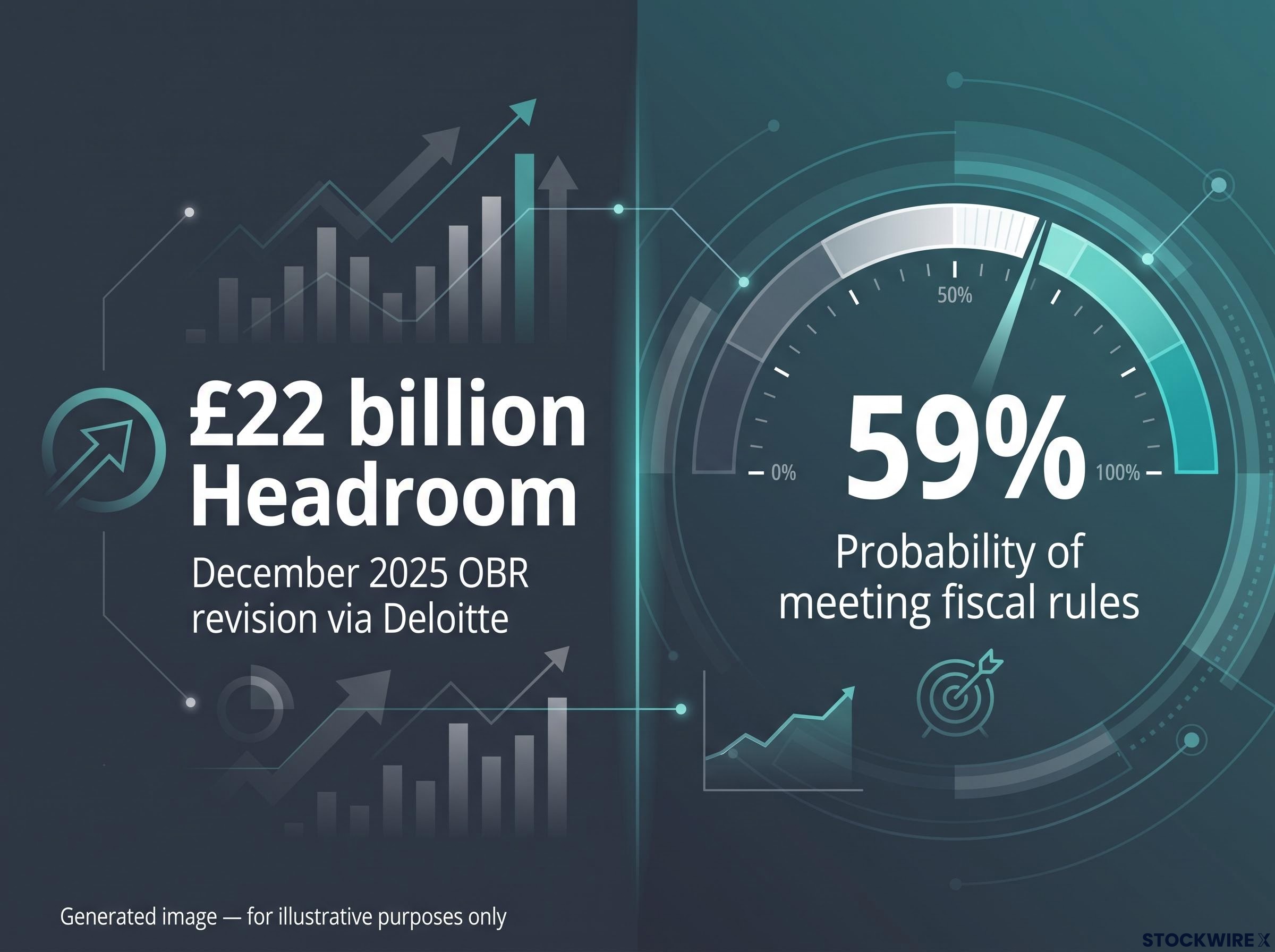
A 59 percent probability tells you something important about sterling’s position: the headroom is probabilistic, not guaranteed. Any data release on growth, inflation, or borrowing costs that narrows the margin carries headline risk for the pound, even from a position that looks comfortable on paper.
The relationship also runs both ways, and that two-way link is the mechanism worth internalising. Deloitte noted that the surprise improvement in OBR projections helped push down government borrowing costs, which is a reinforcing loop:
- Improved headroom projections signal discipline and push down gilt yields.
- Lower gilt yields reduce debt service costs, which in turn improves headroom further.
That loop can work in reverse just as easily, which is precisely why credibility is the operative variable rather than the cash figure.
The central bank credibility premium is not unique to the UK: the Fed’s own experience in mid-2026, where a hawkish written statement paired with a non-committal press conference produced yield curve steepening and a higher long-end term premium, shows how quickly markets reprice when stated policy and actual resolve appear misaligned.
Brown Brothers Harriman framed the Chancellor’s Budget approach as an exercise in building a robust fiscal cushion, and to FX markets that framing carries a specific meaning. Credibility signals that the OBR forecasts underpinning sterling’s stability are achievable rather than optimistic. Reeves has also cited updated OBR projections showing tax revenues expected to exceed day-to-day spending by around £23 billion in 2029/30, up from nearly £22 billion in her earlier Budget.
The read for you is straightforward. If you focus only on the headline headroom figure, you are likely to misread sterling signals, because the market is pricing the credibility of the plan, not the size of the number.
The 2022 mini-budget as the reference point markets still use
To understand how much margin for error the current position provides, you need the empirical anchor that every institutional investor still uses: September 2022.
The Truss and Kwarteng mini-budget, an unfunded package of tax cuts, hit sterling almost immediately. The pound fell to roughly $1.0327, its lowest level since decimalisation, and the gilt market convulsed at a speed rarely seen.
Sterling briefly hit approximately $1.0327 in September 2022, its weakest level since decimalisation, according to The Guardian.
The bond market moved faster still. The Guardian’s retrospective describes long-dated gilt yields rising by more within four trading days than they typically rise across an entire year. That is what a credibility fracture looks like at full speed: currency and bonds punished simultaneously, in days rather than weeks.
The lesson institutional investors drew is the one that shapes how they read every UK Budget since. Unfunded fiscal expansion is punished immediately through both channels; fiscal and monetary policy must point in the same direction; and rebuilding credibility through a rules-based framework is the minimum required to stabilise the pound.
This is not historical colour. It is the live downside scenario markets reach for whenever UK fiscal credibility comes into question, which means any Budget perceived as insufficiently credible risks reactivating that exact comparison in real time.
What the Bank of England and IMF responses revealed
The institutional response to 2022 is as instructive as the market move itself. Al Jazeera reported that the Bank of England was forced to intervene directly in gilt markets, an emergency backstop to prevent a self-reinforcing sell-off from spilling into wider financial stability.
The Bank of England gilt market intervention in autumn 2022 has since been examined in detail by the central bank itself, with its quarterly bulletin analysis setting out how the buy-sell tool operated as a financial stability backstop rather than a monetary policy instrument, a distinction that shaped how subsequent UK fiscal credibility assessments were framed.
That intervention came shortly after the International Monetary Fund (IMF) publicly criticised the package, warning it would likely exacerbate inequality and inflation while working at cross-purposes with monetary policy. Both domestic and international institutional credibility were flashing red at once.
For anyone assessing GBP risk today, these are the guardrails that now frame how markets interpret any UK Budget with loose fiscal parameters. They eventually stabilised sterling in 2022, but only over weeks, and only after a change of government.
Sterling’s competing forces ahead of the October Budget
Both narratives are live at the same time. Fiscal fragility and credible consolidation are competing to define how the market reads the pound, and the Budget on 28 October is the point where one begins to win.
The support case for sterling rests on several factors:
- Improved OBR headroom projections out to around £22-23 billion in the medium term.
- Lower borrowing costs as fiscal credibility improves.
- A rules-based framework that signals discipline to investors.
- Reduced sovereign risk premium if consolidation is judged credible.
The downside case is equally concrete:
- Near-term headroom remains thin relative to potential shocks.
- Gilt yields could re-elevate on adverse growth or inflation data.
- Aggressive tightening may suppress growth and cap GBP upside.
- The 59 percent probability of meeting fiscal rules leaves sterling exposed to negative surprises.
- Any perceived backsliding on rules risks reactivating the 2022 feedback loop.
The mechanism underneath both cases is the same two-channel transmission. Unfunded expansion drives up yields and weakens the pound; credible consolidation lowers yields and can support it. Which channel dominates depends on how investors read the Chancellor’s choices.
As a reference point, GBP/USD was trading around 1.3525 during a recent European session, with the US Dollar Index (DXY) near 99.10. That is the level from which the Budget will move sterling in one direction or the other.
For a reader holding GBP or evaluating UK assets, the Budget is effectively a binary credibility test. A Budget anchored credibly to the fiscal rules is likely to support the pound; one seen as leaning on optimistic OBR projections or backsliding on discipline risks pulling the 2022 comparison back into investor memory.
Three variables to watch before 28 October
You do not need to guess the market’s verdict. Three signals will tell you which way it is reading the Budget:
- The OBR headroom figure at the Budget: does it land near the projected £22-23 billion, or has gilt movement since March 2026 eroded it again?
- The gilt yield reaction in the 48-72 hours after the announcement: a rise signals scepticism, a stable or falling reading signals acceptance.
- Any gap between the Chancellor’s pre-Budget discipline rhetoric and the actual measures: FX markets will register the deviation immediately.
Isolating the fiscal signal within gilt yield moves requires separating domestic credibility concerns from global yield drivers: analysis of H1 2026 showed UK 10-year yields tracing an almost identical arc to US Treasuries, German Bunds, and French OATs, which means the UK-Germany spread rather than the absolute yield level is the cleaner indicator of sovereign-specific risk.
Making sense of the pound in a fiscal tightening cycle
The core finding to carry with you is this: sterling is not simply exposed to fiscal policy decisions, but to the market’s probabilistic assessment of whether those decisions are credible, achievable, and growth-compatible at the same time. The Budget number matters less than whether the rules-based framework holds its credibility under scrutiny.
The two scenarios are not symmetric. The downside, a credibility fracture and a 2022-style feedback loop, is faster and more severe than the upside, which is a gradual rebuilding of confidence and modest support for the pound. The 59 percent probability of meeting the fiscal rules is the statistical shorthand for how much uncertainty remains even in the constructive case, and the swing from roughly £12 billion to £22 billion in headroom between forecast cycles shows how quickly the picture can shift.
The more reliable signal of sterling’s fiscal risk is not the Budget headline. It is the gilt yield and OBR headroom figures you can track in real time.
The 28 October Budget is the next credibility test. If you understand that the pound is pricing a probability distribution over fiscal outcomes rather than a single policy number, you are better equipped to read Budget-day moves than someone watching only the headlines.
For investors wanting to benchmark the UK’s fiscal position against a harder case, our full explainer on fiscal credibility signals to monitor covers Piper Sandler’s framework for identifying when headline debt metrics give way to genuine market stress, including Treasury auction performance, term premium trajectory, and foreign holdings data.
This article is for informational purposes only and should not be considered financial advice. Investors should conduct their own research and consult with financial professionals before making investment decisions. Past performance does not guarantee future results. Financial projections are subject to market conditions and various risk factors.