
Every technology company chasing the artificial intelligence boom can point to a pipeline. The harder question is whether any of that pipeline is real.
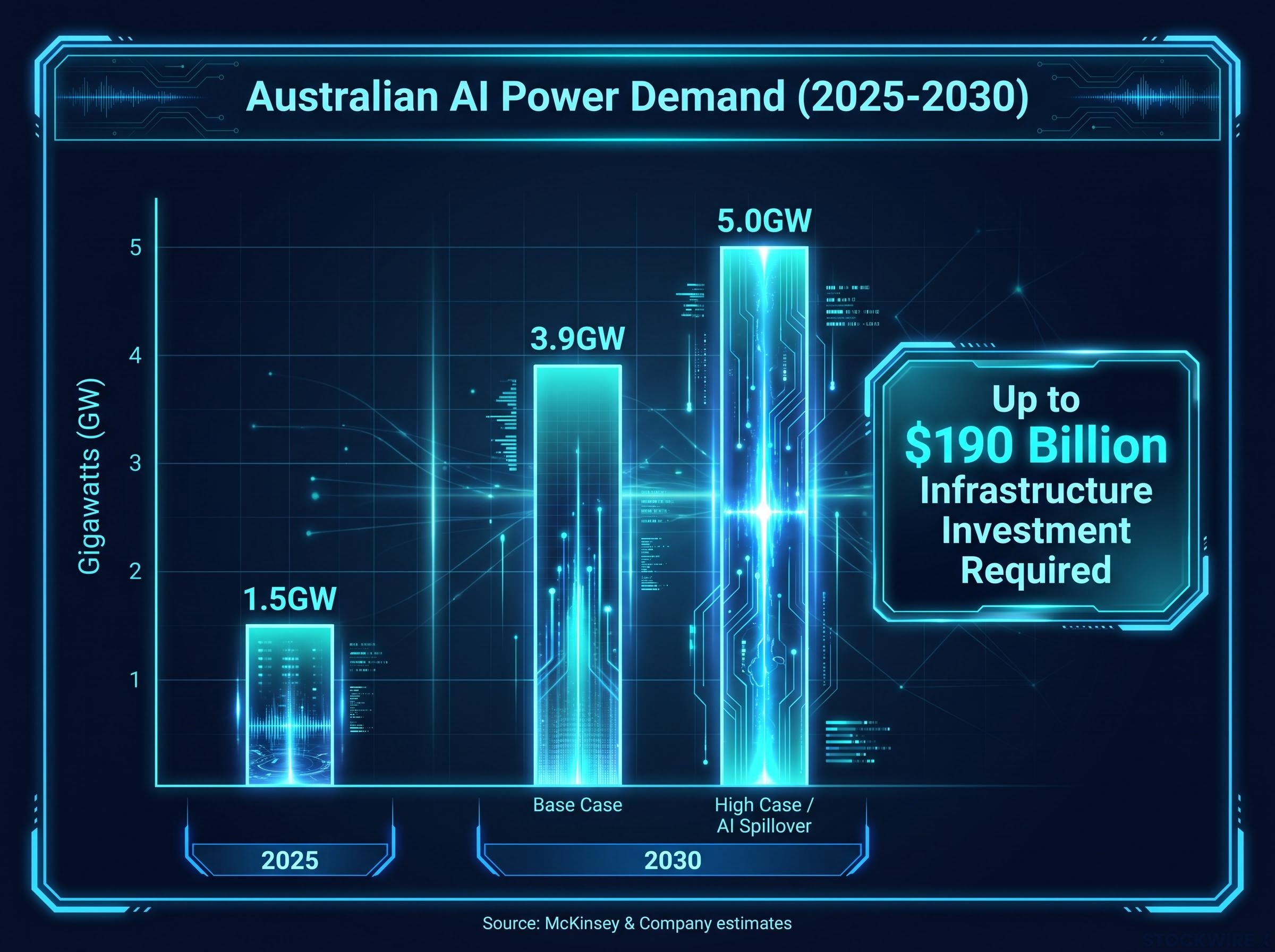
That gap matters more than ever in Australia right now. McKinsey & Company estimates the country’s data centre power demand will climb from 1.5GW in 2025 to a base case of 3.9GW by 2030, potentially reaching 5.0GW if the region captures spillover AI investment. Meeting that demand could require infrastructure investment of up to $190 billion.
The macro numbers underpin the urgency: NVIDIA revised its global AI infrastructure investment outlook to approximately US$1 trillion at its March 2026 GTC conference, and ASX infrastructure investment options span colocation operators, property trusts, and network services businesses, each carrying a distinct risk profile within the same structural trend.
When money at that scale is in play, the distance between holding early discussions and signing a legally binding commercial agreement becomes enormous. One is a slide in an investor deck. The other is contracted revenue.
Here is the framework for telling those two things apart when you evaluate ASX tech stocks, using X2M Connect’s recent contract activity as a live case study you can learn to read.
The $190 billion challenge facing high-density compute
The scale of the AI infrastructure problem is easier to describe than to build. Projections talk in gigawatts and hundreds of billions of dollars, but the physical reality of putting that capacity into the ground is where most of the friction lives.
AI-ready facilities are a different engineering proposition entirely. A traditional enterprise data centre runs general business software at relatively modest power draws. A GPU-accelerated facility, built to run the graphics processing units that train and operate AI models, runs hot and dense.
Industry frameworks indicate AI workloads now demand 30-50kW per rack, with cooling specifications recommended for loads that can climb well past 100kW per rack. That is a step change in power density, not a gradual increase.
AI rack power density benchmarks from infrastructure specialists confirm that current-generation GPU racks operate between 40kW and 142kW, with liquid cooling becoming mandatory above roughly 60kW, which places the engineering challenge well beyond what conventional enterprise data centre design can accommodate.
That density creates real financial danger. Cooling failures have caused multi-day outages at major institutions globally, and load management that cannot keep pace risks both equipment damage and instability on constrained electricity grids.
The market scale McKinsey estimates that meeting Australia’s projected AI compute demand could require up to $190 billion in data centre infrastructure investment by 2030.
Here is what this means for you as an investor. The macro opportunity is genuinely large, but the barrier to managing these power loads is exceptionally high. That barrier is a form of protection: it separates companies that can actually execute from those merely describing an addressable market.
Operators who lack a capable efficiency layer across power, thermal telemetry, and ongoing management run a real risk of constructing costly infrastructure that never delivers its full compute potential per megawatt. Understanding that physical constraint is what protects you from backing hardware or infrastructure plays that lack the software capability to run efficiently at scale.
When big ASX news breaks, our subscribers know first
Decoding commercial traction versus a speculative pipeline
Company announcements are written to sound impressive. Your job is to find the legally binding revenue underneath the marketing language, because that is the primary defensive skill in evaluating technology equities.
Start with the core distinction. A binding agreement is legally enforceable and usually carries a stated dollar value. A non-binding memorandum of understanding or framework is an expression of intent that can be terminated, extended, or replaced without penalty.
Australian disclosure rules treat these differently. Under ASX Listing Rules Guidance Note 8, an agreement generally becomes market-sensitive and disclosable once it is legally binding on the entity, whereas preliminary and non-binding negotiations can sit under confidentiality carve-outs until they firm up.
The following table breaks down how to read the two side by side.
| Agreement Type | ASX Disclosure Trigger | Revenue Certainty | Typical Use Case |
|---|---|---|---|
| Binding contract | Disclosable once legally binding, often with a stated dollar value | High, subject to any conditions precedent such as approvals | Confirmed project delivery with contracted scope |
| Non-binding framework or MOU | May sit under confidentiality carve-outs until firmed up | Low, intent only and terminable | Early collaboration or precinct-scoping ahead of firm deals |
This distinction is not academic. Globally, experts have warned that up to half of the 2026 data centre pipeline may never materialise without credible financing or anchor customers signed to long-term commitments.
Data centre oversupply risk is the scenario the speculative pipeline debate most often ignores: CommBank estimates total nominal construction could approach $150 billion by 2030, raising the genuine possibility that concentrated capital inflows close the supply gap faster than current forecasts assume and erode the pricing power that makes these projects financially viable.
Regulators and analysts are sharpening their focus on this speculative capacity, which can tie up scarce grid resources without any guaranteed funding behind it. A framework describing 100MW of potential precincts is not the same as a facility that has been contracted and financed.
For you, this creates a direct filter. When an announcement lacks binding commercial substance and a stated value, you can discount it heavily against one that carries a firm contract and clear conditions.
Why execution risk multiplies for smaller players
The stakes rise sharply for small-capitalisation companies. Hyperscalers such as Amazon Web Services and Microsoft have the balance sheets to self-fund enormous buildouts. Smaller developers do not.
Instead, they rely on the certainty of binding contracts to progress from expensive equity funding toward cheaper infrastructure-style debt financing. Projects with contracted long-term leases can support that debt; uncontracted pipelines cannot.
That is why forward-looking statements in this sector carry heightened small-cap execution risk. A pipeline is only worth what its conversion rate turns out to be, and conversion is exactly where smaller players struggle most.
X2M Connect and the anatomy of a binding transition
Theory becomes clearer with a live example. X2M Connect (ASX: X2M), historically a smart city utility technology business, offers a recent case study in how a company can hold both a binding contract and a speculative framework at the same time.
On 27 August 2026, X2M announced its first binding agreement to deliver an AI-enabled, GPU-accelerated data centre. The estimated project cost exceeds $250 million, delivered over a three-to-five-year window, and the contract is conditional on only one remaining item: development approval. There are no other conditions precedent.
Days later, on 1 September 2026, the company signed a distinctly different arrangement. This was a non-binding five-year framework with an Australian master development company targeting high-density GPU precincts of 10MW to 100MW in regional Queensland, explicitly terminable and superseded by any precinct-specific agreements that follow.
The timeline below maps the sequence and, more importantly, the commercial status of each deal.
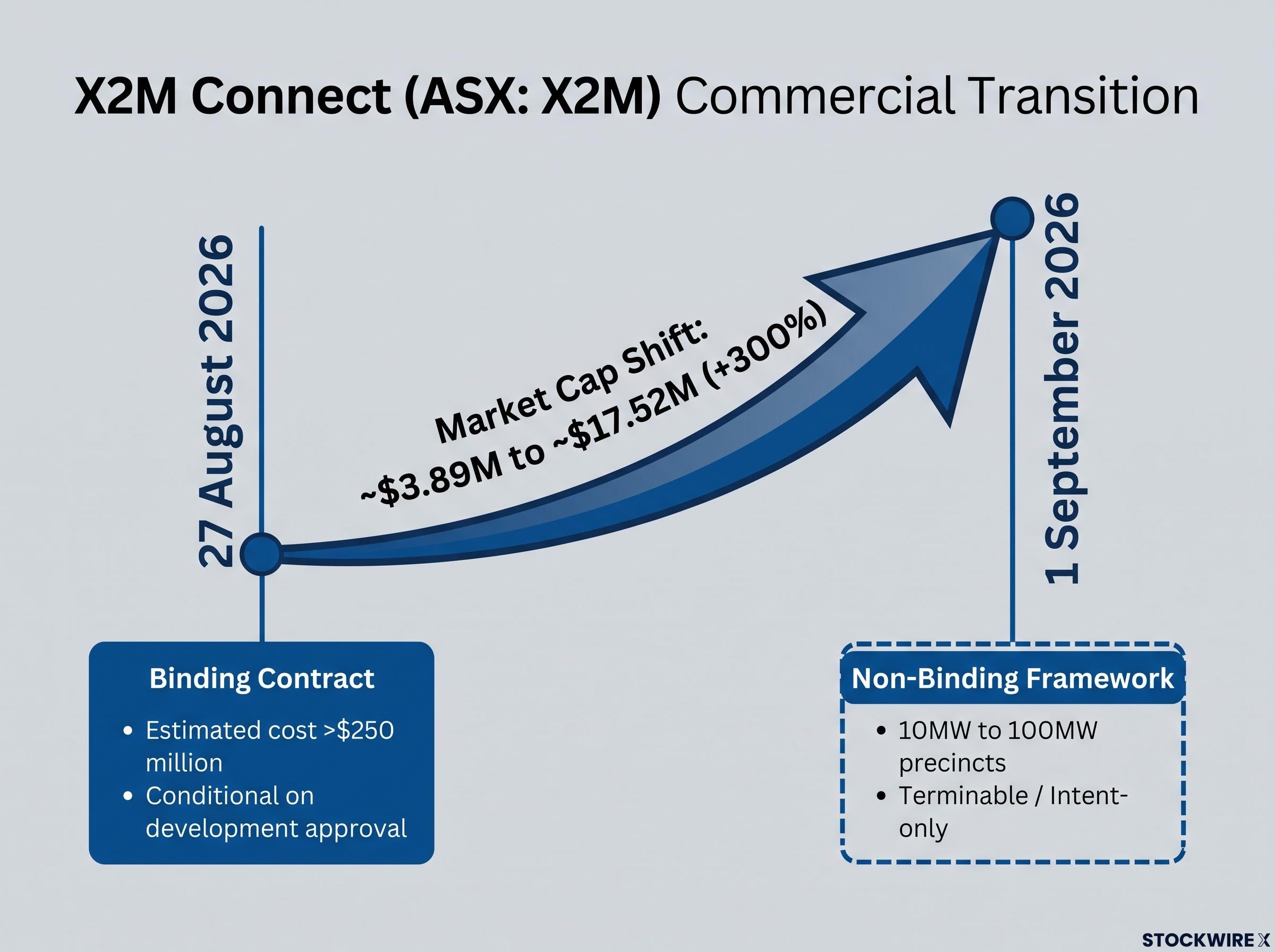
- 27 August 2026: Binding contract to deliver a GPU data centre, estimated cost above $250 million, conditional only on development approval.
- 1 September 2026: Non-binding Queensland framework for 10MW to 100MW precincts, terminable and intent-only.
Read together, the two announcements pushed X2M’s prospective Australian pipeline beyond 200MW in aggregate, once the earlier Resi Ventures partnership near Ballarat in Victoria is included.
The market responded quickly. X2M’s market capitalisation moved from approximately $3.89 million around the binding contract announcement to approximately $17.52 million by the time the Queensland framework was disclosed, a lift of more than 300%.
That figure is historical past performance and nothing more. Past share price movement is not a reliable indicator of future returns, and this is especially true for small-capitalisation ASX-listed technology companies where sentiment can shift sharply in either direction.
What the progression demonstrates for you is the mechanic itself. Underlying technology can be repurposed for a higher-stakes market, but the value inflection depends on the commercial vehicle being binding, not merely announced. Learning to spot that transition helps you identify similar inflection points in other emerging technology names.
Why the efficiency layer dictates the economics
To understand why a data centre contract can be worth signing, you have to go into the machine room. The efficiency software running behind the walls is the linchpin holding these infrastructure valuations together.
X2M’s commercial structure pairs two revenue streams. Upfront Managed Delivery fees cover design, engineering, supply, installation, and commissioning, while recurring Platform Services revenue, delivered as software-as-a-service (SaaS, software sold on an ongoing subscription rather than a one-off licence), continues for the operational life of each facility.
That recurring layer is not an optional extra. CEO Mohan Jesudason has stated that the SaaS component is a non-negotiable part of every commercial arrangement the company enters, a position that underpins the model’s long-term durability well beyond any individual construction engagement.
AI capital allocation has already rotated beyond semiconductors into energy infrastructure and software, with semiconductors now accounting for only about 25% of total AI infrastructure spending; that shift places efficiency software layers, precisely the category X2M’s platform occupies, closer to the structural centre of the trade than the hardware vendors that dominate most investor discussions.
The claim that the technology works is not theoretical. X2M’s platform already runs across more than 500,000 connected devices globally, serving over 90 enterprise and government clients, which provides a measured efficiency baseline before it is applied to the far higher stakes of a data centre.
Those legacy smart city results, achieved by the underlying Hive.AI platform, include:
- A 19% improvement in water leak detection.
- A roughly 20% reduction in gas monitoring logistics costs.
- Estimated annual savings of approximately $1,000 per household in electricity management applications.
The read for you is direct. In high-density compute, software that saves power is worth as much as the hardware that consumes it, because efficiency gains flow straight into the viability of the whole project.
The integrator advantage
X2M positions itself as an integrator rather than a single-vendor hardware supplier. The company has secured exclusive access to a curated panel of globally sourced, pre-approved suppliers across compute, AI chips, networking, energy, and telecommunications.
Avoiding vendor lock-in matters because it lets an operator coordinate environmental sensors, power, cooling, and behind-the-meter energy management as one system. That coordination is precisely what maximises compute per megawatt and holds down total site operating cost, which is where the durable investment thesis actually sits.
Evaluating the next wave of infrastructure announcements
As the AI infrastructure boom matures, the market is likely to become less forgiving. Speculative pipelines will draw more scepticism, and binding commercial execution will increasingly be what earns a re-rating that lasts.
The X2M case shows why proven underlying technology matters. A documented history in utility monitoring de-risks the leap into complex, high-stakes data centre management, because the software has already demonstrated it can deliver measurable efficiency gains.
For investors wanting to stress-test the scale assumptions behind announcements like X2M’s, our full explainer on global data centre demand forecasts covers Citi’s revised 370 GW projection through 2031, the role of agentic AI workloads consuming 20-30 times more compute per user than generative AI, and why regulatory freezes in key US markets are pushing committed capital into the 2028-2030 window.
Take the binding versus non-binding filter into every announcement you evaluate from here. Ask what is legally enforceable, what dollar value is attached, and what conditions remain outstanding before you treat a pipeline number as revenue.
This article is for informational purposes only and should not be considered financial advice. Investors should conduct their own research and consult with financial professionals before making investment decisions.
Remember that all pipeline conversions carry execution risk, and forward-looking statements in this sector are subject to material change. Past performance does not guarantee future results, and financial projections remain sensitive to market conditions and various risk factors.