The US bond market is under pressure that few investors have witnessed in their lifetimes, and the ripple effects are reaching straight into your wallet.
As of today, the 10-year Treasury yield is trading near multi-year highs, and the 30-year is sitting at levels not seen since before the global financial crisis. This is not background noise. It is the single biggest force moving global currencies right now.
The reason this matters to you is simple: when US government bond yields move, the value of the dollar moves with them, and that shift changes your purchasing power abroad, the returns on your foreign holdings, and the risk sitting inside your portfolio.
Here is how the connection between US Treasury yields and currency values actually works, why the dollar is winning today, and the point at which today’s strength could quietly turn into tomorrow’s weakness.
The anatomy of the 2026 Treasury selloff
The most striking feature of this market is how little the government has been able to do about it.
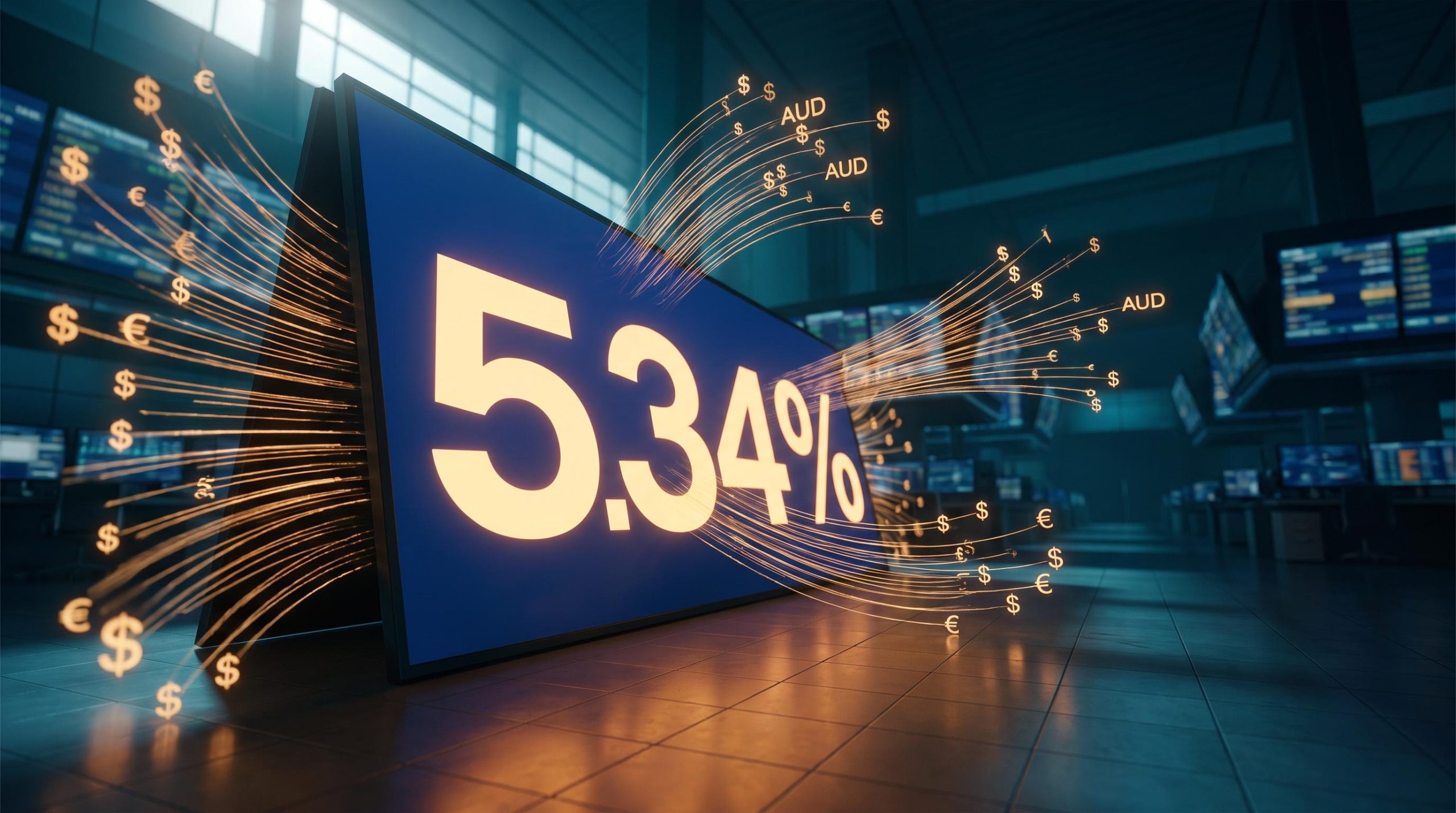
US Treasury yields have climbed to levels that reset the entire pricing of global money. The 10-year benchmark has been trading in a range of roughly 4.63% to 4.85%, its highest since early 2025, while the 30-year has moved between 5.13% and 5.34%, touching territory last seen in 2007.
To calm the selling, the US Treasury Department took an extraordinary step. On 19 August 2026, it announced it was doubling the maximum size of its liquidity-support buyback operations, raising the cap from $2 billion to at least $4 billion per operation for longer-dated securities. One recent operation reached roughly $6 billion in longer-maturity bonds, around three times the typical scale.
The Treasury Department press release published on 19 August 2026 confirmed that the cap increase would take effect on 9 September 2026, with the expanded operations targeting longer-dated nominal coupon securities specifically to address deteriorating liquidity conditions at the long end of the curve.
The purpose was explicit: improve trading conditions in a market where a “buyers’ strike” had taken hold at the long end.
Yet yields stayed stubbornly high. Even after the buyback, long-dated bonds continued to trade near their peaks as traders braced for fresh Consumer Price Index (CPI) and Producer Price Index (PPI) inflation data.
That is the lesson worth holding onto. When inflation fear grips the market, even the deep pockets of the US Treasury cannot force yields lower.
The current global bond selloff is not confined to the United States: Japan’s 30-year JGB yield has climbed to multi-decade highs and UK gilts have followed, meaning the yield pressure underpinning dollar strength reflects a coordinated international repricing of sovereign duration risk rather than any single country’s fiscal problem.
Here is a snapshot of where the key numbers sit today.
| Metric | Current Reading | Context |
|---|---|---|
| 10-Year Treasury Yield | 4.63% – 4.85% | Highest since January 2025 |
| 30-Year Treasury Yield | 5.13% – 5.34% | Highest since 2007 |
| US Dollar Index (DXY) | 98.66 | Previous close 98.79 |
Those elevated yields are the fuel behind everything that follows, starting with why capital is being pulled toward the dollar.
When big ASX news breaks, our subscribers know first
Decoding the bond-to-currency pipeline
Here is the part almost nobody explains properly: how does a yield on a government IOU end up moving the price of a currency?
The answer runs through a mechanism economists call uncovered interest parity. In plain terms, money chases the highest risk-adjusted return, so when US bonds pay more than comparable bonds elsewhere, global investors sell their local currency, buy dollars, and pour that cash into US assets. That buying pressure lifts the dollar.
The numbers behind this are substantial. Federal Reserve research finds that a 100-basis-point positive surprise in US rates is typically associated with a 2.5% to 5% appreciation in the dollar against major currencies. A basis point is simply one-hundredth of a percentage point, so 100 of them equals a full 1% shift.
There is a second force at work, and it is arguably more powerful during stressful periods. It is called the convenience yield.
Academic research, including work by economist Hanno Lustig and analysis from the International Monetary Fund (IMF), shows that investors place a premium on US Treasuries purely because they are the deepest, safest, most liquid asset on the planet. When global stress rises, foreign investors rush to buy them, and buying Treasuries requires buying dollars first. The currency strengthens on the way in.
Put those two forces together and the process unfolds in a clear sequence:
- An inflation shock, often triggered by rising oil prices, hits the market.
- Investors demand higher compensation, pushing US Treasury yields up.
- The widening gap between US and foreign yields makes dollar assets more attractive.
- Global capital floods into Treasuries, which requires purchasing dollars.
- That concentrated demand pushes the US Dollar Index higher.
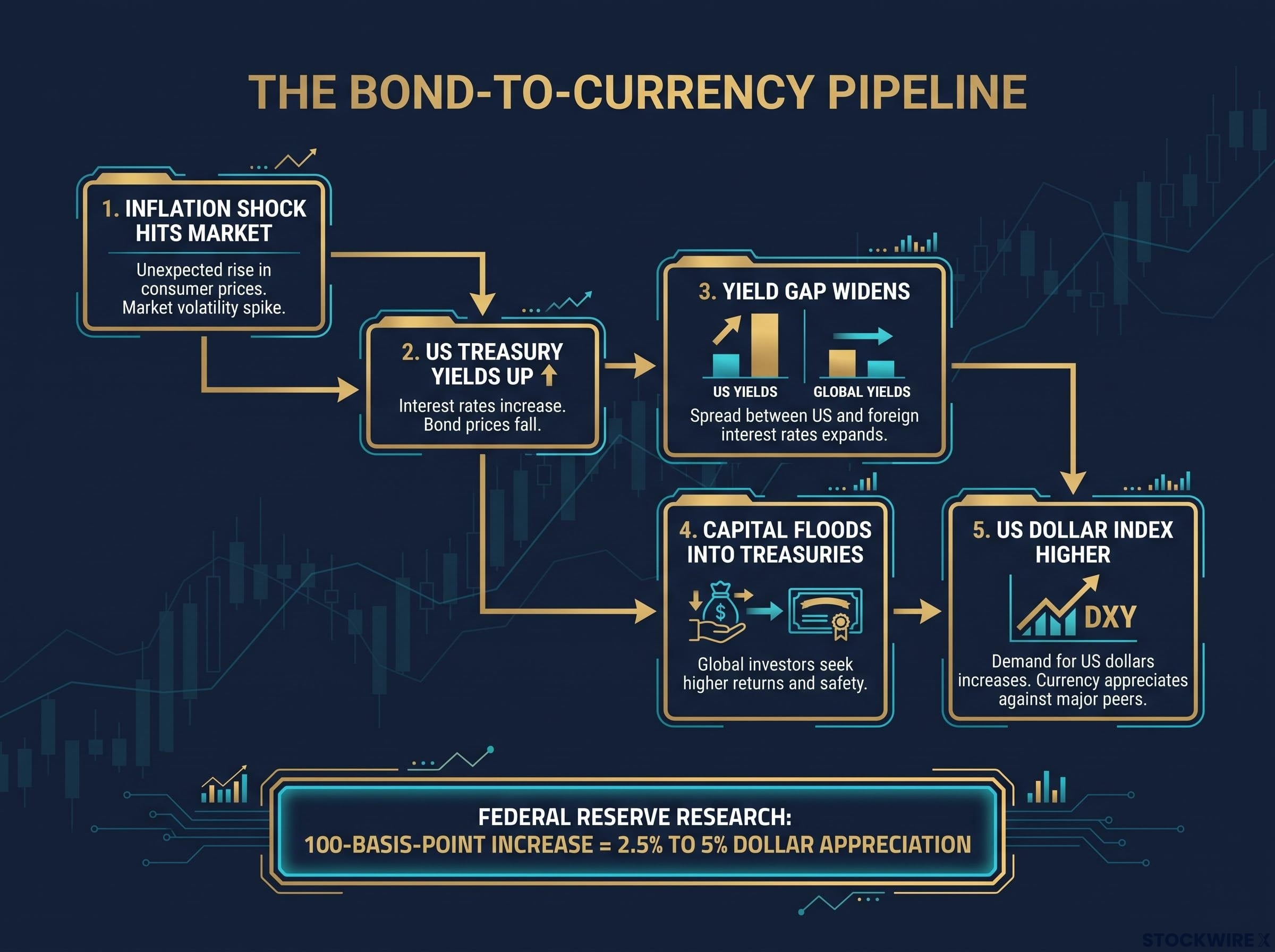
Understanding this pipeline explains something that feels counterintuitive. A strong US economy with rising yields can make your overseas holidays and imported goods cheaper by lifting the dollar, while simultaneously eating into the value of any foreign investments you hold. The same force works for you and against you at the same time.
The global blast radius impacting risk currencies
If the dollar is the magnet, the risk-sensitive currencies are the iron filings dragged out of position.
The Australian dollar is the standout example of what happens when US yields spike. It behaves as a high-beta currency, meaning it moves further and faster than the broader market in both directions, which makes it acutely vulnerable to shifts in US rates.
The Australian dollar drivers that make the currency so sensitive to US yield shifts extend well beyond the carry trade: iron ore prices, Chinese industrial demand, and domestic RBA policy each add an independent layer of volatility, which is why the AUD tends to fall faster and further than other developed-market peers when US yields spike.
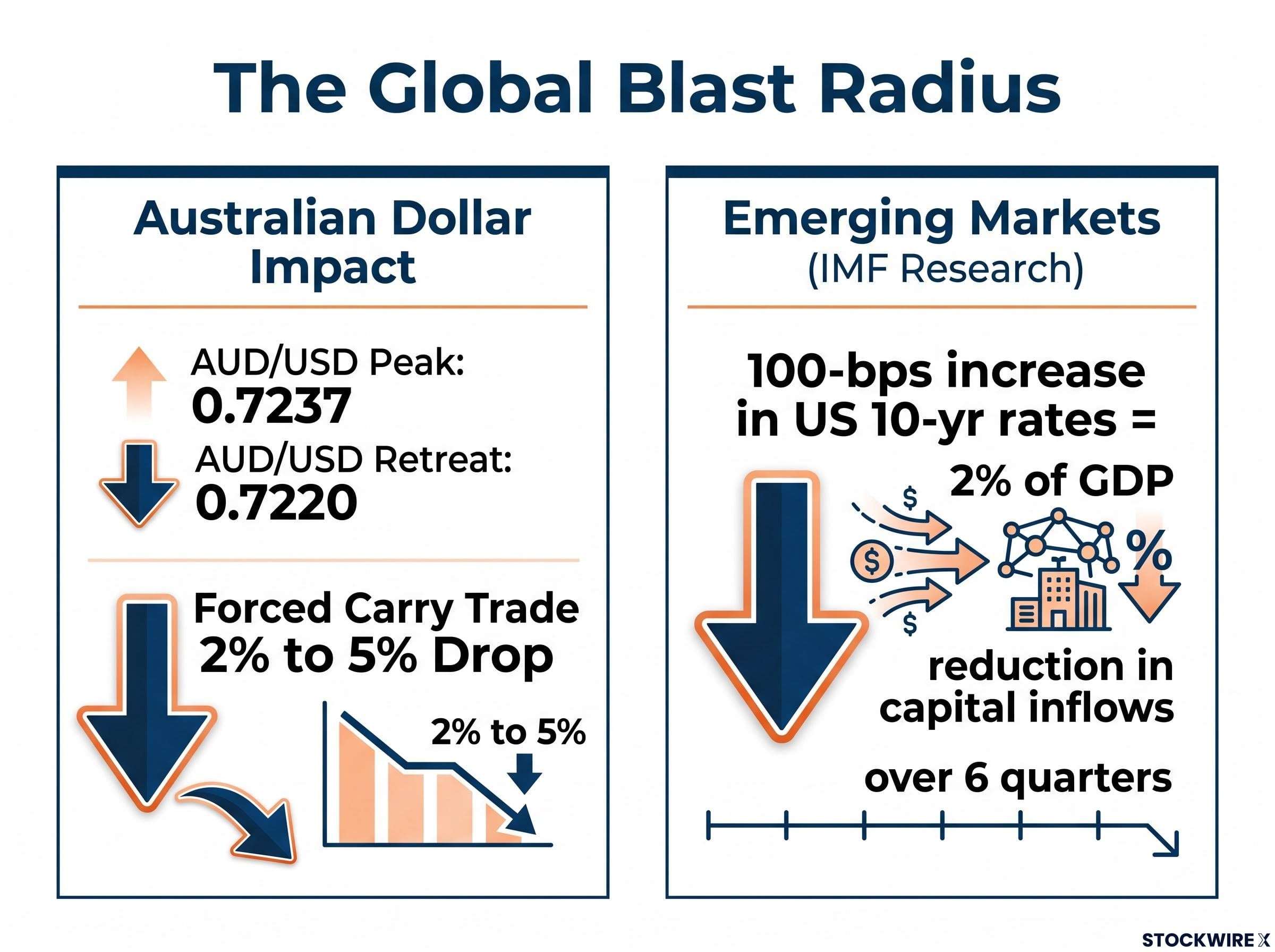
In the session covered by the original reporting, AUD/USD reached a four-month peak of 0.7237 before retreating to around 0.7220 as the dollar recovered. That reversal is a live demonstration of the pipeline in action: US strength capping a risk currency in real time.
The deeper driver is the shrinking yield gap. Carry traders, investors who borrow in a low-yielding currency to buy a higher-yielding one, typically earn 1 to 3 percentage points a year holding the Australian dollar over US rates. When that advantage narrows, the whole trade unravels.
When the yield cushion that made a carry trade profitable disappears, leveraged investors do not wait around. They rush to unwind their positions, and those forced exits can drive the Australian dollar down 2% to 5% in remarkably short windows.
The historical record backs this up. When Australian government bond yields fell below US Treasury yields for the first time since mid-2024, the Reserve Bank of Australia noted it coincided with broad dollar strength and a roughly 5% depreciation in the Australian dollar.
The pain is not limited to developed-market currencies. IMF research finds that a 100-basis-point increase in US 10-year real rates can reduce capital inflows to emerging markets by around 2% of GDP over six quarters.
So when you watch the Australian dollar or emerging-market currencies sliding, you are watching leveraged money scramble for the safety of US cash in real time.
Oil shocks and the safe-haven rotation
Layered on top of the yield story is a geopolitical one.
Escalating Middle East tensions and disruptions around key shipping lanes have pushed oil prices sharply higher through 2026. Higher oil feeds directly into inflation expectations, which reignites the fear that keeps US yields elevated. The cycle reinforces itself.
What is unusual about this episode is where investors are running for cover. Traditionally, a Middle East conflict would send money into Treasuries and pull yields lower. Instead, yields have often risen during conflict flare-ups.
The explanation is that investors are rotating into US cash and short-dated dollar assets rather than long-duration bonds or traditional foreign safe havens. The dollar itself remains the refuge, even when Treasuries wobble, which is precisely why risk currencies get punished twice over during these episodes.
When high yields become a dollar vulnerability
Here is where the story turns, because the dollar’s greatest strength today carries the seed of its greatest weakness.
The structural problem is the sheer scale of US borrowing. With total US debt approaching the $39 trillion to $40 trillion threshold, the government must sell an ever-growing mountain of bonds, and that supply needs matching demand to keep rates from climbing further.
US debt sustainability is already a present-tense budget reality rather than a forward projection: net interest outlays on federal debt hit approximately $881 billion in FY2024, overtaking national defence spending and confirming that the supply pressure feeding into Treasury yields is structural, not cyclical.
That demand is quietly changing character. Brookings research highlights that foreign official holders, the central banks that once bought Treasuries regardless of price, are shrinking their share of the market. What replaces them is price-sensitive private investors who demand more compensation and can walk away.
This is where the yield-dollar relationship stops being a straight line. Beyond a certain point, soaring yields stop signalling economic strength and start signalling credit risk, and that shift could eventually weigh on the dollar rather than support it.
Several specific catalysts could break the traditional link between rising yields and a rising dollar:
- Persistent fiscal deficits that erode confidence in long-term debt sustainability.
- Sovereign credit downgrades that force a repricing of Treasury risk.
- Foreign reserve managers diversifying away from dollar holdings.
- Reserve-managing central banks selling Treasuries to defend their own currencies during oil shocks.
You need to recognise this tipping point when it arrives. There is a threshold where high yields stop acting as a magnet for foreign capital and start acting as a warning siren about the sustainability of US finances. Cross it, and the dollar could weaken even as yields climb, inverting the entire dynamic this article has described.
These statements are speculative and subject to change based on market developments and economic performance.
Navigating the next phase of currency volatility
The picture that emerges is one of tension held in balance. Sticky inflation is keeping US Treasury yields elevated, and those elevated yields are underpinning a dominant dollar, which in turn is pressuring risk-sensitive currencies like the Australian dollar.
The immediate arbiter of the next major move is the upcoming inflation data. The PPI and CPI releases due this week will tell traders whether the inflation fear driving yields is justified or overdone, and the dollar will move accordingly.
For the remainder of the 2026 refunding quarter, running through 4 November 2026, expect elevated currency volatility rather than calm. As long as yields stay high and inflation stays sticky, the dollar holds the upper hand, and any foreign or risk-currency exposure you hold will feel the strain.
The one thing to watch is that tipping point, where high yields shift from signalling strength to signalling stress. That is the moment the whole relationship could turn.
For readers wanting to understand the political dimension of the bond market’s power, our deep-dive into how Treasury yields now drive policy examines how the 10-year yield has displaced the S&P 500 as Washington’s primary forcing mechanism on White House decision-making.
This article is for informational purposes only and should not be considered financial advice. Investors should conduct their own research and consult with financial professionals before making investment decisions. Past performance does not guarantee future results. Financial projections are subject to market conditions and various risk factors.