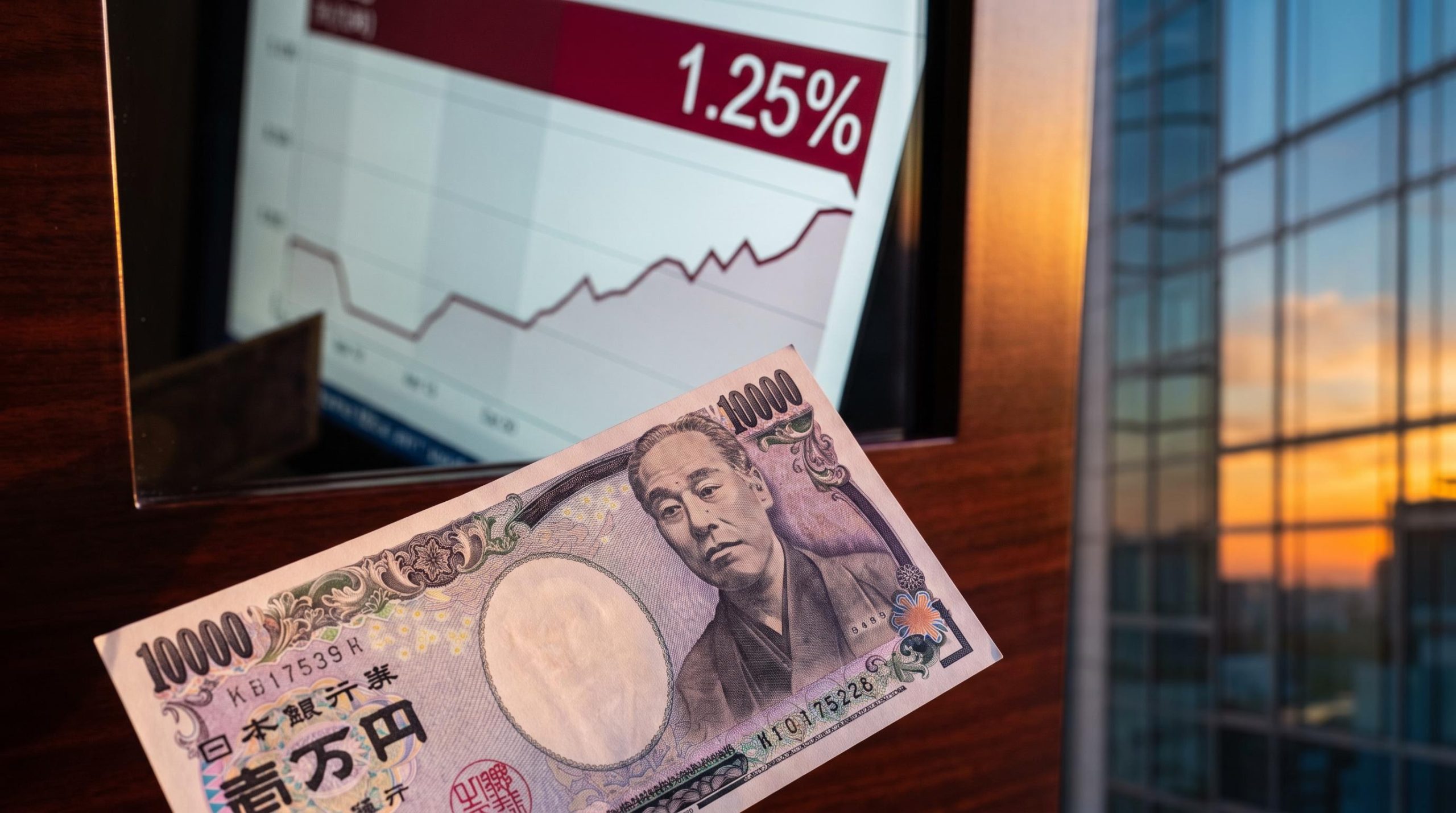
Near-unanimous economist consensus is a rare thing in central banking. On the Bank of Japan’s 18 September decision, it has arrived: all but two of 68 economists surveyed by Reuters expect a rate hike in eight days.
The BoJ’s policy rate currently sits at 1%, a 31-year high reached in June 2026 and held at the July meeting despite acknowledged inflation pressure and a yen at four-decade lows.
The June 2026 hike to 1.0% came alongside a structured JGB tapering schedule that set the template for how the BoJ communicates policy normalisation, with the accompanying bond purchase reduction plan signalling that each rate step would be paired with quantitative tightening guidance.
What has changed since July is not the direction of the data but its velocity. Core-core inflation accelerated in July, wholesale prices held near multi-year highs, and a coordinated US-Japan currency intervention in late July shifted the political conditions around tightening. Governor Kazuo Ueda, speaking on 1 September, described the September meeting as a genuine debate over whether inflationary risks are heightening enough to act.
This piece maps what the Reuters poll reveals about the September decision and the rate path through 2027, why the timetable has compressed, and what the shifting trajectory means for investors positioned in Japanese assets or exposed to the yen. Here is what the data tells you about where Japanese rates are heading, and how fast.
Economists reach near-unanimous verdict on a September rate hike
The number that frames everything: 66 of 68 economists polled by Reuters now expect a 25-basis-point hike to 1.25% at the September 17-18 policy meeting. Only two holdouts remain.
A month ago, that consensus barely existed. The August poll had just 57% of economists expecting a hike. In a single survey cycle, the doubters have effectively capitulated, moving the figure to roughly 97%.
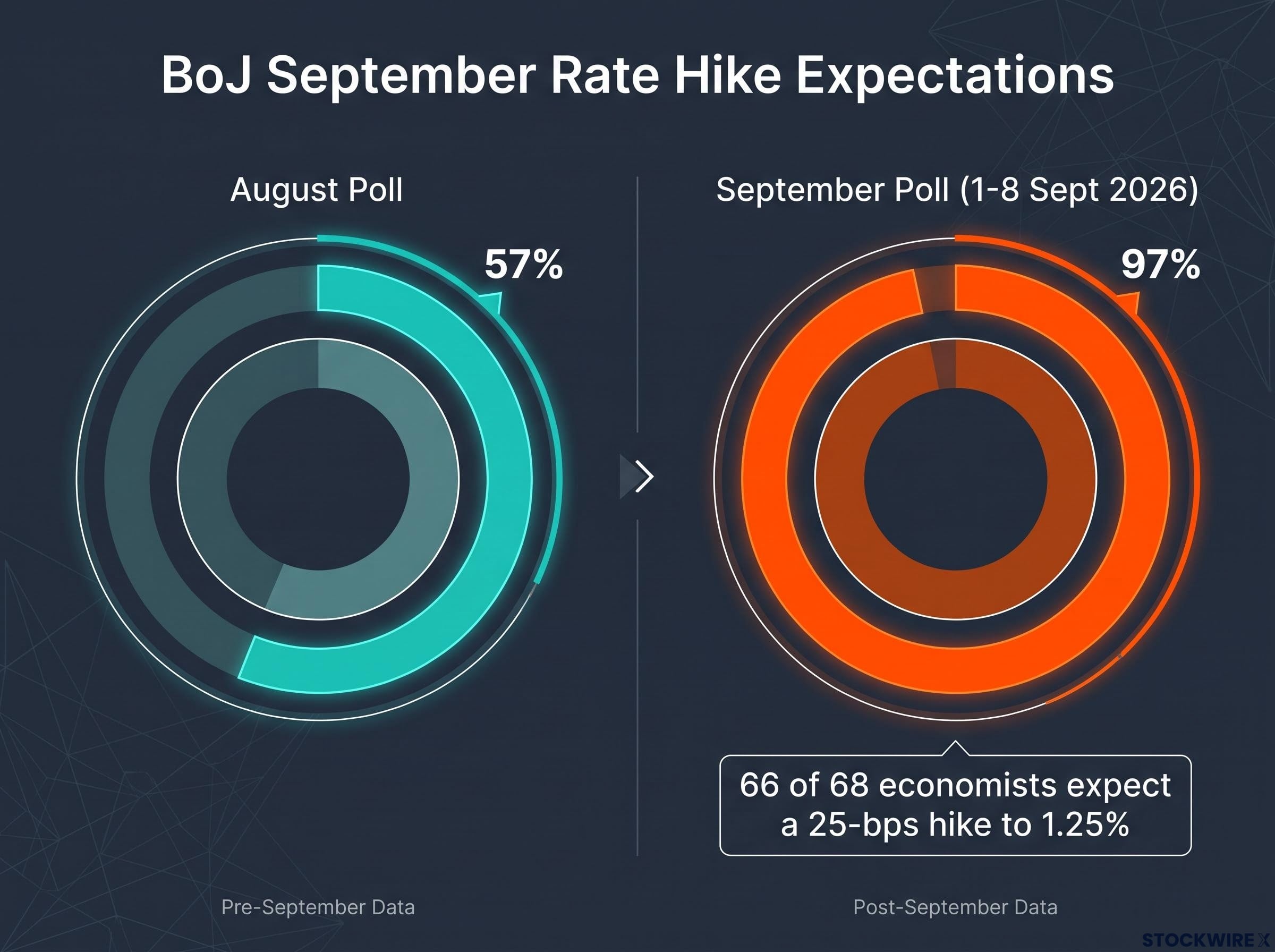
That is the real story here. This is no longer a forecast; it is a near-settled outcome.
Market pricing has moved in lockstep. Japan’s finance minister confirmed on 1 September that markets were nearly fully pricing in the move to 1.25%, and by 7 September the yen had strengthened to its highest level since February, per Bloomberg. At the time the poll was published, USD/JPY was trading at 153.60.
The headline figures worth holding onto:
- 66 of 68 economists (Reuters poll, conducted 1-8 September 2026) expect a hike at the 17-18 September meeting.
- The August poll had 57% expecting a hike. The September poll shows the holdouts have folded.
- Markets have nearly fully priced the September move, per the finance minister’s 1 September statement.
Governor Ueda set the tone at the start of the month.
Speaking on 1 September, Ueda said the bank would debate raising interest rates including in September, focusing on whether inflationary risks were heightening. Reuters characterised the remarks as signalling a “strong chance” of a hike that month.
The jump from 57% to 97% in a month tells you something specific. The live question is no longer whether the BoJ acts on 18 September. It is what comes next. Any investor still treating September as an open call is pricing the wrong risk. The decision is settled; the path is not.
When big ASX news breaks, our subscribers know first
What is driving the urgency: inflation data and a weak yen
The BoJ is not choosing to accelerate. The data is compelling it to.
Three inflation readings sit in front of the board ahead of September. Each points the same direction. Core-core CPI, the bank’s preferred gauge of underlying price pressure that strips out fresh food and fuel, rose 1.9% year-on-year in July, up from 1.7% in June. Tokyo core CPI, a leading indicator, also came in at 1.9%, above the 1.8% economists had forecast.
Then there is the wholesale number. Japan’s producer price index rose 7.2% year-on-year in July, barely below June’s spike of 7.3%, according to BoJ data cited by Reuters.
| Indicator | July 2026 | June 2026 | Relevance to BoJ target |
|---|---|---|---|
| Core-core CPI (ex fresh food and fuel) | +1.9% | +1.7% | Preferred underlying gauge; still below 2% |
| Tokyo core CPI (ex fresh food) | +1.9% | Not stated | Below 2% target for six straight months |
| PPI (wholesale prices) | +7.2% | +7.3% | Upstream pressure feeding into consumer prices |
The gap between those numbers is the whole point. Consumer inflation is still below the BoJ’s 2% target. Wholesale inflation is above 7%. That tells you a pipeline of cost pressure has not fully arrived at households yet, which is precisely why waiting carries more risk than acting.
The driver is cost-push. A weak yen and geopolitical disruption, including a Middle East war, have lifted import costs, and firms are passing them on. The BoJ has warned that underlying inflation could exceed its target as a result.
The “behind the curve” problem shaping BoJ strategy
A 8 September Reuters analysis framed the real concern plainly: it is not the size of any single reading, but keeping markets convinced the bank is not falling behind the inflation curve.
The strategy that follows is one of “betting small.” Incremental hikes now are insurance against a larger, more disruptive catch-up later. Small moves preserve credibility without shocking the economy.
Brookings research on central bank credibility identifies incremental tightening as a tool for preserving institutional trust, with gradualist approaches reducing the risk of market disruption that larger, reactive hikes tend to produce.
The July 31 decision to hold rates at 1% matters here too. Despite acknowledged inflation and yen pressure, the bank paused, evidence it is weighing growth risk against inflation credibility rather than tightening on autopilot. For investors, that PPI reading at 7.2% is the tell: consumer price pressure has further to run, which underpins the case for rates continuing to climb even with September already priced.
The July 31 hold at 1.0% was itself a contested decision, with board member Hajime Takata pressing for an immediate hike to 1.25% in a named dissent that publicly shortened the perceived distance to the next move.
The rate path through 2027: faster and higher than three months ago
The September hike is the easy part. The forward projections are where the shift shows up, and they have all moved in the same direction at once.
Start with the near term. 24 of 66 economists, over a third, now expect a follow-up hike to 1.50% in either October or December. Move further out and the consensus firms: 89% of analysts (57 of 64) project the benchmark at 1.50% or higher by the end of the Japanese fiscal year in March 2027, up from 65% in the prior month’s poll.
The longer horizon has moved too. Roughly 62% of respondents expect the rate to reach at least 1.75% by the close of Q2 2027, a timeline pulled forward by three full months compared with the August poll.
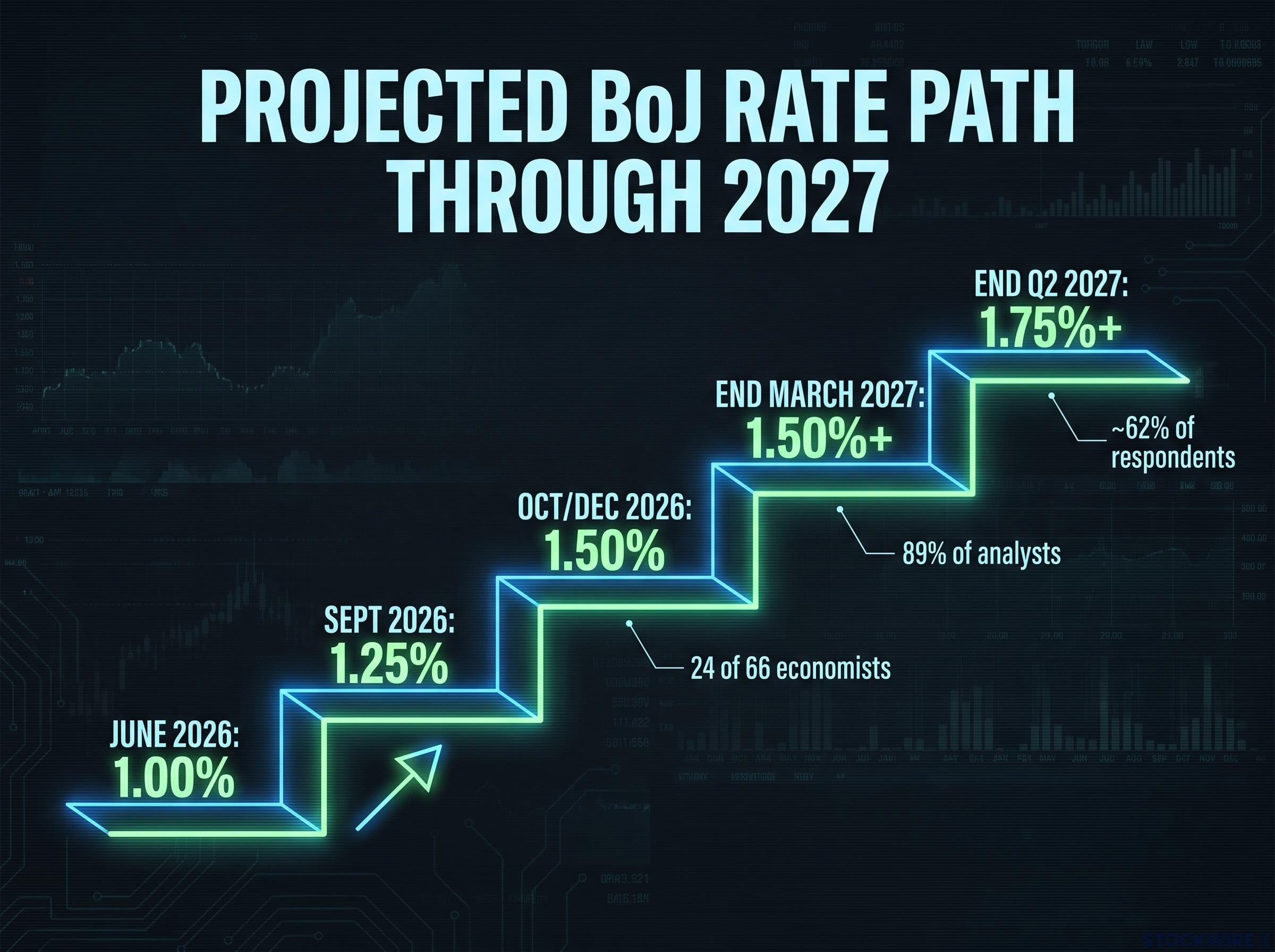
| Period | Expected rate | Share of economists | Change from prior poll |
|---|---|---|---|
| September 2026 | 1.25% | 66 of 68 | Up from 57% expecting a hike |
| October or December 2026 | 1.50% | 24 of 66 | Follow-up hike expectation |
| End March 2027 | 1.50%+ | 89% (57 of 64) | Up from 65% |
| End Q2 2027 | 1.75%+ | ~62% | Three months earlier than August poll |
That three-month acceleration is the single clearest signal that analyst consensus has shifted structurally, not tactically. It is not a rounding error. It tells you that investors who anchored their Japanese rate exposure to the August forecast are now holding positions that are structurally mispriced against where the consensus stands today.
There is a range within that consensus, and the hawkish end is worth marking.
Takuji Aida, economic adviser to Prime Minister Sanae Takaichi, said on 7 September that the BoJ is likely to hike in September and then once every quarter until January, with markets nearly fully pricing in the move to 1.25%.
Reuters reporting on 14 August, citing three sources familiar with BoJ thinking, added weight to that view: the bank is considering hiking more aggressively than its previous rough pace of twice a year. For anyone holding duration exposure to Japanese government bonds or trading cross-border yield differentials, the terminal rate path matters as much as the September call. The direction is clear, and the speed is picking up.
How the US-Japan currency intervention changed the political calculus
The late-July intervention is usually read as a one-off support operation. It was more than that. It removed a political constraint on BoJ tightening.
At the end of July, with the yen at four-decade lows, the US and Japan launched a rare joint yen-buying intervention. What it signalled was as important as what it did: Washington and Tokyo were now aligned against excessive yen weakness, which is exactly the condition higher Japanese rates help correct.
The coordinated intervention in late July was structurally distinct from earlier unilateral Japanese operations: the US participated by selling euro reserves rather than dollar holdings, a design choice that prevented the operation from flooding the Treasury market with supply and revealed how seriously both governments assessed systemic yen collapse risk.
The yen’s path since then tells the story:
- Late July 2026: joint US-Japan intervention, yen at four-decade lows.
- 2 September: yen had retraced roughly half its post-intervention gains before rallying sharply again.
- 3 September: yen hit a one-month intraday high (CNBC), driven mainly by rate-hike bets.
- 7 September: yen reached its highest level since February (Bloomberg), surpassing the immediate post-intervention peak.
That final move is the key one. By early September, the currency had moved well beyond anything the intervention alone could explain.
CNBC’s 3 September read was that the surge owed more to raised bets on a BoJ hike following hawkish comments than to fresh official action. In other words, intervention risk and rate expectations are now complementary yen supports, not competing ones.
Why Bessent’s comments mattered beyond the intervention itself
The survey put a number on the shift. 82% of economists said the joint intervention and US Treasury Secretary Scott Bessent’s comments had “significantly” or “somewhat” reduced political barriers to BoJ rate increases.
That figure reframes the US role. Rather than a constraint on Japanese tightening, Washington’s stance now functions as an enabling condition for it. Japan’s finance minister reinforced the point on 1 September, confirming both sides had agreed to continue coordinating on yen movements and describing orderly currency movement as critical for market stability.
For global investors, the takeaway is that the yen is now held up by two separate forces at once: intervention risk and tightening expectations. That makes a sharp reversal harder to engineer than it was in June. When currency support shifts from intervention-dependent to rate-expectation-driven, it becomes more durable and harder to trade against. Anyone running short-yen positions or unhedged yen exposure is navigating a materially different landscape than two months ago.
What September 18 resolves, and what it leaves open
The 18 September hike is, for all practical purposes, decided. Near-unanimous consensus and near-full market pricing have taken that question off the table. The live question for investors is the pace and ceiling of what follows.
Three variables will shape the post-September path:
- Core-core CPI trajectory. Currently 1.9%, approaching but not yet breaching the 2% target. How fast it closes that gap sets the urgency.
- Yen durability. Whether the dual-support dynamic of intervention risk and tightening expectations holds, or fades once the September move is banked.
- Cadence. Whether the BoJ shifts from its old twice-a-year rhythm to the quarterly pace flagged by August sources and Aida’s projection.
The risk here is asymmetric. Consensus on direction is clear: higher. But the July 31 hold is a reminder the bank will pause if growth conditions deteriorate, and roughly 64% of economists still do not expect a follow-up hike by December. Direction is settled; speed is not.
If you are positioned in Japanese rate markets, the September decision itself is not the trade. The trade is in how the BoJ signals the October-to-March window on 18 September. That guidance statement carries more price-moving potential than the hike it accompanies. The projected path to 1.75% by Q2 2027, now three months earlier than forecast, is where the duration and currency impact compounds.
Japanese equity positioning has been complicated throughout 2026 by the simultaneous pull of yen weakness boosting exporter earnings and BoJ normalisation lifting financials, a dynamic that produced a 15.7% MSCI Japan USD-terms return in the first half of the year even as the yen approached 40-year lows.
This article is for informational purposes only and should not be considered financial advice. Investors should conduct their own research and consult with financial professionals before making investment decisions.
Past performance does not guarantee future results. Financial projections are subject to market conditions and various risk factors, and these forward-looking expectations are speculative and subject to change based on market developments.