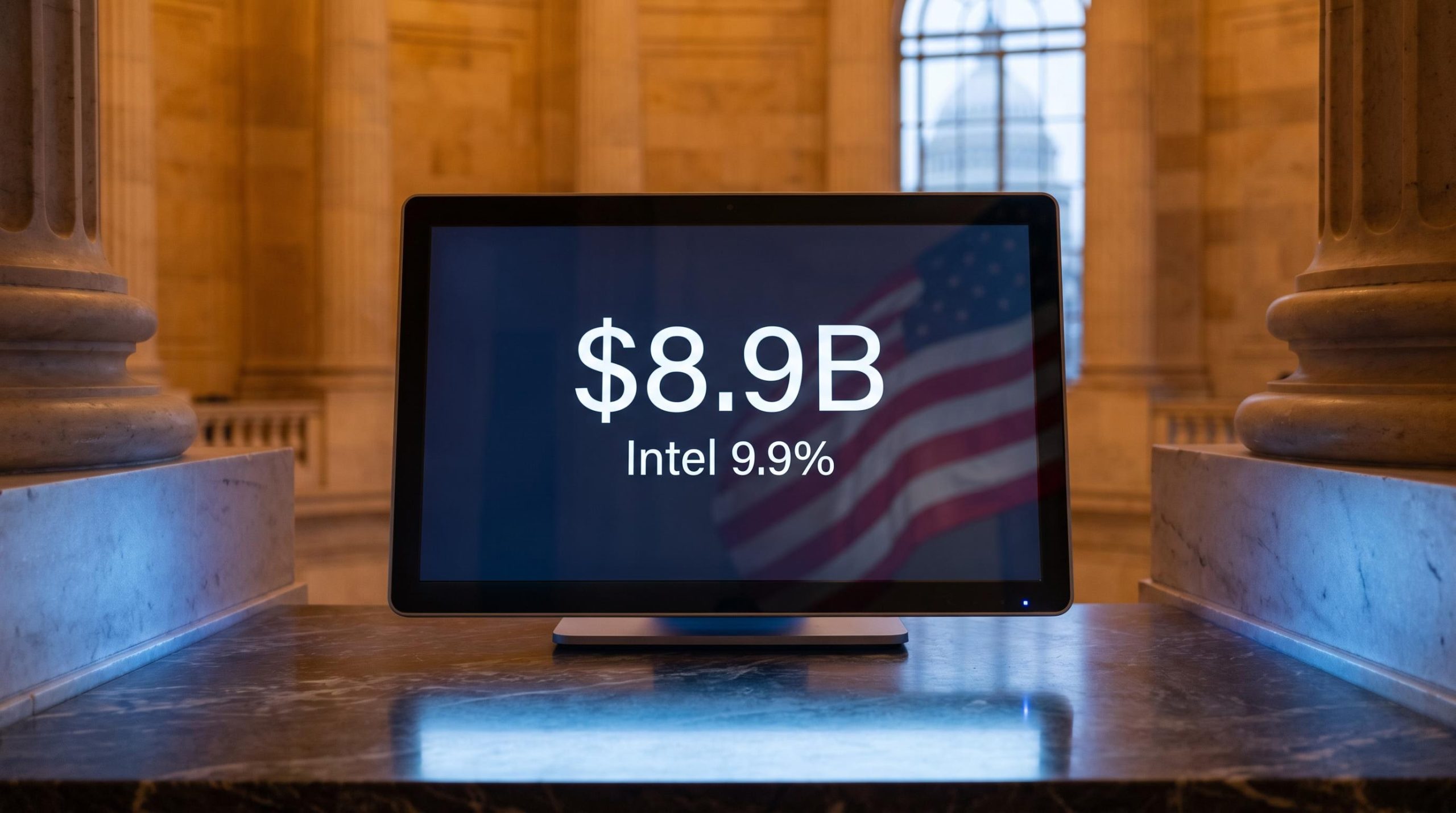
The U.S. government is currently Intel’s largest single shareholder. It holds a 9.9% stake worth roughly $8.9 billion. Yet a formal U.S. sovereign wealth fund does not legally exist.
That gap between what the government is already doing and the institution it has not yet built is the whole story. Ownership without an owner, in effect.
The planning frame is real. Executive Order 14196, signed on 3 February 2025, directed Treasury and Commerce to design a fund structure within 90 days. Congress has capitalised nothing. What has arrived instead is a run of strategic equity purchases in semiconductors and critical minerals that a growing number of analysts read as the early scaffolding of something far larger.
Here is what the evidence actually supports: whether this becomes a real institution, how large it could plausibly grow, and which political conditions would have to line up for it to happen at scale. The answer is more contingent than the headlines suggest, and the checkpoints that determine it are already visible.
The equity stakes that arrived before the fund did
Start with the anchor deal. On 22 August 2025, the federal government took an $8.9 billion position in Intel common stock, buying 433.3 million primary shares at $20.47 each and securing a stake of roughly 9.9%. That made Washington the company’s largest single shareholder.
The mechanism matters more than the size. The stake was funded by converting $5.7 billion in previously awarded but undelivered CHIPS Act grants and $3.2 billion from Secure Enclave programme awards into common equity. The government also holds options on up to 240.5 million additional shares.
The government’s Intel stake carries no board seat, no governance rights, and no special information access, meaning its practical leverage over the company runs entirely through policy instruments such as tariffs, export controls, and procurement decisions rather than shareholder votes.
Grants became ownership. That single choice tells you the government has already picked equity over subsidy as its instrument of choice in strategic industries.
The pattern did not stop at chips. On 11 July 2025, the Department of Defense paid $400 million for a 15% stake in MP Materials, a domestic rare-earths producer. The government has also taken roughly a 5% position in Lithium Americas and its Thacker Pass project, plus a “golden share” in the merged US Steel and Nippon Steel entity.
Pentagon equity in resource concessions has now extended to a 35% stake in a 100-year Venezuelan oil deal covering roughly 65 billion barrels of proven reserves, signed in August 2026, adding a geopolitical and oversight dimension to the government’s equity accumulation that the domestic semiconductor and minerals pattern alone does not capture.
| Company | Stake Size | Value | Mechanism |
|---|---|---|---|
| Intel | 9.9% | $8.9B | CHIPS Act grant conversion |
| MP Materials | 15% | $400M | DoD direct purchase |
| Lithium Americas | ~5% | Undisclosed | Direct stake |
| US Steel / Nippon | Golden share | Undisclosed | Merger condition |
Read chronologically, this stops looking like improvisation. The sector targeting is consistent (semiconductors, rare earths, critical minerals), and the conversion mechanic is repeatable. What you are watching is a coherent industrial-ownership thesis being field-tested one deal at a time, before anyone has formally named the vehicle.
Then the boundary blurred further.
The conceptual line is already moving OpenAI’s Sam Altman reportedly proposed that the Treasury purchase shares in the company and redistribute them to the public. That takes crisis-driven industrial policy and reframes it as a citizen-facing wealth fund. The distance between “securing supply chains” and “public ownership stake” is narrowing in real time.
When big ASX news breaks, our subscribers know first
How the fund would actually be structured, and why the fiscal math is contested
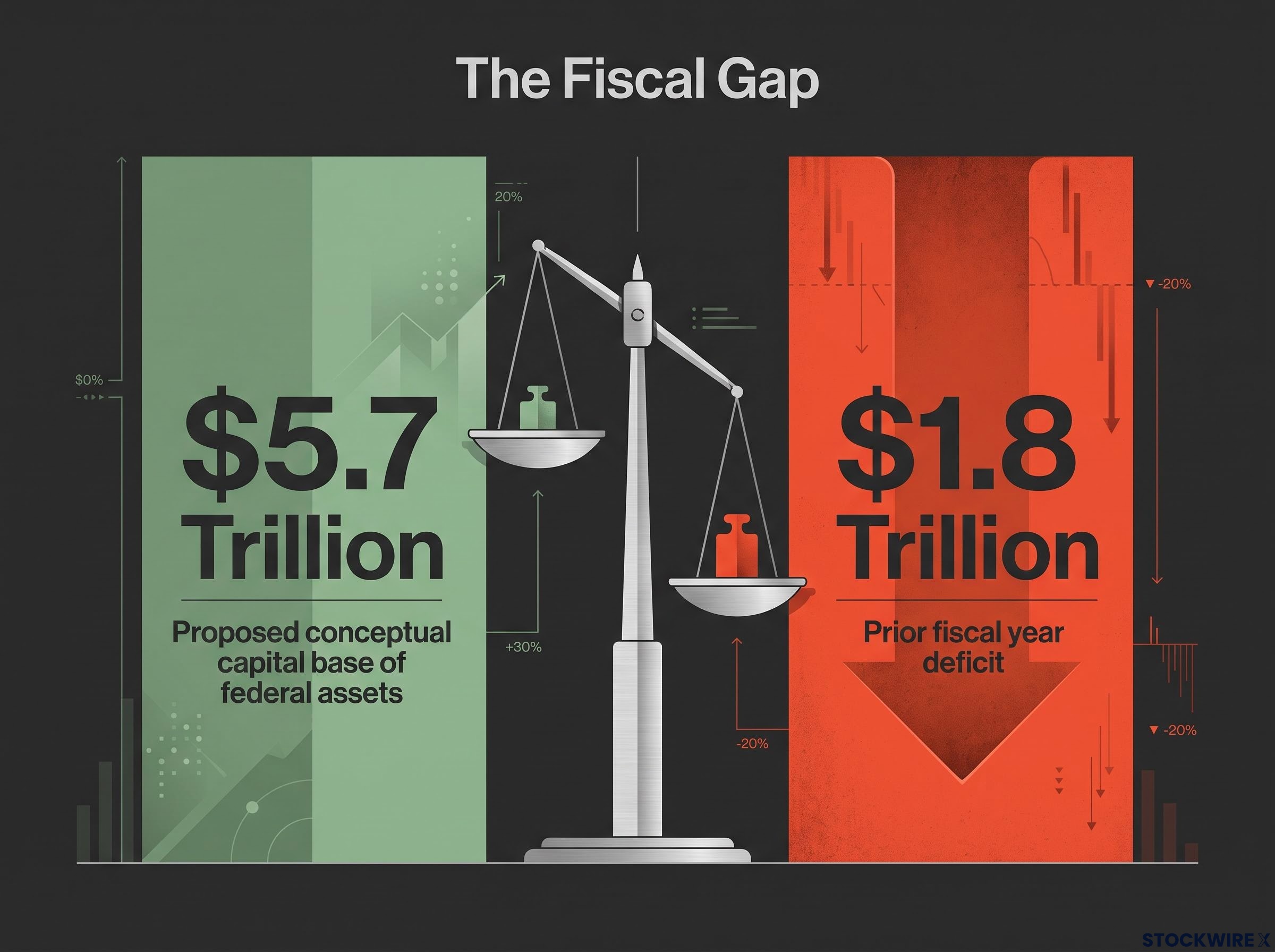
The structural logic is straightforward on paper. The White House frame leans on roughly $5.7 trillion in existing federal assets and natural resource wealth as the conceptual capital base. Executive Order 14196 directed a 90-day planning process covering funding mechanisms, investment strategies, fund structure, and governance.
The toolkit is finite. A fund would have to be built from one or more of these:
- Reallocated federal assets: avoids new borrowing but requires deciding what to sell or redeploy.
- New resource revenues: the traditional SWF model, but the U.S. lacks large uncommitted resource rents.
- Dedicated levies: politically difficult, and functionally a new tax.
- New borrowing: the fastest route to scale, and the one that adds directly to the debt.
That last option is where the plausibility runs into a wall.
Fiscal sustainability constraints shape what a U.S. fund could realistically accomplish: with net interest outlays already exceeding defence spending at roughly $881 billion annually, borrowing to capitalise a sovereign wealth fund adds to a debt load that is already compressing the federal budget’s discretionary room.
The fiscal reality the asset framing skips
Traditional sovereign wealth funds are built from fiscal surpluses or resource rents. The U.S. has neither. It ran a $1.8 trillion deficit in the prior fiscal year.
That is the gap that decides everything. A $5.7 trillion asset headline sits next to a $1.8 trillion annual shortfall, and the second number is the one that determines whether Executive Order 14196 produces an institution or a permanent planning document.
The Peterson Institute for International Economics (PIIE) and the Council on Foreign Relations (CFR) both warn that borrowing to fund a sovereign wealth fund adds to Treasury debt, risks crowding out private investment, and raises awkward questions about interest rates and debt sustainability. Fund something with debt and you have not managed sovereign risk; you have manufactured more of it.
The CFR analysis of U.S. sovereign fund design concludes that any capitalisation requiring new congressional appropriations runs directly into the structural deficit, making the funding mechanism inseparable from the broader debt sustainability debate rather than a separate technical question.
The funding mechanism, in other words, is not a technical footnote. It is the whole argument. Choose reallocated assets and you get a stabilising long-term institution. Choose new borrowing and you get a leveraged government investment vehicle wearing a savings-fund label.
The governance question that proponents have not answered
Structure is only half the design problem. Analysts at the American Enterprise Institute (AEI) and the Cato Institute warn that without statutory independence, a U.S. fund would sit exposed to directional pressure from the executive branch, opening the door to politically motivated capital allocation and cronyism.
There is also a hard legal boundary. Fund returns cannot legally substitute for congressional appropriations, so the vehicle cannot quietly bypass the budget process. Independence is the design feature that separates a functioning sovereign wealth fund from a political slush fund, and no statutory framework for it exists yet.
What Norway and Japan reveal about what the U.S. would be building
International comparisons are useful here, not as templates to copy but as a way to see what each design choice actually does.
Norway sets the governance benchmark. Its Government Pension Fund Global runs on statutory independence and a rules-based mandate, and as of its 12 August 2026 report it held NOK 22,683 billion, roughly $2.267 trillion, after a NOK 1,416 billion gain in the first half of 2026. It funds a meaningful share of Norwegian social services precisely because politicians cannot raid it at will.
Japan looks superficially similar and is fundamentally different. The Bank of Japan and associated public entities hold an estimated 8%-plus of the Nikkei, but those holdings function as a monetary policy instrument run through the central bank, not a fiscally funded savings vehicle.
That distinction is the real fork in the road. A U.S. fund modelled on Norway would be a long-term, independently governed savings institution. One modelled on Japan’s approach would be a central-bank-adjacent policy tool. Calling both a “sovereign wealth fund” hides the choice that matters most.
Singapore offers a third reference point. Its Temasek is wholly owned by the Ministry of Finance but run at arm’s length by professional managers, which is why U.S. commentators keep invoking it when they describe how to wall ownership off from daily political interference.
| Country / Fund | AUM | Funding Source | Governance Model | Primary Purpose |
|---|---|---|---|---|
| Norway GPFG | ~$2.267T | Resource rents / surpluses | Statutory independence, rules-based | Intergenerational savings |
| Japan BoJ holdings | ~8%+ of Nikkei | Central bank operations | Monetary policy instrument | Market and policy support |
| Singapore Temasek | Undisclosed here | State-owned equity | Arm’s-length professional management | State enterprise stewardship |
| Proposed U.S. SWF | Not capitalised | Undecided (EO 14196) | Undefined | Strategic / fiscal (planned) |
Scale sets the stakes.
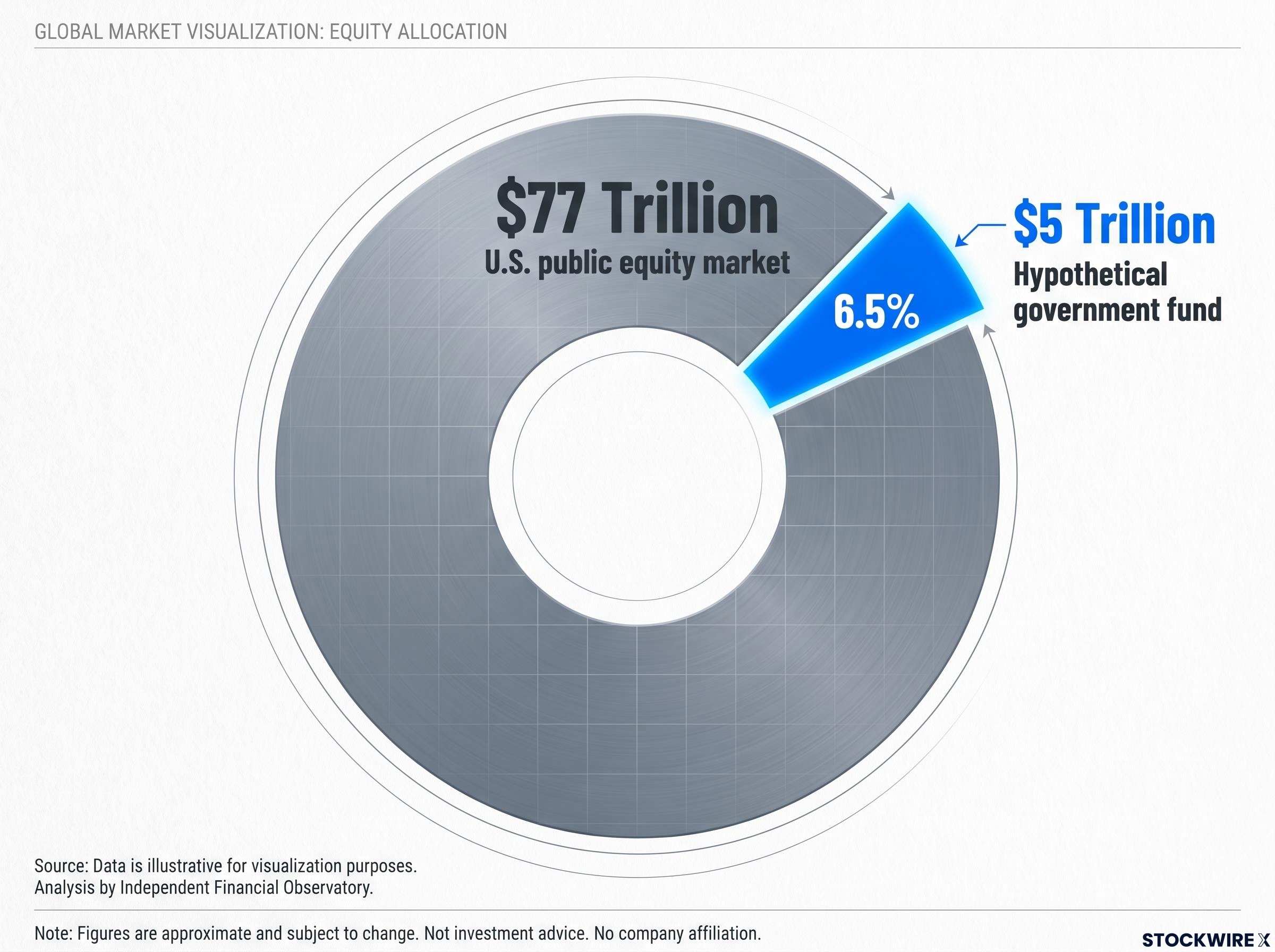
The size question in context Norway’s $2.267 trillion fund sits against a U.S. public equity market estimated at roughly $77 trillion. A hypothetical $5 trillion U.S. fund would represent about 6.5% of total market capitalisation: meaningful, but not dominant.
Understanding what the U.S. would actually be building, rather than what the label implies, lets you judge these proposals on structure instead of political branding.
The political gridlock that could freeze a crisis response
The template everyone reaches for is 2008. During the financial crisis, the government acquired nearly 80% of AIG’s voting stock and around 34% of Citigroup, then placed those shares in trust structures to limit direct political control. It was messy, but it was bipartisan and coherent under genuine pressure.
The current environment does not offer the same conditions. Three structural barriers stand in the way of repeating that response:
- Approval ratings: the president faces historically low support across both left- and right-leaning polling, driven by military engagements and consumer prices.
- Opposition incentives: with midterm elections roughly two and a half months away, Democrats have little reason to hand the administration a win.
- No enacted legislation: nothing on the books pre-authorises a fund, so any capitalisation would need to clear Congress from a standing start.
What informed insiders appear to be signalling
The post-midterm period is the anticipated window for a larger rollout. That timing is telling, because it assumes a legislative alignment that does not currently exist.
Meanwhile, former Treasury Secretary Hank Paulson issued public warnings about a potential Treasury crisis roughly three months ago. Analysts read those comments as something more than commentary.
A deliberate trial balloon Paulson’s warnings are widely characterised as a calculated attempt to prepare markets for a large-scale, post-crisis policy response. When someone who ran the 2008 playbook starts pre-positioning expectations, the signal is that the playbook is being gamed out again.
Here is the tension that leaves you with. A post-crisis government push into equities may be analytically predictable. The political machinery to execute it in a coordinated, durable way is genuinely uncertain. The 2008 window was historically unusual, and assuming it reopens automatically in the next crisis is a planning error with real portfolio consequences.
For readers wanting to understand the specific market-stress conditions that would most likely accelerate a post-crisis government equity push, our deep-dive into the Trump Put trigger thresholds examines the Liberation Day stress benchmark and what a genuine policy-reversal signal looks like versus orderly market repricing.
What a politically viable framing might look like
Both left and right are already testing a workaround: pitch the fund not as government ownership of markets but as citizens holding a direct stake in national wealth. The Altman proposal, redistributing purchased shares to the public, is the sharpest version of that pitch.
The reframing is analytically significant, not cosmetic. Whether the fund reads as “the state owning your economy” or “you owning a slice of national wealth” is what determines if it can draw cross-partisan legislative support. The language is doing structural work.
What the analytical case actually rests on, and where it breaks down
Strip away the noise and the affirmative case is coherent. Set it directly against the conditions that undermine it:
- Supports the thesis: the grant-to-equity conversion at Intel shows a repeatable ownership mechanic. Against it: the fiscal starting point, with a $1.8 trillion deficit, means a debt-funded fund adds sovereign risk rather than managing it.
- Supports the thesis: the DoD’s 15% stake in MP Materials confirms consistent sector targeting. Against it: no statutory independence framework exists, leaving any fund exposed to executive-branch direction.
- Supports the thesis: Paulson’s warning and Executive Order 14196 together look like anticipatory pre-positioning, not reactive scrambling. Against it: assembling a bipartisan coalition is structurally harder now than it was in 2008.
The International Monetary Fund (IMF) offers the closing calibration. Sovereign wealth funds have historically acted as stabilising forces during market turmoil, providing countercyclical support and long-term capital. But that stabilising function presupposes institutional independence, which a U.S. fund does not yet possess.
The IMF analysis of Norway’s fund governance identifies operational independence from the Ministry of Finance as the single feature most responsible for the GPFG’s countercyclical credibility, a finding that maps directly onto the statutory independence gap the article identifies as the critical missing condition for a U.S. equivalent.
That is the filter to apply. The absence of statutory independence is not a procedural gap; it is the structural condition separating a genuine sovereign wealth fund from a government investment arm subject to political direction. As of September 2026, there is no enacted legislation and no capitalised fund, only Executive Order 14196 and a run of equity stakes.
This article is for informational purposes only and should not be considered financial advice. Investors should conduct their own research and consult with financial professionals before making investment decisions.
When the analytical case becomes actionable intelligence
The core tension is now clear. The government’s equity-stake pattern is real, the institutional framework is absent, and the political execution window is narrow and time-sensitive.
The point is not to predict the outcome. It is to know exactly what would move this from anticipation to operational reality. Three triggers are worth watching, in order of significance:
- Enacted legislation that actually capitalises a fund, rather than another planning directive.
- A named governance structure with statutory independence, the feature that separates a real institution from a political vehicle.
- A post-midterm political alignment that creates a credible legislative pathway.
Scale is your orientation tool.
The number to keep in mind In a $77 trillion public equity market, a $5 trillion government fund would hold roughly 6.5% of total capitalisation. That is not too small to matter. A single actor with a long-term mandate and countercyclical intent at that scale would be a structurally significant force, with real implications for sector concentration and price discovery.
Readers who can spot those legislative and governance triggers early will separate signal from noise while others are still reacting to headlines. Forward-looking assessments here are speculative and subject to change based on market and policy developments.