
Here is a fact that should not sit as comfortably as it does. Through the worst of the pandemic, when Qantas planes were grounded and the airline was losing billions, one division kept posting hundreds of millions in earnings almost as if nothing had happened.
That division was the Qantas Frequent Flyer loyalty programme. And its behaviour raises a structural question that matters for anyone weighing up the stock.
What does it mean when one part of a capital-intensive business behaves like an asset-light platform? Does that change the investment case for the whole company? This is not a company profile. It is an exercise in separating business unit quality from whole-company merit.
Here is what you will take away. After reading, you will know how to tell the difference between a genuinely excellent segment and a moat-protected company, and you will understand precisely why Morningstar continues to rate Qantas as having no economic moat even while the loyalty numbers look so compelling. Those two facts can both be true at once, and the reason they can is the whole point.
The financial architecture of a loyalty programme that barely needs planes
Start with how the programme actually earns money, because it is not the way most people assume. Qantas Loyalty does not primarily make its earnings from members booking flights. It makes them by selling points to commercial partners, who then hand those points to their own customers as rewards.
Those partners fall into a handful of categories:
- Banking institutions issuing points-earning credit cards
- Grocery retailers rewarding weekly shops
- Telecommunications providers bundling points with plans
- Department stores attaching points to purchases
Every one of those partners pays Qantas cash upfront for the points. The obligation to provide something in return, a flight, a hotel night, a gift card, only crystallises later, if and when the member redeems. Unredeemed points sit on the balance sheet as a liability, but the cash has already landed. That gap between cash-in-now and obligation-settled-later creates a structural float, money that funds operations before a single seat is sold.
There is a network effect layered on top. More earning and redemption partners make membership more useful, which draws in more members, which makes the programme more attractive to the next partner. The flywheel reinforces itself over time.
Qantas Loyalty FY2025 Underlying EBIT: $556 million
That $556 million came on segment revenue of $2,863 million and represented 9% EBIT growth year-on-year. Against Qantas Group Underlying Profit Before Tax of $2,394 million in FY2025, the loyalty segment alone contributed roughly a quarter of group earnings.
| Metric | FY2025 | H1 FY2026 |
|---|---|---|
| Segment revenue | $2,863M | Not yet reported |
| Underlying EBIT | $556M | $286M |
Here is the interpretation you should carry into the rest of this article. With cash arriving before the obligation is settled and a deferred liability funding the float, Qantas Loyalty is closer in financial character to an insurance company or a prepaid payments platform than to an airline division. Before you compare its returns to the broader airline, you need to understand it operates on entirely different mechanics.
When big ASX news breaks, our subscribers know first
What the pandemic proved about loyalty economics (and what it did not)
The pandemic did something no analyst could have designed deliberately. It forcibly separated the loyalty programme from the flying business, then let everyone watch what happened to each half. That makes it the clearest evidence available of the programme’s structural independence.
When the planes stopped, the flying profits collapsed precipitously across both domestic and international operations. The loyalty programme barely flinched.
In FY20, Qantas Loyalty delivered Underlying EBIT of $341 million, a decline of only 9% at a moment when the rest of the airline was in freefall. In FY21, the programme generated more than $1 billion in gross cash and posted Underlying EBIT of $272 million.
In FY21, the loyalty programme generated over $1 billion in gross cash while the airline’s planes were largely grounded.
Members kept the programme alive without flying. They redeemed points on hotels, goods and services instead of seats. Qantas leaned into that behaviour, lowering the points required for hotels and holidays in February 2022 to keep engagement up. By FY22, loyalty revenue had climbed 36% to $1.33 billion, and membership had reached 14.1 million.
This is not a uniquely Australian story. United Airlines’ MileagePlus programme generated roughly US$5.3 billion in cash from sales in 2019 and reportedly threw off strong cash flows even through the worst pandemic months, the same structural dynamic playing out at greater scale in a different market.
| Financial year | Loyalty Underlying EBIT | Context |
|---|---|---|
| FY20 | $341M | Down just 9% as flying profits collapsed |
| FY21 | $272M | Over $1B gross cash generated |
| FY22 | Revenue $1.33B | Up 36%; membership 14.1M |
| FY25 | $556M | 9% EBIT growth year-on-year |
| H1 FY26 | $286M | Full-year figure not yet available |
The read you should take from this is not simply that the programme is resilient. It is that the loyalty segment runs on a different risk cycle from the airline entirely. Pricing that diversification correctly, not admiring it, is the real analytical task.
The risks the resilience narrative tends to obscure
Resilience is not the same as risk-free, and three structural constraints tend to get lost in the applause.
The first is credit-card revenue concentration. A large share of loyalty economics depends on points sold to banks, so any shift in card interchange economics or bank appetite feeds directly into the programme.
The second is the points overhang. Every point sold but not yet redeemed is a liability that keeps building on the balance sheet, a deferred obligation that grows as the programme grows.
The third is regulatory exposure. Operating at the intersection of financial services and consumer data means the programme carries the regulatory risk of both. These are constraints on how far the programme can scale over the long term, not passing operational bumps.
How the Virgin-Qatar alliance changes the pressure on Qantas’s core earnings
The loyalty programme’s internal stability is only half the picture. The airline it is bolted to is facing a competitive environment that has tightened considerably, and that contrast is where the tension in the Qantas story now lives.
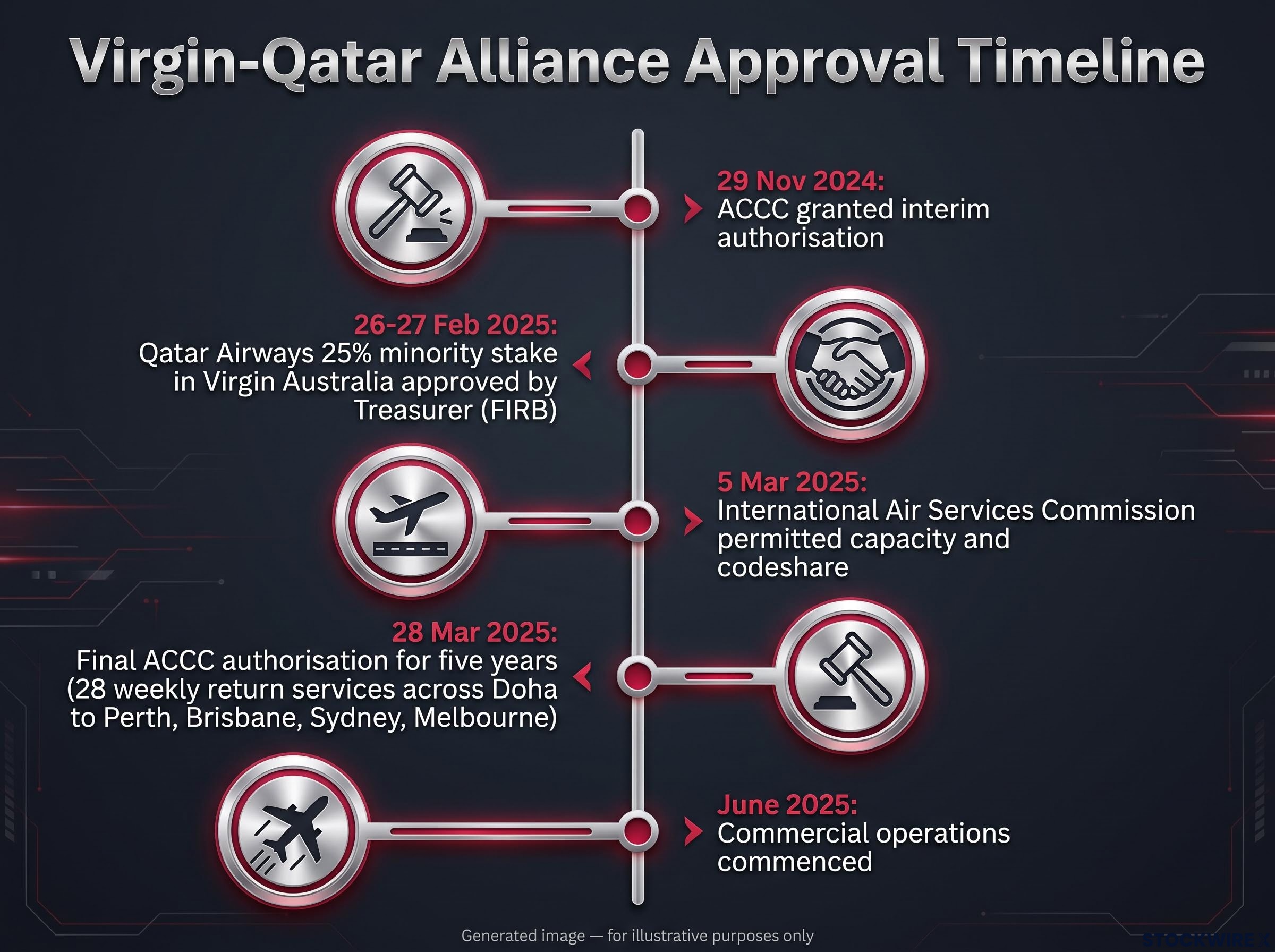
The Virgin Australia and Qatar Airways alliance is not a speculative threat. It cleared a full sequence of regulatory approvals and is already operating:
- 29 November 2024: ACCC granted interim authorisation to begin marketing services.
- 26-27 February 2025: Qatar Airways’ 25% minority stake in Virgin Australia was approved by the Australian Treasurer following FIRB review.
- 5 March 2025: The International Air Services Commission permitted capacity allocation and codeshare services.
- 28 March 2025: Final ACCC authorisation was granted for five years, covering 28 weekly return services across Doha to Perth, Brisbane, Sydney and Melbourne.
- June 2025: Commercial operations of Virgin-branded, Qatar-operated flights commenced.
The competitive mechanism is straightforward. Virgin-branded flights routed through Doha give Australian travellers access to more than 100 international destinations that were previously reached mainly through Qantas’s Emirates partnership. That is direct yield pressure on Qantas’s international book, and the international segment only completed its post-pandemic recovery by the end of FY25.
There is already a number that tells you the pressure is landing. Qantas Group Underlying PBT fell to $2,064 million in FY26, down $330 million from FY25. That decline is early evidence competitive pressure is compressing group earnings, and the alliance’s full capacity deployment may not even be reflected in those figures yet.
The fuel cost pressure on margins intensified sharply through 2H26 as jet refining margins surged from US$20 to approximately US$120 per barrel, pushing Qantas’s estimated half-year fuel bill to $3.1–3.3 billion despite 90% crude hedging cover and forcing fare increases alongside the capacity reductions.
What the domestic and international threats look like in practice
The two threats work through different mechanisms. Internationally, the pressure is direct: Virgin and Qatar competing head-on for long-haul yield via the Doha hub, forcing Qantas to weigh fares against capacity on its own long-haul routes.
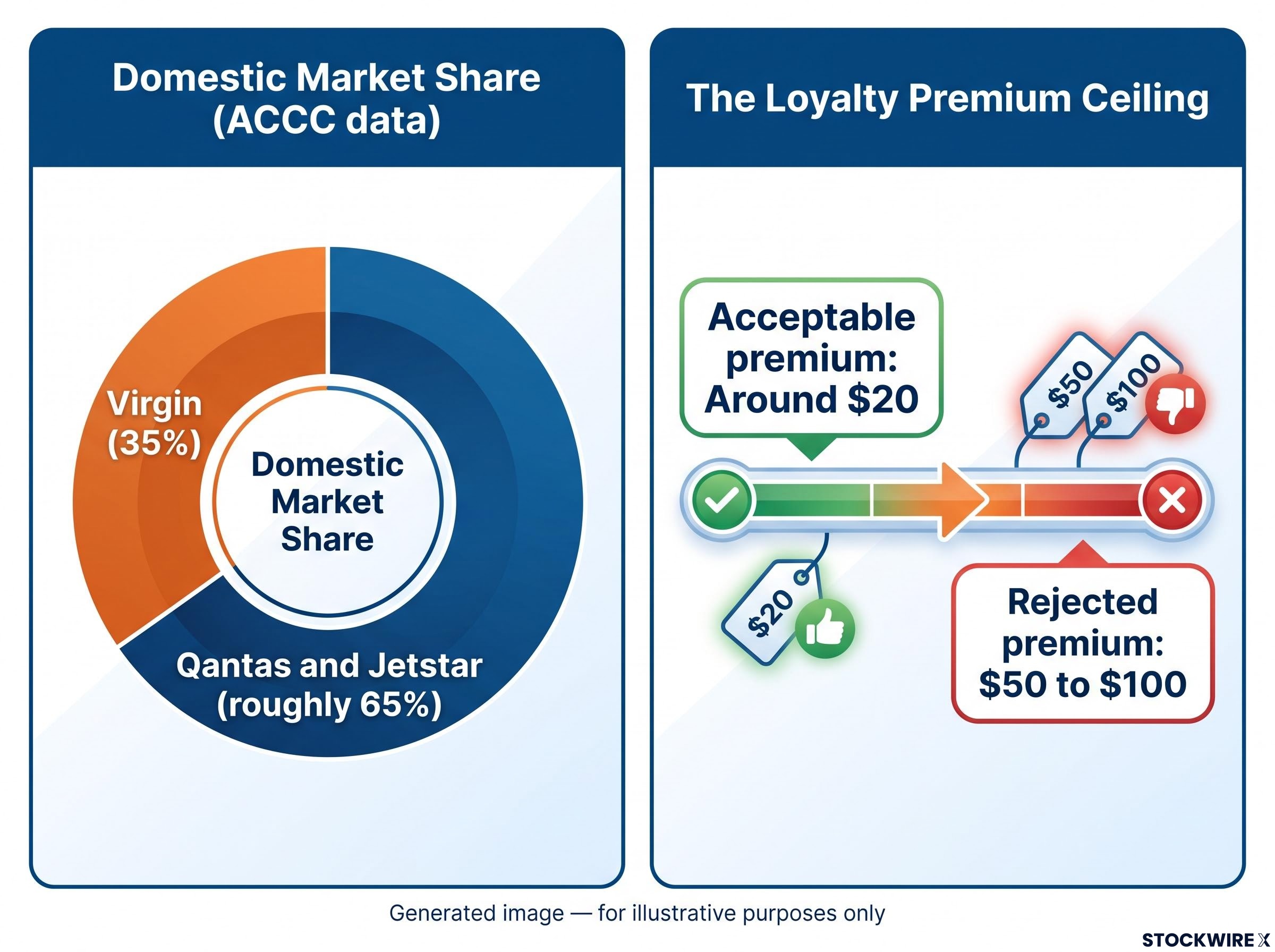
Domestically, the picture is steadier. Qantas and Jetstar hold roughly 65% of the domestic market against Virgin’s 35%, per ACCC data, and that duopoly remains largely intact. The risk is margin, not share: if Virgin channels alliance economics into domestic pricing, Qantas faces harder capacity and fare decisions at home too.
The loyalty programme offers only partial cover here. Research indicates members will accept a modest fare premium, around $20, to keep earning points, but not a large one of $50 to $100. Beyond that ceiling, price wins.
Why a profitable loyalty programme is not the same thing as a competitive moat
Now the pieces come together. The loyalty programme is genuinely valuable. The pandemic data confirms its resilience. And Morningstar’s no-moat rating on Qantas is still correct. Understanding why all three can be true at once is the entire investment lesson.
Morningstar’s no-moat thesis, led by Senior Equity Analyst Angus Hewitt, rests on structural features of the airline business that no loyalty programme can override.
The economic moat framework, as Morningstar formalised it, identifies five distinct sources of competitive advantage: intangible assets, switching costs, network effects, cost advantage, and efficient scale, and treats multiple reinforcing sources as more durable than any single driver in isolation.
| Moat criterion | Qantas assessment |
|---|---|
| Capital intensity | High. Constant aircraft, maintenance and infrastructure spend makes sustained excess returns hard. |
| Input cost volatility | High. Earnings swing with fuel prices, currency and demand cycles largely outside management control. |
| Switching costs | Low. Loyalty makes members stickier only up to a modest fare premium. |
| Barriers to entry | Low. Air travel is commoditised and exposed to aggressive price competition. |
The distinction that matters is between segment quality and whole-company moat. A high-quality, asset-light segment attached to a capital-intensive, moat-free parent does not lend its characteristics to the whole. The loyalty programme is excellent; the airline it funds is still an airline.
Members will absorb roughly a $20 fare premium to earn points, but not $50 to $100.
That ceiling is the single most concrete piece of evidence that the programme does not create airline-level switching costs. It buys loyalty at the margin, not protection from price competition.
The Air Canada and Aeroplan story is the most instructive international precedent here, and it cuts against the idea that separating a loyalty programme is a clean win.
- Aeroplan was spun out into a separate entity, Aimia, which captured most of the profit while Air Canada carried a valuation deficit.
- The separation created lasting strategic misalignment between the airline and the programme it depended on.
- Air Canada eventually bought Aeroplan back in 2019 to repair that misalignment.
- Qantas retaining ownership of its programme is the strategically sound choice, but retention alone does not manufacture a moat.
For context on how markets can value these programmes in isolation, United once implied a valuation of roughly US$22 billion for MileagePlus at around 12x EBITDA, a figure that also carries heavy counterparty concentration risk given its reliance on bank contracts.
Read the no-moat rating as a calibration tool, not a dismissal. For an Australian investor, the practical implication is that Qantas earnings should be modelled as cyclical and mean-reverting even when loyalty is performing strongly, because the airline’s cost structure and competitive exposure can erode group returns faster than loyalty cash flows can offset them.
What the loyalty programme tells investors about Qantas, and what it does not
Pull the threads together and a calibrated position emerges. The loyalty programme is a genuine earnings buffer and a structurally distinct business. The competitive environment is intensifying. And the whole-company case remains cyclical and capital-constrained. None of those cancels the others out.
The scale of the buffer is worth stating plainly. Loyalty’s $556 million of EBIT against group PBT of $2,394 million in FY25 puts the segment at roughly 23% of group earnings. That is meaningful insulation. But an investor who models Qantas primarily as a loyalty business rather than an airline will misprice the cyclical risk carried by the other 77%.
The dual-brand structure, Qantas paired with the low-cost Jetstar, is a related buffer, letting the group flex capacity across demand environments. Its limit is obvious: Jetstar competes on price in exactly the market Virgin is now pressuring harder.
Jetstar’s strategic footprint is itself being actively reshaped: Qantas signed a binding agreement in August 2026 to exit its 33.32% stake in Jetstar Japan via a JPY8.2 billion share buyback, delivering an estimated A$115 million gain in FY27 while all Australia-Japan services and JAL codeshare arrangements continue unchanged.
Three variables will determine whether the loyalty buffer proves sufficient in this cycle:
- The pace at which Virgin and Qatar deploy full alliance capacity
- Qantas’s ability to defend international yields as that capacity lands
- Whether the programme’s partner economics, credit-card revenue especially, face regulatory disruption
As of September 2026, full-year FY26 loyalty figures are not yet available, so the $286 million H1 FY26 EBIT is the most current read. Watch those three variables, and you have a working framework: not a verdict on Qantas, but a clear map of where a well-run business unit ends and a moat-protected company would begin.
For investors wanting to benchmark Qantas’s pricing power against international peers, our full explainer on how fuel costs sort airline stocks examines how Delta, United, and Southwest have diverged on margin resilience, with RASM trajectory and CASM-ex-fuel as the key metrics to watch.
This article is for informational purposes only and should not be considered financial advice. Investors should conduct their own research and consult with financial professionals before making investment decisions. Past performance does not guarantee future results. Financial projections are subject to market conditions and various risk factors.