Switzerland’s factories are running hot. The country’s manufacturing gauge just posted its strongest reading since May, retail sales beat forecasts, and consumer spending is accelerating. By any conventional measure, this is a currency that should be gaining ground.
Instead, the Swiss Franc is the worst-performing G10 currency this quarter.
That contradiction is not a rounding error or a temporary blip. It is a live demonstration of how central bank policy and structural foreign exchange dynamics can completely override the economic fundamentals most investors instinctively reach for when they try to predict currency moves.
For anyone trying to read the Franc, or any low-yield currency, off the back of a strong economic print, this is the analytical trap worth understanding. Good data and a falling currency are not a contradiction the market has failed to notice. They coexist by design.
Here is what actually drives the Franc right now, why positive Swiss data keeps failing to lift it, and the three specific conditions that would need to change before its trajectory reverses.
The data looks strong. So why is the Franc falling?
Start with the numbers that should be bullish. The Swiss SVME Purchasing Managers’ Index (PMI), a survey that measures manufacturing activity where any reading above 50 signals expansion, surged to 57.1 in August 2026. That was not a modest beat.
The August PMI of 57.1 came in far above the 53.5 forecast, marking the strongest reading since May and reversing a five-month low of 53.2 recorded in July.
Consumer spending told the same story. Swiss real retail sales rose 2.3% year-over-year in July 2026, well ahead of the 1.3% expected, with non-food sales up 1.8%. Momentum was building across both industry and the high street.
Here are the key figures side by side:
- Swiss SVME PMI: 57.1 in August 2026, versus 53.5 forecast (up from 53.2 in July and 54.3 in June)
- July 2026 real retail sales: 2.3% year-over-year, versus 1.3% forecast
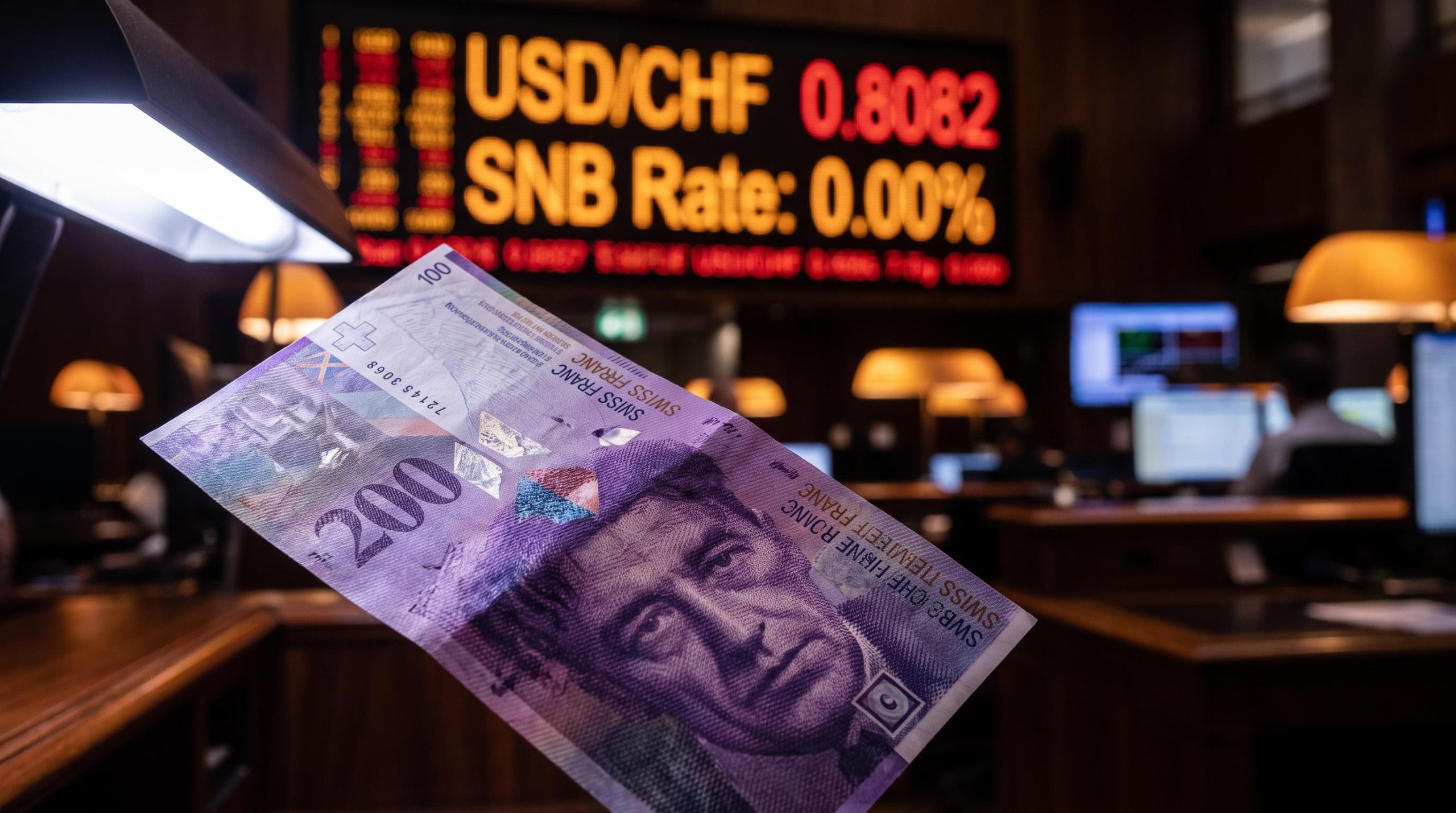
- USD/CHF spot: approximately 0.8082 on 31 August 2026, ranging near the 0.8000 to 0.8100 handles through July and August
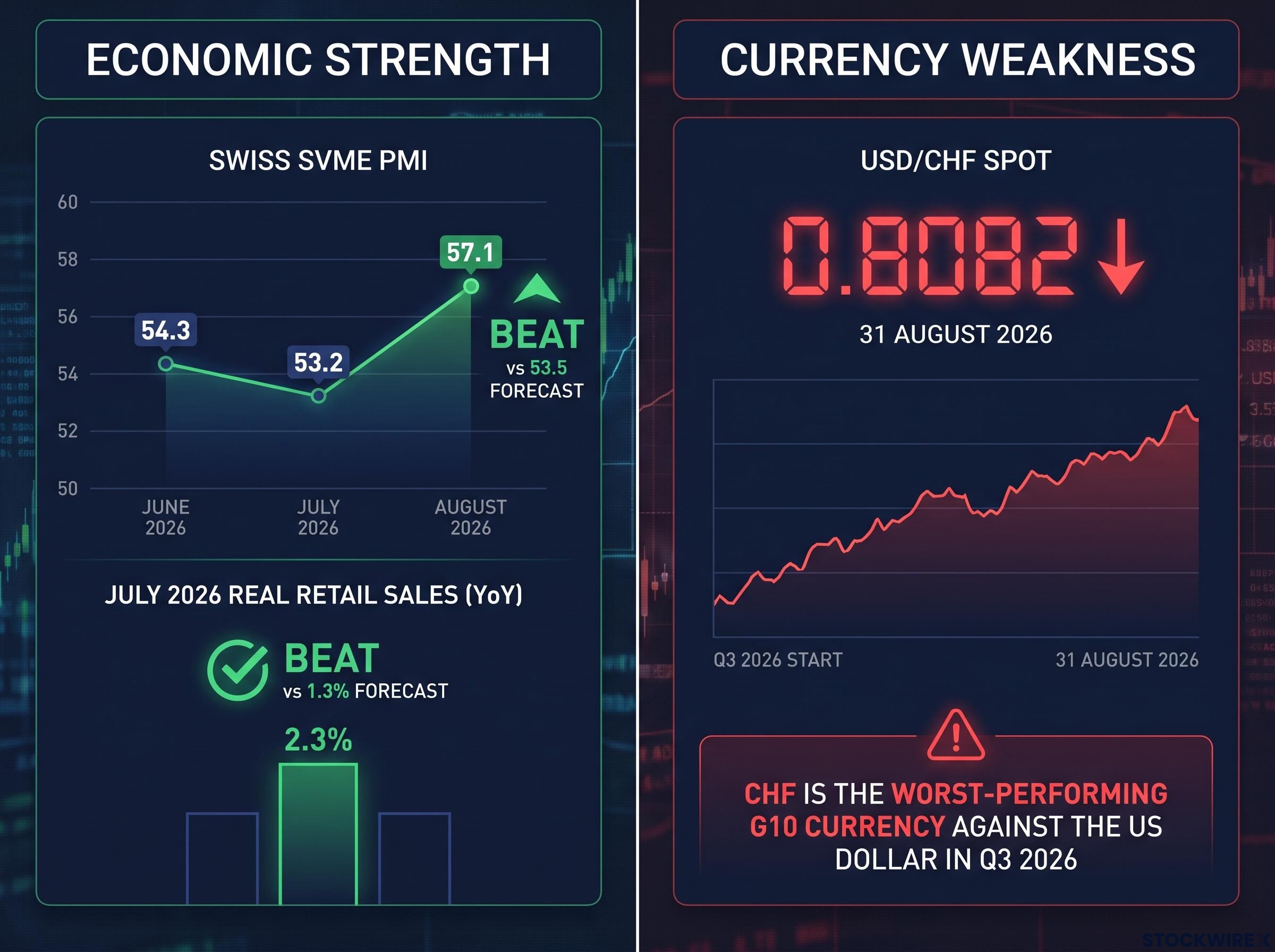
Now the collision. Despite that run of upside surprises, USD/CHF sat near 0.8082 at the end of August, and the Franc held the unwanted title of the worst-performing G10 currency against the US dollar in Q3 2026.
This is the point where conventional macro logic breaks down. In foreign exchange markets, strong fundamentals do not automatically produce a stronger currency. A firing economy can sit alongside a sliding exchange rate, and the Franc is the clearest current example of why.
What that gap tells you is important. The forces holding the Franc down are structural and deliberate, not a symptom of economic weakness. Reading CHF accurately means understanding those forces, because the PMI print alone will point you in exactly the wrong direction.
When big ASX news breaks, our subscribers know first
Why the SNB’s zero-rate policy is the dominant force in CHF markets
The single most important fact about the Franc has nothing to do with Swiss factories. It is the policy rate.
The Swiss National Bank (SNB) has held its policy rate at 0.00% since 20 June 2025, and kept it there through both the March 2026 and June 2026 assessments. The next decision lands on 24 September 2026.
Markets see no near-term route back to higher rates, and the SNB’s own forecasts explain why. Its conditional inflation forecast assumes average inflation of just 0.6% for 2026-2027, a projection built on the assumption that rates stay at 0% all the way through 2028. When the central bank itself pencils in a zero rate for years, traders stop pricing normalisation entirely.
The USD/CHF rate differential, currently running at approximately 350 basis points with the Fed at 3.50%-3.75% and the SNB pinned at zero, is the quantitative backbone of the pressure the Franc faces, and it also explains why every US inflation print has become a secondary signal for CHF direction.
The SNB June 2026 monetary policy assessment confirmed the 0.00% rate hold and set out conditional inflation projections of just 0.6% through 2026-2027, a forecast built explicitly on the assumption that rates remain at zero all the way through 2028.
A 0% rate does more than sit quietly in the background. It turns the Franc into a funding currency for the carry trade, a strategy where investors borrow a low-yield currency to buy a higher-yielding one and pocket the difference.
The mechanism runs in three steps:
- Borrow Swiss Francs at effectively 0%, meaning the cost of the position is close to nothing.
- Convert those Francs into a higher-yielding G10 currency such as the US dollar.
- Earn the interest rate spread between the two, collecting yield for as long as the trade stays open.
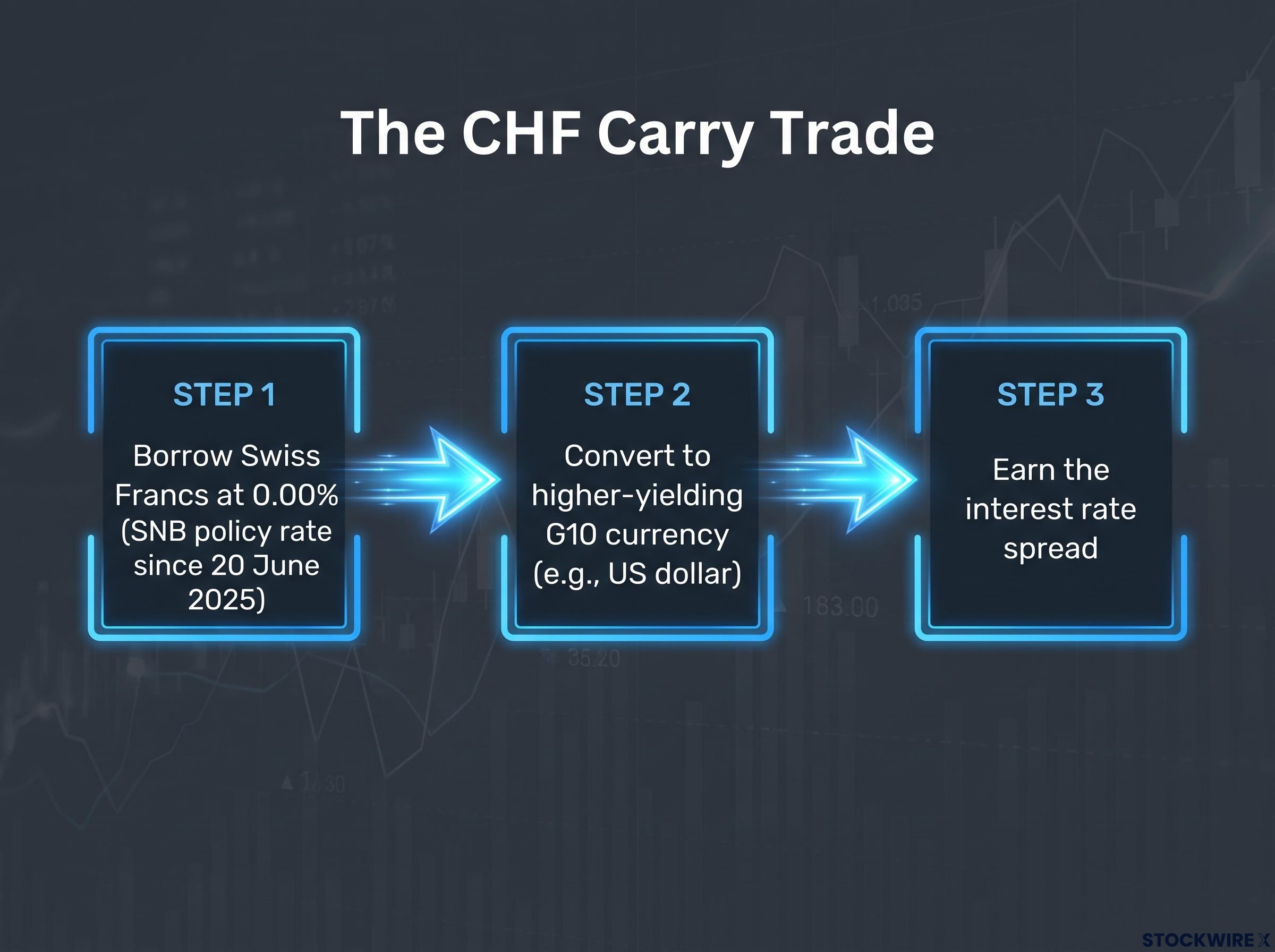
Every time that trade is put on, someone sells Francs. Multiply it across the market and you get a continuous stream of structural selling pressure that exists entirely independent of Swiss economic data.
This is why policy overrides fundamentals here. As long as the SNB holds at zero, every carry trader in the market has a standing incentive to be short the Franc. A strong PMI does not remove that incentive. The pressure does not lift because retail sales beat a forecast, and that is the piece most fundamentals-driven analysis misses.
How CHF absorbed the carry trade demand that shifted from JPY
The Franc has not been the market’s only zero-cost funding vehicle. The Japanese Yen (JPY) has long played that role too, but recent interventions in the yen raised the cost and risk of borrowing it, pushing carry traders to look elsewhere.
The Franc absorbed some of that displaced demand, becoming the comparatively more attractive currency to borrow. That added an extra layer of selling pressure driven by market structure and positioning shifts, entirely separate from anything the SNB chose to do with its own rate.
The overvaluation trap: why being expensive and low-yield is a double bind
Even after a quarter of underperformance, the Franc carries a second problem that compounds the first. On long-run fair value measures, it is still viewed as the most overvalued currency in the G10.
Ordinarily, an overvalued currency attracts sellers who expect it to fall back toward fair value. That alone would be a headwind. But the Franc pairs its rich valuation with the lowest yield in the group, and the combination creates a genuine double bind.
Consider the total-return maths. Holding Francs against the US dollar means accepting negative carry, paying away yield for the privilege of holding the position.
To simply offset that negative carry against the US dollar, analysts estimate the Franc would need to appreciate 10-15% over 3-5 years, a figure flagged as an unverified estimate.
That is a steep hurdle. You are asked to hold an expensive currency that pays you nothing, on the hope of an appreciation large enough just to break even. For active investors, that is the worst of both worlds: the level deters buyers and the carry punishes holders.
The table below shows how the Franc’s profile stacks up against higher-yielding peers:
| Currency | Approx. policy rate | Valuation status |
|---|---|---|
| Swiss Franc (CHF) | 0.00% | Most overvalued in G10 |
| US Dollar (USD) | Higher-yield peer | – |
| British Pound (GBP) | Higher-yield peer | – |
The Franc’s deep ties to the Eurozone add to the picture. In mid-2026, EUR/CHF traded near 0.92 and USD/CHF around 0.79, and analytical models put the correlation between CHF and EUR valuations at roughly 90% or higher. The Franc’s fate is bound tightly to its largest trading partner.
EUR/CHF corridor forecasts from Commerzbank, UBS, and Rabobank cluster the pair inside a 0.91-0.95 band over the next 12-18 months, a range that implies near-term softness giving way to a structurally grounded recovery once rate hike expectations are fully repriced out.
The SNB’s intervention posture and what it signals to markets
There is a final piece that caps the upside. The SNB has explicitly signalled a willingness to intervene in currency markets to prevent unwanted Franc appreciation, and it does so precisely because an overvalued Franc threatens Swiss export competitiveness.
What that means for you is stark. Even during mild risk-off periods, safe-haven inflows into the Franc get priced as temporary, because the market expects the SNB to step in and suppress any sustained gain.
Markets take that rhetoric seriously for a reason. Between 2011 and 2015 the Franc was pegged to the Euro, and when the SNB abruptly removed that peg in 2015, the currency surged more than 20%. That episode remains the benchmark for how violently SNB policy can reprice the Franc, and it cuts both ways.
What could actually reverse the Franc’s trajectory?
The Franc’s weakness is durable under current conditions, but durable is not permanent. Three specific catalysts could reprice it quickly, and each works through a different mechanism.
- Geopolitical shock: A severe escalation, with Middle East tensions the live example, could overpower policy-driven suppression and trigger a flood of defensive flows into the Franc.
- Carry trade unwind: If global risk appetite reverses or yield differentials narrow sharply, CHF-funded carry trades unwind, and traders closing short positions are forced to buy the Franc back, pushing it higher fast.
- SNB stance shift: Any signal that the central bank is stepping back from its intervention rhetoric would be read as a bullish regime change, removing the cap on upside.
The safe-haven angle deserves particular attention, because it explains the timing risk. The Franc’s safe-haven premium, its traditional pull during market stress, is largely dormant in calm periods. It only becomes the dominant pricing force during acute, extreme risk-off episodes.
Carry trade unwind dynamics are non-linear and historically concentrate their damage in thin-liquidity windows, with three major blowups in August 2007, August 2015, and summer 2024 each proving that seasonal calm amplifies rather than cushions the reversal when a macro shock materialises.
Since the start of the Middle East conflict, the Franc has been described as the third-worst-performing G10 currency, weakening around 3% against the dollar, a figure flagged as unverified. Even a live geopolitical flashpoint has not yet flipped the safe-haven switch, which shows how firmly policy and carry are holding it down.
The 2015 peg removal, which triggered a CHF surge of more than 20%, is the historical anchor for how quickly an SNB policy shift can reprice the currency.
For you, these are not abstract risks. Any of the three can materialise with force, and a Franc that looks structurally weak in calm conditions can become a rapidly appreciating one within a single session if the trigger appears.
Reading CHF in a policy-dominant FX environment
Pull the four layers together and the Franc’s story becomes clear. Strong data collides with a falling currency because a 0.00% rate turns the Franc into a carry-trade funding vehicle, extreme overvaluation paired with the group’s lowest yield creates a double bind, and SNB intervention caps whatever upside safe-haven flows might otherwise deliver.
None of that is really about Switzerland’s economy. A 57.1 PMI against a 53.5 forecast, a 0.6% inflation forecast, USD/CHF near 0.81: the fundamentals are secondary signals here, not primary drivers of direction.
That is the transferable lesson. The Franc is an extreme version of a pattern visible across low-yield currencies, where policy stance and structural carry dynamics dominate over economic data in setting near-term direction. When you assess any low-yield currency, ask what the central bank’s intervention posture is before you ask what the PMI says. In almost every calm-market scenario, the former overrides the latter.
For investors exploring how carry dynamics and central bank positioning play out across other low-yield or policy-constrained currencies, our dedicated guide to commodity currency positioning examines why a Fed dovish pivot failed to generate the expected rally in AUD, NOK, and peers, with BNY iFlow data showing basket-wide net selling within one week of the pivot.
The next inflection point is the 24 September 2026 SNB decision. Watch not only the rate itself but the language around FX intervention tolerance:
- SNB commentary on 24 September, particularly any softening on intervention
- Global risk appetite signals that could unwind carry positioning
- JPY carry dynamics that shift funding demand back and forth
This article is for informational purposes only and should not be considered financial advice. Investors should conduct their own research and consult with financial professionals before making investment decisions. Past performance does not guarantee future results, and financial projections are subject to market conditions and various risk factors.