
Five Chinese regulatory bodies simultaneously overhauled the country’s residential property system on 28 August 2026. Presale-linked mortgages are being phased out. The maximum home loan term has been raised to 40 years. And developer access to capital markets has been structurally reopened, with regulators widening permitted instruments to cover equities, bonds, asset-backed securities, and real estate investment trusts.
China’s housing sector has spent years haunted by undelivered apartments, collapsed developers, and buyer mortgage boycotts. This reform package targets the underlying mechanics of those failures rather than applying another round of cyclical stimulus, and the distinction matters. Five agencies acting simultaneously on structural rules signals a different policy intent from anything the market has seen in prior support rounds.
Here is what actually changed, why it reshapes developer viability, what the 40-year mortgage means for banks and borrowers, and where enforcement gaps could still catch investors off guard.
How China just rewired its housing market in four moves
The structural anchor is the shift from presale to completed-home sales. Mortgages now attach to delivered, registered units, not purchase contracts for apartments that may take years to build. That single change means buyers no longer finance construction risk with their own borrowed money, and it restructures cash-flow timing across the entire residential development model.
Making that shift operationally real required enforcement architecture. A new lead-bank system links each project’s financing to a single bank that monitors all project funds through regulated accounts. Down payments, mortgage proceeds, and other buyer funds must be held in dedicated project accounts, reducing diversion risk. Where a home has already been completed, mortgage funds are released only once the sale has been formally registered. Where a project was sold before completion and remains in the pipeline, funds are withheld until the formal completion registration has been recorded.
The demand-side lever: the People’s Bank of China (PBOC) and the National Financial Regulatory Administration (NFRA) pushed the ceiling on individual home loan terms upward, from 30 to 40 years, with each loan limited to the appraised value of the property. The supply-side lever: the China Securities Regulatory Commission (CSRC) opened four new financing instrument categories to eligible developers, covering equities, bonds, ABS, and REITs, with the expanded access taking effect straight away.
The PBOC’s role in the August reform package sits within a broader monetary backdrop: the current PBOC policy configuration, with the 10-year Chinese government bond yield below 1.70% and the yuan at its strongest since February 2023, creates a rare environment where domestic stimulus and FX stability are not in direct conflict, reducing one constraint on reform implementation.
The five agencies behind the joint announcement:
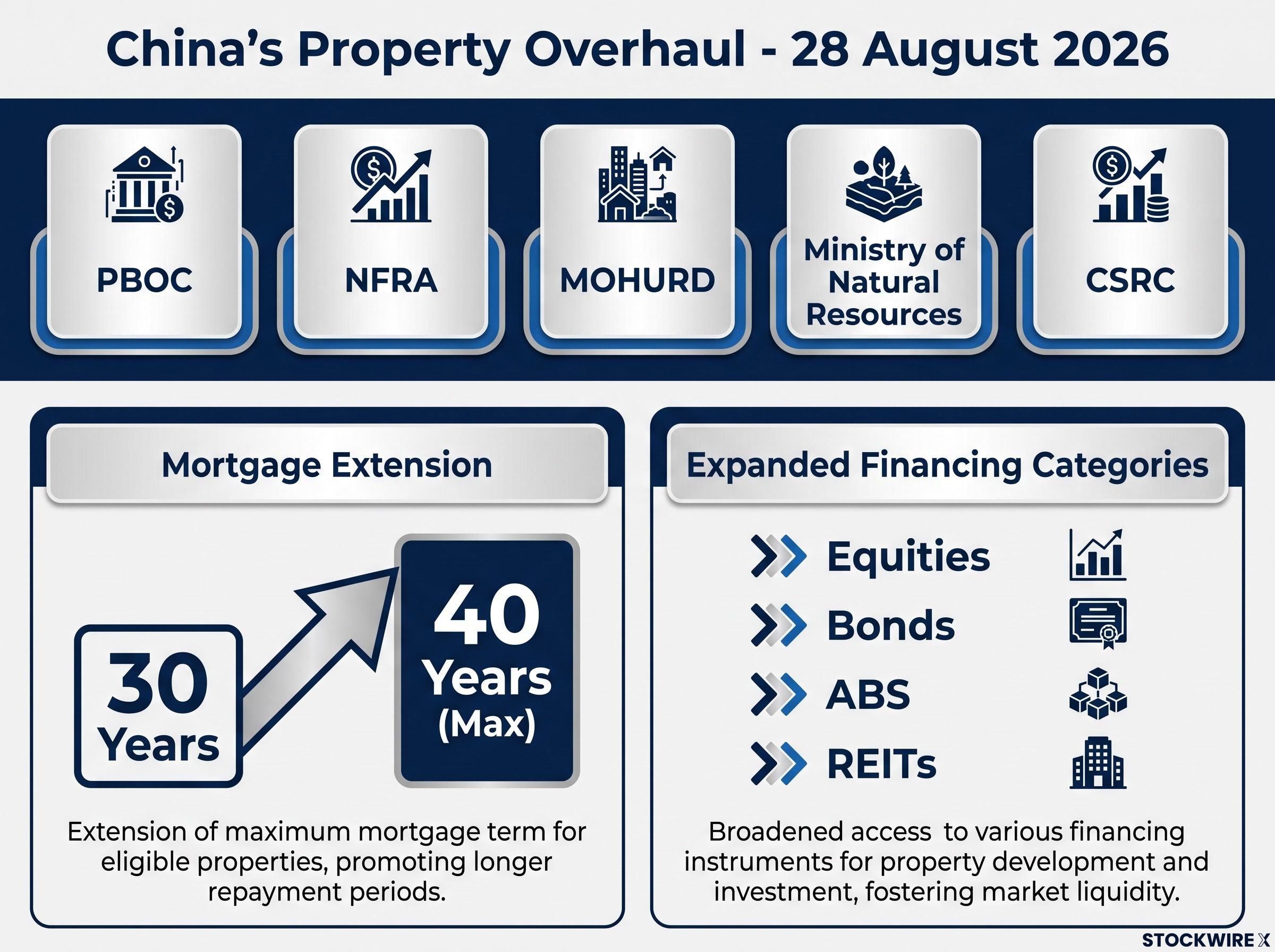
- People’s Bank of China (PBOC)
- National Financial Regulatory Administration (NFRA)
- Ministry of Housing and Urban-Rural Development (MOHURD)
- Ministry of Natural Resources
- China Securities Regulatory Commission (CSRC)
| Metric | Detail |
|---|---|
| Mortgage term extension | From 30 years to maximum 40 years |
| Mortgage ceiling | Must not exceed appraised property value |
| Financing categories expanded | Four: equities, bonds, ABS, REITs |
| Disbursement trigger (completed homes) | After formal sales registration |
| Disbursement trigger (presold projects) | After formal completion registration |
| Announcement and implementation | 28 August 2026, immediate effect |
When big ASX news breaks, our subscribers know first
What the presale shutdown means for developers: survival of the well-capitalised
Presales were the engine that made Chinese property development work at scale. Developers collected buyer payments before construction was finished, then used that cash to acquire more land and fund new projects. The system worked until it didn’t: when sales slowed, the cash stopped flowing, projects stalled, and buyers who had already begun mortgage repayments were left with nothing to show for it.
Removing that mechanism forces a fundamental shift. Developers must now self-finance or raise external capital before any sales proceeds arrive. For firms with strong balance sheets or state backing, that is an adjustment. For highly leveraged private developers that depended on presale cash flows to stay solvent, it is an existential squeeze.
According to Wee Khoon Chong, a BNY analyst via FXStreet, services and construction sectors remained challenged despite the reform announcements, reflecting ongoing structural stress in the property sector.
Who qualifies for the new financing channels
The CSRC’s expanded financing framework is not a sector-wide bailout. It is selectively available to projects with what regulators describe as “sound fundamentals” and “stable cash flows”, though the exact thresholds for those terms remain emergent. The operating principle is project-level evaluation rather than blanket developer-level access, which means conglomerates with mixed-quality project books could see some assets qualify while others do not.
The selectivity the CSRC is applying to developer financing access follows the same logic it has applied to overseas listings: CSRC regulatory gatekeeping has become project-level and compliance-driven rather than sector-wide, meaning well-governed entities with clean documentation can access capital markets while poorly positioned ones face structural exclusion regardless of sector.
The four categories of expanded financing:
- Equities: Private placements and convertible bonds for listed developers
- Bonds: New corporate bonds for eligible projects and debt rollover for existing obligations
- ABS: Property-backed asset-backed securities and commercial mortgage-backed securities for projects with stable operations
- REITs: New REIT launches or injections of eligible assets into existing vehicles
The financing expansion is a selective upgrade for policy-aligned, better-capitalised developers. Investors should expect continued bifurcation in listed developer equities and high-yield property bonds rather than a broad recovery.
The 40-year mortgage: affordability gain with a long tail of risk
The immediate appeal is straightforward. A longer mortgage term reduces monthly repayments for a given loan size, easing the entry-cost pressure that has kept buyers out of high-price urban markets. In a sector where demand has been suppressed for years, that is a meaningful lever.
Demand-side benefits:
- Lower monthly payments for equivalent loan sizes
- Easier affordability thresholds in major urban markets
- Potential stabilisation of buyer demand at the margin
Risk-side concerns:
- Higher total interest burden over the life of the loan
- Greater household leverage sensitivity to income or labour-market shocks across a 40-year horizon
- Increased asset-liability management complexity for banks carrying longer-duration mortgage books
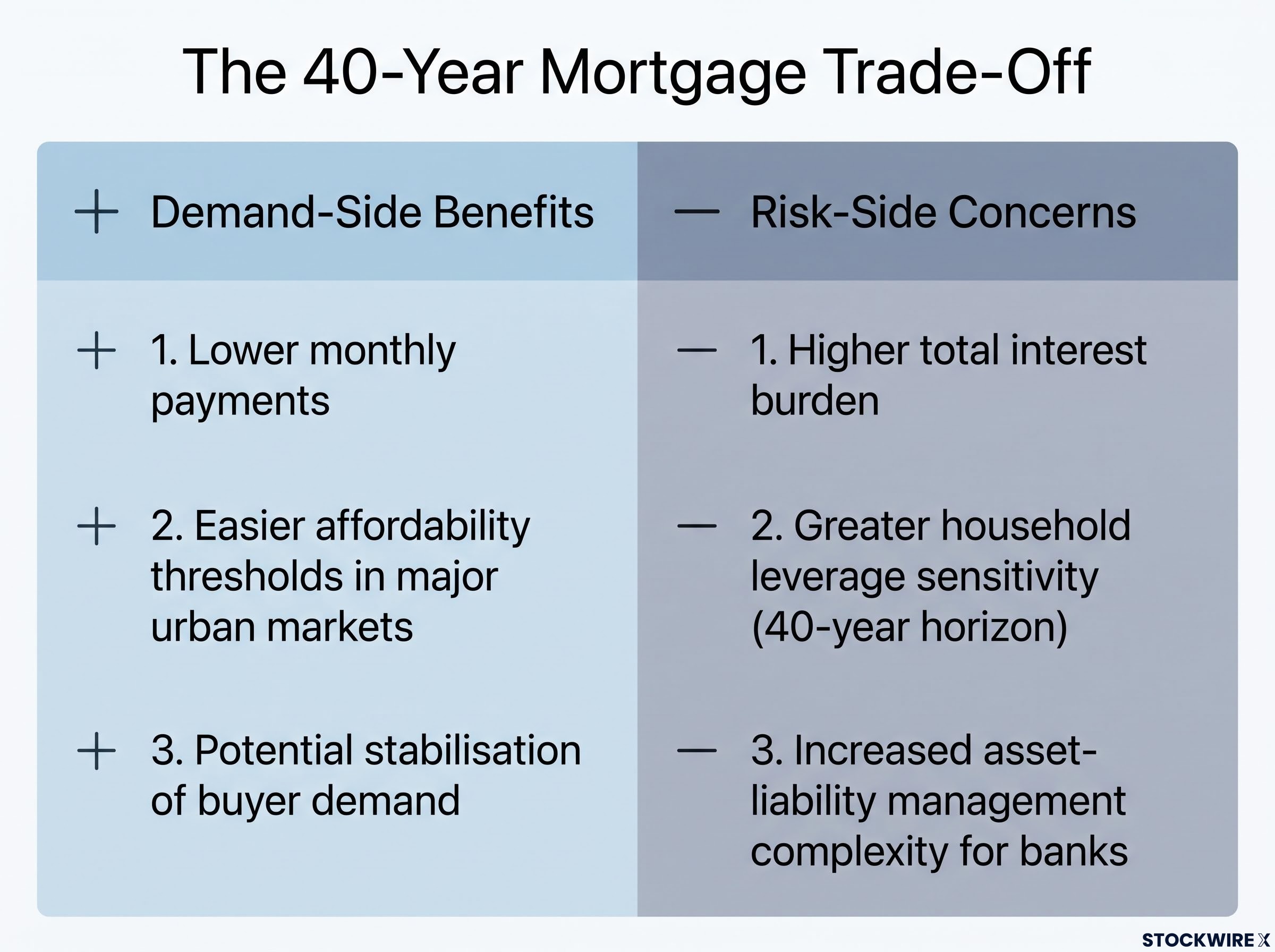
The trade-off is genuine. Longer terms mean higher total interest costs and higher leverage sensitivity if income growth underperforms over a multi-decade period. For banks, 40-year loans extend asset duration and raise long-run credit quality questions that shorter-term books do not carry.
Banks extending 40-year mortgage books into a rising global rate environment face long-duration credit risk that extends well beyond domestic Chinese monetary conditions; the simultaneous repricing of G10 sovereign yields to multi-year highs raises asset-liability management complexity for any institution carrying fixed-rate long-duration assets.
Whether 40-year mortgages actually support housing demand depends entirely on how commercial banks price and distribute them. The regulatory opening does not guarantee market availability; banks retain full discretion over product design, pricing, and risk appetite. Investors in Chinese financials cannot treat the announcement as a settled demand catalyst yet.
Where enforcement gaps could undermine the reform logic
The design is structurally sound. Whether it survives contact with implementation is another question entirely.
The primary near-term risk is local government execution. Completed-home sales requirements and regulated buyer accounts will be enforced at the city level, and historical enforcement across Chinese local governments has been uneven. Some cities may implement rigorously. Others may lag, creating a patchwork market where structural protections exist on paper but not in practice.
Four open risk categories investors should be monitoring:
- Local implementation variance: City-level enforcement rigour has historically diverged significantly between major and secondary cities
- Project-selection criteria ambiguity: “Financially sound” and “stable cash flows” are the regulator’s words, but operationalised thresholds have not been published
- Bank discretion on 40-year products: Regulatory permission does not equal commercial availability; bank pricing and product rollout timelines remain unknown
- ABS and REIT market depth: These markets in China remain relatively young, requiring investor education, regulatory fine-tuning, and performance track records before supply-demand balance stabilises
The gap between policy intent and city-level execution is where prior Chinese property reform cycles have stalled. That is the variable investors should be monitoring most closely in the months ahead.
What the reform package actually changes for global investors, and what it does not
What is structurally de-risked:
- Delivery failure risk, through the completed-home sales shift
- Buyer fund diversion, through regulated project accounts and lead-bank oversight
- Presale financing dependency, through the move to completion-linked mortgage disbursement
What remains unresolved:
- Rapid price or volume recovery in the residential market
- Near-term developer earnings pressure as firms adjust to new funding models
- Enforcement consistency across hundreds of local jurisdictions
- ABS and REIT market depth and investor appetite for new issuance
The reforms signal that authorities are addressing structural mechanics rather than applying cyclical stimulus. That is the constructive long-term signal for allocators with a genuine China macro view. But the near-term path for developers and construction-related firms remains pressured, and the financing expansion is selectively available to policy-favoured, better-capitalised (often state-linked) names rather than the sector at large.
Four variables to monitor from here: Local enforcement activity across major and secondary cities; commercial bank pricing and availability announcements on 40-year mortgage products; ABS and REIT post-reform issuance flow and pricing as a market-depth signal; and listed developer performance divergence between state-linked and private names as a real-time read on financing access.
This reform package is best read as a reduction in certain structural risks rather than a catalyst for immediate price recovery. Global investors should position their monitoring accordingly rather than treating 28 August 2026 as a turning-point event.
Monitoring the reform in motion: variables that will define the outcome
The structural intent is clear. Whether the reform achieves its aims depends on implementation fidelity over the next 12-18 months. Four observation points will tell the story:
- City-level enforcement activity: Watch for divergence between major cities (which typically enforce faster) and secondary cities (where legacy practices tend to persist longer). Early variance will signal how uneven the de-risking actually is.
- Commercial bank behaviour on 40-year mortgages: Watch for product availability timelines, pricing announcements, and risk appetite signals. If banks price aggressively, demand support is real. If they hold back, the regulatory opening stays theoretical.
- ABS and REIT issuance pipeline: Watch for the first post-reform issuances as a market-depth signal. Pricing and subscription levels on early deals will indicate whether investor appetite matches the regulatory encouragement.
- Listed developer performance divergence: Watch for state-linked versus private developer share and bond price performance as a real-time read on which firms are accessing the new financing channels and which are being left behind.
The next meaningful signal will come not from further policy announcements but from observable enforcement decisions and bank product launches in the weeks ahead. That is where investors should be directing their attention now.
These reforms represent a shift toward mechanism-level intervention rather than cyclical support, and that is the variable long-term allocators should weigh most carefully when reassessing China real estate exposure.
For investors wanting to model how the property reform sits within China’s broader macro trajectory, our deep-dive into China’s macro divergence and currency outlook examines why external surplus dynamics and policy credibility are sustaining yuan appreciation even as domestic activity indicators deteriorate.
This article is for informational purposes only and should not be considered financial advice. Investors should conduct their own research and consult with financial professionals before making investment decisions. Forward-looking statements regarding reform outcomes and market impacts are speculative and subject to change based on implementation developments and market conditions.