
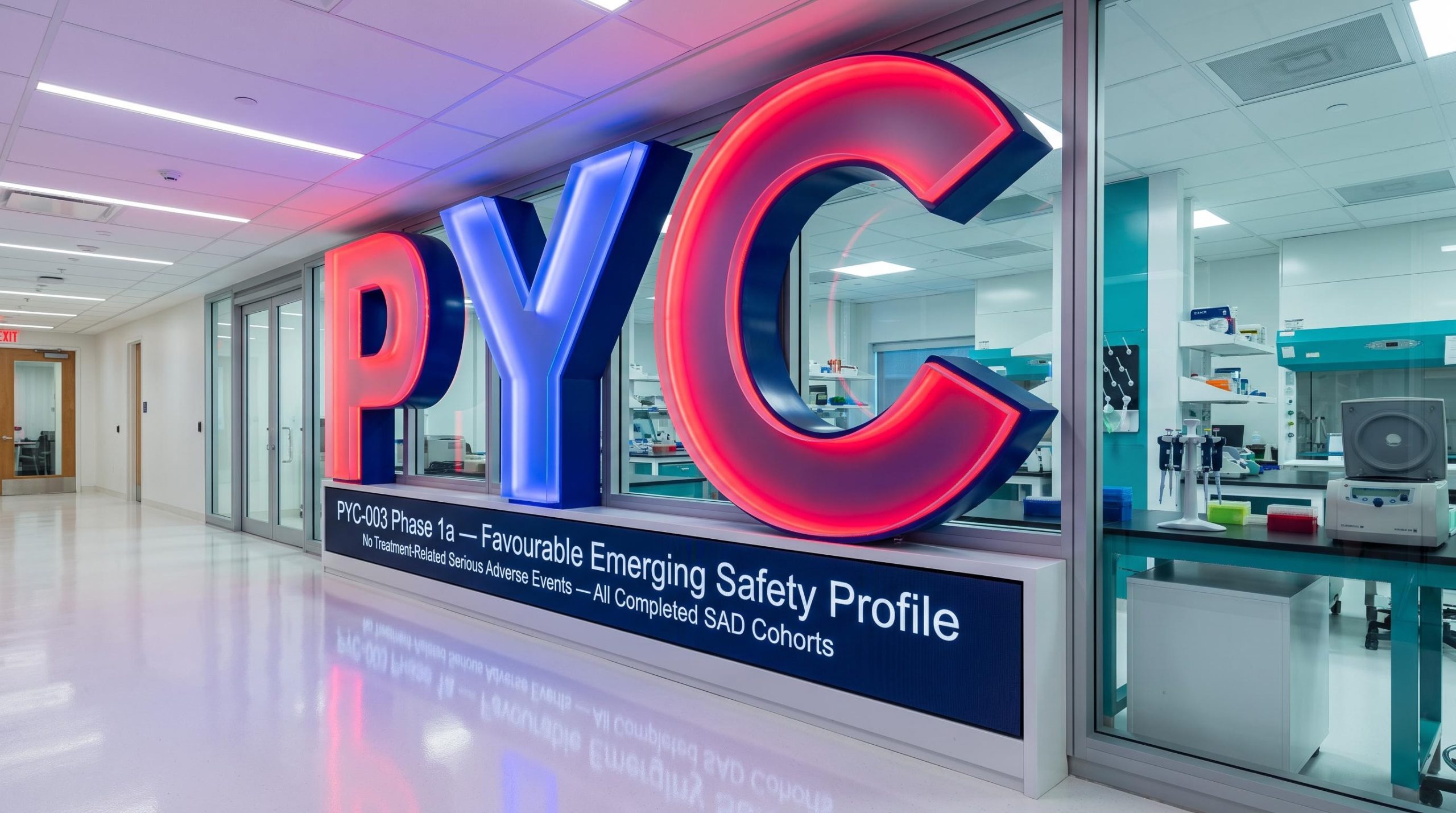
PYC Therapeutics presents favourable PYC-003 safety data at ANZSN conference
PYC Therapeutics (ASX:PYC) has presented safety data for its kidney disease candidate PYC-003 at the Australian and New Zealand Society of Nephrology (ANZSN) conference in Brisbane on 31 August 2026, delivered by Dr. Aron Chakera.
The data covers the completed single dose cohorts of the ongoing Phase 1a/1b clinical trial evaluating the safety and tolerability profile of PYC-003 in healthy volunteers and Polycystic Kidney Disease (PKD) patients.
According to the presentation, PYC-003 demonstrated a favourable emerging safety profile throughout the expected human pharmacodynamic range. Four key safety findings were highlighted:
-
No Treatment Emergent Serious Adverse Events (based on Safety Review Committee review of day 28 post-dose data for Part B patients)
-
No changes in serum electrolytes or creatinine outside the reference range
-
No changes in liver function tests (alanine aminotransferase and aspartate aminotransferase)
-
No evidence of renal injury, as assessed by exploratory endpoints Kidney Injury Molecule-1 (KIM-1) and Neutrophil Gelatinase-Associated Lipocalin (NGAL)
Safety is the gating hurdle any new drug must clear before advancing toward registrational trials. A clean early safety readout at this stage helps de-risk the programme as it progresses to repeat-dose studies.
When big ASX news breaks, our subscribers know first
Why ADPKD represents a major unmet need
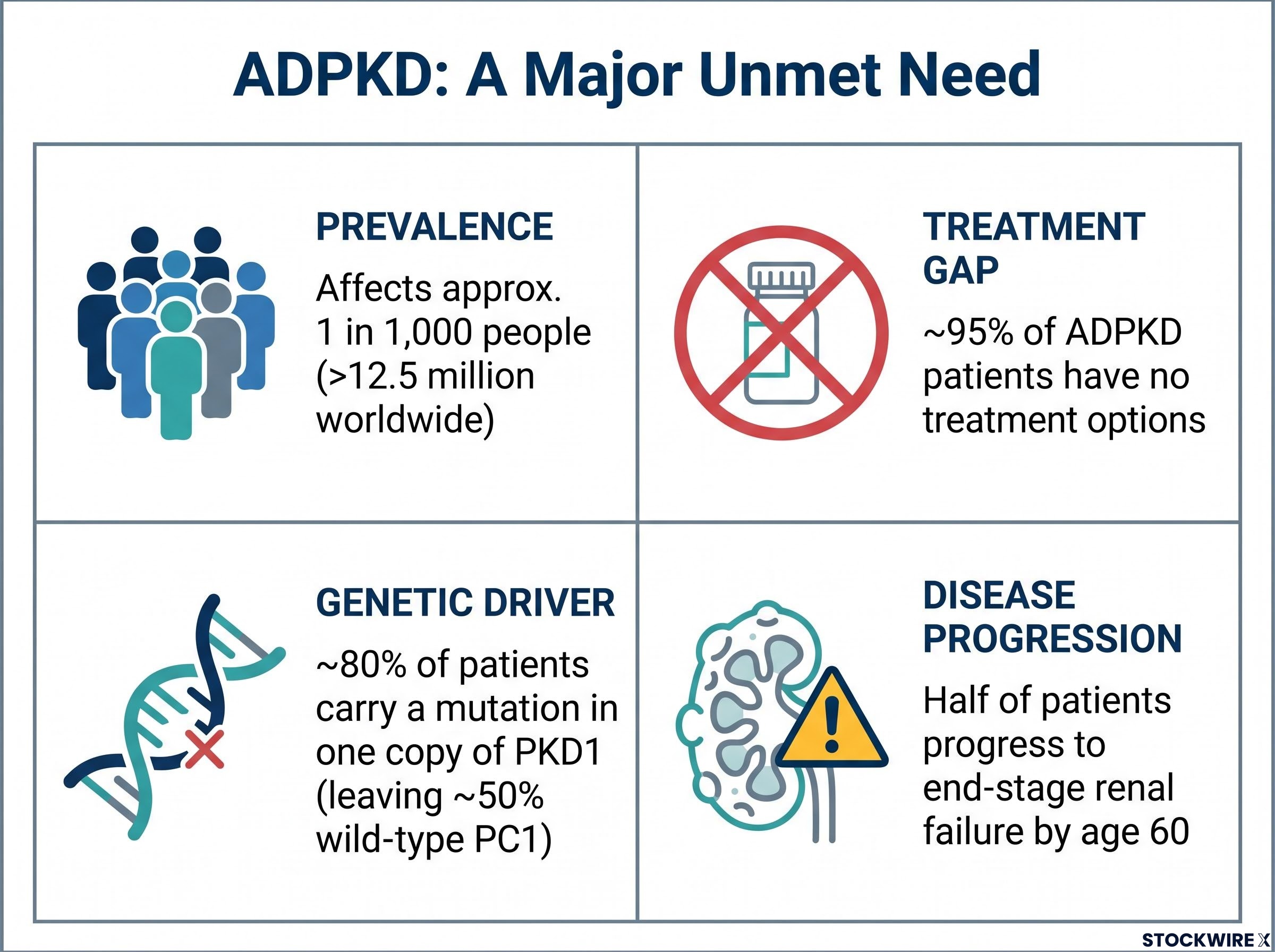
Autosomal Dominant Polycystic Kidney Disease (ADPKD) is a single-gene disorder. A faulty copy of the PKD1 gene leaves patients with insufficient Polycystin-1 (PC1) protein, which drives the formation of fluid-filled cysts that progressively destroy kidney function.
The scale of the problem is substantial:
-
ADPKD affects approximately 1 in 1,000 people, indicating over 12.5 million people worldwide are affected
-
Approximately 95% of ADPKD patients have no treatment options available
-
Around 80% of patients carry a mutation in one copy of PKD1, leaving roughly 50% of wild-type PC1
-
Half of patients progress to end-stage renal failure by the age of 60
PYC-003 is designed to address the underlying cause of the disease by increasing PC1 expression. According to the poster presentation, a preclinical signal has been observed: in a cyst model derived from ADPKD patient kidneys, PYC-003 prevented cyst progression. This finding is preclinical and does not constitute evidence of efficacy in humans.
A candidate targeting the root cause of a high-prevalence disease, in a market where the vast majority of patients remain untreated, defines a large potential addressable opportunity should development succeed.
Inside the safety data
The presentation detailed safety findings across the single ascending dose cohorts. According to the data, single doses of PYC-003 were safe and well-tolerated in both healthy volunteers and PKD patients, with no treatment-related serious adverse events across all completed cohorts.
| Safety Measure | Healthy Volunteers (A cohorts) | ADPKD Patients (B cohorts) | Outcome |
|---|---|---|---|
| Treatment Emergent Serious Adverse Events | 1 total (cohort A4, not treatment related) | 0 | Favourable |
| Treatment Related TESAEs | 0 | 0 | Favourable |
| TEAEs leading to discontinuation | 0 | 0 | Favourable |
For transparency, the presentation noted a single event of flu-like symptoms in cohort B3 on day 14. This event was not deemed treatment related.
Plasma pharmacokinetic (PK) modelling of kidney exposure supports a 6-weekly dosing interval, a factor relevant to the design of the ongoing Multiple Ascending Dose study. A clean tolerability profile, combined with a supported and convenient dosing interval, strengthens the rationale for advancing to repeat-dose and, potentially, registrational studies.
The road to a registrational trial
The announcement outlined the forward development pathway for PYC-003. The ongoing Phase 1b comprises Part C (Multiple Ascending Dose, or MAD) and Part D (Open-Label Extension, or OLE), designed to determine the safety, tolerability and optimal dosing regimen in a repeat-dose setting ahead of a proposed transition to a registrational trial.
The PKD dose escalation approval to 2.4 mg/kg, secured in July 2026, also came alongside a 24-month Open-Label Extension cleared by both Human Research Ethics Committee and regulatory authorities, structuring the ongoing Phase 1b to mirror the proposed registrational trial design.
According to the Company, successful completion of the Phase 1b MAD study, followed by alignment with relevant regulatory authorities, would lead to the initiation of a registrational combined Phase 2/3 trial aimed at supporting a New Drug Application for PYC-003 in PKD. This pathway remains subject to confirmation with the relevant regulatory authorities.
Two near-term data catalysts were disclosed:
-
Phase 1a Single Ascending Dose (SAD) study data expected to be presented in H2 CY26
-
Phase 1b MAD study and OLE data expected to be presented in CY27
Presented Data (Dr. Aron Chakera, ANZSN Poster Presentation)
The poster presentation concluded that single doses of PYC-003 were safe and well-tolerated in healthy volunteers and PKD patients, with no treatment-related serious adverse events across all completed cohorts. No direct management quote was provided in the announcement.
These defined milestones through CY26 and CY27 give investors clear points at which to track the programme’s progress.
What this means for PYC investors
PYC Therapeutics is a clinical-stage precision medicine company with three clinical-stage drug development programmes. The Company utilises its proprietary drug delivery platform to enhance the potency of precision medicines within the rapidly growing and commercially proven RNA therapeutic class, targeting monogenic diseases.
The favourable early safety profile for PYC-003 advances an approach aimed at the root cause of ADPKD, a disease where approximately 95% of patients currently remain without treatment options. Importantly, this is a safety data readout at an early clinical stage. It does not represent proof of efficacy in humans, regulatory approval, or a commercial launch.
For investors, the upcoming SAD and MAD readouts through CY26 and CY27 represent the key value inflection points to watch as the programme progresses.
For investors exploring the company’s other programmes alongside PYC-003, our full explainer on PYC’s broader clinical pipeline covers the VP-001 and PYC-001 data presented at ARVO 2026, including early vision gain signals and the clean safety profiles reported across both blinding disease programmes.
Don’t Miss the Next ASX Healthcare Breakthrough
Big News Blast delivers FREE breaking ASX healthcare news directly to your inbox within minutes of release, complete with in-depth analysis already done. Join 20,000+ subscribers who stay ahead of the market on clinical milestones, data readouts, and sector-moving announcements. Click the “Free Alerts” button at Big News Blast to never miss another market-moving healthcare update.