
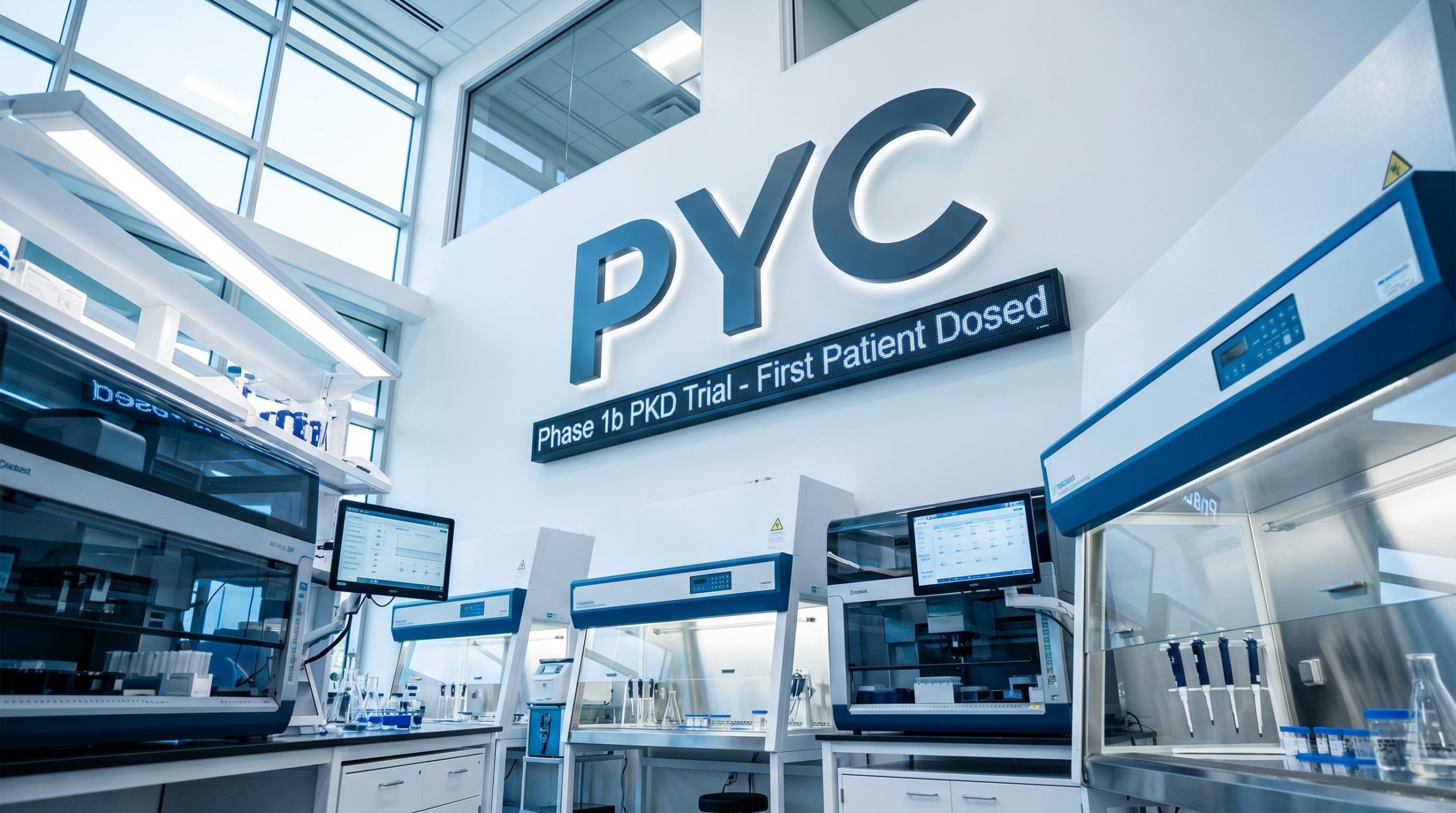
PYC Therapeutics has dosed the first patient in a Phase 1b Multiple Ascending Dose (MAD) study of PYC-003, its investigational drug candidate targeting the underlying genetic cause of Polycystic Kidney Disease (PKD). The open-label trial will enrol 24-48 patients across multiple dose cohorts, with progression contingent on Safety Review Committee approval.
PYC Therapeutics doses first patient in Phase 1b PKD trial
The Phase 1b MAD study follows the Company’s ongoing Phase 1a Single Ascending Dose (SAD) trial, which remains in progress. PYC-003 is designed to increase PC1 protein expression in the kidneys of PKD patients, addressing the root genetic dysfunction rather than symptomatic management.
The trial structure incorporates multiple cohorts with escalating dose levels and frequencies. Cohort C1 administers 0.4 mg/kg every 6 weeks (Q6W), while cohort C2 delivers 0.4 mg/kg every 8 weeks (Q8W). Two optional cohorts — one at 4.0 mg/kg Q8W and another at 0.4 mg/kg Q6W — may be included based on safety and preliminary efficacy signals from the initial cohorts.
Progression to cohort C2 requires Safety Review Committee clearance following review of SAD cohort B3 data four weeks after last patient dosing, plus safety data from the first three patients in MAD cohort C1 seven weeks after the third patient’s first dose.
When big ASX news breaks, our subscribers know first
What is Polycystic Kidney Disease and why does it matter?
Polycystic Kidney Disease is a genetic disorder characterised by the growth of numerous fluid-filled cysts in the kidneys, progressively impairing renal function. Current therapeutic approaches focus on symptom management rather than correcting the underlying genetic defect. PYC-003 targets the genetic cause by increasing PC1 protein levels, which are deficient in PKD patients due to genetic mutations.
PC1 Protein Function
PC1 protein plays a critical role in maintaining normal kidney structure and function. In PKD patients, genetic mutations reduce PC1 expression, leading to abnormal cell signalling that drives cyst formation. By restoring PC1 levels, PYC-003 aims to address the disease mechanism at its source rather than managing downstream consequences.
The approach represents a shift from palliative care to potentially disease-modifying therapy. For investors, this positions PYC-003 within a patient population that currently lacks curative treatment options, representing substantial unmet medical need.
Trial design and efficacy endpoints
The MAD study is evaluating three key efficacy endpoints alongside safety and tolerability:
- Urinary PC1 protein levels — acts as a biomarker of kidney PC1 protein expression, providing measurable evidence of drug activity at the target site
- Total kidney volume on MRI — measures structural changes in kidney size, a validated marker of PKD progression
- Estimated glomerular filtration rate (eGFR) — assesses kidney function, with data expected to be evaluated in the context of the planned Open Label Extension
The multi-endpoint structure provides several pathways to demonstrate clinical activity. A positive signal on urinary PC1 would confirm target engagement, while improvements in total kidney volume or eGFR would indicate functional benefit.
| Cohort | Dose | Frequency | Patient Number |
|---|---|---|---|
| C1 | 0.4 mg/kg | Q6W (every 6 weeks) | 12 |
| C2 | 0.4 mg/kg | Q8W (every 8 weeks) | 12 |
| Optional 1 | 4.0 mg/kg | Q8W (every 8 weeks) | 12 |
| Optional 2 | 0.4 mg/kg | Q6W (every 6 weeks) | 12 |
Inclusion of the optional cohorts will depend on safety and exploratory efficacy results from cohorts C1 and C2, allowing adaptive trial design based on emerging data.
Pathway to registrational trial
The clinical development pathway for PYC-003 follows a sequential progression: Phase 1a SAD (in progress) → Phase 1b MAD (now initiated) → Phase 2/3 registrational trial (planned). Successful completion of the MAD study, combined with regulatory alignment, would enable a combined Phase 2/3 trial aimed at supporting a New Drug Application.
The combined Phase 2/3 design could compress development timelines compared to running separate Phase 2 and Phase 3 trials sequentially. This approach, subject to regulatory authority agreement, would position PYC to move directly from dose-finding studies to a registration-enabling efficacy trial, potentially accelerating the path to market approval.
Data timelines and next steps
PYC has provided guidance on expected data readouts for both ongoing Phase 1 studies:
- Phase 1a SAD data presentation: H2 CY26
- Phase 1b MAD data presentation: CY27
These timelines are subject to risks and uncertainties outlined in the Company’s ASX disclosures dated 2 February 2026. The H2 CY26 SAD data readout represents a near-term catalyst, providing visibility on drug safety and preliminary efficacy signals within the current calendar year.
The SAD study will deliver safety and tolerability data from single-dose administration, alongside initial biomarker assessments. The subsequent MAD data in CY27 will provide repeat-dose safety profiles and more robust efficacy signals across all three endpoints, forming the foundation for registrational trial design.
PYC’s broader clinical pipeline
Beyond PYC-003, the Company operates three clinical-stage drug development programmes, leveraging its proprietary RNA drug delivery platform. The platform is designed to enhance the potency of precision medicines, a competitive differentiator in the RNA therapeutic class.
PYC’s strategic focus targets monogenic diseases — genetic conditions caused by mutations in a single gene. This focus aligns with clinical development success rates, as monogenic diseases present clearer therapeutic targets and more defined patient populations compared to complex, multifactorial disorders.
The RNA delivery platform underpins multiple programmes, potentially supporting future drug candidates without requiring fundamental technology redevelopment. For investors, this diversified clinical pipeline reduces single-programme risk while maintaining technological cohesion across the portfolio.
Get Healthcare News Before the Market Moves
Join 20,000+ investors receiving FREE breaking ASX healthcare alerts within minutes of release, complete with in-depth analysis. Click the “Free Alerts” button at Big News Blast to get real-time coverage of biotech breakthroughs, clinical trial updates, and regulatory milestones the moment news breaks.