
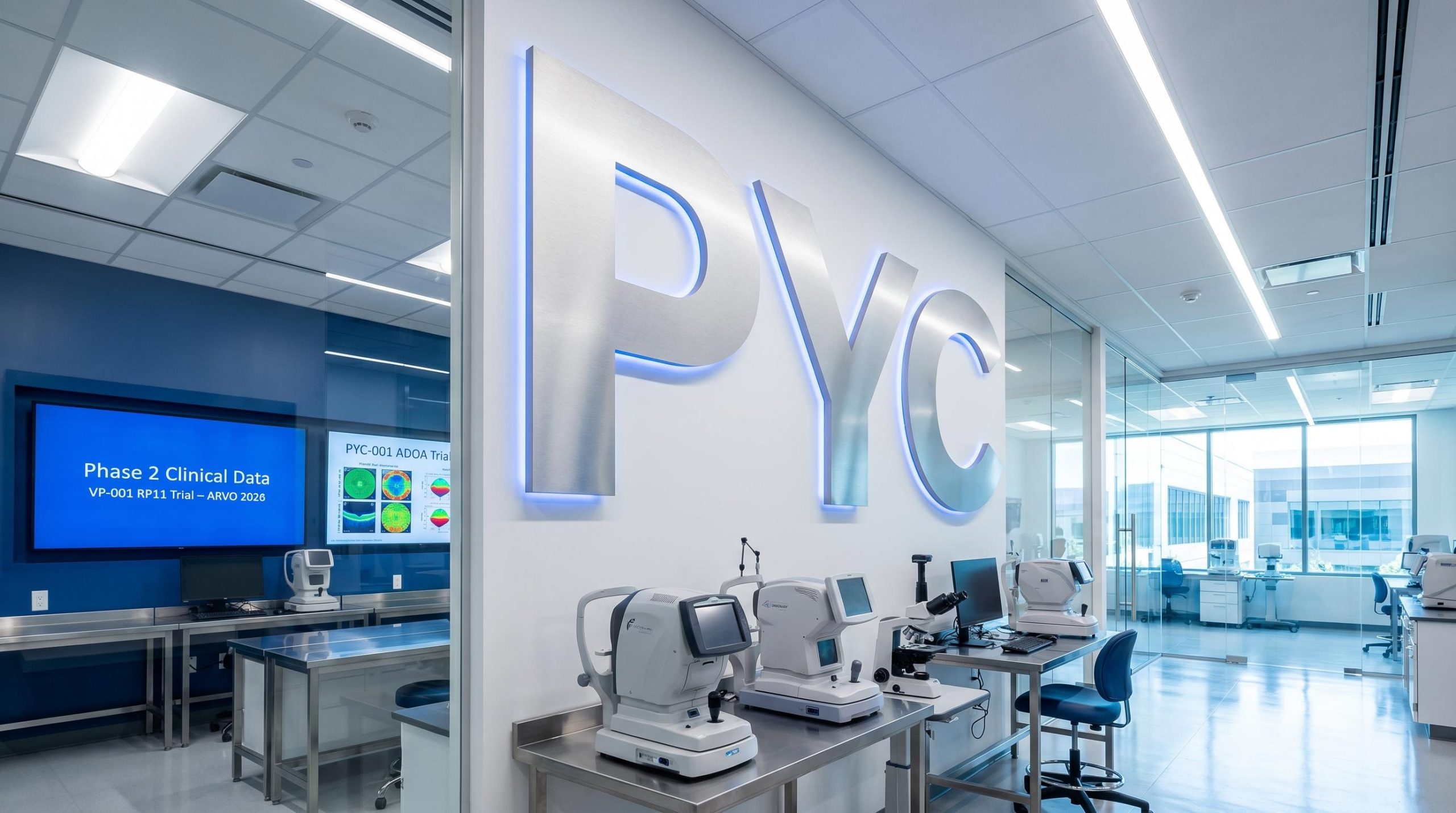
PYC Therapeutics presents clinical data for two blinding disease treatments at major ophthalmology conference
PYC Therapeutics is presenting clinical trial data for VP-001 (RP11) and PYC-001 (ADOA) at the Association for Research in Vision and Ophthalmology (ARVO) conference in Denver, Colorado, running 3-7 May 2026. Both drug candidates represent the most advanced clinical programmes for their respective diseases and hold first-in-indication potential. The conditions target progressive blinding diseases of childhood with no currently approved treatments. PYC’s proprietary drug delivery platform utilises RNA-peptide conjugate technology designed to address the genetic causes of disease.
Four presentations will be delivered by clinical investigators during the conference. Both VP-001 and PYC-001 are designed to correct the underlying genetic causes of their target diseases by increasing protein expression from the remaining functional gene copy in affected patients.
Conference presentations validate clinical progress and attract specialist investor attention in rare disease markets. First-in-indication positioning creates potential first-mover advantage in therapeutic areas with no competing approved treatments.
When big ASX news breaks, our subscribers know first
Understanding inherited retinal diseases and RNA therapeutics
Inherited retinal diseases like RP11 and ADOA are caused by genetic mutations affecting specific proteins in the eye. Patients with these conditions have haploinsufficiency, meaning they possess only one working copy of a gene, producing insufficient protein levels to maintain normal cellular function. This protein deficiency triggers a cascade of cellular dysfunction that ultimately leads to progressive vision loss.
PYC’s approach uses RNA therapeutics designed to increase protein expression from the remaining functional gene copy. The company’s drug candidates bind to the messenger RNA (mRNA) of target genes, modifying their structure to enhance protein production. This represents a disease-modifying approach targeting the root cause rather than symptoms.
Disease-modifying therapies command premium pricing compared to symptomatic treatments in rare disease markets. The mutation-agnostic mechanism demonstrated by PYC-001 in particular broadens the addressable patient population beyond specific genetic variants.
VP-001 demonstrates safety and visual improvements in RP11 patients
Clean safety profile across escalating doses
No treatment-related serious adverse events have been observed in any patients dosed with VP-001 as at 21 April 2026. This safety profile includes patients receiving multiple doses in repeat-dose studies conducted through the WALLABY and DINGO programmes. Treatment-emergent adverse events were mostly mild and procedure-related, with no ongoing adverse events reported.
Clinically meaningful improvements in low-luminance visual acuity
Low-Luminance Visual Acuity (LLVA) measures ability to see in low-light conditions, directly assessing rod function. LLVA improvements matter clinically because RP11 patients first lose night vision before peripheral and central vision deteriorate. Analysis of treated eyes receiving 30 mcg or more of VP-001 showed 21.4% demonstrated ≥10 letter gain at multiple timepoints versus 7.1% of untreated fellow eyes. Critically, 0% of treated eyes showed ≥10 letter loss versus natural history data showing 11.5% of eyes losing ≥10 letters over comparable follow-up periods.
| Metric | VP-001 Treated Eyes (n=14) | Untreated Fellow Eyes (n=14) | Natural History (n=96) |
|---|---|---|---|
| ≥10 letter gain (multiple timepoints) | 21.4% | 7.1% | 3.1% |
| ≥10 letter loss (multiple timepoints) | 0% | 0% | 11.5% |
| Stable vision | 78.6% | 92.9% | 85.4% |
Microperimetry and advanced imaging support efficacy signals
Treated eyes showed statistically significant improvements in retinal sensitivity (p<0.001 in paired t-test) when assessed by microperimetry. Patients receiving at least four doses of 30 mcg or more demonstrated a mean improvement in the number of retinal loci gaining ≥7dB sensitivity compared to baseline, with the treated eye outperforming the untreated fellow eye.
Adaptive optics imaging presented by Dr Jessica Morgan showed cone structure and function were maintained or improved in treated eyes. Optoretinography, an objective measure of photoreceptor function, showed improvements in treated versus untreated eyes across multiple follow-up timepoints extending to 29 weeks post-treatment.
Patient-Reported Functional Improvements
“I had become accustomed to finding my Starbucks cup by feel… when I only had my left eye open (my non-treated eye), the cup disappeared. When I had only my right eye open (my treated eye), the cup appeared. It is a moment I’ll always remember.”
“I see aeroplanes in the sky (never have before), stars at night, animals/creatures along the road…”
PYC-001 shows encouraging results in ADOA patients
Safety profile supports continued development
No treatment-related serious adverse events were observed across all dose cohorts (3, 10, 30 and 60 mcg) in the SUNDEW (Phase 1a SAD) and MYRTLE (Phase 1b MAD) studies. Treatment-emergent adverse events were mostly mild and procedure-related with no ongoing adverse events reported.
Visual acuity improvements relative to baseline and control eye
Encouraging improvements in low-contrast visual acuity have been observed relative to both baseline and the untreated control eye in patients receiving PYC-001. Data presented by Professor Patrick Yu-Wai-Man showed treated eyes demonstrating improvement trajectories that diverged from untreated fellow eyes across multiple follow-up timepoints extending beyond 60 weeks.
PYC-001 is described as the first precision therapy dosed in patients with OPA1 ADOA with disease-modifying potential. ADOA affects approximately 9,000-16,000 individuals in the western world, with a median age of onset at 7 years. Approximately 80% of patients become symptomatic before age 10. As an orphan disease with no competing approved therapies, PYC-001 addresses a significant unmet medical need.
Preclinical mechanism supports clinical observations
PYC-001 targets a stem-loop structure in OPA1 mRNA that normally restricts protein production. A 1.6-fold increase in OPA1 protein expression was demonstrated in non-human primates at safe, well-tolerated doses (15 mcg per eye). This protein upregulation is associated with rescue of functional deficits in ADOA patient-derived models, including restoration of mitochondrial structure and approximately 1.5-fold increase in cellular bioenergetics.
The mechanistic pathway operates as follows:
- OPA1 haploinsufficiency causes approximately 50-70% protein expression compared to normal
- PYC-001 binds to OPA1 mRNA, disrupting the inhibitory secondary structure in the 5’UTR region
- Increased OPA1 protein restores mitochondrial network function and corrects fragmented mitochondrial ultrastructure
- Improved cellular bioenergetics support retinal ganglion cell survival and function
Pathway to potential registrational trials
VP-001 is advancing through the Phase 2 open-label extension study (DINGO) with a long-term 24-month treatment period. The planned registrational trial design for VP-001 includes a primary endpoint of mean change in LLVA, with duration of 48 months total (12-month enrolment period plus 36 months treatment). The study is expected to enrol 90 patients randomised to 30 mcg, 75 mcg, or sham control arms.
PYC-001 is progressing through the MYRTLE Phase 1b study to demonstrate clinical proof of concept, with participants receiving at least three doses across multiple cohorts (10 mcg Q8W, 10 mcg Q12W, 30 mcg Q8W, 30 mcg Q12W, and a 60 mcg single dose cohort followed by repeat doses Q12W).
Clear articulation of registrational pathways reduces regulatory uncertainty for both programmes. Both drug candidates target diseases with no approved treatments, potentially streamlining regulatory interactions with authorities. Development remains subject to risks and uncertainties outlined in the Company’s ASX disclosures of 2 February 2026.
Key upcoming milestones include:
- VP-001: Long-term DINGO data to finalise Phase 2/3 design
- VP-001: Potential 90-patient registrational trial with LLVA primary endpoint
- PYC-001: MYRTLE Phase 1b data to establish clinical proof of concept
- PYC-001: Phase 2/3 study to follow pending successful completion of dose-ranging studies
Want the Next Biotech Breakthrough in Your Inbox?
Join 20,000+ investors receiving FREE breaking ASX healthcare news within minutes of release, complete with in-depth analysis. Click the “Free Alerts” button at Big News Blast to get market-moving biotech announcements delivered straight to your inbox the moment they break.