
Safety committee clears PYC to escalate PYC-003 dosing in Phase 1b PKD study
PYC Therapeutics (ASX:PYC) has received approval from the Safety Review Committee (SRC) governing its ongoing Phase 1b Multiple Ascending Dose (MAD) study to escalate to the higher 2.4 mg/kg dose of PYC-003 in patients with Polycystic Kidney Disease (PKD).
Announced on 22 July 2026, the update also confirms the Company has secured approval for an Open-Label Extension (OLE) of the ongoing study, enabling continuous dosing for a period of up to 24 months.
PYC-003 is designed to address the underlying cause of PKD. Each of these clearances allows progression toward the proposed registrational trial, though both approvals relate to safety and tolerability only, with no efficacy data disclosed at this stage.
When big ASX news breaks, our subscribers know first
Two approvals move PYC-003 closer to a registrational trial
The announcement details two distinct regulatory and committee approvals, each advancing the clinical programme along its proposed development pathway.
Dose escalation to 2.4 mg/kg
The SRC approved escalation to the higher 2.4 mg/kg dose designated for evaluation in the Phase 1b MAD study. The decision followed a review of safety and tolerability data drawn from two sources:
Phase 1b MAD study enrolment covers 24-48 patients across up to four dose cohorts, with the two optional cohorts only activated based on safety and preliminary efficacy signals from the earlier cohorts.
-
Cohort B3 in the Phase 1a Single Ascending Dose (SAD) study, evaluated through 4 weeks of follow-up after patients received a 2.4 mg/kg dose.
-
The first 3 patients dosed at 1.2 mg/kg in Cohort C1 of the Phase 1b MAD study, evaluated through 1 week of follow-up after their second dose.
This is strictly a safety and tolerability decision. No efficacy data has been released in connection with the approval.
The Company noted that optional future cohorts (either 0.4 mg/kg every six weeks or 4.0 mg/kg every eight weeks) may be added to the Phase 1b MAD study. Their inclusion would depend on safety and exploratory efficacy results from the C1 and C2 cohorts and remains optional rather than confirmed.
Open-Label Extension approved for up to 24 months
Human Research Ethics Committee and regulatory approval have been granted for a Part D OLE study, open to participants who complete Part C of the Phase 1b trial.
The extension enables continuous dosing of the drug candidate for up to 24 months, a duration that mirrors the registrational trial set to follow completion of the ongoing Phase 1b MAD study. The 24-month design directly bridges the current study toward the proposed registrational phase.
The two milestones at a glance
| Approval | What it enables | Key figure | Study | Significance |
|---|---|---|---|---|
| Dose escalation | Higher dose evaluation | 2.4 mg/kg | Phase 1b MAD | Enables evaluation of higher dose |
| Open-Label Extension | Continuous dosing | Up to 24 months | Part D OLE | Bridges to registrational trial |
Understanding PYC-003 and Polycystic Kidney Disease
Patients currently have no treatment options available.
PYC’s approach uses a precision RNA therapy delivered via its proprietary drug delivery platform, targeting the underlying cause of the disease rather than only its symptoms. PKD is a monogenic disease.
According to the Company, monogenic diseases represent the indications with the highest likelihood of success in clinical development. This underpins the rationale behind PYC’s focus.
PYC currently has three clinical-stage drug development programmes. PYC-003 is the candidate directed at PKD.
What the clinical pathway looks like from here
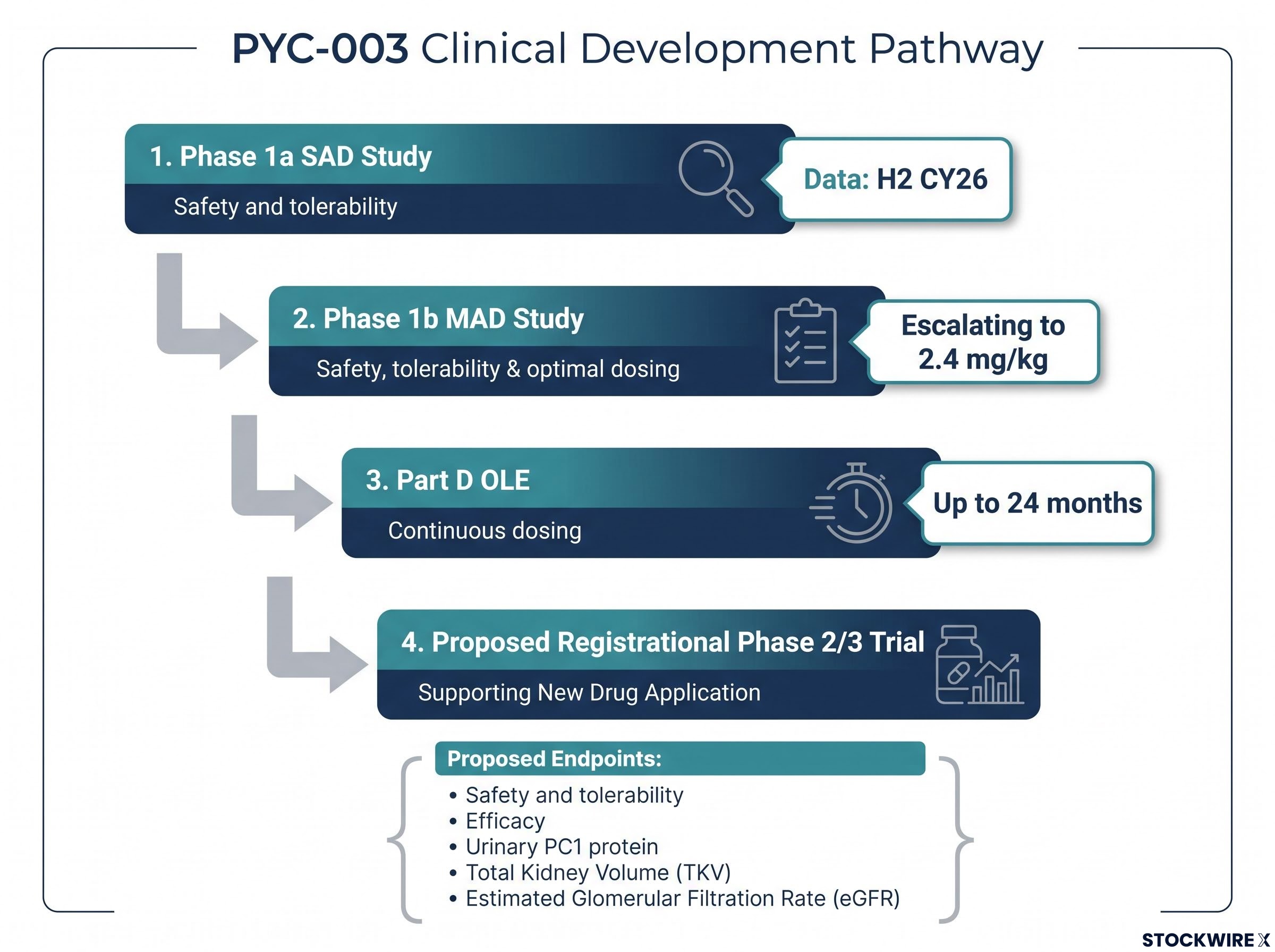
The disclosed development sequence for PYC-003 progresses through several stages:
-
Phase 1a SAD study, assessing safety and tolerability, with data expected in H2 CY26.
-
Phase 1b MAD study, evaluating safety, tolerability and optimal dosing, now escalating to the 2.4 mg/kg dose.
-
Part D OLE, enabling continuous dosing for up to 24 months.
-
Proposed registrational combined Phase 2/3 trial aimed at supporting a New Drug Application for PYC-003 in PKD, subject to alignment with relevant regulatory authorities.
At the registrational stage, endpoints are expected to include safety and tolerability, efficacy, a biomarker (urinary PC1 protein), Total Kidney Volume (TKV) and estimated Glomerular Filtration Rate (eGFR).
Successful completion of the Phase 1b MAD study, followed by alignment with relevant regulatory authorities, would lead to initiation of the registrational trial. The transition remains subject to confirmation with the relevant regulatory authorities and is not yet confirmed.
Key catalysts and data timelines investors should watch
The announcement outlines a defined set of near-term data catalysts:
-
Phase 1a SAD study data is expected to be presented in H2 CY26.
-
Phase 1b MAD study and OLE data is expected to be presented in CY27.
These readouts provide investors with multiple data points to monitor across the CY26 to CY27 window.
From the announcement
“The objective of the ongoing Phase 1b MAD study is to determine the safety/tolerability profile and optimal dosing regimen of PYC-003 in a repeat dose setting ahead of a proposed transition to a registrational trial.”
Why this milestone matters for the investment case
Each SRC clearance incrementally de-risks the PYC-003 programme and validates its safety profile to date. The dose escalation approval reflects a positive review of accumulated safety and tolerability data across both the SAD and MAD studies.
The OLE approval, with its 24-month design, directly foreshadows the structure of the proposed registrational pathway and signals the Company’s intent to bridge the current study toward that phase.
With Phase 1a data anticipated in H2 CY26 and Phase 1b MAD plus OLE data expected in CY27, investors are presented with a defined catalyst calendar. The programme remains centred on genetic diseases where patients currently have no treatment options available.
US patent protection for PYC-003 extends to June 2044, with composition of matter claims covering the PKD candidate granted by the US Patent Office, strengthening the commercial foundation behind the clinical programme now advancing into higher-dose evaluation.
Don’t Miss the Next ASX Healthcare Breakthrough
Big News Blast delivers FREE breaking ASX healthcare news directly to your inbox within minutes of release, complete with in-depth analysis. Join 20,000+ investors already staying ahead of the market. Click the “Free Alerts” button at Big News Blast to start receiving alerts the moment market-moving announcements drop.