
Japan’s unemployment just hit a 12-month low. Its underlying inflation gauge landed squarely on the Bank of Japan’s 2% target. And the yen kept falling.
USD/JPY climbed past 159.50 on Friday 28 August 2026, extending its losing run for the Japanese currency to five consecutive sessions and closing the gap toward the psychologically significant 160.00 mark, the level that prompted an 11.7 trillion yen intervention campaign earlier this year. The move tells you that something more powerful than domestic data is driving this pair right now.
The five-session slide is the market’s verdict: Japan’s economy is performing well, but the BoJ’s expected rate path, not its inflation or employment numbers, is what traders are pricing. The gap between what the data says the BoJ should do and what the market believes it will do is the entire story. Here is exactly why the data failed to move the yen, what the 160.00 level actually means in terms of intervention risk, and what to watch when the BoJ meets on 17-18 September.
Japan’s data beat expectations. The yen fell anyway.
The numbers released on Thursday 27 August by the Statistics Bureau of Japan were not ambiguous. Tokyo Core CPI, the measure most relevant to BoJ policymaking (it strips out fresh food prices), accelerated to 1.8% year-over-year in August from 1.7% the previous month, surpassing the consensus estimate of 1.7%.
The narrower gauge mattered more. Tokyo Core-Core CPI, which excludes both fresh food and energy and is the BoJ’s preferred read on underlying price trends, climbed to 2.0% from 1.8% in July. That reading lands directly on the BoJ’s stated 2% inflation objective, the level policymakers have been trying to reach sustainably for years. Headline Tokyo CPI eased slightly to 1.9% from 2.0%, but the underlying trend was clearly firming.
The labour market reinforced the picture. July’s unemployment rate in Japan came in at 2.4%, a full tenth of a percentage point below June’s 2.5% and beneath the 2.5% consensus, reaching its lowest reading in a year.
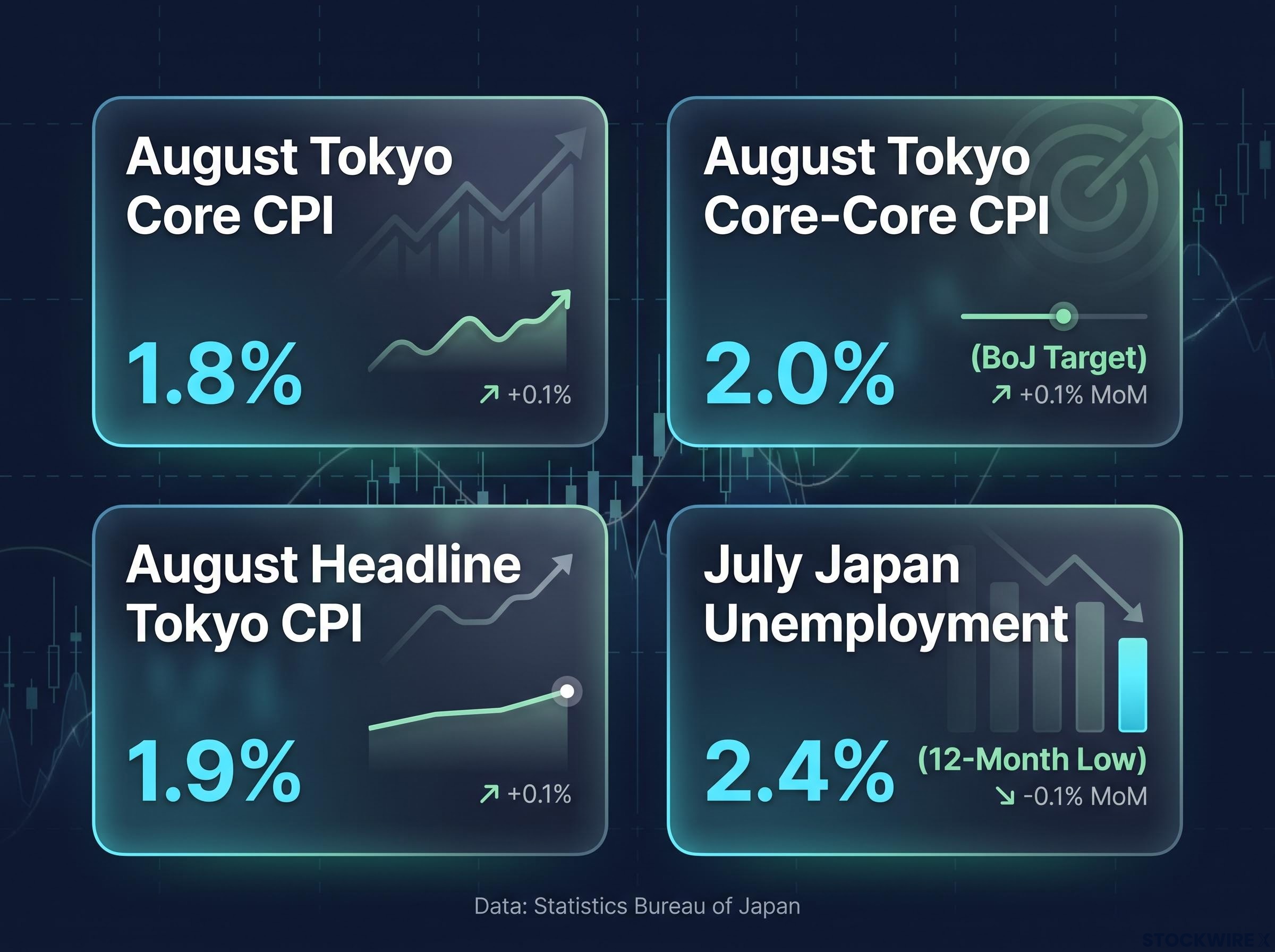
| Indicator | Previous | Current | Forecast | Result |
|---|---|---|---|---|
| Tokyo Core CPI (ex. fresh food) | 1.7% (Jul) | 1.8% | 1.7% | Beat |
| Tokyo Core-Core CPI (ex. food & energy) | 1.8% (Jul) | 2.0% | n/a | At BoJ target |
| Headline Tokyo CPI | 2.0% (Jul) | 1.9% | n/a | Slight easing |
| Japan Unemployment Rate | 2.5% (Jun) | 2.4% | 2.5% | Beat (12-month low) |
In isolation, this data package is unambiguously yen-positive. It strengthens the case for further BoJ tightening on every front. Yet USD/JPY did not reverse, did not pause, and did not even wobble. The fact that data this strong failed to produce a meaningful bid for the yen tells you the forces currently overriding Japan’s domestic story are operating on a different scale entirely.
When big ASX news breaks, our subscribers know first
Five reasons the data disconnect makes sense once you look beyond Japan
The yen’s weakness is not a failure to read the data. It is the market reading a larger dataset that overwhelms Japan’s improving domestic numbers. Five structural forces explain why:
- Rate differentials and the carry trade: Even after recent normalisation steps, Japanese interest rates remain far below US yields. The wide gap preserves the “carry trade” incentive, where traders borrow cheap yen to buy higher-yielding dollar assets. Until the BoJ’s actual hiking path is seen as meaningfully closing that gap, profitable yen-funded strategies remain intact.
The carry trade unwind dynamics that traders fear most, a rapid forced de-leveraging cascading into global risk assets, have historically resolved faster than headlines suggest, with the 2024 episode clearing 40-60% of speculative positioning within weeks before structural breakdown materialised.
- The “already priced in” problem: Markets expected positive data. Confirmation without a significant upside shock adds no new information that would force traders to reposition. The beat was good, but it did not change anyone’s forward model.
- Dollar strength as an independent force: The yen is falling against a dollar with its own tailwinds. Geopolitical safe-haven demand, US economic resilience, and higher US yields are all lifting the greenback independently of anything happening in Tokyo.
- Intervention credibility fatigue: The approximately $73 billion (roughly 11.7 trillion yen) intervention campaign earlier in 2026 produced temporary yen strength that fully faded as the rate gap reasserted itself. Traders increasingly treat verbal warnings as cheap talk unless backed by repeated, large-scale action.
- Improving inflation raises both hawkish and currency-negative risks: Stronger CPI readings theoretically call for faster tightening, but markets do not believe the BoJ will deliver it quickly enough. The result is a paradox where better data confirms the direction but not the pace.
How yen weakness feeds back into the inflation problem
BoJ Deputy Governor Ryozo Himino sharpened this point on 27 August 2026. Himino warned that yen depreciation now transmits into domestic prices faster than it has historically, amplifying the urgency of what he called “timely” rate increases. His argument centres on the sequencing of risk: when currency-driven price pressures build while policy stands still, the BoJ ultimately faces a steeper, more destabilising tightening path than if it had moved promptly, precisely the scenario gradualism is supposed to prevent.
The credibility gap sits here. Markets are pricing the scenario where the BoJ reacts slowly, allowing the inflationary pressure from yen depreciation to persist before policy catches up. Himino sees the feedback loop. Traders see it too; they just do not believe the BoJ will break it fast enough.
Himino’s ‘timely’ framing reflects a broader shift in the BoJ rate decision framework, with Deputy Governor Himino having declared publicly that the BoJ does not need complete information before acting, a structural departure from a decade of data-confirmation-first communication that has materially lowered the threshold for future moves.
What 160.00 actually means for USD/JPY right now
With USD/JPY above 159.50, the 160.00 level is now a live question rather than a distant reference point. It carries weight across three dimensions:
- Technical: It is a round-number level that concentrates option positioning and triggers algorithmic flows, amplifying volatility around it.
- Psychological: Market participants broadly recognise it as a threshold that has drawn official attention before.
- Policy: When the yen previously fell to around 160, authorities responded with the approximately 11.7 trillion yen intervention campaign.
Market strategists now identify 160.70-161.00 as the band where intervention risk rises sharply, particularly if US yields soften or the Fed tone turns more dovish.
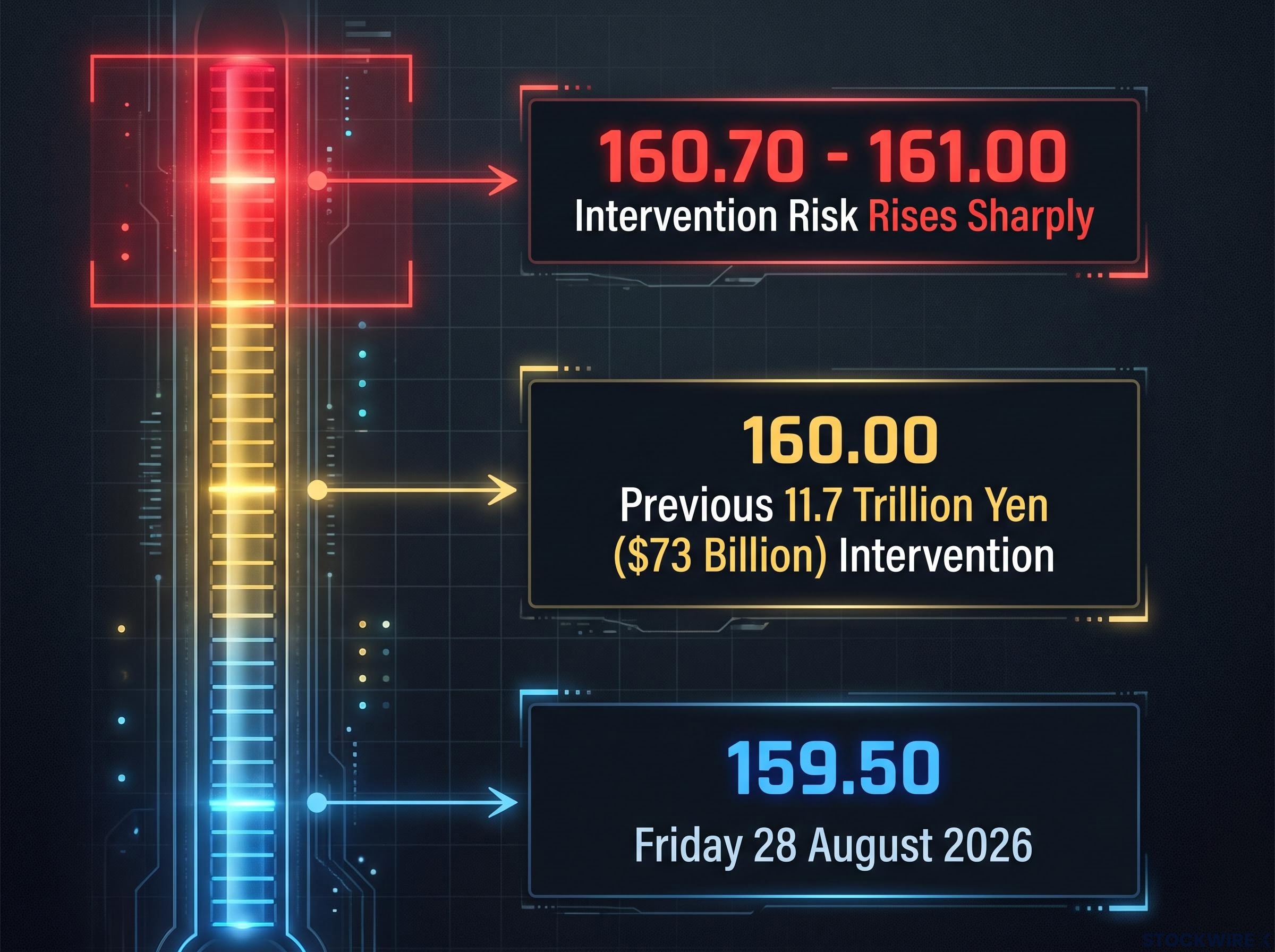
The distinction between 160.00 and the 160.70-161.00 stress zone matters. The round number draws headlines and speculative probing. The higher band is where verbal warnings are more likely to convert into actual yen-buying intervention. Between those two points sits a zone of elevated uncertainty, where carry trade rewards compete directly against the risk of sudden, policy-driven reversals.
For anyone holding a position in or around this pair, the gap between 159.50 and 161.00 is not a straightforward trend continuation zone. It is a space where intervention risk is real, asymmetric, and historically capable of producing sharp reversals within hours.
The most consequential precedent for any escalation above 160.00 is the coordinated yen intervention conducted in August 2026, when the US participated directly by selling euro reserves rather than Treasuries, a structural design that revealed how seriously both governments assessed the systemic risks of a disorderly yen collapse.
Three variables that will determine whether the yen stabilises or slides further
The data already released is not going to resolve this story. Three forward-looking variables will:
- The BoJ’s September 17-18 meeting: This is the nearest catalyst, but the rate decision alone is not the swing factor. Himino’s “timely” framing has primed expectations for a hike. What matters is the guidance that accompanies it. A modest rate increase paired with cautious forward signalling risks disappointing yen bulls even if the hike itself arrives. Markets need to believe the pace of normalisation is accelerating, not just continuing.
Swap markets are already reflecting this dynamic, with the September hike probability sitting at 78-85% following two consecutive above-forecast core CPI prints, and technical levels on USD/JPY showing the 50-period EMA at 160.13 acting as overhead resistance that aligns with the intervention stress zone discussed above.
- US data and Fed tone: This is the variable entirely outside Japan’s control. Strong US economic data, hawkish Fed commentary, or renewed geopolitical shocks would keep USD/JPY elevated regardless of what the BoJ does. Conversely, softer US yields and a more dovish Fed path would narrow the rate gap and give BoJ tightening room to actually move the yen.
Whether authorities draw a harder line above 160.00
- Intervention credibility at 160.00-plus: The practical question facing the Ministry of Finance and BoJ is whether to act more forcefully than last time, or signal a higher effective tolerance for yen weakness. The prior 11.7 trillion yen campaign produced gains that faded entirely, teaching traders that intervention buys time but does not change the underlying dynamic unless rates follow.
Traders will watch verbal commentary closely for any shift in tone suggesting the 160.70-161.00 zone is being treated as a genuine ceiling rather than a guideline. If authorities respond more forcefully and the BoJ delivers a meaningfully hawkish September meeting, the calculus around 160.00 changes. If they do not, the market has its answer.
The data made the yen’s case. The market ruled against it.
Japan printed its strongest underlying inflation reading in months, its lowest unemployment in a year, and hawkish commentary from a Deputy Governor who explicitly warned about falling behind the curve. The yen is a session or two from testing 160.00 against the dollar anyway.
The carry trade and rate differential environment does not move on a single data beat, no matter how strong. Markets are pricing a gradual BoJ path, not an aggressive one, and until that expectation changes, domestic fundamentals are playing a supporting role to a story being written elsewhere.
The September 17-18 BoJ meeting is the next genuine inflection point. The intervention question is the wildcard. If authorities respond to 160.00-plus levels more forcefully than they did in the last episode, the calculus shifts quickly. If they do not, traders probing the level will have confirmation that the ceiling has moved higher.
This article is for informational purposes only and should not be considered financial advice. Investors should conduct their own research and consult with financial professionals before making investment decisions. Past performance does not guarantee future results, and currency markets are subject to rapid changes based on policy decisions and global macro conditions.