Every time a Federal Reserve official steps to a microphone in Jackson Hole, Wyoming, stock markets shift, bond yields move, and currency traders recalibrate positions within minutes. A speech at a mountain resort carries more market weight than almost any corporate earnings release, any employment report, any single data point on the economic calendar. The question that follows is worth answering properly: why?
The timing makes the question urgent. It is late August 2026, and Chair Kevin Warsh is delivering his first Jackson Hole address as Fed Chair. Scotiabank analysts have flagged that short-term implied volatility for the week ahead is tracking considerably below typical recent levels, pointing to the possibility that markets are not fully pricing in what a new Chair might signal. If you do not have a firm grasp of how the Fed actually operates, that observation is impossible to evaluate.
Here is the framework to interpret any Fed headline, from rate decisions to balance-sheet announcements to carefully worded symposium speeches. By the time you finish, you will understand not just what the Fed does, but why its words alone can reprice global assets.
The dual mandate that drives every decision the Fed makes
The Federal Reserve Act of 1913 created the Fed and gave it a legal obligation, not a suggestion. Congress instructs the institution to pursue three objectives:
- Maximum employment
- Stable prices
- Moderate long-term interest rates
In practice, two of those three define the day-to-day work. Maximum employment and stable prices, known as the dual mandate, are the operating targets that shape every rate decision, every balance-sheet move, and every word the Chair chooses at a podium.
The Fed has given “stable prices” a precise number. Through its “Statement on Longer-Run Goals and Monetary Policy Strategy,” the Federal Open Market Committee (FOMC) defines price stability as 2% inflation measured by the Personal Consumption Expenditures (PCE) price index.
The FOMC’s Statement on Longer-Run Goals, reaffirmed by the Federal Reserve Board in January 2026, establishes the 2% PCE inflation target as the formal definition of price stability that every subsequent rate decision is measured against.
The number to remember: 2% PCE inflation is the Fed’s formal price stability target. It is the single threshold that tells you whether the Fed is in tightening mode, easing mode, or holding, and that determination flows directly into your borrowing costs, savings rates, and investment returns.
Here is where the job becomes genuinely difficult. Strong labour markets tend to push inflation higher as employers compete for workers and consumers spend more freely. Disinflationary policy, raising rates to cool prices, can soften employment conditions. The Fed is always trading one objective against the other, calibrating its tools in real time with imperfect information.
When you see a headline reading “the Fed is concerned about inflation,” the dual mandate tells you what that concern means: the 2% threshold is being breached or threatened, and the policy response will tighten financial conditions. Knowing this single framework turns vague commentary into directional signal.
When big ASX news breaks, our subscribers know first
Who actually sets interest rates, and how the FOMC is structured
The committee responsible for monetary policy decisions is the Federal Open Market Committee (FOMC), and it is a specific group of people with a defined voting structure, not a faceless institution.
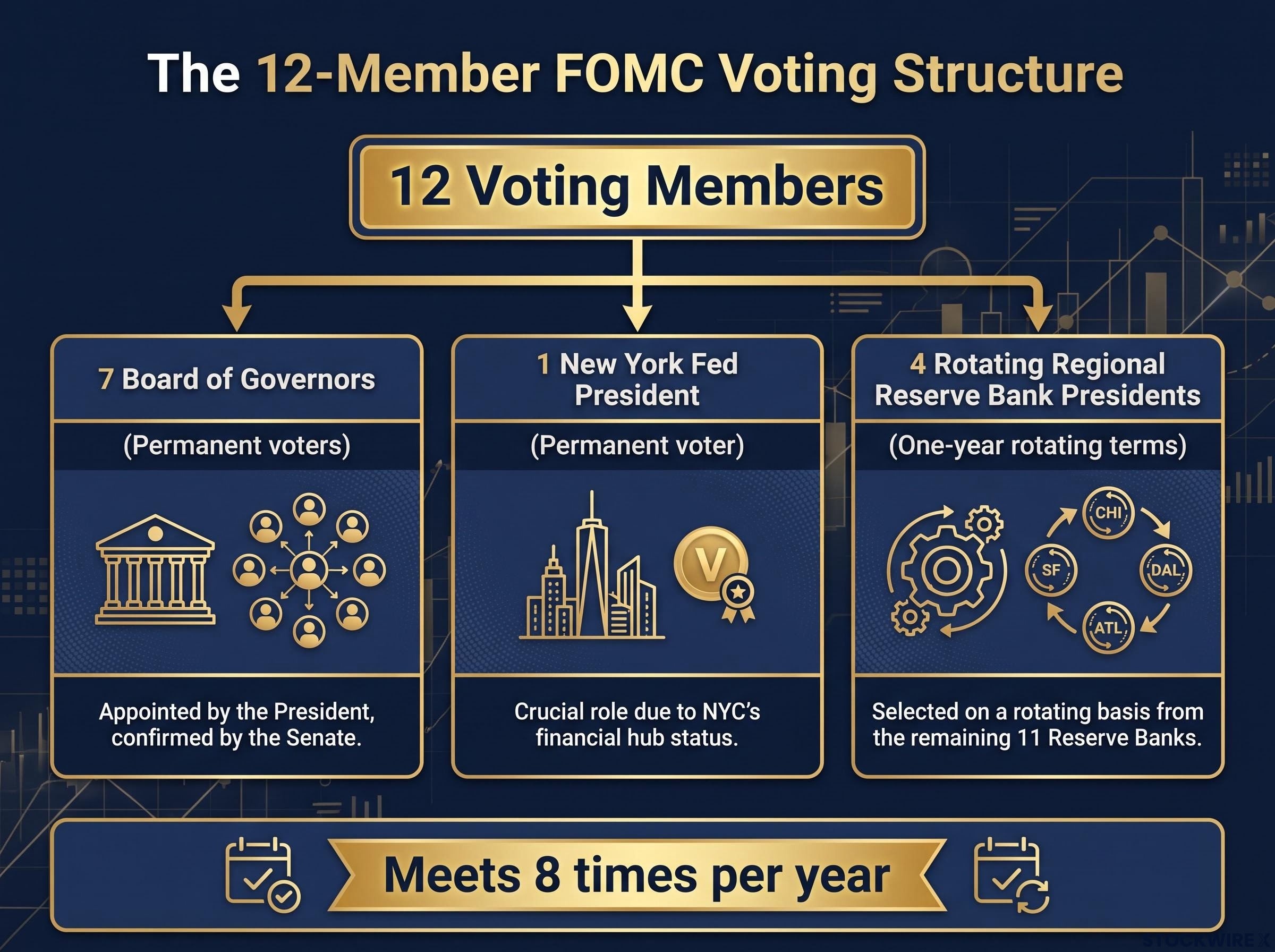
At any scheduled meeting, 12 members vote:
| Seat Type | Number of Members | Voting Status |
|---|---|---|
| Board of Governors | 7 | Permanent voters |
| New York Fed President | 1 | Permanent voter (central role in market operations) |
| Rotating Regional Reserve Bank Presidents | 4 | One-year rotating terms for geographic representation |
All 12 Reserve Bank presidents attend meetings and participate in the discussion. But voting rights belong only to the four rotating regional presidents, the seven Board of Governors members, and the New York Fed president; the remaining regional presidents contribute to debate without casting a formal vote. That distinction matters more than most investors realise.
When a Fed governor or the New York Fed president speaks publicly, you are hearing from someone whose view will directly shape the next rate decision. When a non-voting regional president speaks, it is useful context but not a binding signal. Knowing the difference prevents you from overreacting to a dissenting voice that carries no vote.
How often the FOMC meets and what happens at each meeting
The FOMC holds eight regularly scheduled meetings per year, typically in Washington D.C., at intervals of roughly six weeks. Each meeting involves a thorough review of economic and financial conditions before any rate decision is made. The committee assesses where inflation sits relative to that 2% target, how tight or loose labour markets are, and what risks have emerged since the previous meeting.
That six-week rhythm is worth tracking. It is the cadence at which the policy rate can change, the cadence at which new economic projections are released (quarterly), and the cadence at which the Chair addresses the press and shapes market expectations.
The Fed’s toolkit: from rate decisions to balance-sheet moves
The Fed’s primary lever is the federal funds rate, the target rate at which banks lend reserves to each other overnight. When this rate moves, the effects transmit across the entire financial system. Mortgage rates shift. Auto loan and credit card rates adjust. Business borrowing costs rise or fall. Bond yields and broader financial conditions recalibrate, shaping spending, investment, and asset valuations.
When inflation is persistently above 2% and employment is strong, the FOMC typically raises the federal funds rate to cool demand. When inflation is below target and labour markets are weak, it cuts the rate to stimulate borrowing and spending.
The mechanics of central bank rate transmission extend well beyond the overnight rate itself, touching mortgage rates, business loan costs, deposit yields, currency valuations, and gold pricing through a chain of interconnected market channels that all reprice simultaneously when a policy committee speaks.
The forward-looking dynamic: Because markets price assets based on expectations of future rates, changes in the expected path of the federal funds rate often move markets more than the actual decision on any given meeting day. This is why Fed communication is nearly as consequential as the policy decisions themselves.
That dynamic explains a pattern you have probably noticed: markets sometimes rally on a rate hike or sell off on a rate cut. The decision itself matters less than whether it confirms or disrupts the market’s expectation of what comes next.
Quantitative easing and tightening explained
When short-term interest rates are near zero and further cuts alone are insufficient, the Fed turns to its balance sheet. Quantitative Easing (QE) involves large-scale purchases of longer-term Treasury securities and agency mortgage-backed securities. These purchases increase bank reserves, compress longer-term yields, and ease financial conditions broadly. QE was deployed extensively after the 2008 financial crisis and again during the COVID-19 shock, in both cases extending the Fed’s reach well beyond the short end of the yield curve.
Quantitative Tightening (QT) is the reverse. Rather than reinvesting the proceeds from maturing securities, the Fed lets those holdings run off its balance sheet, reducing its footprint in credit markets. This shrinks the balance sheet, tends to push longer-term yields higher, and tightens overall financial conditions.
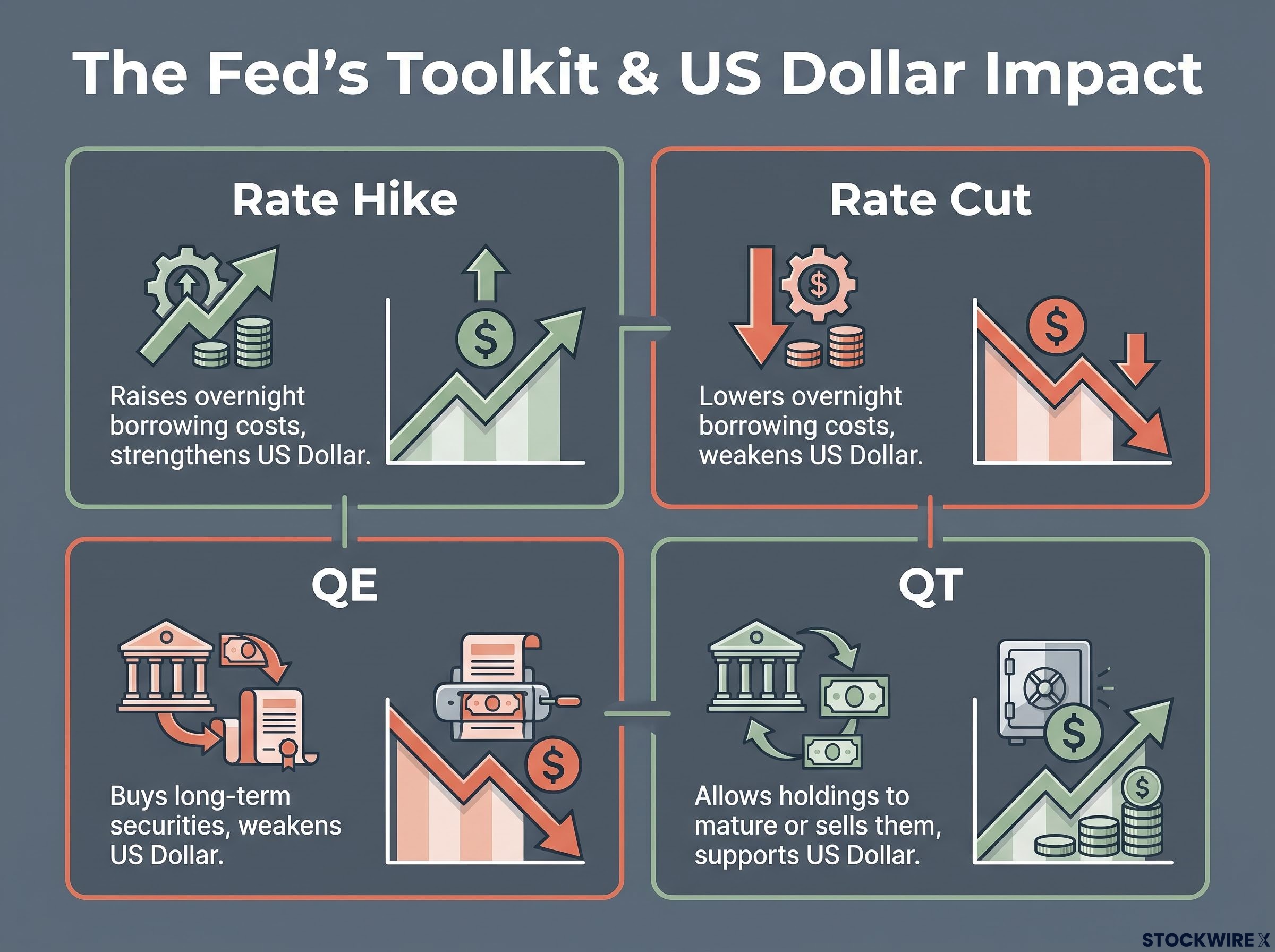
| Tool | Mechanism | Typical Dollar Impact |
|---|---|---|
| Rate Hike | Raises overnight borrowing costs, tightening financial conditions | Generally strengthens the US Dollar |
| Rate Cut | Lowers overnight borrowing costs, easing financial conditions | Generally weakens the US Dollar |
| QE | Buys long-term securities, compresses yields, expands balance sheet | Generally weakens the US Dollar |
| QT | Allows holdings to mature or sells them, raises yields, shrinks balance sheet | Generally supports the US Dollar |
The practical takeaway is that the Fed’s reach extends well beyond short-term borrowing costs. When the Fed adjusts its balance sheet, it is reshaping long-term mortgage rates, government borrowing costs, and the relative attractiveness of US assets to global investors. If you track the federal funds rate and stop there, you are missing half the picture.
Why Jackson Hole moves markets: forward guidance as a policy weapon
Because asset prices move on expectations of future policy, communication has become a policy tool in its own right. The Fed calls it forward guidance, and it takes four structured forms:
- Post-meeting policy statements that describe the economic outlook and signal likely future actions
- The Summary of Economic Projections (SEP), published quarterly, presenting individual FOMC participants’ forecasts for growth, inflation, unemployment, and interest rates, including the widely watched “dot plot” of individual rate-path expectations
- Press conferences where the Chair explains decisions and reinforces key messages
- Speeches and interviews by Fed officials, which markets parse closely for changes in tone or emphasis
The language in these communications is deliberate. Phrases like “patient,” “data-dependent,” or “higher for longer” are chosen specifically to shape how you and every other market participant perceive the future path of rates. Even without a formal decision, a change in tone can shift expectations for inflation, growth, and policy, driving moves across bonds, equities, and currencies.
Forward guidance credibility depends not on how many words the Fed uses but on whether the committee’s subsequent actions match its prior commitments, a dynamic that became sharply visible when two decades of expanding FOMC statements produced the taper tantrum of 2013 and the transitory inflation misjudgement of 2021-2022.
The phrase that moved markets: In August 2022, Chair Jerome Powell delivered a speech titled “Monetary Policy and Price Stability” at the Jackson Hole symposium themed “Reassessing Constraints on the Economy and Policy.” His explicit commitment to keeping policy restrictive “until the job is done” was interpreted as hawkish and was associated with sharp equity market declines and higher bond yields. A single phrase repriced global assets.
Detecting real shifts requires comparing current language against the latest SEP and prior guidance. If the words are the same, the signal has not changed. If new language appears, particularly around the balance between inflation and employment risks, that is where the genuine policy signal lives.
Reading a Jackson Hole speech: what to look for
The Federal Reserve Bank of Kansas City hosts the Jackson Hole symposium annually, bringing together global central bankers, academics, and policymakers. No formal FOMC decisions are taken there. Instead, it has become the venue of choice for signalling regime shifts or framework recalibrations outside the regular meeting cycle. The combination of high visibility, absence of immediate meeting pressure, and strategic focus amplifies its impact.
Apply this to right now. Running from August 27 to 29, 2026 under the theme of financial innovation and its implications for payments and monetary policy, the symposium marks Warsh’s debut as Chair on this particular stage. He has been described as reluctant to offer additional forward guidance. According to Scotiabank analysts, near-term implied volatility across the one-week horizon is sitting noticeably beneath its recent historical range.
That subdued volatility before a Jackson Hole speech by a new Fed Chair signals that markets may be underpricing the risk of a framework shift. For you, that means the cost of hedging against a surprise move is unusually low right now, and that is itself a signal worth noticing.
When watching any Jackson Hole address, here is what to track: changes in emphasis between inflation and employment risks, new language not present in prior statements, the Chair’s posture on future guidance, and implied volatility levels relative to historical norms. When the Chair signals reluctance to give forward guidance, the absence of reassurance may itself be the signal.
For readers wanting to understand how Warsh’s rejection of forward guidance reshapes every subsequent data release, our full explainer on the Warsh communication regime details how the June 2026 FOMC press conference eliminated the buffer that prior guidance provided and what toolkit investors now need in its place.
Putting it together: a practical guide to reading any Fed headline
You now have four layers of framework: the dual mandate tells you what the Fed is optimising for, the FOMC structure tells you whose words carry voting weight, the toolkit tells you which levers are being pulled, and forward guidance tells you how to detect shifts before they become formal decisions.
Apply them as a checklist. The next Fed headline you encounter will fall into one of three categories:
- Rate decision: Ask where inflation sits relative to 2% and how tight or loose labour markets are. A hike generally strengthens the dollar and tightens financial conditions; a cut does the reverse. Ask whether the decision was expected or a surprise.
- Balance-sheet announcement: Ask whether the Fed is expanding (QE) or shrinking (QT) its holdings and what that implies for longer-term yields. QE tends to weaken the dollar; QT tends to support it. This is where long-term mortgage rates and government borrowing costs live.
- Speech or communication event: Compare the language against the most recent SEP and prior statements. Ask whether the wording implies a different path for rates or the balance sheet. Ask who is speaking: a voting governor or the Chair carries categorically more weight than a non-voting regional president.
The single most reliable technique: Compare current Fed language against the most recent Summary of Economic Projections. If the words have changed but the projections have not been updated, you are likely witnessing a real-time shift in the committee’s thinking, and that is where positioning advantages emerge.
The Scotiabank observation about low implied volatility ahead of the 2026 Jackson Hole symposium is a live example of applying this framework. Markets are calm; the framework tells you to ask whether that calm is justified given a new Chair’s first major address.
Asymmetric repricing risk is a structural feature of this particular Jackson Hole: with markets appearing to have priced in implicit patience from Warsh, a single hawkish framework signal carries a larger downside for long-duration Treasuries and rate-sensitive equities than the relief available from a dovish outcome.
Whether Warsh speaks or stays silent, the framework is what lasts
Jackson Hole 2026 will resolve within the next day or two. Warsh will speak, or he will stay deliberately vague, and markets will react accordingly. That event is temporary.
What lasts is the structure underneath it. The Fed’s dual mandate, its committee voting hierarchy, its rate and balance-sheet tools, and its communication patterns will drive markets every six weeks for years ahead. Every Fed headline is now interpretable. You know which officials’ words carry voting weight, which tools are being deployed, where inflation sits relative to the 2% threshold, and how to detect whether a speech signals a genuine regime shift or merely reinforces existing guidance.
The next FOMC meeting arrives in roughly six weeks. Track how Warsh’s Jackson Hole address, whatever form it takes, shapes the language in the post-meeting statement that follows. That is where the framework converts from understanding into edge.
This article is for informational purposes only and should not be considered financial advice. Investors should conduct their own research and consult with financial professionals before making investment decisions.