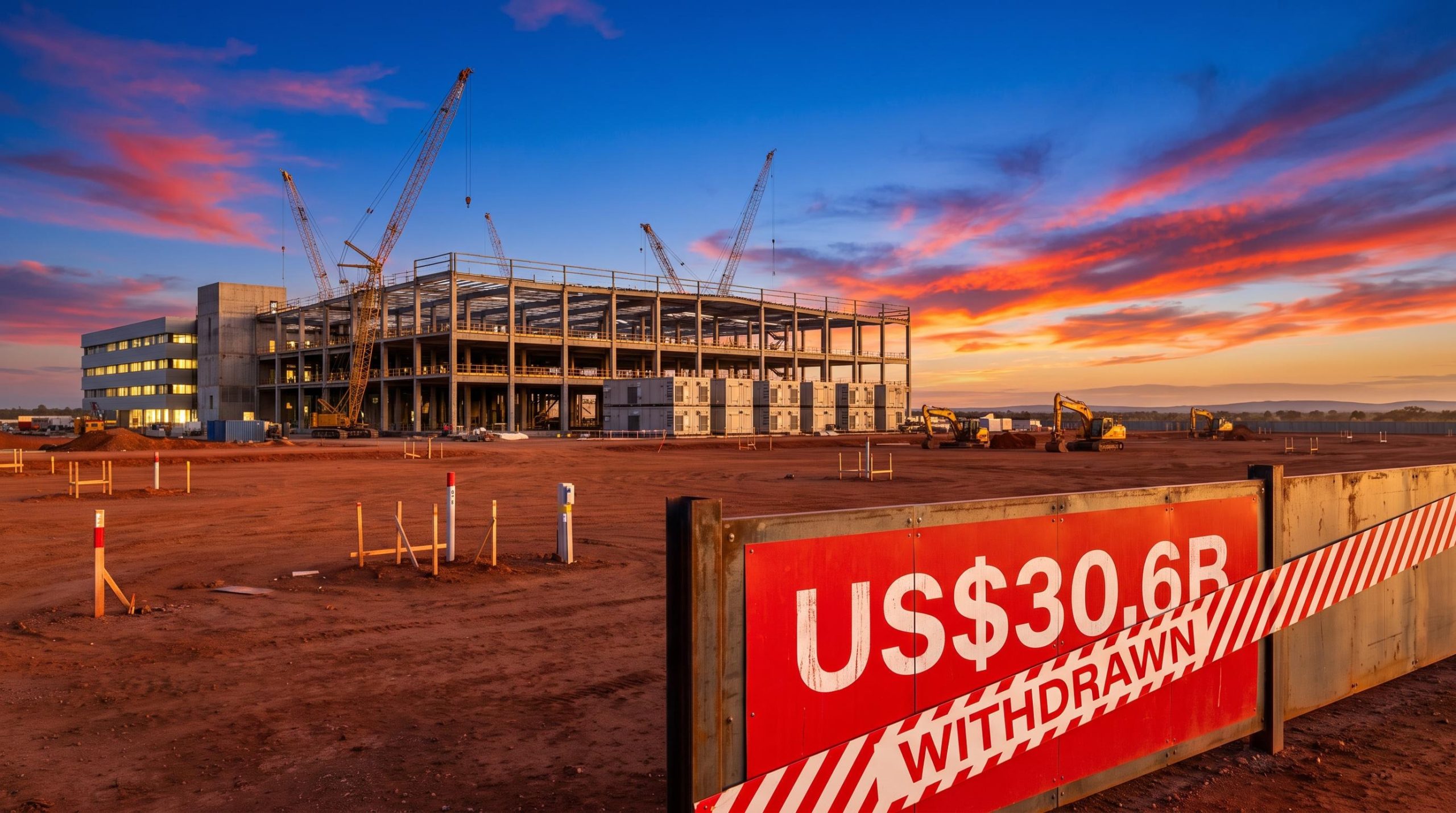
The Nvidia-backed data-centre developer Firmus set out to raise about US$5 billion at $11 a share. Its books opened on a Tuesday, and by Friday 9 October 2026 the offer had been withdrawn. Many investors are reading the failed Firmus IPO as a verdict on artificial intelligence. It looks more like a verdict on the price of capacity that has not yet been built.
That difference matters. This was the first Australian test of whether public investors would fund AI infrastructure at the prices set in private rounds. The answer came back as a firm no.
The story is still unfolding a week later. The outcome reaches anyone holding AI exposure through exchange-traded funds (ETFs), listed investment companies or unlisted vehicles.
Here is how to separate what was contracted from what was delivered, and why that gap is now the first question to ask of any AI infrastructure holding.
What did investors actually reject when the Firmus IPO books opened?
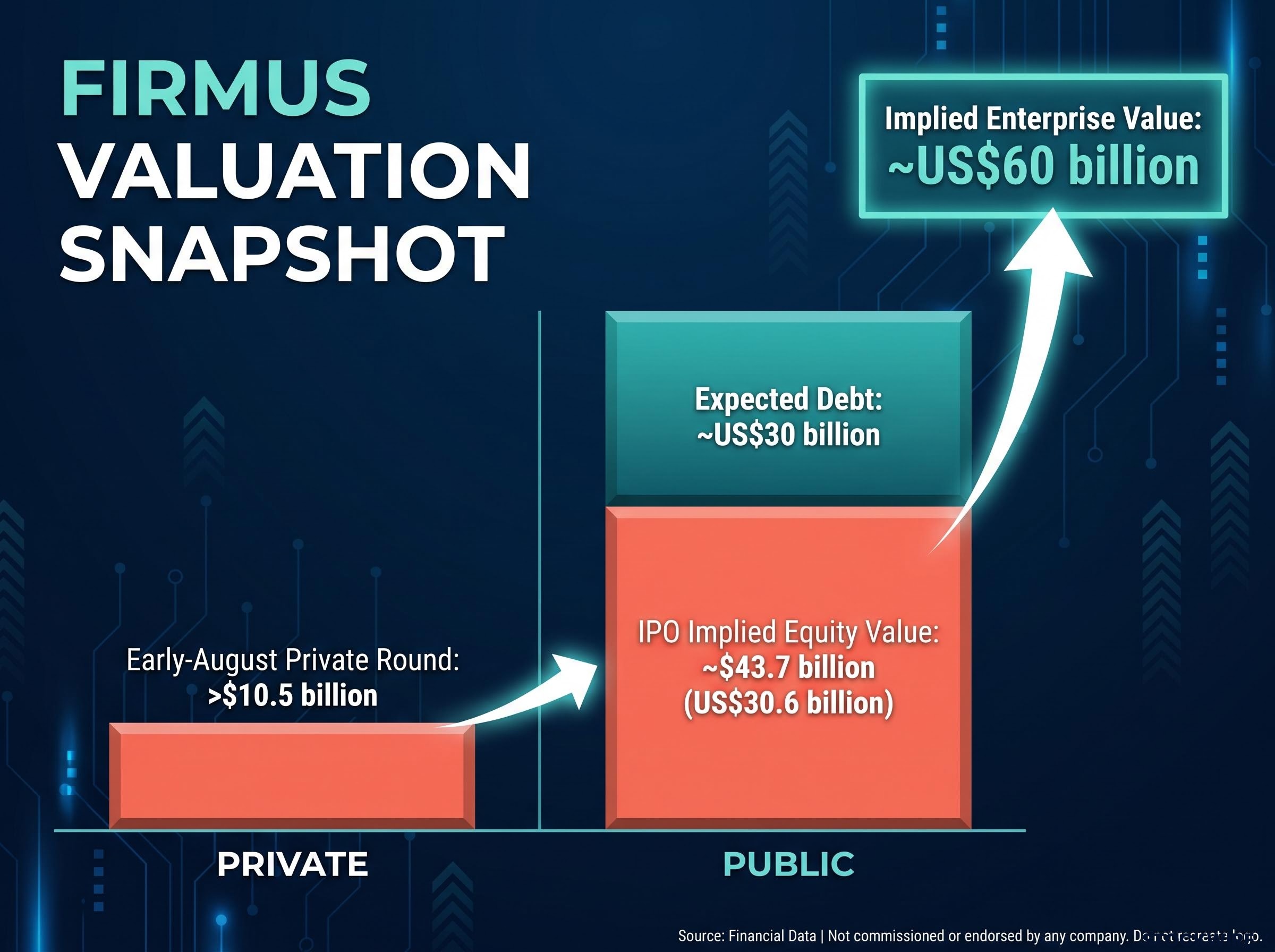
On paper, the numbers looked strong. An early-August private round valued Firmus at more than $10.5 billion. At the IPO price, the implied equity value was about US$30.6 billion (about $43.7 billion). In Australian dollar terms, that is roughly four times the August mark, reached in about two months.
| Item | Detail |
|---|---|
| Offer price | $11 per share |
| Intended raise | About US$5B (about $7.1B) |
| Implied equity value | About US$30.6B (about $43.7B) |
| Implied enterprise value | Around US$60B (The Star) |
| Expected debt | About US$30B once planned facilities are built |
| Lead managers | Bank of America, JPMorgan, Morgan Stanley, Morgans |
The leverage figure carried the most weight. Analysts for the joint lead managers expected about US$30 billion of debt against forecast 2028 operating earnings of US$5 billion. The ABC put that at about six times earnings that do not yet exist.
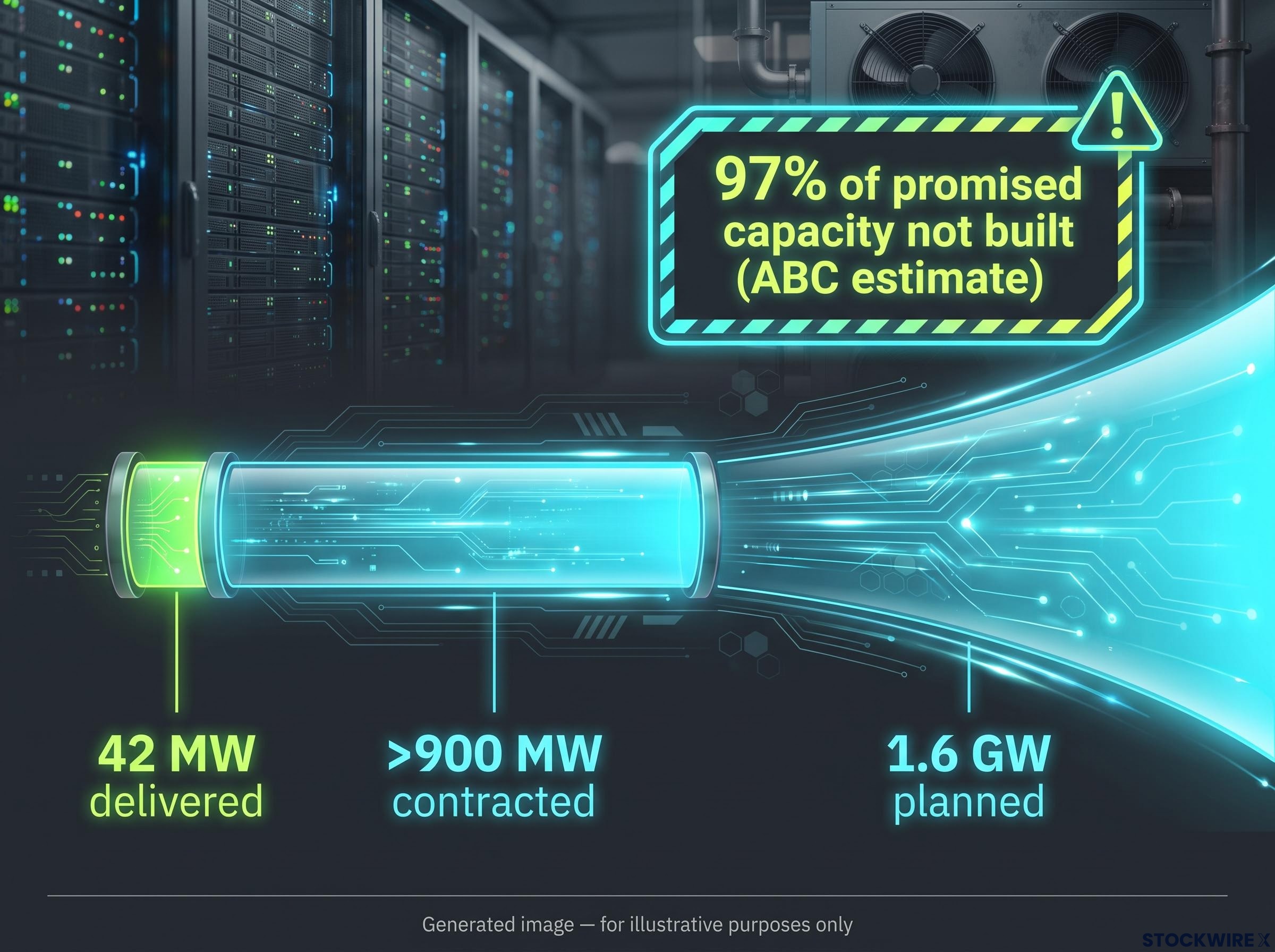
The capacity gap turned a growth story into a credibility problem. Firmus had delivered about 42 MW, had contracted more than 900 MW and planned 1.6 GW. The ABC estimated that about 97% of promised capacity had not been built.
Bullish data centre capacity forecasts from major banks keep rising, yet the Firmus case shows that forecast gigawatts and delivered megawatts are very different things when public investors are asked to pay.
The escrow terms added to the doubts. Escrow is a rule that stops existing shareholders from selling for a set period after listing. Here it would have let existing holders sell more than half their shares from day one, according to Investor Strategy News. The main objections were:
- Valuation reset too quickly
- Dependence on future execution
- Heavy leverage
- The end of Project Southgate
- Insufficient disclosure
Joseph Koh, Blackwattle Investment Partners Koh did not bid. He said the price reflected expected future outcomes too richly and that he lacked confidence in delivery. He preferred Goodman Group for its record of building data centres on time and on budget.
Firmus blamed “recent market volatility and prevailing market conditions”. It reportedly considered cutting the price but withdrew instead. A price built on 2028 earnings asked public buyers to take on delivery risk that private backers had carried. If you own AI infrastructure, you are implicitly taking the same risk.
The Project Southgate gap
Project Southgate, a partnership between Firmus and CDC Data Centres, was billed at up to $73.3 billion for a 1.6 GW rollout with Nvidia. Firmus co-founder Oliver Curtis said the parties had agreed not to proceed and that contracted capacity was unaffected. CDC chief executive Greg Boorer said Firmus had chosen to pursue its own developments. Orders began dropping mid-week, after CDC’s statement.
When big ASX news breaks, our subscribers know first
Why did an OpenAI revenue miss and a Maas Group sell-off land in the same week?
Southgate was one fault line. Two more opened within days.
The first was demand. Reuters identifies OpenAI as Firmus’s anchor customer, and it informed investors that its annualised revenue for September came to close to US$50 billion. Annualised revenue is one month’s revenue multiplied by twelve. The market had previously reported a figure of roughly US$70 billion. Revenue was not falling; it was growing more slowly than valuations had assumed. The market reacted quickly:
- Nvidia fell about 3%
- Oracle fell nearly 6%
- CoreWeave fell nearly 8%
- The Nasdaq 100 fell about 1.4% late in the session
- Chip stocks fell between 3.4% and close to 4%, depending on the source
The second was credit. Matt Maley of Miller Tabak said investors were growing sceptical about how long the AI spending cycle could last as borrowing costs rose.
The third shock landed on the ASX through Maas Group, which is both a Firmus shareholder and a contractor through its JLE subsidiary.
| Item | Detail |
|---|---|
| Firmus stake | About 3.2% fully diluted; about $410M invested |
| Construction work orders | About $1.1B |
| Payments received | About $373M |
| Expected completion | End of calendar 2027 |
Maas shares fell more than 20% on Thursday, wiping out about $517 million in market value. After the trading halt, they fell as much as 10.7% to $4.43, leaving the stock more than 30% below its early-October record. On the disclosed figures, about $727 million of the order book is still outstanding. That is simple arithmetic, not a reported impairment, and Maas said its contracts remain in place and JLE is still delivering Power Cubes.
For Australian investors, this is the key lesson. A failed valuation test can hit one local stock twice, through its equity stake and through its customer concentration. Your exposure may be larger than a single portfolio line suggests.
Australian exposure to AI infrastructure investment runs through different models, from colocation operators to property owners, and each carries a distinct balance of contracted revenue and dilution risk from capital-intensive builds.
How can a private mark and a public price differ this much?
It is natural to assume a valuation is simply a valuation. The Firmus episode shows why the same company can carry two defensible prices.
Why private marks hold
The August round drew backers including Coatue, Blackstone and Jane Street. Private investors often negotiate preferred shares, which rank ahead of ordinary shares if a company is sold or wound up. They can also secure liquidation preferences, which guarantee they are repaid a set amount before ordinary holders receive anything. Add lock-ups, downside protection and the strategic value of a backer such as Nvidia, and a high headline mark can hold without anyone having to trade at it daily.
Wilson Asset Management bought in at about $70 per share a year earlier, and the implied value had reached about $230 by late September. Before the withdrawal, WAM’s Shaun Weick expected Firmus to trade at a premium to its peers.
Oscar Oberg, Wilson Asset Management After the withdrawal, Oberg said the market had delivered its verdict.
Why debt changes the equity risk
Debt sits ahead of shareholders. Construction delays, higher rates, refinancing, power costs, customer concentration, obsolescence and weak utilisation all hit equity first, because lenders have priority claims. With about US$30 billion of expected debt, IPO buyers were effectively pricing a far larger enterprise.
Hyperscalers are the giant cloud operators. They can still borrow at investment grade for roughly 40 basis points over US Treasuries, where one basis point is one-hundredth of a percentage point. A developer with little delivered capacity cannot borrow on those terms.
| Feature | Private round | Public IPO |
|---|---|---|
| Liquidity | None daily | Traded daily |
| Investor protections | Preferences, lock-ups | Ordinary shares |
| Debt visibility | Negotiated privately | Fully scrutinised |
| Price discovery | Few negotiating parties | Broad market |
The month before the float, Bentham’s Richard Quin asked whether capital markets were starting to question returns on AI infrastructure. Australian funds holding private AI exposure may now face that question about their own marks. A last-round price is a negotiated figure with protective terms attached. It is not necessarily a price you could sell at, so treat unlisted AI holdings with a haircut in mind.
Is this a one-off, a temporary window problem or a structural repricing?
There are three serious readings of what happened.
- A reality check on speculative marks. Jun Bei Liu of Ten Cap called it a reality check for the AI boom rather than its end, citing an “unprecedented lack of detail.” The Nightly argued that credibility, not the headline valuation, was the failure.
- A temporary sentiment window. This is Firmus’s own explanation. Reports suggest a private round of US$2-3 billion, and the ABC reported a possible Nasdaq listing in 2027.
- Structural repricing. Investors are now drawing sharper lines between backlog and cash flow, and between investment-grade borrowers and leveraged specialists.
Comparable cases put each reading to the test.
| Comparable | What it illustrates |
|---|---|
| CoreWeave | Listed at US$40 in March 2025; debt of about US$35-36B and pressured bonds despite a large backlog |
| Nebius | About 40x market cap to trailing revenue, against about 6x for CoreWeave as of 1 September 2026 |
| AirTrunk REIT | Blackstone-backed listing reportedly pulled or paused the same week |
| SB Energy | SoftBank-backed offering also reportedly pulled or paused |
Public markets will still pay rich multiples, as Nebius shows. They are less willing to fund leveraged builders while credit tightens. On balance, the evidence supports all three readings at once: a temporary shock exposed real concerns about leverage, delivery and the reliability of private marks.
CoreWeave debt concerns show the same pattern in the bond market, where its 2032 notes trade well below par and yields near 15% signal financing stress that the share price had not fully reflected.
Firmus now appears likely to list offshore. That could thin the near-term supply of large ASX tech and infrastructure floats. It could also push future deals toward more realistic pricing and better disclosure.
What the evidence cannot tell us yet
A failed float does not prove the contracts are worthless. Maas and Firmus both say their contracts stand. Private investors may yet fund Firmus on stronger terms, and public prices can re-rate sharply if rates fall or contracted capacity becomes operating capacity. These scenarios are speculative and depend on market developments and company performance.
The useful question is not whether AI demand exists. It is whether delivered capacity, cash flow after interest and capital spending, and liquid pricing support the valuation.
What the withdrawal changes for AI exposure, and what it leaves open
The withdrawal was both a company-specific credibility problem and a test of whether private AI marks carry over to public equities. On this occasion, they did not. Three variables will show which reading proves right:
- The terms of Firmus’s private round and the timing of any Nasdaq listing
- Whether the more than 900 MW of contracted capacity becomes delivered, revenue-producing capacity
- The credit health of leveraged peers such as CoreWeave
If you hold AI infrastructure through ETFs, ASX suppliers or unlisted funds, the decision is the same each time: weigh what has been delivered against what has only been promised.
For readers wanting to check what their funds hold, our full explainer on ASX AI ETFs breaks down the infrastructure layer each one targets.
This article is for informational purposes only and should not be considered financial advice. Investors should conduct their own research and consult with financial professionals before making investment decisions. Past performance does not guarantee future results.
—