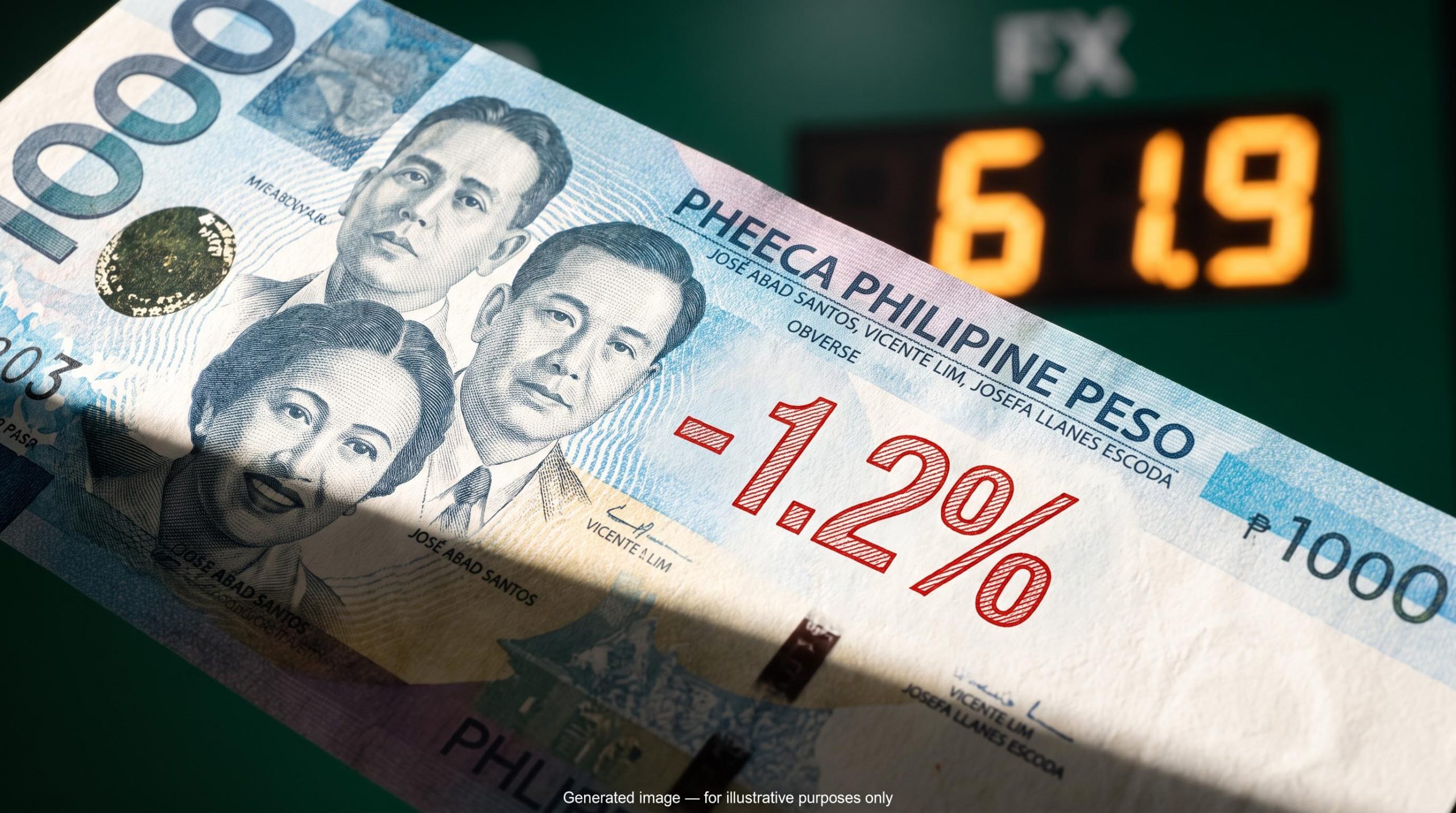
The Bangko Sentral ng Pilipinas (BSP) has raised interest rates three times in 2026, pushing the policy rate to 5.00%. The Philippine peso is trading near record lows around 61.6-61.9 per dollar.
Those two facts should not coexist. Rate hikes are supposed to support a currency. Three consecutive increases should, in theory, have given the peso a floor. Instead, the currency has continued sliding, and the gap between what the BSP has done and what the peso has priced tells you the market sees a problem the headline rate does not capture.
This is not just a Philippine story. Any emerging-market currency facing an inflation overshoot while its central bank tightens gradually is running the same experiment: whether nominal rate moves that fail to deliver positive real yields can buy credibility, or whether they simply burn political capital while the currency keeps falling. Here is the framework for understanding why BSP hikes have not worked, what the peso actually needs to stabilise, and the specific signals that would mark a genuine turning point.
Three hikes and still behind: why the BSP’s tightening cycle hasn’t moved the needle
Rate hikes are supposed to tighten financial conditions and attract capital. The BSP has delivered three consecutive 25-basis-point increases in 2026:
- April 2026: 25 bps hike, policy rate to 4.50%
- June 2026: 25 bps hike, policy rate to 4.75%
- August 2026: 25 bps hike, policy rate to 5.00% (overnight deposit facility at 4.50%, overnight lending facility at 5.50%)
Each move was methodical. Each was small. And each left the underlying arithmetic unchanged.
The structural problem is straightforward: with headline inflation running at 6.2% and the policy rate at 5.00%, the BSP is still delivering a negative real return on peso-denominated assets. The central bank’s own governor made this explicit.
Governor Eli Remolona acknowledged that real interest rates, the policy rate adjusted for inflation, were still negative even at the prior 4.75% level, meaning borrowing costs remained low once inflation was taken into account.
That admission reframes the entire tightening cycle. The BSP has not been leading; it has been catching up. BBH analyst Elias Haddad argued that the August decision looked more like a response to conditions already in place than a forward-looking intervention, pointing to the fact that inflation had already exceeded the top of the BSP’s tolerance band before the hike was delivered.
According to a Bloomberg poll, 20 out of 25 analysts surveyed had pencilled in a rate increase for August, with the remainder expecting no change. A widely anticipated rate increase that does not push real rates into positive territory delivers no new information to currency markets. The peso’s level near 61.6-61.9 per dollar after the decision confirmed exactly that: the hike was absorbed without producing a rally.
When big ASX news breaks, our subscribers know first
The real rate gap: what negative yields actually mean for peso holders
The arithmetic is simple. Take the BSP’s 5.00% policy rate. Subtract July 2026 headline CPI (consumer price index, the broadest measure of inflation) of 6.2%. The result is approximately negative 1.2%.
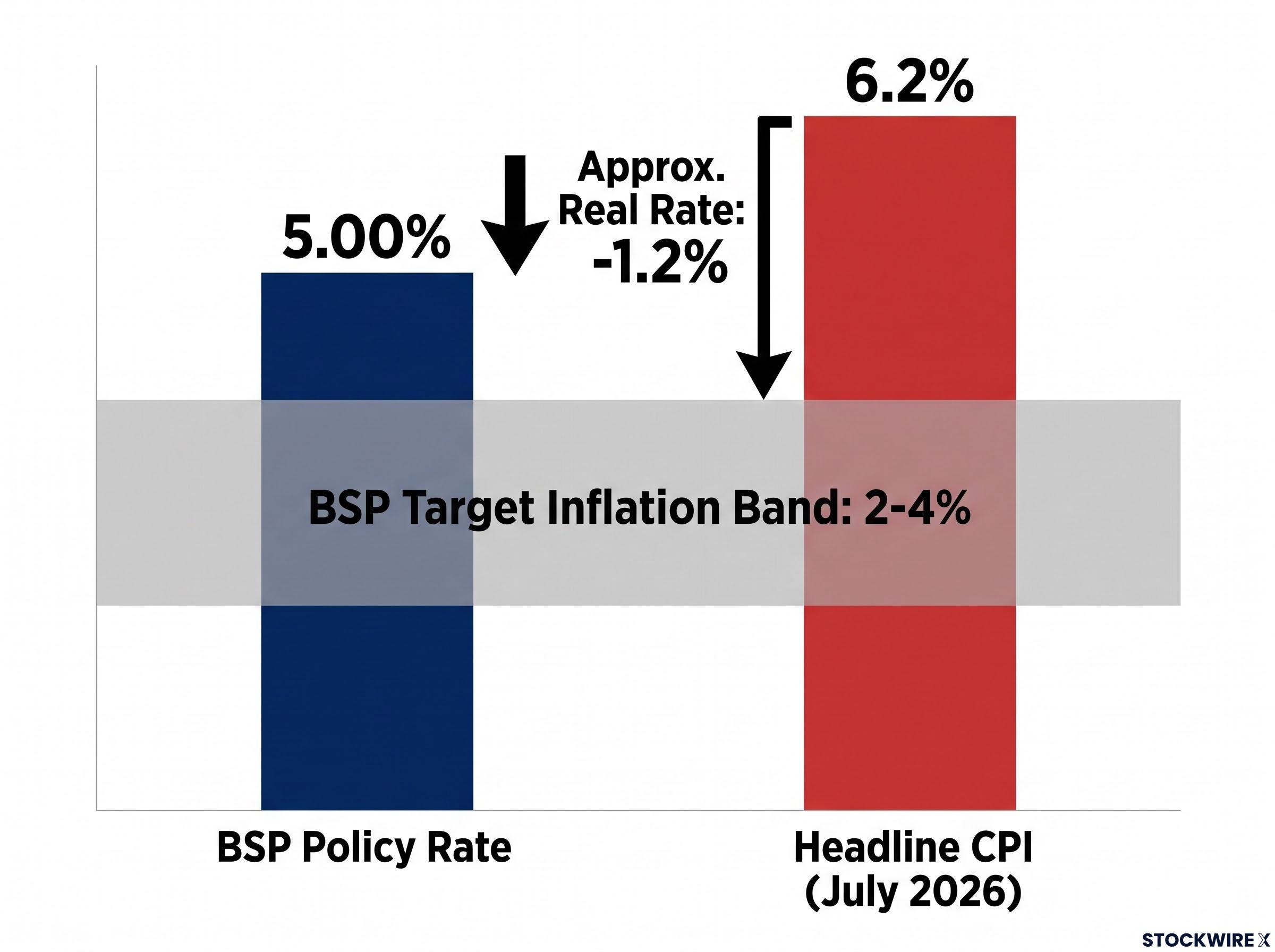
That figure is the real interest rate, the return an investor earns after inflation erodes purchasing power. A real rate of negative 1.2% means that holding peso-denominated assets costs investors money in real terms. Every month they hold, their purchasing power shrinks.
In isolation, that might be tolerable. But global capital does not sit in isolation. It moves toward the highest risk-adjusted real return available. When the Philippines offers a negative real yield while regional peers offer something better, the allocation decision is automatic.
The external headwind compounding the BSP’s task is the U.S. real yield environment, where the 10-year TIPS benchmark reached 2.22% under new Fed Chair Kevin Warsh, establishing a materially higher hurdle rate that dollar-denominated assets now clear with ease while peso-denominated assets at negative 1.2% real yields cannot compete.
The BSP’s own 2026 full-year inflation forecast of 6.1% means this negative real rate condition is not expected to self-correct under the current tightening path. The BSP’s target inflation band is 2-4%, and current readings are more than two percentage points above the upper bound.
ING Bank warned that the peso would likely be among Asia’s worst performers if the BSP maintained a cautious posture while inflation pressures persisted. That warning has played out in real time.
How the peso compares to regional peers on real yield terms
The peso’s underperformance becomes clearest when measured against its neighbours. Currencies such as the Malaysian ringgit, Singapore dollar, and Thai baht have shown more resilience, supported by stronger external balances and less deeply negative real rates.
| Country | Policy Rate | Headline CPI | Approx. Real Rate | FX Performance |
|---|---|---|---|---|
| Philippines | 5.00% | 6.2% | -1.2% | Among Asia’s worst; record lows in 2026 |
| Malaysia | Higher relative to inflation | Lower than PHP | Less negative / near neutral | More resilient; stronger external position |
| Singapore | MAS policy band tightened | Lower than PHP | Near neutral / positive | Outperforming regional peers |
| Thailand | Comparable range | Lower than PHP | Less negative | Mixed; periodic weakness but firmer than PHP |
For relative-value investors comparing real yields across the region, the Philippines has become a natural underweight. When your real return is the most negative in the neighbourhood and the central bank’s credibility is in question, capital flows elsewhere. That outflow is precisely what keeps pushing the peso lower, which in turn raises the cost of imports, feeding back into the inflation figure that created the problem in the first place.
The contrast within Asia sharpens this point: MUFG explicitly identifies the Korean won as the standout beneficiary of a softer dollar environment while naming the Philippine peso among the laggards, a regional FX divergence driven by the same real yield arithmetic that leaves the BSP’s tightening cycle looking insufficient against better-credentialed peers.
The feedback loop that three hikes haven’t broken
The peso’s problem is not a single cause. It is a self-reinforcing cycle with four stages, each compounding the next:
- Elevated inflation reduces real returns on peso assets, making PHP less attractive to hold
- Capital outflows accelerate as investors shift toward currencies offering higher real yields
- The peso weakens, raising the cost of imported energy and food for Philippine consumers and businesses
- Higher import costs feed back into domestic CPI, reinforcing the inflation that started the cycle, while the BSP’s gradual response allows expectations of further weakness to become entrenched

This is the mechanism that three 25-basis-point hikes have failed to break. Each incremental move has been too small to snap the chain.
The peso’s 2026 trajectory illustrates the loop in action. In March 2026, as Middle East tensions and strong U.S. yields drove investors toward safe-haven assets, the currency slid to record lows around 60.1-60.7 per dollar. By 27 August 2026, after three rate hikes, the peso had weakened further to approximately 61.6-61.9, a deterioration of more than 4% in a single episode.
MUFG analysis identified the peso, alongside the Thai baht and South Korean won, as leading regional losses, with domestic vulnerabilities magnifying the effect of global shocks.
The Philippines’ persistent current account deficit and reliance on foreign capital make the currency disproportionately sensitive to shifts in U.S. yield expectations and global risk-off episodes. When U.S. yields stay elevated, the dollar strengthens, and currencies with external financing needs absorb the worst of it.
This is not unprecedented. In 2022, the peso became Southeast Asia’s poorest performer before the BSP was forced to deliver a surprise 75-basis-point hike to restore credibility. The pattern was the same then: gradual tightening failed to break the loop, and only an aggressive surprise move changed the trajectory.
Bank Indonesia’s shock 50-basis-point hike in May 2026 provides the regional template for aggressive surprise moves: the rupiah stabilised not because of the cumulative tightening delivered but because the single unexpected action broke the market’s assumption that the central bank would remain behind the curve, precisely the credibility threshold the BSP has not yet crossed.
The distinction matters for any investor assessing PHP exposure. A currency in a temporary correction recovers when the catalyst fades. A currency caught in a structural depreciation cycle requires a policy response large enough to break the feedback mechanism. So far, the BSP’s 2026 moves have not crossed that threshold.
What would actually stabilise the peso: the 75-basis-point question
Markets have already done the arithmetic on what comes next. Swap markets are currently implying around 75 basis points of further tightening across the next 12 months, a trajectory that would lift the policy rate to approximately 5.75%.
That pricing creates an important asymmetry for the peso.
If the BSP delivers those incremental hikes broadly in line with expectations, the currency may stabilise rather than rally, because much of the tightening will already have been anticipated and priced in. Genuine upside for the peso would require a hawkish surprise: a larger individual hike, faster sequencing, or credible forward guidance committing to positive real rates for an extended period.
Even at 5.75%, with the BSP’s own 2026 full-year inflation forecast at 6.1%, real rates would remain marginally negative. The peso’s recovery therefore depends on inflation falling faster than the BSP currently projects, not just on rate hikes arriving on schedule. The BSP has also pointed to a set of upside price risks that could keep inflation from retreating quickly, among them the effects of El Niño on food and agricultural costs and the prospect of future wage increases.
For anyone with exposure to Philippine assets or regional FX, three metrics define the watch list from here:
- Real yield trajectory versus regional peers: Is the Philippines closing the gap, or is it widening as neighbours tighten more aggressively or see inflation fall faster?
- BSP communication on the target band timeline: Is the central bank committing to a specific path back to the 2-4% inflation target, or hedging with vague language?
- Headline CPI trend: Are the monthly readings showing momentum toward the target, or are they sticky above 6%?
Until those indicators shift, the peso’s structural underperformance case remains the base scenario, and the market-priced 75 basis points becomes the floor of what is needed, not the ceiling.
A credibility gap that rate arithmetic alone cannot close
Three structural drags continue to weigh on the peso simultaneously: negative real rates of approximately negative 1.2%, an entrenched inflation-currency feedback loop that each incremental hike has failed to break, and external vulnerability to global risk appetite and U.S. yield dynamics that the BSP cannot control.
The 5.00% policy rate was a necessary step. It was not a sufficient one. “Sufficient” requires real yields that are clearly and durably positive, communication that commits the BSP to maintaining that stance until inflation is within the 2-4% target band, and a pace of tightening that surprises markets rather than confirming what they have already priced.
The BSP’s own 2026 full-year inflation forecast of 6.1% tells you the gap will not close on its own under the current path. Markets have priced 75 basis points more as the minimum the tightening cycle must deliver, and even delivering that in line with expectations may not produce a peso rally.
The BSP’s challenge is not purely cyclical: structural inflation dynamics, including supply chain restructuring, energy transition costs, and demographic shifts, suggest that emerging-market central banks may be fighting an inflation regime that cannot be resolved through conventional rate cycles alone, regardless of how many basis points are delivered.
The single clearest signal to watch is whether the BSP’s tightening path pushes real yields into positive territory in a durable way, combined with credible messaging that it will hold that stance until inflation is firmly back within the 2-4% band.
Until that happens, the structural case for peso underperformance versus other Asian currencies is intact. No individual rate decision changes that calculus on its own. The framework applies beyond the Philippines: any emerging-market currency caught between an inflation overshoot and a central bank perceived as behind the curve faces the same arithmetic, and the same test of whether gradual tightening can restore credibility or whether only a decisive surprise can break the cycle.
This article is for informational purposes only and should not be considered financial advice. Investors should conduct their own research and consult with financial professionals before making investment decisions. Past performance does not guarantee future results. Financial projections are subject to market conditions and various risk factors.