
Nvidia reported $96.2 billion in quarterly revenue for Q2 FY2027, a 106% increase year-over-year. That number alone would have made it a strong quarter. What made it a different kind of quarter was the decision to break from standard practice and hand investors multi-year revenue visibility they were not expecting.
That matters because the extended guidance, covering approximately $500 billion in order visibility and a $1 trillion cumulative revenue pathway, shifts the market conversation. The question is no longer whether AI demand is real. It is how long the cycle lasts and whether the ambition now priced into the market can be sustained. Wall Street’s reaction on 28 August, a nearly 9% single-day gain in Nvidia shares and double-digit surges across software names, reflects how decisively investors answered that question, at least for now.
Here is what the numbers actually say, why software firms moved in sympathy, and the specific signals worth tracking before the next earnings cycle.
Nvidia’s Q2 results and what the extended guidance actually means
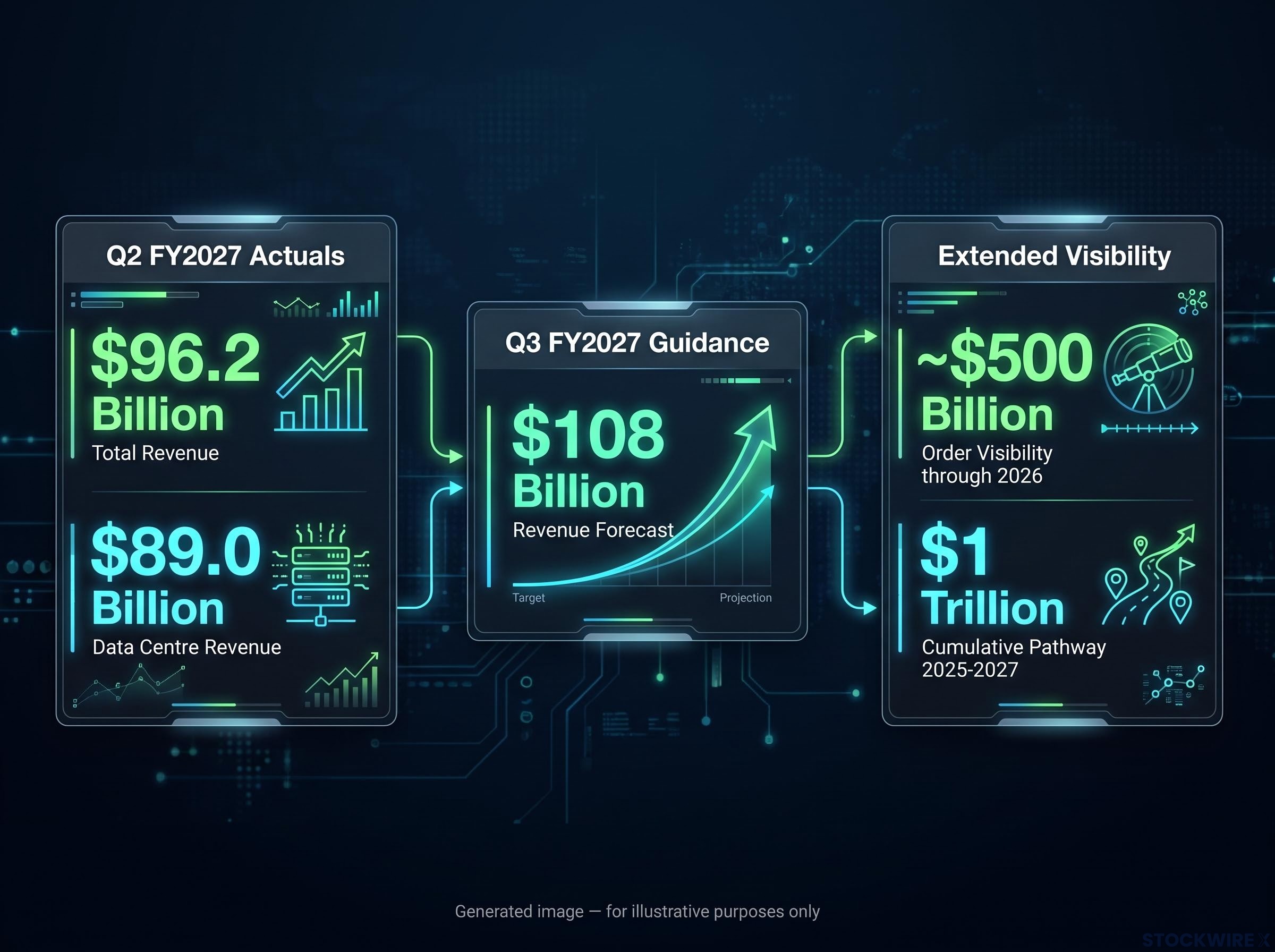
The headline numbers came in well above expectations. Nvidia posted $96.2 billion in Q2 FY2027 revenue, with data centre revenue reaching $89.0 billion, up 117% year-over-year. Q3 guidance landed at $108 billion, plus or minus 2%, and management projected fiscal 2028 growth of approximately 70%. The Vera Rubin platform, successor to Blackwell, entered production in 2026 and is expected to account for approximately 20% of data centre revenue in Q3 FY2027.
Nvidia’s official Q2 FY2027 earnings release confirmed total revenue of $96.2 billion and data centre revenue of $89.0 billion, with third-quarter guidance set at $108 billion and CEO commentary citing accelerating AI demand as the primary driver of the extended multi-year visibility.
| Metric | Q2 FY2027 | Year-over-year change |
|---|---|---|
| Total revenue | $96.2B | +106% |
| Data centre revenue | $89.0B | +117% |
| Q3 FY2027 guidance | $108B (±2%) | N/A |
| Fiscal 2028 growth guidance | ~70% | N/A |
Strong results are one thing. Extended guidance is another. Nvidia typically issues only quarterly forecasts. This time, the company disclosed order visibility of approximately $500 billion for its Blackwell and Rubin data centre systems through calendar 2026, with a significant portion already shipped, and framed a path to $1 trillion in cumulative platform revenue spanning 2025 through calendar 2027.
$500 billion in disclosed order visibility through calendar 2026. That figure is the clearest single measure of how far Nvidia departed from its standard guidance practice, and it tells the market that large, creditworthy customers have pre-booked years of AI capacity.
The supply-constrained framing matters most for downside scenarios. Growth is explicitly described as limited by memory component shortages, not by any softening in demand. For investors weighing near-term risk, that distinction is material: Nvidia’s earnings vulnerability in coming quarters is a logistics and component problem, not a demand problem.
The post-earnings share price dynamics reflect a valuation condition that has become structural for mega-cap AI names: institutional investors had largely pre-positioned for strong results, shifting the market question from whether Nvidia beat to whether it beat by enough to justify incremental buying at current multiples.
When big ASX news breaks, our subscribers know first
How software stocks posted double-digit gains on a hardware earnings report
Software stocks had been carrying a question all year: would AI cannibalise their business models, or augment them? Nvidia’s demand data argued forcefully for augmentation, and the market responded with purpose.
The reasoning runs like this. If enterprises are committing hundreds of billions to AI infrastructure, they are not just buying GPUs. They are building and scaling AI applications, many of which run through established software, security, and workflow platforms. Nvidia’s multi-year visibility implied that AI-related line items in IT budgets are being funded and expanded, not redirected away from incumbent vendors.
The AI substitute versus complement framework separates software businesses with genuine displacement risk from those where AI integration deepens product value and raises switching costs, a distinction that explains why the sympathy move on 28 August was concentrated in specific names rather than uniform across the entire enterprise software sector.
The individual stock moves reflected a mix of company-specific catalysts and broader sentiment read-through:
- Salesforce: jumped over 20% after lifting its full-year revenue and profit outlook and unveiling a new plugin built around Anthropic’s Claude AI models
- CrowdStrike: rose 21% after the cybersecurity firm lifted its full-year revenue outlook and delivered second-quarter earnings that came in ahead of analyst estimates
- ServiceNow: gained approximately 10%, moving primarily on AI sentiment rather than a concurrent earnings release
- Palo Alto Networks: gained approximately 13%, similarly benefiting from the read-through effect
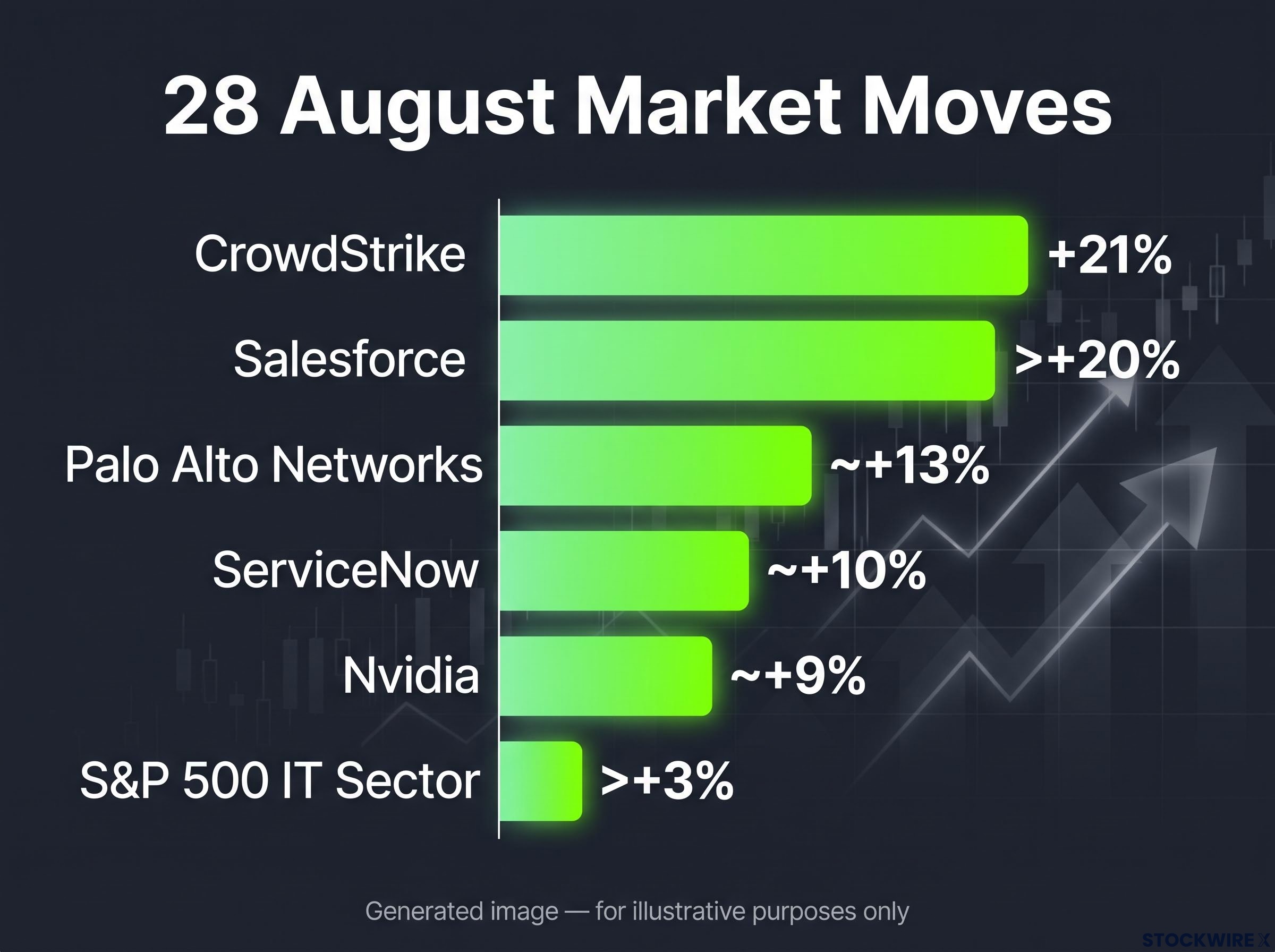
On 28 August, the S&P 500 information technology sector posted gains exceeding 3%, finishing as the single advancing sector across all 11 S&P 500 groupings. The Nasdaq Composite rose 1.6%, the S&P 500 added 0.7%, and the Dow Jones Industrial Average edged up 0.2%. The fact that IT was the sole advancing sector tells you this was a targeted conviction rotation into AI-adjacent names, not a broad risk-on day.
What the demand data confirms about the AI infrastructure cycle
Nvidia’s single-quarter results sit inside a much larger structural picture, and third-party data supports the view that this is a multi-year buildout rather than a one-quarter peak.
Hyperscaler capital expenditure estimates for 2026 have moved substantially higher, now approaching or exceeding $700 billion, well above prior consensus estimates in the $400-$500 billion range. That revision alone signals how rapidly the spending trajectory has steepened. Gartner estimates that spending on AI-optimised infrastructure-as-a-service (IaaS), the cloud-hosted computing power that runs AI workloads, nearly doubled from approximately $21.5 billion in 2025 to more than $42 billion in 2026.
The hyperscaler capital expenditure trajectory has been revised upward repeatedly through 2026, with Amazon, Microsoft, Alphabet, and Meta collectively spending $130 billion in Q1 2026 alone, establishing the demand floor that makes Nvidia’s $500 billion order visibility figure a contractual reality rather than a speculative projection.
| Category | 2025 estimate | 2026 estimate | Growth |
|---|---|---|---|
| AI-optimised IaaS (total) | ~$21.5B | ~$42B+ | ~95% |
| Inference workloads | N/A | ~$23.3B | ~55% of total |
| Training workloads | N/A | ~$19.0B | ~45% of total |
| Hyperscaler capex | Prior est. $400-$500B | ~$700B+ | Significant upward revision |
U.S. federal AI spending has added a material government demand layer on top of private-sector commitments. According to analysis of federal contracting data, approximately $7.2 billion in obligated funds and approaching $91.8 billion in potential awards are allocated for 2026, both representing substantial increases from 2024 levels.
Inference workloads are projected at approximately $23.3 billion in 2026, accounting for roughly 55% of AI-optimised IaaS. The tilt toward inference over training is the structural shift that matters most: it means enterprises are no longer just testing AI models. They are running them in production, embedding AI into existing software and workflows. That is what converts capital expenditure into durable, recurring demand rather than one-time buildout spending.
What investors should watch before the next earnings cycle
Nvidia’s extended guidance has raised the expectations bar in a specific way. Any future softening in supply language, order timing, or hyperscaler capex commentary will now be measured against a $1 trillion revenue pathway and approximately 70% fiscal 2028 growth guidance. The stock, which posted a gain of close to 9% on results day while the wider semiconductor index added over 2%, is now more sensitive to incremental changes in management tone.
The software re-rating carries its own risk. Double-digit single-day moves can price in AI monetisation assumptions that are not yet visible in multiple quarters of revenue and margin data. The metrics that would validate or invalidate those assumptions are identifiable.
Three variables to monitor before the next earnings cycle:
- Hyperscaler capex and procurement commentary: This is the primary demand signal for the entire AI infrastructure chain. Any moderation or deferral by major cloud providers would ripple through Nvidia and its ecosystem.
- Software AI monetisation metrics: Net retention rates, AI feature pricing (add-ons, usage tiers, upsell revenue), and margin leverage from internal automation are the signals that will determine whether the 28 August software re-rating was justified or anticipatory.
- Nvidia supply constraint language: Watch for any shift from “supply-constrained” to softer phrasing. That change would signal demand moderation, not just production improvement, and could trigger a re-evaluation of forward estimates.
Portfolio construction considerations for AI-exposed investors
Concentration risk is structural, not just a current-moment observation. Nvidia and a handful of mega-cap AI beneficiaries represent a significant share of major indices, meaning index investors carry implicit AI infrastructure exposure whether they intend to or not.
Diversifying within AI, spreading exposure across infrastructure, hyperscaler, and software names, reduces single-company execution risk. Balancing secular AI exposure (GPUs, cloud, AI platforms) with defensive sectors can reduce drawdown risk if hyperscaler capex is delayed or reprioritised.
For investors wanting to stress-test the assumptions behind the software re-rating, our deep-dive into AI capex versus monetisation examines how 93-94% of hyperscaler operating cash flow is now absorbed by infrastructure spending, and what that concentration means for the timeline before AI returns show up in equity earnings.
Whether the AI buildout has legs, or whether the bar is now too high
The evidence from this earnings cycle points in one direction. AI infrastructure demand is structurally real, multi-year in scope, and now backed by disclosed order visibility at a scale that moves it beyond sentiment into contractual commitment. Nvidia’s $1 trillion cumulative revenue pathway through calendar 2027, hyperscaler capex estimates approaching or exceeding $700 billion for 2026, and the tilt toward inference (approximately 55% of AI-optimised IaaS) signalling production-stage deployment all support the same thesis.
The tension sits in what that confidence now requires. By quantifying multi-year demand so precisely, Nvidia has reduced the “AI bubble” narrative today but amplified the downside sensitivity to any future deviation. The market is implicitly assuming three conditions will hold:
- Hyperscaler capex sustains or grows through 2027
- Software AI monetisation shows up in measurable revenue and margin metrics within two to three quarters
- Nvidia supply constraints resolve through expanded production rather than becoming a demand signal for competitors
The margin for error across the next two to three earnings cycles is now smaller because market expectations have moved to match the ambition of Nvidia’s own guidance. The bullish case is well-supported by disclosed data. The test ahead is whether software monetisation, hyperscaler capex discipline, and supply chain execution can all track the ambitious trajectories now priced into the market.
This article is for informational purposes only and should not be considered financial advice. Investors should conduct their own research and consult with financial professionals before making investment decisions. Forward-looking statements regarding revenue pathways, capex estimates, and growth projections are subject to change based on market developments and company performance.