“We don’t need complete information.” When a central bank that spent more than a decade waiting for perfect conditions tells markets it will move without them, the words carry a different weight. Deputy Governor Ryozo Himino’s phrase is not a technicality. It is a policy departure.
The remark arrives just weeks after the Bank of Japan raised its policy rate to 1%, the highest in 31 years, and ahead of the September 17-18 meeting where markets are pricing in a further move to 1.25%. USD/JPY was trading at 159.35 when Himino spoke. The bar for BoJ action has been structurally lowered, and that matters for anyone with exposure to yen-denominated assets or yen-funded positions.
Here is what the language actually signals about the pace and direction of Japanese rate policy, why the inflation data now supports this posture, and what it concretely means for USD/JPY positioning, JGB exposure, and the carry trades that have treated cheap yen as a permanent fixture.
What Himino actually said, and why the framing matters
Himino’s remarks made clear that the BoJ is prepared to adjust policy without waiting for a full picture of economic, price, and financial conditions to crystallise is not rhetorical softening. It is a deliberate lowering of the action threshold. For the better part of a decade, BoJ communication anchored itself to data confirmation before moving. That anchor has been pulled up.
The logic behind the shift is Himino’s “too late” framing. His stated concern is that waiting for full data confirmation risks inflation overshooting and requiring sharper corrections later. In central banking, “too late” language is a specific signal: it tells markets the cost of inaction now exceeds the cost of acting on incomplete data.
“We don’t need complete information.” Deputy Governor Ryozo Himino, August 2026, in remarks on the BoJ’s willingness to adjust policy ahead of full data confirmation.
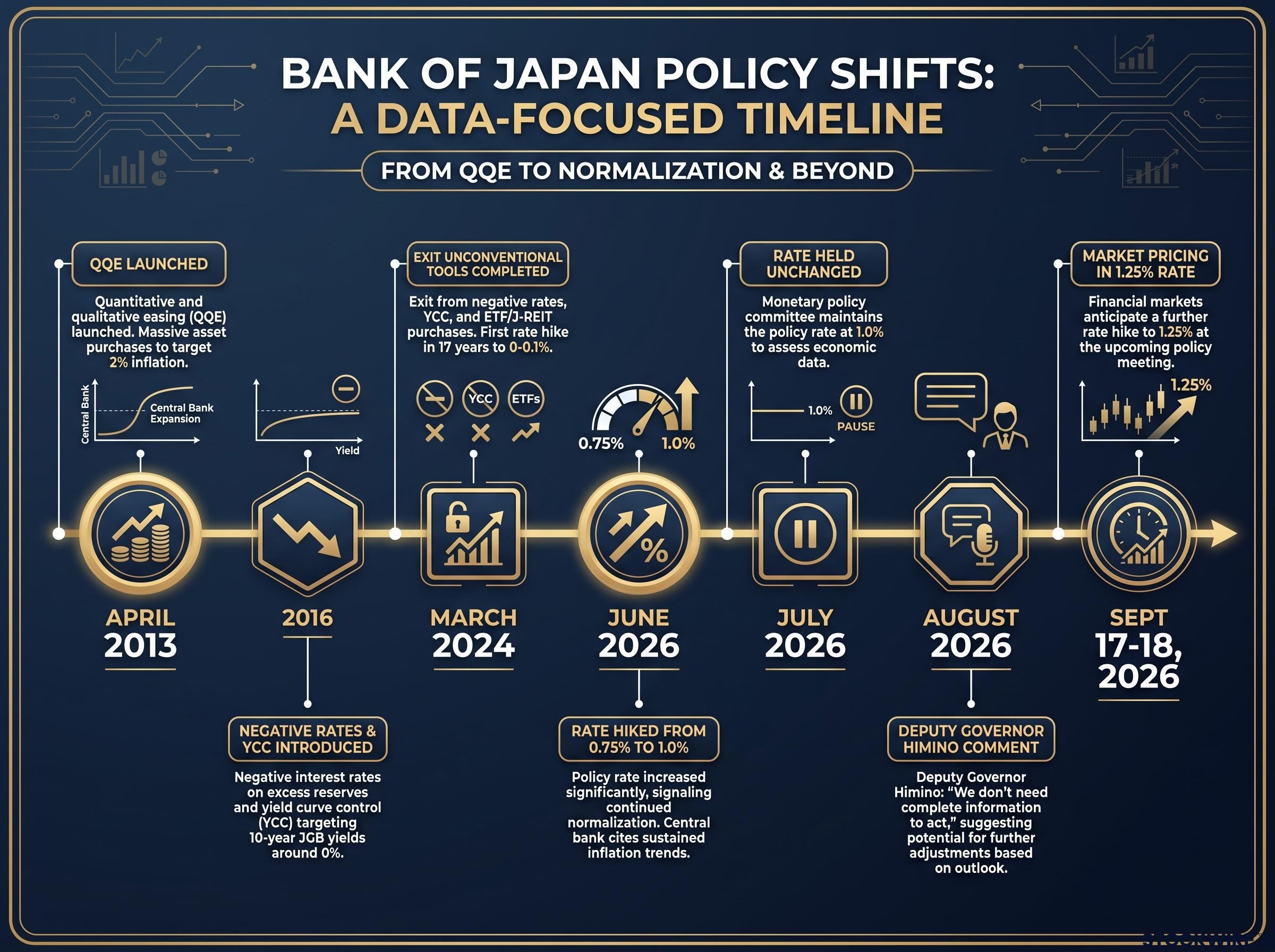
What makes this framing especially pointed is the starting position. These remarks followed the June 2026 rate hike from 0.75% to 1.0%, with the rate held unchanged at the July 2026 meeting. The BoJ is not preparing a first move from zero. It is signalling continuation from an already-elevated rate, with markets pricing a high probability of a further 25 basis point increase to 1.25% at the September 17-18 meeting. The immediate market response to Himino’s comments was barely perceptible, with USD/JPY edging just 0.02% higher on the day, though the pair’s prevailing level of 159.35 underscores that the yen continues to face entrenched structural headwinds.
The June 2026 rate hike delivered a 25-basis-point move to 1.0% via a 7-1 board vote and was accompanied by a structured JGB tapering schedule, making it the clearest single expression of the BoJ’s intention to sustain normalisation rather than execute a one-off adjustment.
The shift from “wait for data confirmation” to “act to avoid falling behind” changes the BoJ’s reaction function. Anyone pricing in BoJ inaction as the base case is now taking on asymmetric risk.
When big ASX news breaks, our subscribers know first
Why Japan’s inflation picture now supports a more aggressive stance
The BoJ’s FY2026 core CPI projection sits at 2.5%, revised down from 2.8% due to temporary energy subsidies. Even after that revision, upside risks remain flagged. Core inflation is expected to exceed 2% from September 2026 onward, meaning the BoJ’s concern about overshooting is not a theoretical exercise but a near-term scheduling problem: the inflation data may breach target in the same month as the next scheduled rate decision.
Governor Kazuo Ueda has stated that underlying inflation is steadily accelerating toward the 2% goal and could converge around that level sometime between the latter half of FY2026 and FY2027. The convergence, however, rests on one variable above all others.
| Metric | Detail |
|---|---|
| Current policy rate | 1.0% (effective mid-June 2026) |
| Market-implied next rate | 1.25% at September 17-18 meeting |
| FY2026 core CPI projection | 2.5% (revised from 2.8%) |
| Core inflation exceeds 2% from | September 2026 onward |
| Inflation convergence target | H2 FY2026 through FY2027, contingent on wages |
Internal and external voices corroborate the hawkish tilt. Board member Naoki Tamura has suggested Japan is close to durably achieving the 2% target. External analyst Tsutomu Watanabe has echoed the assessment, arguing Japan may shift to a more explicitly inflation-fighting posture. The policy question has moved from “will we get there” to “can we hold it without overshooting.”
The IMF’s 2026 Article IV assessment of Japan corroborates the BoJ’s own projections, flagging wage growth as the decisive variable in determining whether domestic demand-driven inflation proves durable rather than a temporary byproduct of yen weakness and imported cost pressures.
The wage growth conditionality
Durable inflation requires domestic demand-driven price pressure, not just imported cost push from a weaker yen and elevated global energy costs. Wages are the primary channel through which that manifests, and it is the variable the BoJ has repeatedly flagged as the linchpin. Robust wage growth supports continued hikes; disappointing wage data gives the BoJ a credible off-ramp. If you are watching one number ahead of each meeting, wages are it.
Two of the three carry trade warning signals that preceded the 2024 S&P 500 decline of approximately 10% were already active in mid-2026, with Japan’s 10-year JGB yield at roughly 2.65% and the US 10-year at approximately 4.46-4.49%, and the third trigger, a confirmed USD/JPY breakdown below 160, remains the single threshold to watch.
When core inflation is projected to exceed target in the same month as the next scheduled rate decision, the BoJ’s language about avoiding overshoot is not abstract caution. It is a direct signal that September action is data-supported.
The September hike probability has moved from roughly 23% before the July hold to 78-85% in overnight-indexed swap markets, with two consecutive above-forecast core CPI prints compressing the US-Japan yield differential and pushing USD/JPY toward 158.80 in the process.
The decade-long arc that makes this moment legible
Himino’s language sounds abrupt only if you miss the context. The BoJ’s shift toward active rate management is the endpoint of a transformation that has unfolded across three distinct phases:
- Quantitative and qualitative easing (QQE), launched April 2013. The BoJ undertook large-scale, open-ended purchases of government and corporate bonds, channelling liquidity into the economy to lift inflation from its persistently low trajectory.
- Negative interest rates and yield curve control (YCC), introduced 2016. The BoJ extended its stimulus arsenal by taking its deposit rate below zero and capping 10-year JGB yields directly, keeping long-term borrowing costs suppressed at or near the floor.
- Exit from unconventional tools, completed March 2024. The BoJ judged the price stability target was within sight and shifted back to a conventional framework where the uncollateralised overnight call rate, the short-term interest rate the BoJ targets when setting policy, is the primary instrument. Rate adjustment rather than balance-sheet expansion became the main lever.
That third phase is the one that makes Himino’s “we don’t need complete information” framing operationally meaningful. The BoJ no longer needs to manage 10-year JGB yields directly, which is itself a form of additional policy flexibility. It no longer needs to justify bond-purchase volumes. It has the same tool the Federal Reserve and European Central Bank use, and it is now explicitly willing to use it more actively.
The policy rate at 1.0% stands well above the zero bound maintained for most of the prior decade, with negative rates in place from 2016 until the March 2024 exit. For anyone who calibrated their mental model of Japanese monetary policy during the QQE era, that framework no longer exists. The BoJ now uses rates the way the Fed and ECB do, and that changes how to read every subsequent statement.
What the normalisation cycle means for the yen, JGBs, and carry trades
Yen and USD/JPY positioning
As Japan’s policy rate rises from 0.75% to 1.0% and potentially to 1.25%, the interest-rate differential with the United States narrows, which historically supports the yen over the medium term.
- Direction: Conditionally yen-positive. Each BoJ hike that is not matched by a Fed hike compresses the spread.
- Primary risk modifier: The Federal Reserve’s path. If U.S. rates remain elevated or cuts are delayed, the spread trade embedded in USD/JPY still favours the dollar and caps the magnitude of yen appreciation.
- Variable to watch: Fed meeting outcomes relative to BoJ meeting outcomes. The sequencing matters as much as the levels.
USD/JPY at 159.35 reflects a still-large spread. The direction of travel favours yen strength, but the pace is Fed-dependent.
JGB repricing and tapering discipline
A rising policy rate mechanically pushes up yields and down prices on existing fixed-rate JGB holdings. The question is not whether yields move higher; they almost certainly will in a normalisation cycle.
JGB yield normalisation from near-zero to 2.77% has eliminated the artificial suppression that shaped a decade of cross-asset positioning, and with Japanese institutional investors including the near-2 trillion dollar GPIF now holding a credible domestic alternative, even partial repatriation removes a major stable long-duration buyer from US, European, and Australian sovereign bond markets.
- Key implication: Gradual, well-telegraphed yield increases rather than abrupt dislocation. The BoJ has emphasised orderly adjustment at every step.
- Primary risk modifier: Himino has assessed that there are currently no notable distortions in the JGB market, which supports the BoJ proceeding with its existing bond reduction schedule without modification.
- Variable to watch: Tapering adjustments scheduled from April 2027 onward. Any acceleration of that timeline would signal the BoJ is more confident in market absorption capacity than currently communicated.
Global carry trade dynamics
As the yen funding rate rises from near zero toward and past 1%, the cost-of-carry on yen-funded positions increases. Yen carry trades, where investors borrow in low-yielding yen and invest in higher-yielding assets, become less one-sided.
- Key implication: Reduced attractiveness of yen as a cheap funding currency, raising the risk of position unwinds that ripple through emerging-market FX, high-yield debt, and equities that benefited from cheap yen financing.
- Primary risk modifier: Volatility around scheduled BoJ meetings. Carry-trade unwind pressure concentrates around policy dates because that is when the funding cost outlook can shift abruptly.
- Variable to watch: Implied volatility in USD/JPY around the September 17-18 meeting and subsequent decisions. Rising vol is the carry trader’s cost signal.
The combination of a rising yen funding cost and a BoJ that has explicitly said it will not wait for complete data means carry traders can no longer treat BoJ inaction as the base case. That recalibration has a price, and it shows up in volatility around every policy date.
Four variables that will determine the pace from here
These are not analyst guesses. They are the BoJ’s own stated conditionalities, drawn directly from Himino’s and Ueda’s remarks:
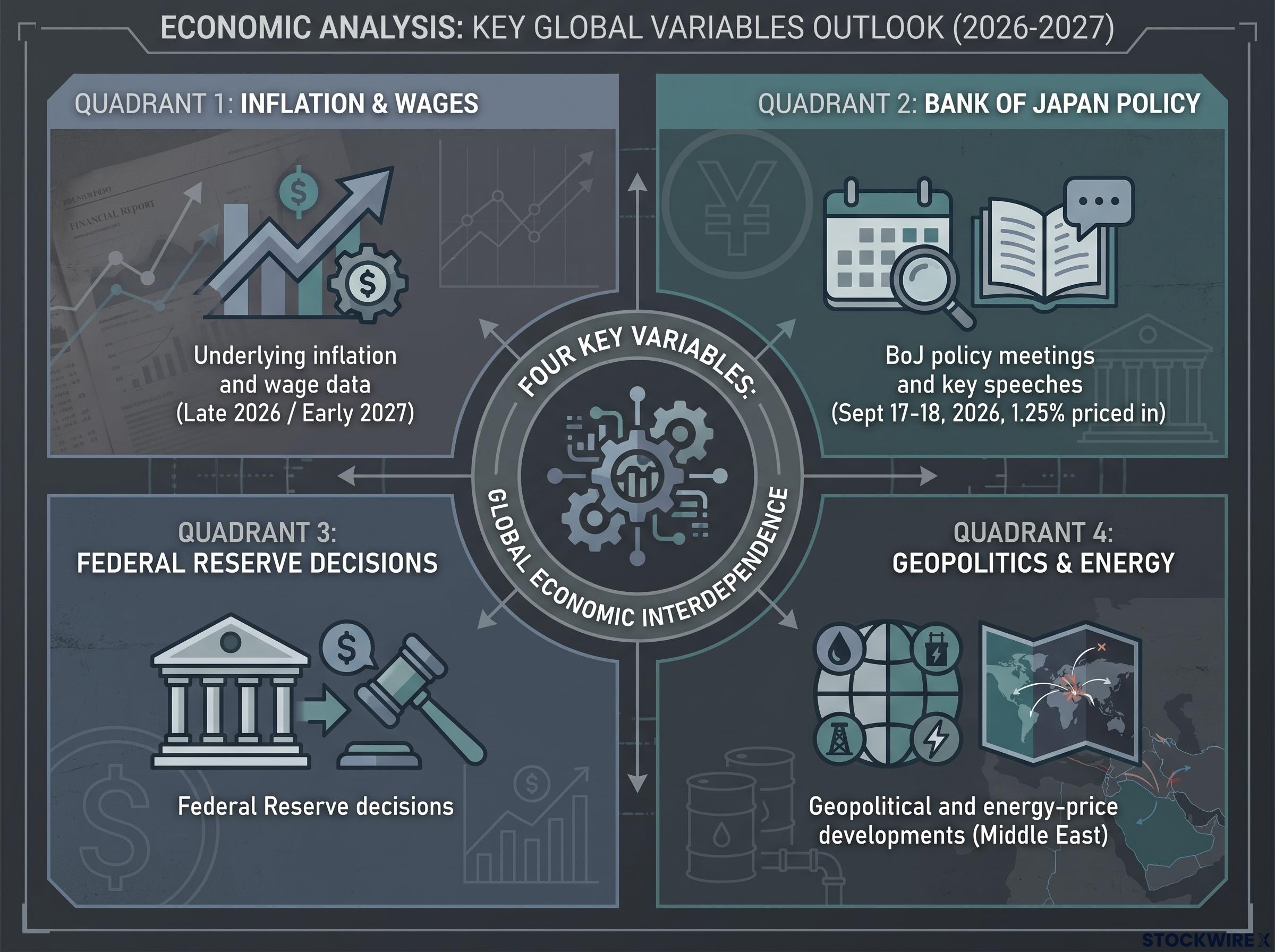
- Underlying inflation and wage data. Track late 2026 and early 2027 releases closely. Robust wages support continued hikes and validate the convergence projection. Disappointing wages create a credible off-ramp, and the BoJ has pre-built the language to use it.
- BoJ policy meetings and key speeches. The September 17-18, 2026 meeting is the next scheduled decision, with 1.25% priced in. Beyond the rate call itself, watch remarks from Governor Ueda, Deputy Governor Himino, and board member Naoki Tamura for signals on the ceiling and pace of the cycle.
- Federal Reserve decisions. Elevated or delayed U.S. rate cuts cap yen appreciation and limit real tightening impact even as the BoJ raises nominally. The rate differential is a two-central-bank equation, and the Fed side shapes how far BoJ action translates into market impact.
- Geopolitical and energy-price developments. Himino has explicitly identified Middle East developments as potential drivers of sharp changes in Japan’s economic and price outlook. This is the primary external risk scenario that could slow or pause the hiking cycle. An energy shock that pushes inflation higher complicates the picture because it could simultaneously justify hikes (imported inflation) and argue against them (growth drag).
The September 17-18 meeting is the first near-term stress test of how the BoJ weighs these variables in combination. A reader who tracks all four will be able to interpret each BoJ communication as a weighting decision across them, which is a more precise framework than simply watching the rate announcement.
Reading the BoJ’s next move before it makes one
The directional question is no longer open to debate. A BoJ that once waited for certainty is now explicitly willing to act without it, and that change in reaction function is the durable takeaway regardless of what happens at any single meeting.
What remains genuinely uncertain is pace, not direction. The two variables that could alter the timeline, the Fed’s rate path and geopolitical disruption, are real constraints. But conditional uncertainty is not the same as directional uncertainty. Investors who conflate the two risk misreading pauses as retreats.
The September 17-18 meeting is not an endpoint. It is the first confirmation point in what is projected to be a multi-year normalisation cycle. How the BoJ weighs wages, inflation, and external risk at that meeting will tell you more about the next twelve months of Japanese rate policy than any single data release.
This article is for informational purposes only and should not be considered financial advice. Investors should conduct their own research and consult with financial professionals before making investment decisions. These statements are speculative and subject to change based on market developments and central bank decisions.
—