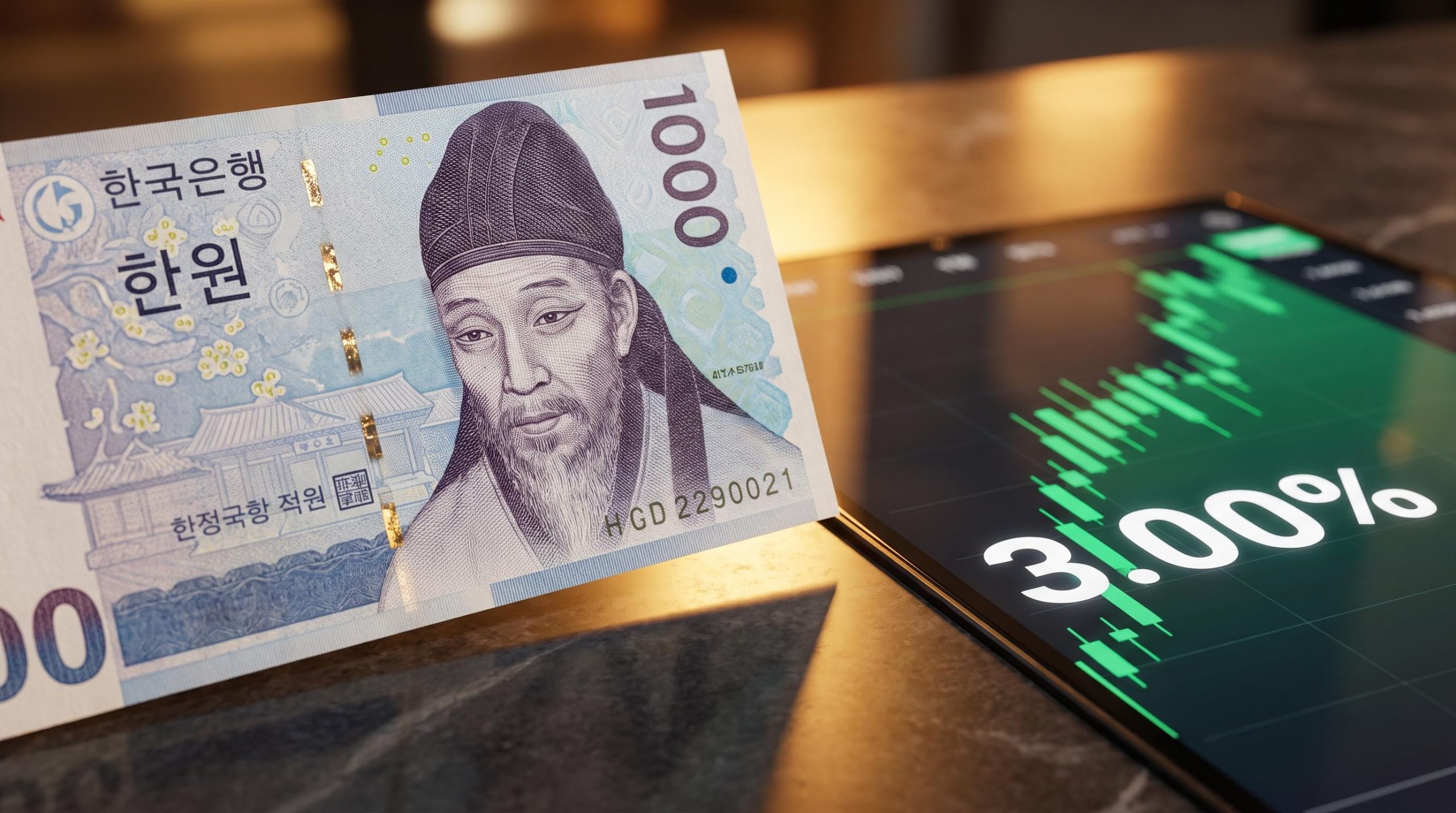
The Bank of Korea delivered a further 25 basis point increase to its policy rate on 27 August 2026, lifting borrowing costs to 3.00% and marking back-to-back tightening moves that placed the rate at its highest point since January 2025. That alone would be a straightforward story. What makes it unusual is the backdrop: the Korean won has gained around 12% in value relative to the US dollar since the start of the year and is hovering close to levels not seen in 11 months. Rate hikes typically weigh on a currency by signalling tighter conditions ahead. Here, the currency has surged anyway.
That disconnect reflects something deeper than rate mechanics. Markets are repricing South Korea’s growth trajectory and external position, and the BoK’s willingness to tighten into a strong currency tells you policymakers share that confidence.
What follows is a breakdown of the decision itself, the revised macro forecasts that underpin it, the won’s trajectory and its cost to exporters, and what the combination means for anyone holding or considering Korean equities, bonds, or currency exposure. The tension between tighter policy and a surging won is the thread running through all of it.
The BoK’s decision: what the vote reveals about where the board stands
The core facts are clean:
- Policy rate: 3.00%, up from 2.75%
- Decision date: 27 August 2026, the second consecutive hike
- Vote: 6-1 in favour, with board member Hwang Kun-il dissenting in favour of holding at 2.75%
The rate now sits at its highest since January 2025, and the decision matched market consensus. That matters because it tells you this was not a surprise move designed to jolt expectations. It was a deliberate, telegraphed signal that the BoK believes conditions require continued tightening.
The vote composition carries its own message. A 6-1 split is decisive, but it is not unanimous. Hwang’s dissent marks a real threshold within the board: at least one member believes conditions may already be tight enough. That distinction shapes the probability of further action. A unanimous board hiking to 3.25% at the next meeting is a different proposition from a board where the majority must override a dissenting view that the cycle has run far enough.
For anyone positioning in Korean assets, the 6-1 vote is the number to watch as closely as the rate itself. The direction is clearly restrictive. The question is how much further the majority is willing to push.
Reading central bank vote splits as a forward policy signal applies beyond the Fed: the BoK’s 6-1 decision carries meaningful information about how close the board is to pausing, and the same interpretive framework, where the size and direction of dissent reshapes rate-cycle probability, applies across major central banks.
When big ASX news breaks, our subscribers know first
Growth upgraded, inflation still running above target
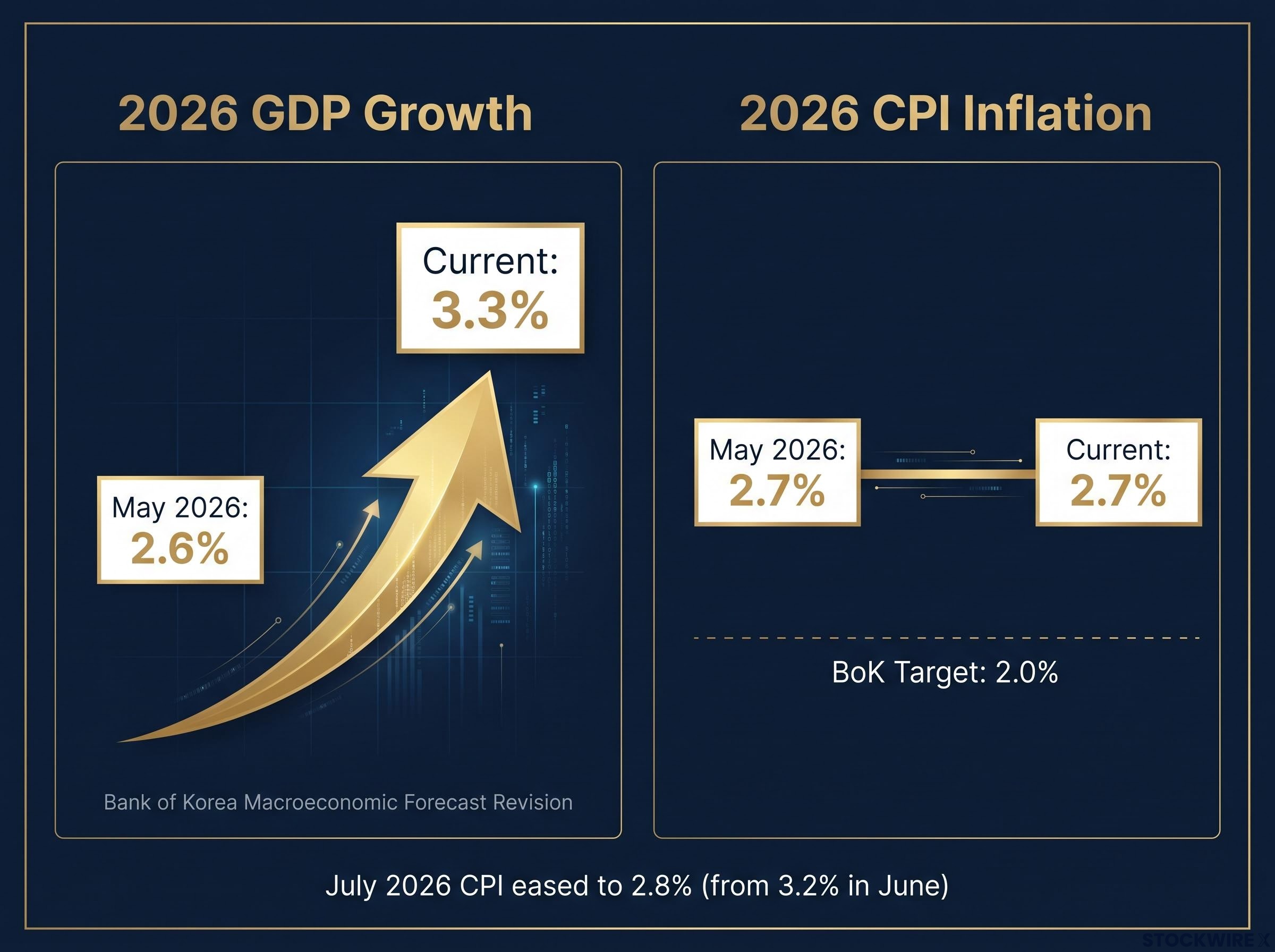
In its accompanying statement, the BoK revised its 2026 GDP growth projection upward to 3.3%, a substantial improvement on the 2.6% figure it had published in May 2026. The 2027 outlook was also raised to 2.9%. Stronger exports and recovering domestic demand drove both revisions.
That is not a cosmetic adjustment. A 0.7 percentage point upgrade to the current-year growth forecast reprices the earnings base for Korean companies and shifts the sovereign credit profile. It tells you the BoK is not tightening into weakness; it is tightening into genuine expansion, which materially changes the risk of a policy error in either direction.
| Indicator | Prior forecast (May 2026) | Revised / current forecast |
|---|---|---|
| 2026 GDP growth | 2.6% | 3.3% |
| 2026 CPI inflation | 2.7% | 2.7% (unchanged) |
The inflation picture explains why the upgraded growth has not shifted the BoK toward easing. The 2026 CPI projection remained pinned at 2.7%, with 2027 also kept at 2.3%. Both sit above the 2% target. Consumer prices rose 2.8% year-on-year in July 2026, easing back from the 3.2% recorded in June, while the core measure came in at 2.6%. Disinflation is underway, but it is not complete.
The BoK characterised the current environment as one of “mounting inflationary pressure,” a framing that leaves little room for interpreting the board as satisfied with the pace of price deceleration.
Better growth with unchanged inflation forecasts is the BoK’s bind. The expansion is real, but the job on prices is unfinished, and policymakers are making clear they intend to see it through.
The won’s 12% rally and what it means for exporters
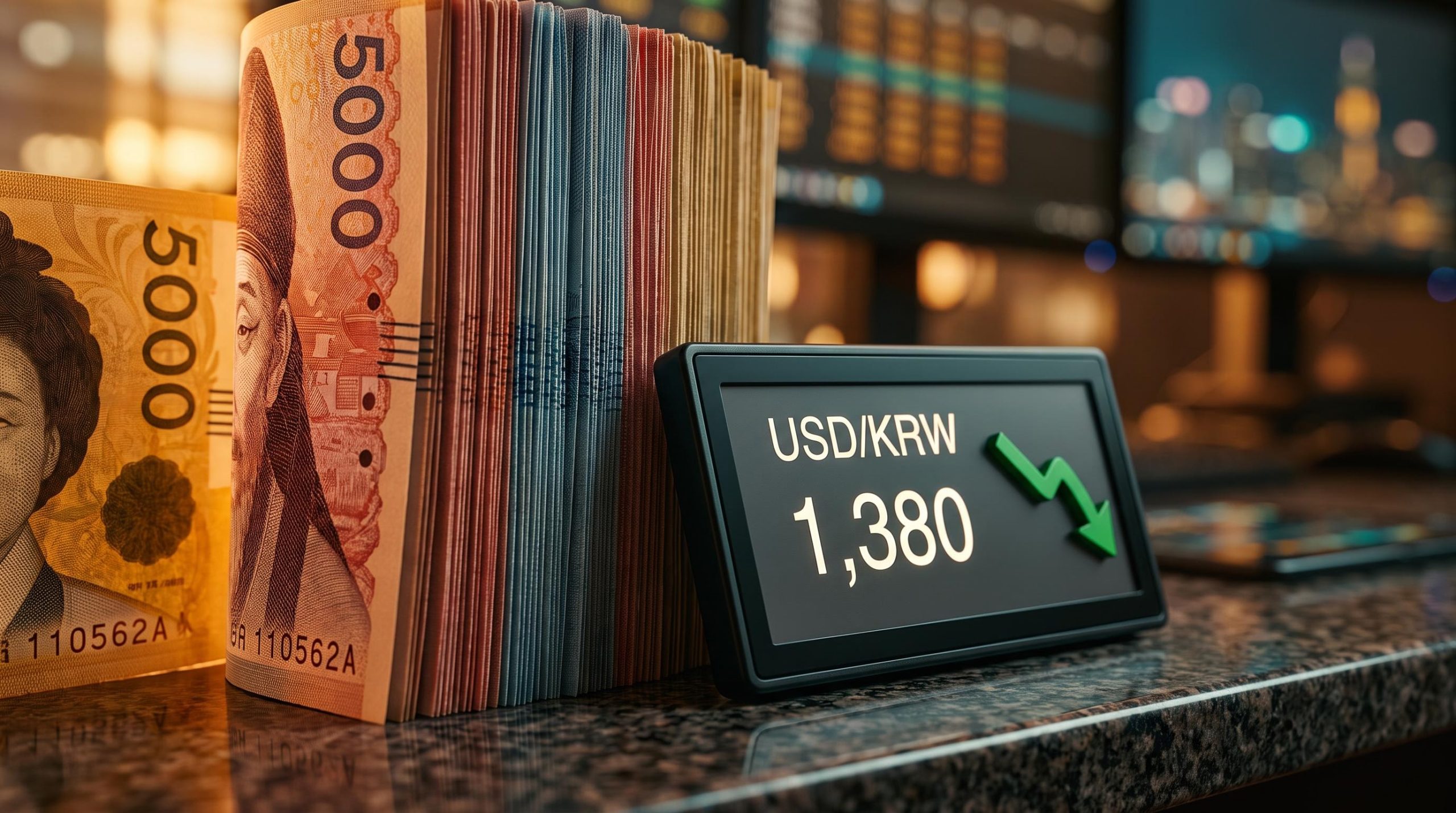
The scale of the currency move demands attention. On 27 August, USD/KRW dropped by around 0.3% to the 1,380 area, touching territory last seen roughly 11 months prior. The pair had been changing hands near 1,560 at the start of June 2026, representing a shift of around 180 won per dollar in under three months.
Export repatriation flows, specifically Korean corporates converting record dollar revenues back into won, have provided a structural demand pillar for the currency that is qualitatively different from speculative positioning and harder to reverse on a single macro headline.
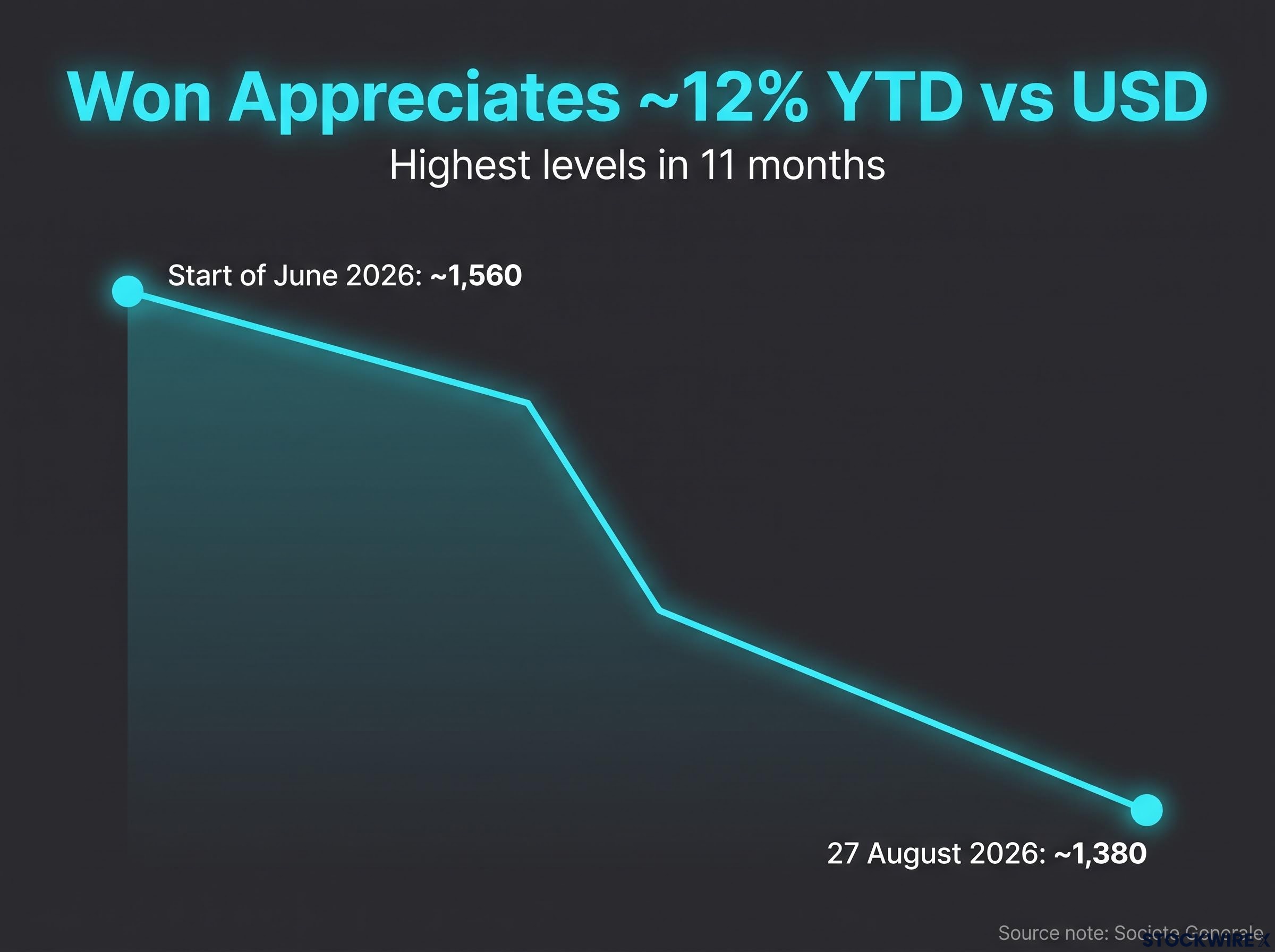
Societe Generale analysts noted the Korean won had climbed roughly 12% versus the USD on a spot year-to-date basis as of late August 2026.
A stronger won gives the BoK a helpful tailwind on inflation. Cheaper imports reduce headline price pressure, which eases the burden of tightening further. For the central bank, the currency is doing part of the inflation-control work that rate hikes are designed to do.
The exporter squeeze
The other side of that equation hits company margins directly. Three sectors carry the most exposure:
- Autos
- Shipbuilding
- Semiconductors
The mechanism is straightforward. Overseas revenues earned in US dollars or other foreign currencies are worth fewer won at current exchange rates. Even if export volumes hold steady, reported earnings compress because each dollar of foreign revenue buys less when translated back into the domestic currency.
The KOSPI’s heavy weighting in export-oriented tech and industrial names means index-level returns can mask a divergence between domestically exposed and export-exposed stocks. The won’s strength is not neutral for the Korean equity market; it creates winners and losers within it.
The BoK’s willingness to hike into this currency environment is itself a statement. It signals that policymakers believe South Korea’s growth is broad-based enough to absorb FX headwinds without derailing the expansion. That confidence is a key input when assessing the durability of the outlook.
What the rate decision and won surge mean for Korean bonds and equity positioning
With the base rate at 3.00% and CPI running at 2.7-2.8%, real policy rates have moved into modestly positive territory. That is a meaningful shift. Positive real rates in an improving-growth economy change where Korean debt sits in a global portfolio context: from a yield-thin developed-Asia allocation to a destination that can attract foreign fixed-income inflows on its own merits.
Foreign flow dynamics in Korean equities have swung sharply since July, with Goldman Sachs’ Korea Equity Risk Barometer hitting -1.5 on cumulative net selling of 157.50 billion won before the BoK’s second hike began to attract fresh inflows into domestic-demand sectors.
Duration sizing is the live question. Some board members see the rate peaking closer to 3.25-3.50%, which means one or two more hikes could still be ahead. Locking in duration too early carries mark-to-market risk; waiting too long means missing the yield peak.
The FX hedge decision for USD-based investors
For USD-based investors, the 12% year-to-date gain is already in the book. The forward question is whether the growth and real-rate story remains intact enough to justify holding unhedged exposure.
Unhedged positioning made sense during the appreciation leg and may still be justified if the fundamentals hold. But active hedging becomes rational if global risk sentiment turns or export data shows visible deterioration. This is a sizing question, not a binary one.
| Asset class | Implication of current macro setup |
|---|---|
| Korean government bonds | Modestly positive real yields attract inflows; duration risk from potential further hikes to 3.25-3.50% |
| Domestically exposed equities | Upgraded growth and disinflation tailwind support earnings for domestic-demand sectors |
| Export-exposed equities | FX-driven earnings drag from 12% won appreciation compresses margins despite solid volumes |
The equity split is where the positioning logic sharpens. Sectors with a more positive backdrop:
- Services
- Retail
- Financials
Sectors facing headwinds:
- Tech hardware
- Autos
- Shipbuilding
Treating “South Korea” as a single monolithic exposure misses the divergence the BoK’s move has accelerated. The rate decision and the currency together create a clear domestic-versus-export split that should inform sector allocation.
Where the cycle goes from here
The tightening is clearly in a late phase. The rate is at 3.00%, and the potential peak cited by some board members sits at 3.25-3.50%. The remaining distance is limited but not yet closed.
Three variables will determine the next move:
- Core CPI trajectory relative to the 2% target: the 2026 forecast sits at 2.7% and 2027 at 2.3%, meaning the BoK needs to see further deceleration before it can credibly signal a pause
- Export performance data under the stronger won: sustained volume growth would validate the BoK’s confidence; visible deterioration would challenge it
- Global risk sentiment, which drives capital flows into Korean assets and affects whether the won’s strength is self-reinforcing or vulnerable to reversal
South Korea’s current positioning, positive real rates, upgraded growth at 3.3% for 2026, and a currency that has appreciated roughly 12% year-to-date, is a relatively unusual configuration in the emerging-market universe right now. Most EM economies are not offering all three simultaneously. For global allocators, that combination may warrant a reclassification of where Korean assets sit in portfolio construction, and those who recognise that shift before consensus catches up will be better positioned for what comes next.
South Korea’s configuration of positive real rates, upgraded growth, and a surging currency becomes more notable when measured against won versus regional peers: MUFG strategists identified the Korean won as the standout vehicle for Asia FX upside, contrasting it explicitly with lagging currencies such as the Thai baht and Philippine peso.
This article is for informational purposes only and should not be considered financial advice. Investors should conduct their own research and consult with financial professionals before making investment decisions. Forward-looking statements regarding rate trajectories, currency movements, and growth forecasts are subject to change based on market developments and economic conditions.