USD/CNH is stuck. The pair sits at approximately 6.72, and for a currency that fell sharply last week, the stillness is conspicuous. Intraday ranges have compressed to fractions of a percent. Momentum indicators are flat. The medium-term bias toward a stronger renminbi has not reversed, but something is actively preventing it from expressing itself.
Two forces are colliding at this level, and neither is cyclical. The People’s Bank of China (PBoC) is using its daily fixing mechanism to slow the pace of renminbi appreciation. Simultaneously, a new round of US sanctions targeting Chinese entities linked to Iran’s shadow oil trade has introduced a geopolitical risk premium that did not exist a fortnight ago. Together, these two policy-driven headwinds explain why a pair with a clear directional lean has stopped moving.
Here is the analytical framework for separating the signal from the noise in USD/CNH right now, covering what the PBoC is actually telling you each morning, why the Iran sanctions have become a renminbi story, where the institutional forecasts disagree, and how to position through a consolidation that could break in either direction.
What the price action is actually telling you
Start with the raw numbers, because the flatness itself is the first piece of evidence.
- USD/CNH spot: approximately 6.72 as of 26 August 2026
- Intraday ranges: limited to a few tenths of a percent across recent sessions
- Prior week: a sharp move lower in USD/CNH, representing meaningful renminbi strength
- ING’s forward target: USD/CNY at approximately 6.70 over a multi-month horizon, attributed to Chris Turner at ING via FXStreet
ING’s base case: Chris Turner at ING projects USD/CNY drifting toward approximately 6.70 under a baseline assumption of mild, gradual dollar weakness over the coming months.
The consolidation is not random. It follows a directional move, and neither buyers nor sellers are dominating at this level. That absence of conviction is itself informative: it tells you the forces behind the prior week’s move have not disappeared, but something is actively offsetting them.
For anyone holding or considering a position, the distinction matters. A trend that stalls because the underlying thesis has broken behaves differently from a trend that stalls because a central bank and a sanctions regime are applying friction. Understanding which of those forces is doing the restraining, and whether the restraint is temporary or structural, is the only way to assess whether this pause is worth trading through or a signal to step aside.
When big ASX news breaks, our subscribers know first
How the PBoC uses its daily fixing to pump the brakes
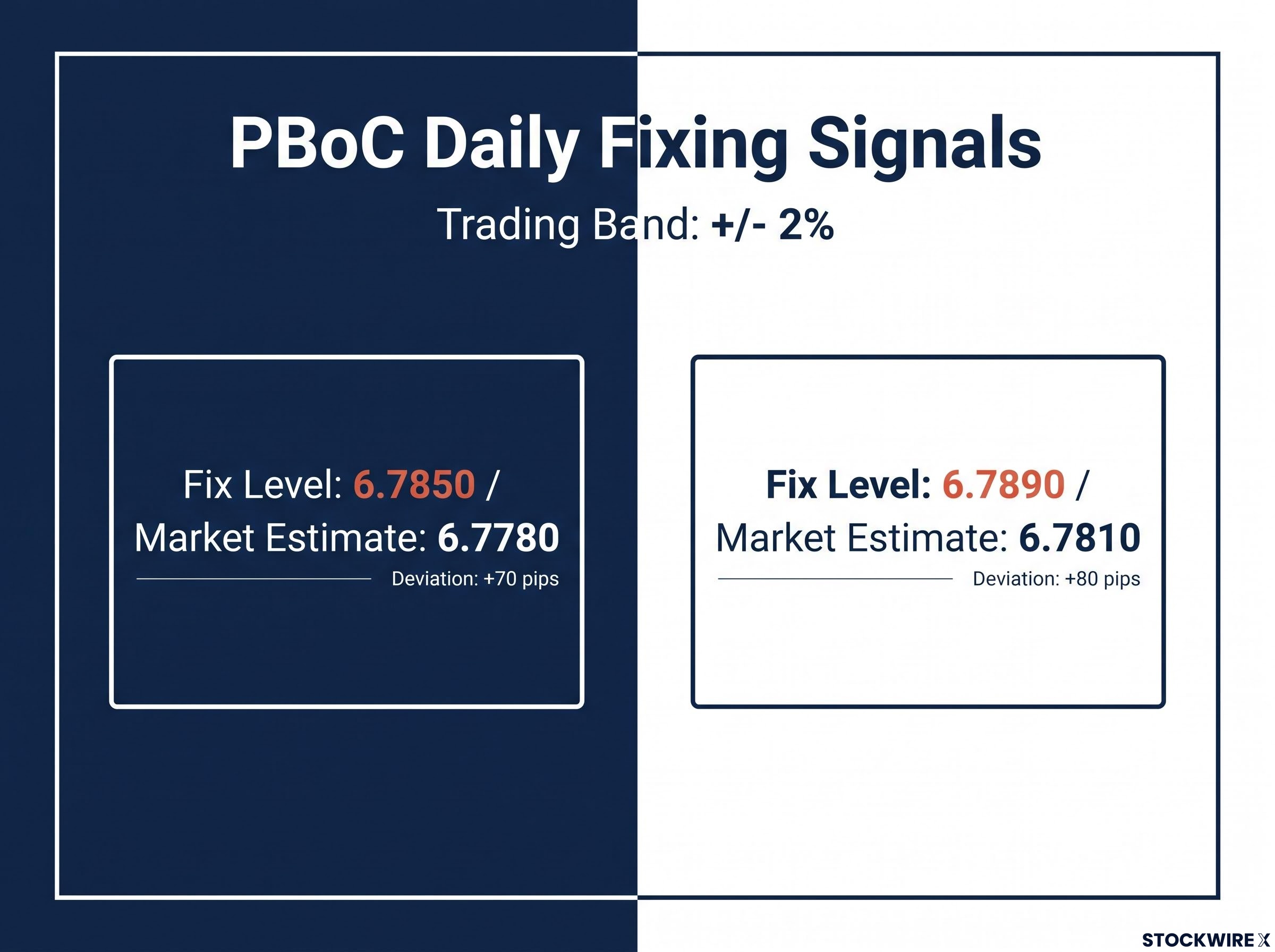
The PBoC does not set the renminbi’s exchange rate directly, but it controls the range within which the onshore rate can move each day. Every morning, the central bank publishes a central parity fixing for USD/CNY. The onshore spot rate is then permitted to trade within a band of plus or minus 2% around that fix.
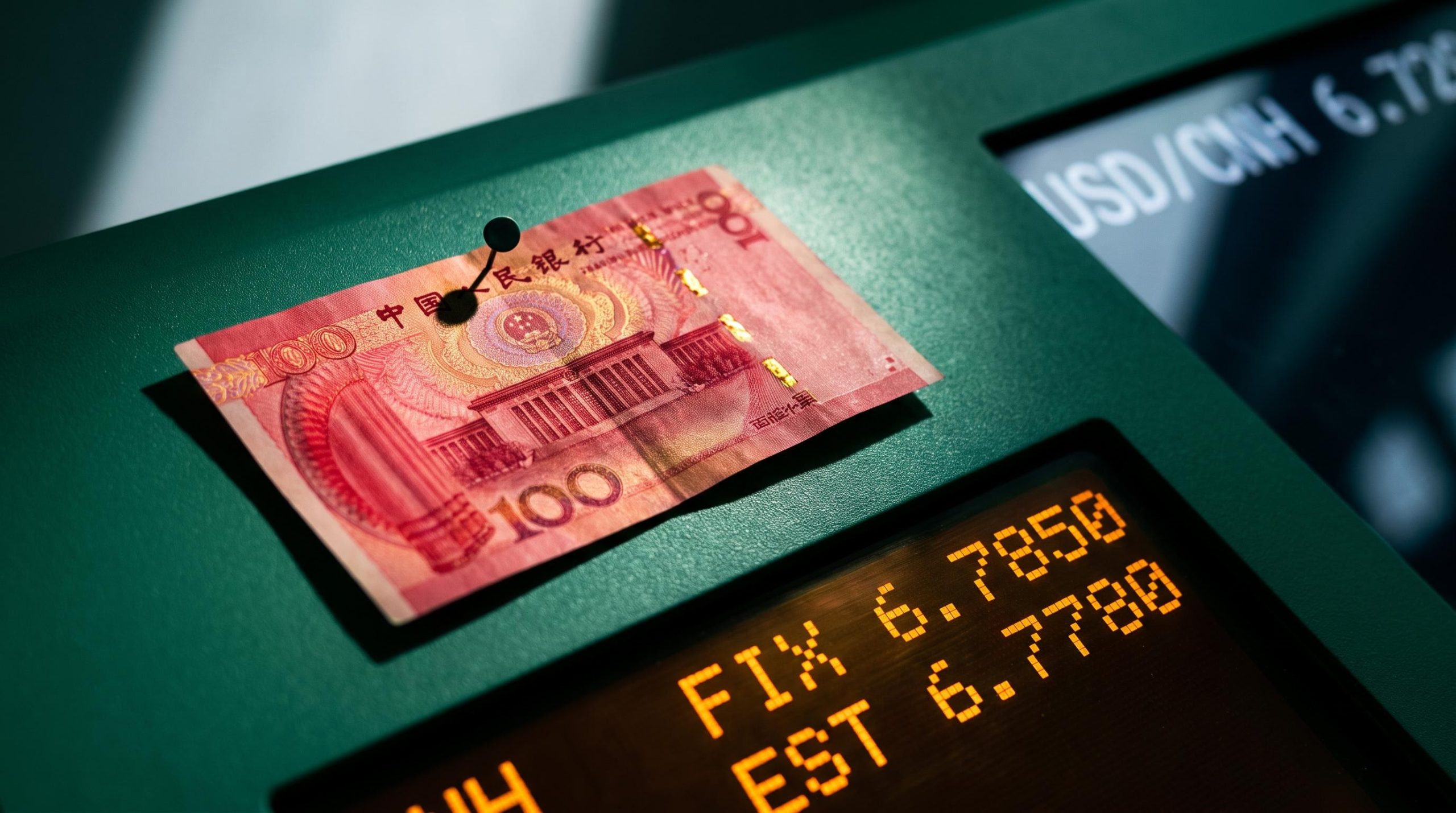
This gives Beijing a powerful tool. By adjusting the pace at which the fix moves lower (which corresponds to renminbi appreciation), the PBoC can slow a rally without issuing a single public statement. Recent daily fixes have been observed in the 6.78-6.79 area, with notable gaps versus market estimates. Those gaps are not random noise. They are the signal.
When the fix comes in weaker than market participants expected (meaning the PBoC has set the dollar higher than the market anticipated), it communicates a specific message: Beijing is uncomfortable with the speed of renminbi gains and wants the market to slow down. Analysis from Chris Turner at ING and commentary from UOB and RBC Capital Markets support this reading. The PBoC is willing to lean against both excessive weakness and excessive strength, which creates an asymmetry that caps enthusiasm for aggressive CNH longs.
Reading the daily fix as a trading signal
For traders, the fixing deviation is one of the most actionable daily data points in the USD/CNH market. The process is straightforward:
- Step 1: Observe the PBoC’s published central parity fixing each morning
- Step 2: Compare it against the Reuters or Bloomberg market estimate published beforehand
- Step 3: Interpret the direction and magnitude of the gap as a directional signal for that session and beyond
| Fix Level | Market Estimate | Deviation Direction | Signal Interpretation |
|---|---|---|---|
| 6.7850 | 6.7780 | Fix weaker than expected (higher USD) | PBoC resisting pace of RMB appreciation; caution on fresh CNH longs |
| 6.7890 | 6.7810 | Fix weaker than expected (higher USD) | Sustained resistance; signals continued discomfort with rapid gains |
The gap between fix and estimate each morning tells you directly whether Beijing is tightening or loosening its grip on the pace of appreciation that day. That converts a seemingly opaque central bank intervention into a readable, daily input you can incorporate into position management.
Why the Iran sanctions are now a USD/CNH story
On 24-26 August 2026, the United States announced a sanctions package designated Operation Economic Outcast. The action targeted dozens of Chinese and Hong Kong entities linked to Iran’s shadow oil trade and broader procurement networks. No major state-backed Chinese banks were sanctioned, but US officials explicitly threatened to target an unspecified “major financial institution” if sanctions evasion continues.
China has publicly condemned these sanctions as “illegal” and has vowed to defend its trade with Iran.
That public condemnation underscores that this is no longer a purely Iran-US matter. It is a live US-China friction point, and it is being priced into the currency.
The market interpretation is layered. ING views the prospect of Washington moving against a significant state-backed Chinese bank over Iran-related trade as unlikely at this point in the cycle. But the threat alone is doing work. Even without escalation, the credible possibility of a sanctions shock is sufficient to suppress position-building appetite in CNH. Traders are not pricing in the worst case; they are pricing in the uncertainty.
The escalation gradient and what each level means for CNH
The sanctions risk operates on a gradient, not as a binary:
- Current state: Entity-level sanctions on smaller Chinese and Hong Kong firms. Market impact is modest but cumulative, raising the background risk premium on CNH positions.
- Stated threat: Sanctions on a major Chinese financial institution. This would likely trigger a sharp CNH sell-off and a spike in USD/CNH, as offshore investors reprice counterparty and access risk across the board.
- Tail scenario: Broad secondary sanctions on China’s financial system. No institution has modelled this scenario with precision, but the directional implication is unambiguous: a severe weakening of CNH and a dramatic widening of the onshore-offshore spread.
The fact that Washington has moved incrementally along this path, from rhetoric to entity-level action to explicit threats against larger targets, means the tail risk is not purely theoretical. For position sizing and stop discipline, the gradient matters more than the probability of any single level being triggered. A low-probability, high-impact risk still belongs in your risk management framework.
The institutional forecast landscape and where the disagreements lie
The institutional consensus on USD/CNH is narrower than you might expect, but the disagreements within it are instructive.
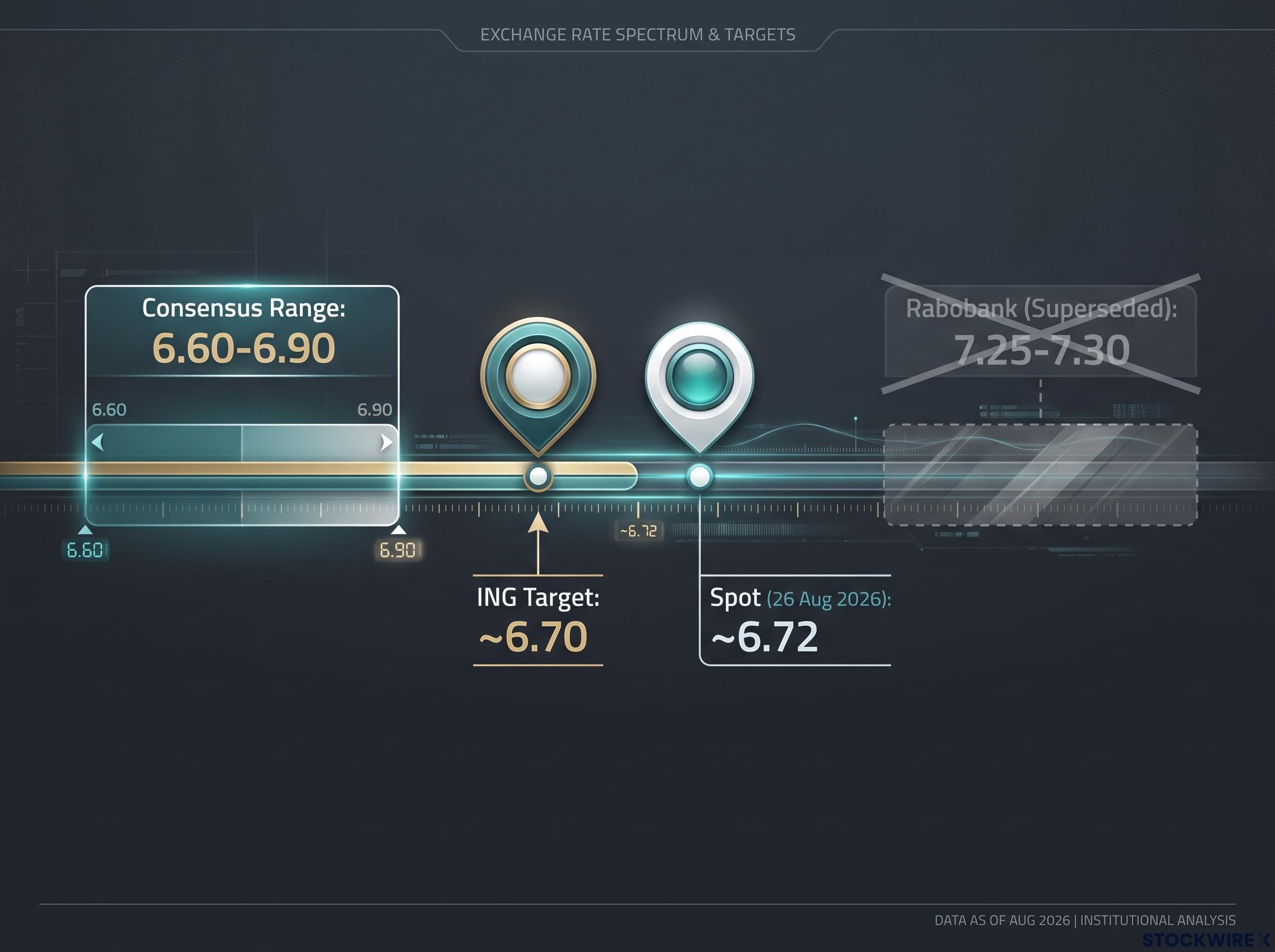
| Institution | Target / Range | Horizon | Key Assumption |
|---|---|---|---|
| ING (Chris Turner) | ~6.70 | Multi-month | Mild, gradual dollar weakness |
| Consensus range | 6.60-6.90 | One year | Varies by institution |
| Rabobank (prior) | 7.25-7.30 | Now superseded | Prior dollar strength thesis |
The Rabobank example is worth pausing on. A reputable institution had USD/CNH heading toward 7.25-7.30 before actual appreciation rendered that forecast obsolete. That revision history is a useful calibration for how much confidence to place in any single forward number. Forecasts shift materially as the data arrives, and the current cluster of targets in the 6.60-6.90 range carries the same model uncertainty.
What separates the bullish end from the bearish end of that range comes down to four swing factors, ordered by how actively they are in flux right now:
- US dollar cycle and Fed policy: If rate cuts materialise and the broad dollar softens, that supports gradual CNH appreciation. A resilient US economy that delays cuts would limit or reverse RMB gains.
- China’s growth and policy mix: Stronger activity data and credible property sector support favour a stronger CNH. Weak data or aggressive domestic easing pull in the opposite direction.
- PBoC’s tolerance for volatility: The more Beijing uses the fixing to cap both sharp gains and losses, the more USD/CNH stays range-bound regardless of external drivers.
- Sanctions trajectory: Entity-level sanctions may gradually be discounted. A move against a major Chinese institution would overwhelm all three factors above.
The width of the institutional range tells you that USD/CNH is genuinely difficult to forecast right now. The sensible response is not to pick one number but to understand which of these four inputs you have a view on and size your exposure accordingly.
Positioning through the friction without mistaking it for a trend
The consolidation near 6.72 is friction, not a reversal. The medium-term lean toward CNH appreciation (and a lower USD/CNH) remains intact in the base case, but the path is being deliberately muddied by PBoC moderation and sanctions risk. Both forces are persistent and policy-driven, which means waiting for them to resolve before positioning could mean waiting a long time.
Four practical considerations for managing exposure through this environment:
- Treat the daily fixing as a surveillance tool. The gap between the PBoC’s fix and market expectations is your highest-signal daily input. Monitor it before making intraday decisions.
- Price in the sanctions option through position sizing and stop discipline. Even if broad sanctions remain a tail risk, they are a high-impact tail risk. Recent enforcement actions demonstrate Washington’s willingness to escalate incrementally. Your position size should reflect that possibility.
- Separate your structural view from your tactical execution. A medium-term conviction that USD/CNH drifts toward the mid-6s is compatible with range-trading near current levels. Conflating the two timeframes is the most common positioning error in a consolidating pair.
- Consider options for expressing directional views. Options allow you to maintain exposure to the base case while capping downside from a geopolitical surprise that you cannot quantify precisely.
Onshore-offshore divergence note: In periods of heightened sanctions or geopolitical stress, CNH can weaken more than CNY as offshore investors demand a higher risk premium. This widens the spread between the two rates and creates additional risk for cross-market strategies.
Structural view versus tactical execution: keeping them separate
A trader can hold a medium-term directional view that USD/CNH moves toward 6.70 while using range-trading tactics near current levels. The structural view determines your net bias and the direction of your average-in strategy. The tactical execution determines your entry points, stop levels, and position sizing within the current range. Conflating the two, buying the structural view at a tactical level that offers poor risk-reward, is how traders turn a correct directional call into a losing position in a consolidating market.
The distance between current spot at approximately 6.72 and ING’s target of 6.70 is narrow enough that execution quality and risk management matter as much as being directionally correct.
When the stall ends: the variables that will break the range
The consolidation will resolve. The question is which direction, and which data releases or headlines will trigger the break. Here is the watchlist.
| Trigger | Direction of Break | Implied USD/CNH Move | Key Indicator to Watch |
|---|---|---|---|
| Fed rate cuts materialise | Lower (CNH strengthens) | Toward 6.70 or below | FOMC statements, US employment and inflation data |
| China activity data improves | Lower (CNH strengthens) | Supports drift toward mid-6s | PMI, retail sales, property sector indicators |
| Dollar re-strengthens on resilient US data | Higher (CNH weakens) | Back toward 6.80+ | US GDP, payrolls, core PCE |
| Major Chinese institution sanctioned | Higher (CNH weakens sharply) | Spike well above 6.80 | US Treasury/State Dept announcements |
Tail risk scenario: If the US follows through on its threat to sanction a major Chinese financial institution, the likely result is a sharp CNH sell-off and a spike in USD/CNH that would overwhelm the base-case forecasts of every institution currently publishing a target. This scenario is low-probability but high-impact, and it is the primary reason why the sanctions trajectory sits at the bottom of the swing factor list: not because it is least important, but because it is least predictable.
ING’s 6.70 target represents a plausible resolution under the first set of conditions. But Rabobank’s revision history, from 7.25-7.30 to something meaningfully lower, illustrates how quickly institutional targets shift when the macro inputs change. The value of this watchlist is not that it tells you which scenario will happen. It tells you exactly which data releases and headlines to monitor so you are not caught repositioning after the range has already broken.
Acting on a structural view when the path is deliberately unclear
Two forces, PBoC moderation and sanctions risk, are features of this market, not temporary distortions waiting to clear. Traders and investors who wait for both to resolve before positioning may find the move has already happened.
The medium-term directional lean remains intact. A mild drift toward the mid-6s in USD/CNH is the base case under a scenario of gradual dollar weakness, improving Chinese data, and sanctions that stay at the entity level. But with spot at approximately 6.72 and ING’s target at 6.70, the remaining distance is narrow enough that the quality of your risk management matters as much as whether you are right about the direction.
The question is not whether 6.70 is the right target. The question is which of the four swing factors, Fed policy, China’s growth trajectory, PBoC tolerance, or the sanctions path, will move first, and whether your positioning framework can absorb the answer regardless of which one it is.
This article is for informational purposes only and should not be considered financial advice. Investors should conduct their own research and consult with financial professionals before making investment decisions. These statements are speculative and subject to change based on market developments and company performance.