
JPMorgan is bullish on equities into year-end 2026. That alone is not the story. The story is what the bank is not saying: this is not a call for a broad rally. It is a call for a specific kind of rally, one where what you own matters more than whether you are long.
The call comes from Fabio Bassi, JPMorgan’s Head of Cross-Asset Strategy, published on 24 August 2026. It lands at a moment when the Fed’s next move remains genuinely uncertain, when the durability of AI capital expenditure is an open question on every earnings call, and when the market’s recent gains look uncomfortably concentrated. That combination of unresolved variables is precisely why a structured macro-to-sector framework, rather than a simple directional bet, deserves close reading right now.
Here is what this analysis gives you: the logic behind JPMorgan’s positioning, broken into its component parts, so you can assess whether the regime they describe still holds, which of their three bets carries the most conviction, and how to monitor the conditions that would break the thesis. You leave with a framework, not a headline.
Why JPMorgan sees a Goldilocks window, not a melt-up
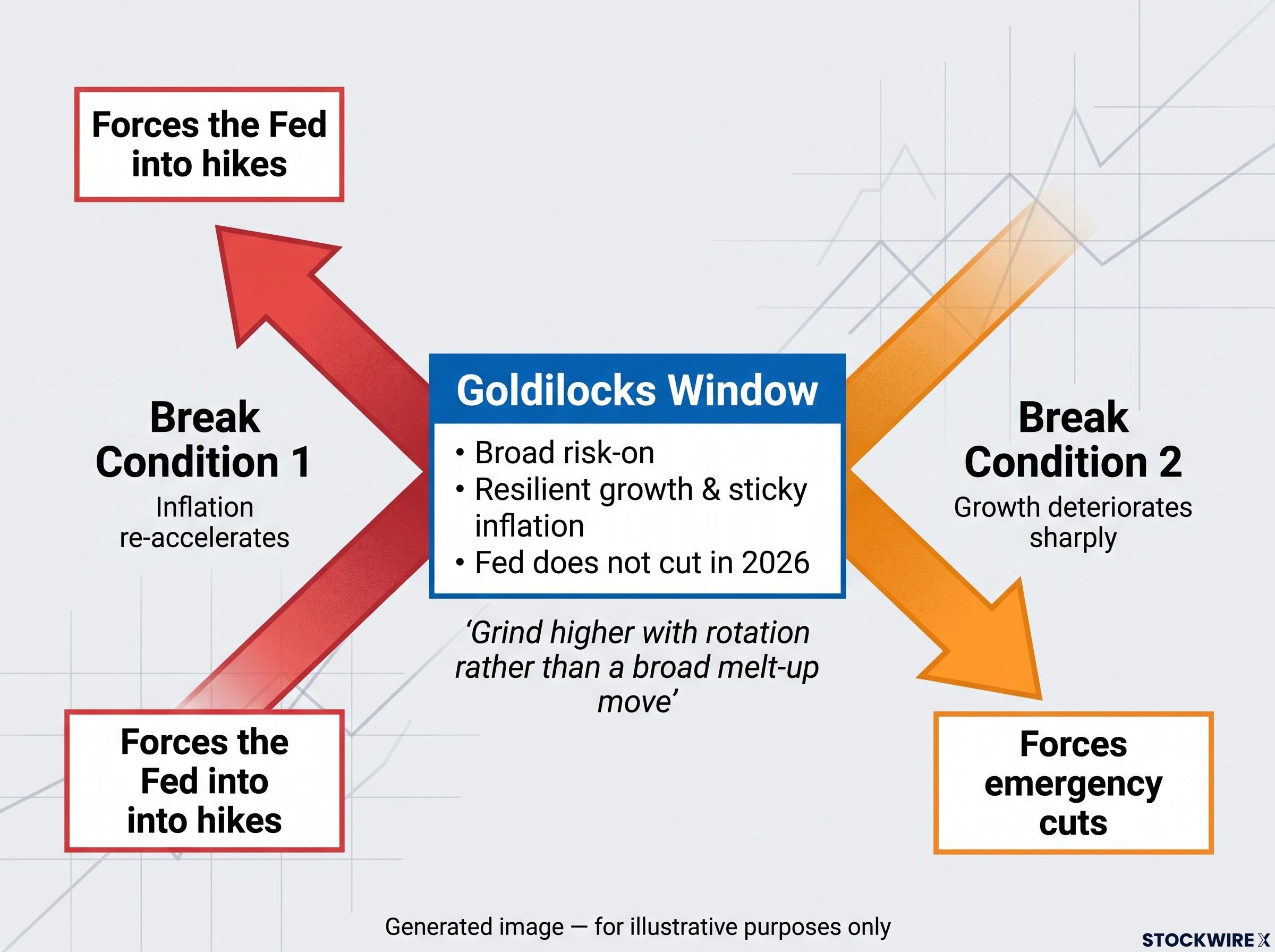
The entire thesis rests on a macro condition that is more unusual than it sounds. JPMorgan characterises the current environment as “broad risk-on” with resilient growth and sticky inflation, a combination that, in most cycles, would force the Fed to act in one direction or the other. The reason it has not, and the reason Bassi builds his equity call on top of it, is that disinflation is real enough to keep the Fed patient but not sharp enough to trigger cuts.
Bassi’s non-consensus view is explicit: the Fed does not cut in 2026. Most strategists treat that as a headwind. JPMorgan treats it as a feature. When the Fed holds steady and earnings remain solid, volatility stays low, and that low-volatility backdrop gives institutional investors the room to deploy risk budgets more fully. That is what creates the conditions for sector rotation to do the heavy lifting, rather than a rising tide lifting everything at once.
The Federal Reserve’s July 2026 FOMC statement confirmed the decision to hold the federal funds rate at 3-1/2 to 3-3/4 percent, citing resilient economic activity and inflation still above target, a posture that directly underpins the patient-hold assumption at the centre of JPMorgan’s low-volatility thesis.
“Grind higher with rotation rather than a broad melt-up move.”
The bank is not, however, calling this backdrop permanent. JPMorgan continues to highlight upside inflation risks and takes the view that the policy reaction-function debate will remain unresolved beyond Jackson Hole. The Goldilocks window is real but monitored, and it breaks under two specific conditions:
The earnings breadth signal behind JPMorgan’s August 2026 target revision is worth examining alongside Bassi’s rotation call: positive surprises from industrials, healthcare, financials, and consumer sectors, not just technology, gave the bank enough confidence to shift its prior bull case into the official base case without requiring a multiple expansion.
- Inflation re-accelerates to a degree that forces the Fed into hikes
- Growth deteriorates sharply enough to force emergency cuts
What this tells you is that the bullish call is conditional. If either trigger fires, the low-volatility environment that makes rotation possible disappears, and the positioning logic changes with it. Monitoring those two variables is not optional if you are using this framework.
When big ASX news breaks, our subscribers know first
The three bets inside JPMorgan’s rotation thesis
JPMorgan’s three positioning themes are not interchangeable bets of equal conviction. Reading Bassi’s logic carefully, they form a hierarchy: a defensive anchor, a conviction overweight, and a tactical gauge. Knowing which is which matters for how you size each.
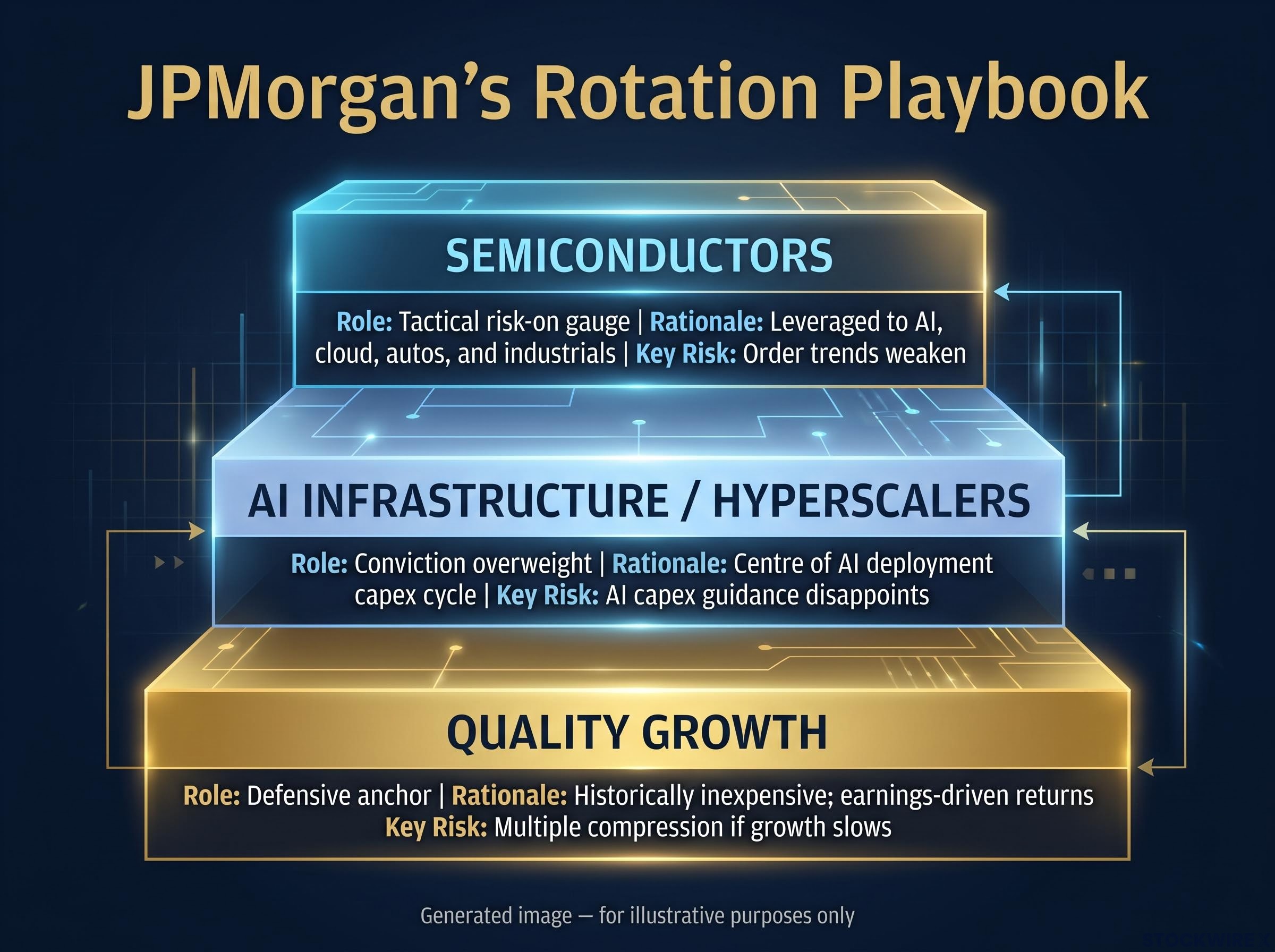
Quality Growth equities sit at the foundation. JPMorgan’s Global Equity Views and Factor Views make the case that equity quality is historically inexpensive and that returns should come from earnings, not multiple expansion (the idea that stock prices rise because investors pay a higher price-per-dollar of earnings, rather than because earnings themselves grow). That distinction is the bank’s way of saying: buy companies with strong balance sheets and durable cash flows, not story-only AI names trading on hope. Quality Growth is the anchor, the position you hold regardless of which way the rotation turns next.
| Theme | JPMorgan’s Rationale | Portfolio Role | Key Risk |
|---|---|---|---|
| Quality Growth | Historically inexpensive; earnings-driven returns | Defensive anchor | Multiple compression if growth slows |
| AI Infrastructure / Hyperscalers | Centre of AI deployment capex cycle | Conviction overweight | AI capex guidance disappoints |
| Semiconductors | Leveraged to AI, cloud, autos, and industrials | Tactical risk-on gauge | Order trends weaken as leading indicator |
AI infrastructure and semiconductors as the higher-conviction tactical layer
Hyperscalers sit at the centre of the AI deployment cycle. JPMorgan’s pro-risk stance in U.S. equities runs directly through them, treating ongoing AI capex and data-centre build-out as central to the current expansion. These are not speculative bets on future revenue; they are companies already converting capital expenditure into measurable cloud and AI services revenue. That is why the bank positions them as the conviction overweight, not just a thematic tilt.
AI infrastructure binding constraints, particularly power availability and cooling density thresholds, explain why JPMorgan positions hyperscalers as a conviction overweight rather than a speculative tilt: companies resolving structural bottlenecks on AI deployment have historically built more durable compounding franchises than the headline technology providers capturing the narrative.
Futurum Group’s 2026 AI infrastructure capex analysis projects combined hyperscaler spending of between $660 billion and $690 billion for the year, nearly double 2025 levels, a scale of commitment that supports JPMorgan’s characterisation of the AI deployment cycle as a durable earnings driver rather than a speculative theme.
Semiconductors play a different role. JPMorgan frames them as leveraged to AI, cloud, automotive, and industrial demand, but also as a leading indicator of broader risk appetite. When semis rally in a sustained way, it points to improving risk conditions across the wider market, not merely within the sector itself. The bank’s positioning argues for diversified exposure across chip designers, foundries, and equipment makers rather than a single high-beta name, sized to volatility tolerance. Semis are the gauge you watch to confirm the rotation thesis is still working.
Why dispersion matters more than the index level
Here is the uncomfortable implication of JPMorgan’s thesis: being long equities is not enough. The “grind higher” language explicitly signals that passive index exposure will only partially capture the gains the firm expects. If returns are driven by rotation across sectors rather than a broad lift, the index level will not tell you whether the bank’s call is working for your portfolio unless you own the right parts of it.
Returns should be led by earnings rather than multiple expansion.
JPMorgan acknowledges that markets have broadly tracked earnings and that valuations do not look excessive. But the firm also identifies pockets of speculative froth, which argues against overconcentration in any single crowded theme. Leadership is expected to rotate across data releases and policy developments, meaning some diversification across cyclicals and defensives remains appropriate even within a pro-risk stance.
The capital rotation patterns visible in June 2026, with energy gaining more than 22% year-to-date and healthcare and industrials outpacing the broad index while mega-cap technology stalled, provide the empirical backdrop against which JPMorgan’s selective pro-risk thesis was shaped.
The portfolio construction implications, taken sequentially, look like this:
- Build a core quality sleeve anchored in strong balance sheets and durable earnings
- Add a measured AI infrastructure tilt through hyperscalers and cloud platforms
- Hold a diversified semiconductor allocation as both a return driver and a risk-on barometer
- Respect dispersion by complementing core index exposure with satellite allocations that express these three themes more directly
- Monitor the regime: watch for the two break conditions that would challenge the entire framework
What this tells you is that investors who simply hold broad index funds and assume JPMorgan’s bullish call applies to them fully are likely to be disappointed by the distribution of returns. The dispersion argument is the bank’s implicit warning that selectivity, not just direction, determines outcomes in this phase.
How professional strategists turn macro conditions into sector bets
The specific JPMorgan call is useful. But the method behind it is more durable. Understanding how a strategist like Bassi translates a macro regime into sector positioning gives you a framework you can reuse the next time any major bank publishes a similar note.
The process follows three steps:
- Regime assessment: Identify the macro backdrop by evaluating the growth trajectory, inflation direction, and central bank posture. Is the environment expansionary, contractionary, or transitional?
- Factor identification: Determine which equity style and sector factors benefit from that regime. A low-volatility, growth-intact environment favours quality and growth factors. A high-volatility, deteriorating environment favours defensives and minimum-volatility factors.
- Valuation check: Rank those identified factors by their current valuation relative to historical averages. A factor that fits the regime but trades at a historical premium carries less upside than one that fits the regime and trades at a discount.
Applying the framework to JPMorgan’s August 2026 call
Bassi’s application follows this sequence precisely. Step one: a patient Fed alongside genuine disinflation and resilient earnings identifies a Goldilocks regime, low volatility, risk-on conditions intact. Step two: that regime points toward quality and growth factors over pure value or defensives, because earnings stability is rewarded when volatility is suppressed. Step three: JPMorgan’s Factor Views confirm that quality is historically inexpensive, meaning the factor is not just regime-appropriate but attractively priced relative to its own history.
The break conditions map directly back to step one. If inflation re-accelerates, the regime shifts from Goldilocks to tightening, and the factor preferences change. If growth deteriorates sharply, the regime shifts to defensive, and the same factors that work now become the wrong positioning. This is why regime monitoring is not an afterthought but an embedded part of the framework.
The next time a strategist publishes a sector rotation note, you now have a three-step checklist: does the regime assessment hold, do the factors they selected actually benefit from that regime, and are those factors attractively valued? That sequence separates a structured argument from a guess.
What JPMorgan’s playbook can and cannot tell you about the next six months
JPMorgan’s framework, anchored in Bassi’s 24 August 2026 client note, assembles into a coherent picture. A patient Fed creates the low-volatility environment. Rotation into Quality Growth and AI infrastructure captures earnings-driven gains within that environment. Semiconductors serve as the real-time gauge of whether risk-on conditions are broadening or narrowing. Together, the three themes express a single macro view through differentiated portfolio roles.
The call is conditional, not a forecast with a guarantee attached. Bassi has identified specific break conditions, and those belong on any investor’s monitoring list. Three variables matter through the end of 2026:
- Fed signals at Jackson Hole and subsequent meetings, for any shift from the patient-hold posture that underpins the low-volatility regime
- AI capex guidance from hyperscaler earnings calls, for confirmation that the investment cycle driving the conviction overweight remains intact
- Semiconductor order trends as a real-time barometer of whether risk appetite across markets is strengthening or fading, confirming or contradicting the rotation thesis in real time
The “grind higher with rotation” framing is the honest summary of what JPMorgan expects: moderate gains, unevenly distributed, available to investors who position selectively rather than passively. A strategist’s note is most useful not as a buy or sell signal but as a structured way of linking macro conditions to positioning decisions. The framework gives you a method for evaluating whether those conditions still hold, not just today but the next time you check.
For readers wanting to compare JPMorgan’s framework against a contrasting institutional view, our dedicated guide to competing rotation calls in mid-2026 covers Barclays strategist Emmanuel Cau’s case for rotating out of semiconductors and into software, defence, and European equities, offering a direct point of analytical contrast to Bassi’s conviction overweight.
This article is for informational purposes only and should not be considered financial advice. Investors should conduct their own research and consult with financial professionals before making investment decisions. These statements are speculative and subject to change based on market developments and company performance.