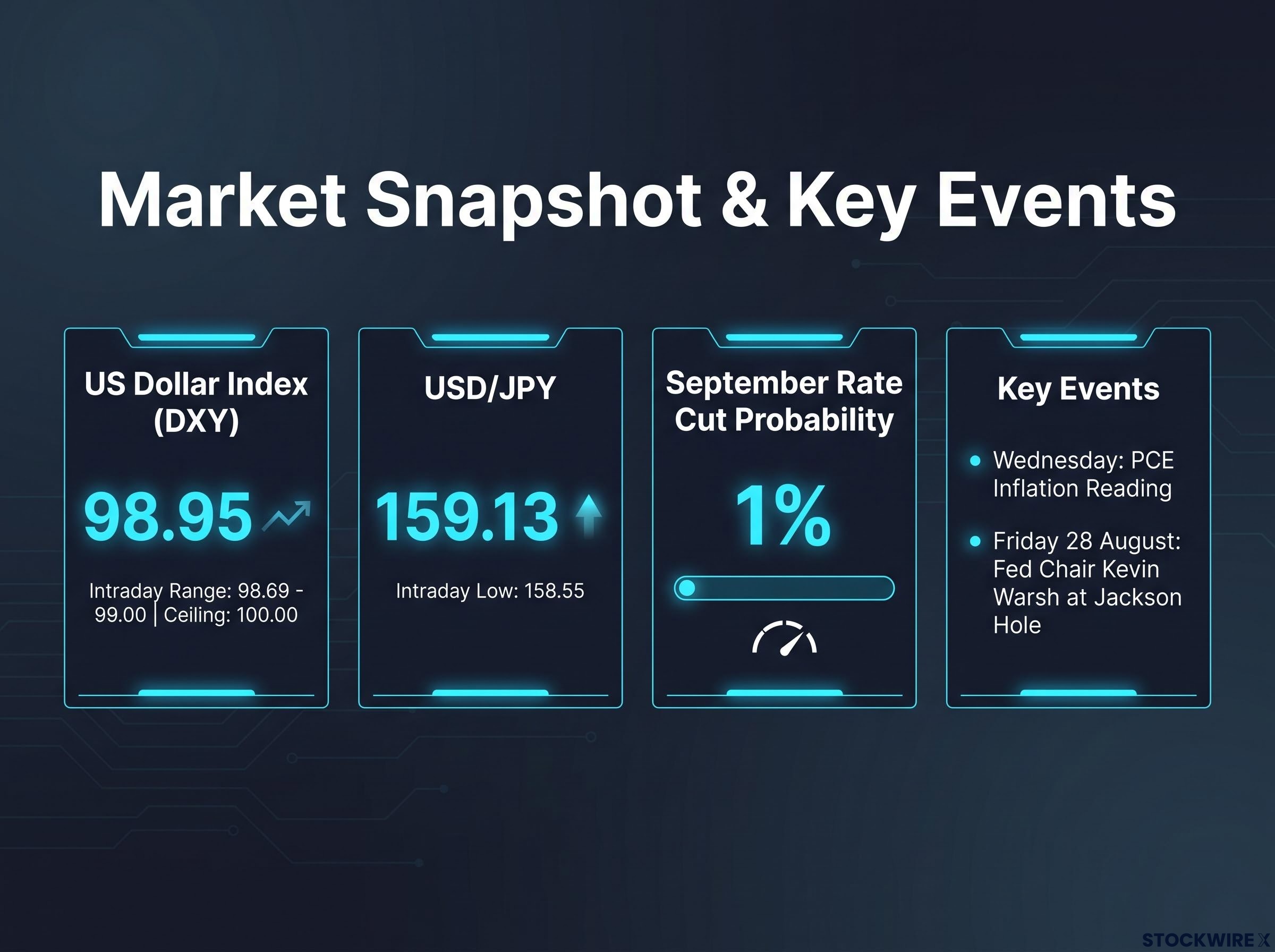
The US Dollar Index is clinging to 98.95 on Monday, trying to reclaim 100 after last week’s sharp fiscal-anxiety selloff, with two market-moving events arriving before Friday that could confirm the stabilisation or send it lower.
This is not a routine week of Dollar-watching. The selloff was not driven by a data miss but by something harder to price out: a structural narrative around debt expansion, Treasury buyback operations, and currency debasement concerns. Against that backdrop, the PCE inflation reading due Wednesday and Fed Chair Kevin Warsh‘s scheduled address at Jackson Hole on Friday do not just carry their usual data-point weight. They will be interpreted through a fiscal lens that was not this prominent a year ago.
Here is the framework for reading the four forces bearing on the Dollar right now, what each scenario means for DXY direction heading into September, and where to focus attention as the week unfolds. The goal is a clear analytical structure for monitoring the Dollar through Friday, not a set of predictions.
What last week’s selloff is actually telling you about the Dollar
The DXY opened Monday near 98.95, with an intraday range stretching from roughly 98.69 to just under 99.00. That is a fragile stabilisation, not a recovery. The index has backed off meaningfully from earlier highs above 99-101, and the psychologically significant 100.00 level remains overhead like a ceiling the market has lost permission to test.
What triggered the decline was not a weak jobs number or a soft retail print. It was the US Treasury’s announcement that it would scale up its liquidity-support buyback programme for longer-dated government bonds. Markets read that as quasi-monetisation: the Treasury stepping in to absorb duration risk in a way that looks, to sceptical investors, like the government backstopping its own borrowing costs. That distinction matters because fiscal narratives do not resolve the way data surprises do. A bad payrolls number gets revised or offset by next month’s release. A credibility question about sovereign debt lingers, eroding confidence in purchasing power gradually and making every rally vulnerable to being faded.
Federal net interest payments hit $659 billion in FY 2024 and the CBO projects they will surpass defence spending as a share of GDP by 2034, making fiscal credibility signals like Treasury auction bid-to-cover ratios and term premium trajectory the variables that now shadow every Fed communication cycle.
Three conditions would signal that fiscal risk is being priced more aggressively:
- Long-end term premia (the extra yield investors demand for holding longer-dated bonds) rising independently of the near-term Fed rate path
- Dollar rallies consistently faded near 100, with sellers appearing on any approach to that level
- The Dollar weakening even as yields rise, a pattern that flips the normal relationship and signals “debt concern” rather than “growth-positive” higher rates
Round numbers like 100 on the DXY tend to act as sentiment anchors. Trading below 100 reinforces the perception that the Dollar is in a corrective phase; a sustained move back above it would suggest last week’s decline was a positioning washout rather than the start of something structural.
The buyback-driven selloff tells you that the Dollar’s near-term stability depends less on the next data print and more on whether the fiscal credibility narrative shifts. That means this week’s events will be judged by a harsher standard than usual.
When big ASX news breaks, our subscribers know first
Iran sanctions and oil: the geopolitical variable traders are watching on the side
Running in parallel to the fiscal story is a genuinely separate axis of risk. Reports indicate the US is moving toward an expansion of secondary sanctions on Iran, and the prospect added a layer of market attention during Monday’s session that has nothing to do with Treasury buybacks or PCE projections.
USD/JPY was trading at around 159.13 on Monday, having climbed back from an intraday low of 158.55. That recovery reflected renewed Dollar stability alongside the sanctions headlines, but the pair’s movements say more about idiosyncratic safe-haven and carry dynamics than about broad Dollar strength. The Yen has its own structural story.
The Iran angle feeds into Dollar direction through a three-step conditional chain, and where you land depends on which leg of the chain dominates:
Iran sanctions escalation operates through a ladder dynamic: moving from targeted teapot refiners to Chinese state banks would shift Iranian exports from disrupted to severely constrained, a supply shock that would push crude well above the range where the inflation impulse can be absorbed without feeding back into fiscal arithmetic.
- Inflation impulse dominates: Sanctions constrain Iranian oil exports, oil prices rise, headline inflation expectations lift, markets price a firmer Fed stance, and the Dollar strengthens on rate expectations.
- Growth concerns dominate: Higher energy costs weigh on growth expectations, risk-off flows emerge, and the Dollar’s reaction becomes mixed as investors fear a global slowdown more than an inflation spike.
- Both interact with fiscal anxiety simultaneously: An oil-driven inflation impulse lands on top of an already strained fiscal narrative, producing a Dollar environment where yields rise for the wrong reasons and the index struggles to benefit.
| Scenario | Oil price direction | Inflation implication | Dollar impact |
|---|---|---|---|
| Sanctions tighten, supply constrained | Higher | Headline inflation expectations rise | Near-term positive on rate repricing |
| Growth fears overtake inflation | Higher, then volatile | Inflation up but offset by demand destruction | Mixed; safe-haven bid competes with fiscal drag |
| Sanctions plus fiscal anxiety compound | Higher | Worsens fiscal arithmetic via higher costs | Negative medium-term; yields rise without Dollar benefit |
An earlier episode illustrates the interaction. A PCE print of 0.3% month-over-month and 2.8% year-over-year on the headline index coincided with the onset of conflict with Iran, and the DXY edged up to approximately 99.95 as markets balanced contained inflation with heightened geopolitical risk.
The Iran factor does not resolve the Dollar’s direction on its own. But it complicates the reaction function for this week’s data and speech events. A hot PCE alongside escalating sanctions produces a different Dollar outcome than a hot PCE in a calm geopolitical environment. If you are watching only the Fed narrative, you risk being caught off-guard by an oil-driven inflation impulse that reshuffles near-term rate expectations entirely.
What PCE and the Fed’s preferred inflation gauge mean for Dollar direction this week
PCE, the Personal Consumption Expenditures price index, is the Federal Reserve’s preferred inflation gauge, the metric the Fed weights most heavily when assessing whether inflation is moving toward its target. Wednesday’s release is the highest-frequency directional input for Dollar positioning before Friday’s Jackson Hole speech.
The three PCE scenarios map to distinct Dollar outcomes, but what makes this week unusual is how the fiscal backdrop changes the reaction function for each one.
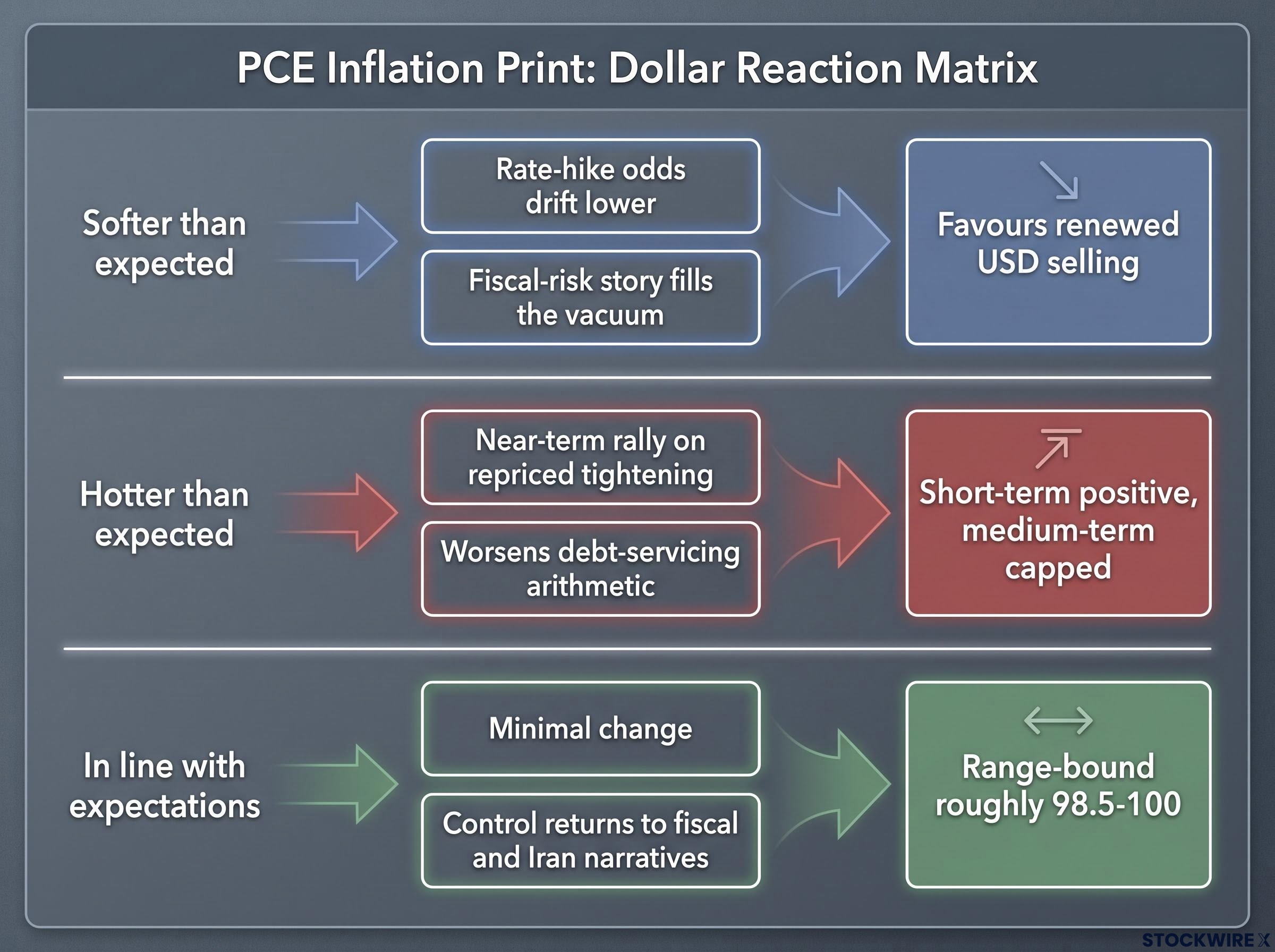
| PCE outcome | Rate expectation shift | Fiscal narrative effect | Dollar direction |
|---|---|---|---|
| Softer than expected | Rate-hike odds drift lower | Fiscal-risk story fills the vacuum | Favours renewed USD selling |
| Hotter than expected | Near-term rally on repriced tightening | Higher inflation worsens debt-servicing arithmetic | Short-term positive, medium-term capped |
| In line with expectations | Minimal change | Control returns to fiscal and Iran narratives | Range-bound roughly 98.5-100 |
A softer print would normally be straightforward: lower inflation, less reason to hike, Dollar weakens. In this environment, it does something additional. It removes the one counterweight to the fiscal-anxiety narrative. Without upside inflation pressure forcing the Fed’s hand, markets may lean harder into the debasement story, and selling could concentrate against currencies where central banks look more likely to tighten or where fiscal positions appear cleaner.
A hotter print historically lifts the Dollar because it forces markets to price further tightening. But higher inflation also means higher real debt-servicing costs. Bond markets may interpret the number as worsening the fiscal arithmetic rather than simply supporting growth, which caps the rally’s follow-through.
An in-line print is the scenario that looks neutral but is not. It provides no new directional information, which means fiscal worries and Iran risk remain the dominant swing factors. The DXY likely stays range-bound, with volatility expressed more in individual currency crosses than in the index itself. Historical context supports this: in January, a PCE reading broadly matching expectations helped the Dollar hold near 99-100 during geopolitical uncertainty, but it did not resolve the underlying directional question.
The unusually wide reaction function this week is itself informative. It tells you markets are not directionally convicted on the Dollar. The print’s interaction with the fiscal story matters as much as the number itself.
Knowing which PCE outcome aligns with which Dollar scenario lets you interpret Wednesday’s release in real time. It also explains why a “good” inflation number might not produce the historically expected Dollar rally.
Kevin Warsh at Jackson Hole: three messages and what each one means for the Dollar
Warsh’s address on Friday 28 August arrives 19 days before a September policy decision that markets genuinely do not view as a lock. Current pricing shows roughly 1% probability of a September rate cut, far below what the White House had hoped for, alongside a non-trivial probability of a hike reflecting lingering inflation concerns.
Warsh’s communication regime amplifies the weight of every data release: with forward guidance eliminated, the two-year Treasury yield surged 18 basis points intraday on a single FOMC press conference in June 2026, and markets are now pricing each data print and each speech as a standalone directional input rather than a signal to be filtered through pre-committed guidance.
That setup gives the keynote outsized directional weight. But evaluating the speech requires separating two layers of communication that will land differently for markets.
What Warsh says about rates
Three rate-stance scenarios carry immediate DXY implications:
- Confident hold: Warsh emphasises that inflation is trending appropriately, current rates are restrictive enough, and the Fed is not panicking. This likely locks in September “on hold” expectations and shifts focus back to fiscal debates and geopolitics. The Dollar impact depends on whether investors view stability as reassuring or as complacency about deficits.
- Hawkish surprise: Warsh signals further hikes are on the table or that the Fed is more concerned about inflation than markets assume. This would immediately lift rate-hike probabilities and could trigger a fast short-covering rally, especially given the DXY’s position just below 100 and proximity to prior highs near 101.
- Dovish or fiscally constrained: Tone that highlights concern about debt sustainability or limits to tightening would validate the fiscal-anxiety narrative and could send the Dollar back toward recent lows, particularly if paired with a soft PCE earlier in the week.
Why the fiscal framing matters more than the rate signal
Markets will parse Warsh’s framing of fiscal dynamics as intensely as his rate guidance. The question is binary: does he treat the deficit and debt trajectory as background noise, or as a binding constraint on monetary policy?
If Warsh acknowledges fiscal limits explicitly, it validates the narrative that drove last week’s selloff and becomes the longer-duration signal, even if his rate message drives the immediate reaction. A hawkish rate stance paired with fiscal constraint language, for instance, may produce a brief Dollar rally that investors subsequently fade, because markets would interpret tightening as temporarily credible but ultimately unsustainable.
The compound scenario logic is what matters most. A soft PCE on Wednesday followed by a dovish Warsh on Friday is the bearish Dollar compound: rate-hike odds fall, fiscal worries rise, and the DXY likely fails to reclaim 100 in any durable way. A hot PCE followed by a measured but firm Warsh is the bullish reinforcement compound: the DXY has room to reclaim and consolidate above 100, potentially revisiting the 101 area. An in-line PCE followed by a carefully neutral Warsh is the no-resolution compound: range-bound near 98.5-100, with volatility expressed in individual crosses rather than the index.
The right question on Friday morning is not “what did Warsh say?” It is how his tone resolves or amplifies whatever the PCE print established two days earlier.
Where to look when the dust settles on Friday afternoon
By Friday’s close, the compound scenario will be taking shape. Three observable variables will tell you which one is playing out:
- DXY behaviour around 100: Sustained trading above that level signals that macro and Fed-communication risks have been absorbed. Failure to reclaim it confirms the corrective phase has further to run.
- Rate-probability shifts after PCE and Jackson Hole: Watch the balance between hike odds and the term structure of yields. A rising long end driven by fiscal worry is less Dollar-positive than a curve that steepens on growth and inflation expectations.
- Oil price direction: Moves in energy prices provide a real-time gauge of whether Iran sanctions are feeding into inflation (supportive for near-term Dollar) or into global growth fears (potentially Dollar-mixed and risk-negative).
Fiscal credibility stabilisation, not any single data print, determines the Dollar’s medium-term path. This week’s events are high-signal inputs into that larger question, not the question itself.
Central bank dollar diversification is accelerating through the same fiscal credibility concern that drove last week’s DXY selloff: the OMFIF Global Public Investor survey released June 2026 recorded the first-ever instance where net dollar-reduction intent outnumbered net dollar-increase intent among sovereign institutions, a structural shift that makes Dollar rallies harder to sustain even when rate differentials favour the US.
The Dollar’s current position near 98.95 is a decision point, not a prediction. The structure of the next move is legible across three compound scenarios with associated DXY ranges: bearish (fails 100, retests lows), bullish reinforcement (reclaims and consolidates above 100, revisits 101 area), and choppy no-resolution (98.5-100). What you are watching for this week is which one resolves first.
This article is for informational purposes only and should not be considered financial advice. Investors should conduct their own research and consult with financial professionals before making investment decisions. Forward-looking statements regarding Fed policy, inflation data, and Dollar direction are speculative and subject to change based on market developments.