
The US 30-year Treasury yield has reached approximately 5.27-5.33%, touching intraday levels not seen since 2007. That would be notable on its own. What makes it structurally significant is that it is not happening in isolation. Japan’s 30-year JGB yield has climbed to roughly 4.0-4.13%, multi-decade highs. UK, French, Italian, and German long-term yields have all moved sharply higher in the same window.
When multiple major governments face rising borrowing costs simultaneously, the conventional playbook breaks down. In a typical sovereign scare, you sell the stressed country’s bonds and buy another country’s as a safe haven. That logic assumes there is a haven to rotate into. When the stress is everywhere at once, the question becomes harder: where does the capital go?
Here is a framework for reading these yield moves as fiscal signals rather than just interest rate signals, and for understanding the counter-intuitive dynamic at the centre of all of it: why the US dollar can strengthen at the same time sovereign stress is rising globally. By the end, you will have a sharper lens for evaluating your own bond exposure, wherever it sits.
What the numbers are actually telling you right now
Start with the raw data, because the pattern does the arguing for you.
US 30-year Treasury yield: approximately 5.27-5.33%, with an intraday high near 5.33%. That is the highest level since 2007, and yields have remained above 5% for an extended continuous period, not a brief spike.
| Market | Instrument | Current Yield Level | Context |
|---|---|---|---|
| United States | 30-year Treasury | 5.27-5.33% | Highest since 2007; sustained above 5% |
| Japan | 30-year JGB | ~4.0-4.13% | Multi-decade highs |
| United States | 10-year TIPS (real yield) | ~2.41% | Elevated real yield reference point |
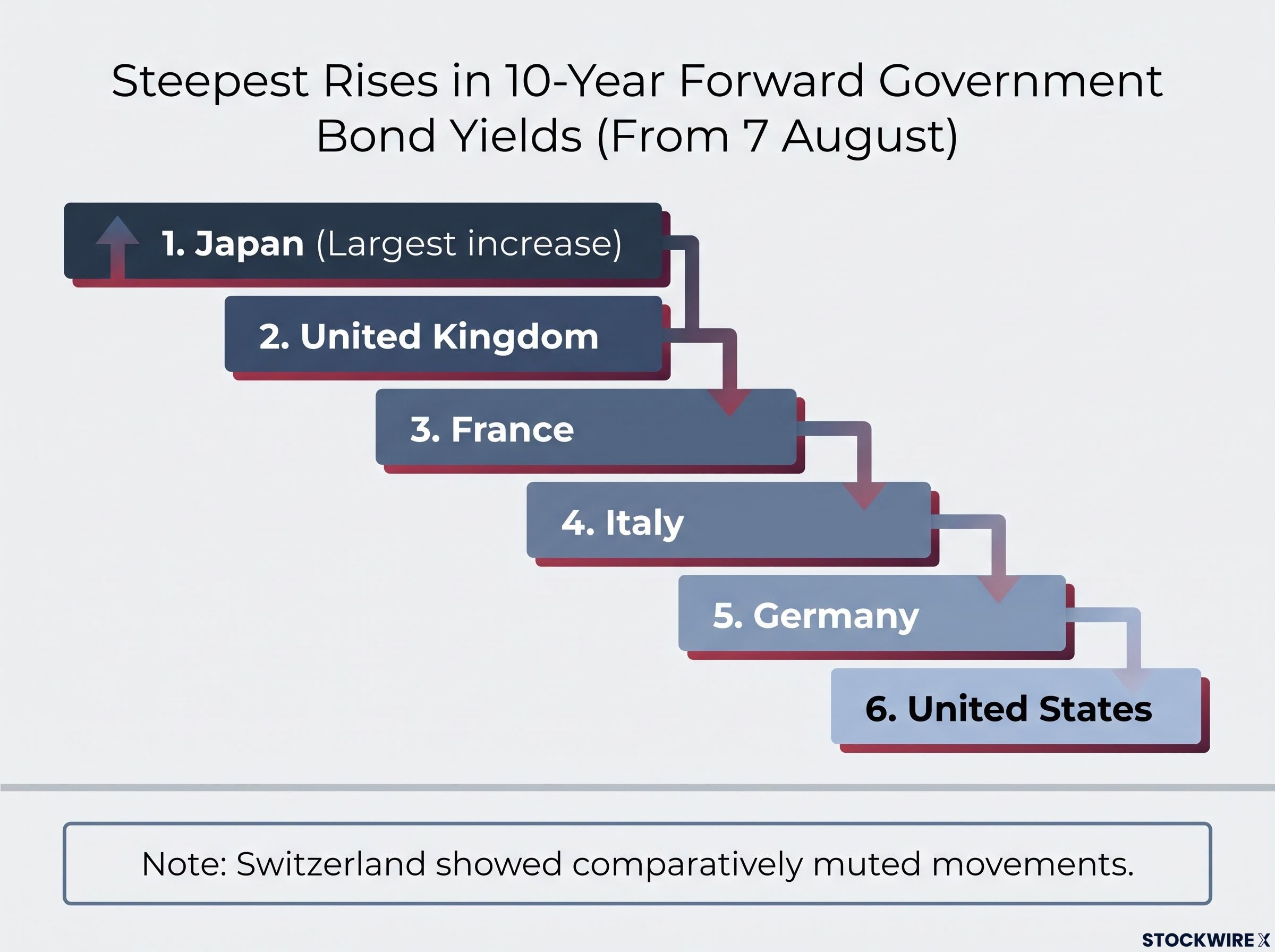
Now look at the cross-country ranking. According to analysis by Robin Brooks, the steepest rises in 10-year forward government bond yields from 7 August onwards ranked as follows, from largest to smallest increase:
- Japan (largest increase)
- United Kingdom
- France
- Italy
- Germany
- United States
The sharpest moves have landed on the countries carrying the heaviest fiscal burdens. Countries with stronger fiscal positions saw comparatively muted movements; Switzerland stood out as a clear example of this pattern. Meanwhile, inflation expectations have remained broadly anchored despite a rebound in crude oil prices, which rules out a simple oil-price-driven inflation story.
The cross-country pattern tells you this is a systemic repricing of how much compensation investors demand to lend long-term to major governments. You cannot diversify this away by simply shifting capital from one sovereign to another.
Bond yield mechanics, including how auctions set initial prices and how secondary markets continuously reprice them based on inflation data and fiscal risk perceptions, form the foundation for reading the cross-country signals this environment is producing.
When big ASX news breaks, our subscribers know first
Three forces pushing yields higher across every major economy
Three structural drivers are operating simultaneously, and the critical point is that they are not alternative explanations. They compound one another.
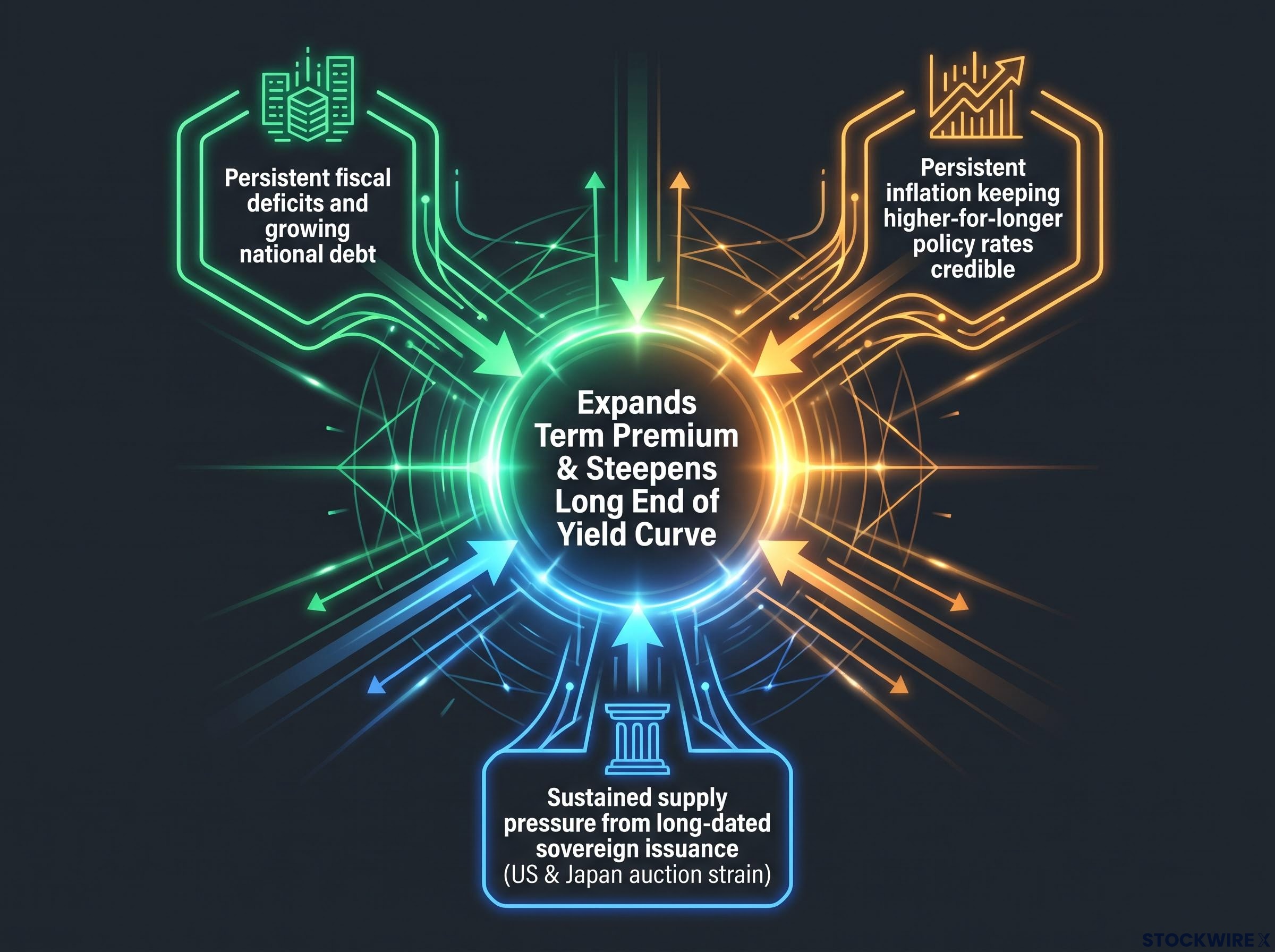
- Persistent fiscal deficits and growing national debt. This is the foundational pressure. Markets are pricing in the prospect that major governments will continue running elevated deficits for years, requiring continuous issuance at scale. The problem is structural, not cyclical.
- Sustained supply pressure from long-dated sovereign issuance. A flood of long-dated bond supply is forcing markets to absorb increasing volume. Auction outcomes in both the US and Japan have reflected this strain, with episodes of weaker demand at the long end of the curve.
- Persistent inflation keeping higher-for-longer policy rates credible. Inflation remains above central bank targets in several major economies, which keeps the prospect of tighter-for-longer monetary policy alive. This shorter-term force reinforces the two structural ones above by keeping the floor under yields elevated.
Each driver on its own would push long-end yields higher. Together, they produce something more potent.
NBER research on federal debt and term premia finds that a significant portion of the increase in long-term interest rates reflects term premia rather than revised expectations of future short rates, which substantiates why fiscal deficit trajectories translate directly into long-end yield pressure rather than staying contained at the short end of the curve.
How these forces combine: understanding term premium
Term premium is the additional yield you receive as compensation for uncertainty over the full life of a long-dated bond, beyond what expected short-term interest rates alone would justify. Think of it as the price of not knowing what fiscal policy, inflation, and supply dynamics will look like over 10 or 30 years.
When all three drivers are elevated simultaneously, term premia expand and the long end of the yield curve steepens independently of what central banks do with short-term rates. That distinction matters enormously for you. If you hold long-duration bond funds, the risk you face is not just central bank rate decisions but a structural repricing of the long end driven by fiscal and supply dynamics that central banks do not directly control.
Duration exposure is the specific channel through which term-premium expansion translates into portfolio losses; a long-dated bond fund with a duration of 17 loses approximately 17% for every one percentage-point rise in yields, regardless of the credit quality of the underlying sovereign.
Why simultaneous stress is structurally different from a typical sovereign shock
The conventional response to a single-country sovereign scare is straightforward. If one government’s bonds sell off, you sell those bonds and buy another country’s as a safe haven. Capital flows to the relative winner, yields stabilise, and the shock stays contained.
That playbook assumes the stress is localised. In the current environment, it is not.
- Single-country shock (conventional playbook):
- Sell the stressed country’s bonds
- Buy another sovereign’s bonds as a haven
- Capital flows re-establish equilibrium
- Diversified sovereign bond allocation provides protection
- Global simultaneous repricing (current environment):
- Long-end yields rising across most major sovereigns at once
- No obvious cross-border haven large and liquid enough to absorb displaced capital at scale
- Even “core” sovereigns now require higher yields to attract buyers
- Diversified multi-country government bond allocation does not insulate you
Markets are still differentiating by degree of fiscal stress; the cross-country ranking is evidence that relative judgments persist. Japan’s outsized yield move reflects both its fiscal position and the domestic concentration of JGB holdings, which limits the JGB market’s role as a global safe-haven substitute. Yet a broad upward repricing in which relative distinctions still exist is a fundamentally different situation from capital cleanly exiting one sovereign market and flowing into another.
If you believe a diversified multi-country government bond allocation provides sufficient protection against sovereign stress, this environment is testing that assumption in real time. The entire long-end sovereign curve is shifting higher, and that requires a different risk management response.
The dollar paradox: why fiscal stress can strengthen the currency of a stressed sovereign
Here is where the logic appears to break. If the US is running large deficits and its long-term borrowing costs are at 2007 levels, why would capital flow into dollar assets? Why would the dollar strengthen?
The answer is that when the stress is global, the driver of dollar strength is not confidence in US fiscal health. It is the absence of a viable alternative at scale.
Large institutional investors and global banks do not simply need safety. They need:
- Markets that trade around the clock with tight bid-ask spreads
- Deep repo and derivatives markets for collateral management
- High-quality collateral that can be posted and rehypothecated at the scale global finance demands
The US Treasury market is the only sovereign market that reliably meets all three requirements at the volumes global capital requires. The dollar remains the primary funding and settlement currency for international finance. When investors de-risk in Europe, Japan, or emerging markets, much of that capital ultimately parks in dollar assets because no other market is large and liquid enough to absorb it.
Federal Reserve analysis of the dollar’s international role confirms that the depth and liquidity of US financial markets, combined with the scale of safe dollar-denominated assets, are what sustain its primacy as a funding currency, a structural feature that persists independently of US fiscal performance in any given cycle.
In 2008, the US dollar strengthened considerably even as the financial crisis was rooted in US markets. Rather than fleeing dollars, investors rushed into them, treating the currency as the world’s primary liquidity source at a moment of acute stress, not as a vote of confidence in American fundamentals, but as the only venue capable of absorbing flows at that scale.
Relative value in a world with no perfect sovereign
The dollar’s safe-haven pull is a relative judgment, not an absolute one. Investors are not deciding whether US Treasuries are safe in isolation. They are deciding whether Treasuries are safer and more liquid than the available alternatives given the size of the capital they need to deploy. The euro area’s sovereign bond market is split across multiple issuers with differing credit quality, which undermines its capacity to serve as a global haven at scale. Japan’s JGB market, heavily concentrated in domestic hands, is far less accessible to international investors seeking to redeploy large sums. Against those alternatives, US Treasuries remain the default, even under fiscal strain.
For you, this means something specific. If you are reducing exposure to Japanese or European sovereign bonds due to fiscal concerns, some of that capital will, by institutional gravity, end up in US dollar assets, even if your view on US fiscal sustainability is equally cautious. Understanding this dynamic prevents a common analytical error: assuming that fiscal stress in the US must translate into dollar weakness and capital outflows.
Reading the yield curve as a fiscal signal, not just a rate signal
If you have followed yield curve analysis before, you probably know it as a recession predictor. An inverted curve (short-term yields above long-term yields) has historically signalled economic slowdowns. That signal still matters. But this environment demands you track additional signals, because the repricing happening now is concentrated at the long end, not the short end.
Treasury yields as a policy lever have displaced equity market stress as Washington’s primary forcing mechanism, with the 10-year at 4.66-4.67% and the 30-year at 5.18% simultaneously tightening mortgage rates, corporate borrowing costs, and federal debt servicing in a way that a stock market correction alone does not.
Here is the upgraded monitoring framework:
- Traditional yield curve signals (still relevant):
- Inversion at the short end as a recession indicator
- Short-end moves reflecting central bank rate path expectations
- Fiscal and term-premium signals to add now:
- Long-end moves in the 10-30 year range, where duration exposure lives
- Auction outcomes and demand indicators as leading signals of supply-absorption stress
- Real yields (nominal yields minus inflation expectations) to distinguish fiscal repricing from inflation repricing
The US 10-year TIPS yield sits at approximately 2.41%. That is the real yield investors are demanding after stripping out inflation expectations, and its elevation tells you the repricing is not just about prices rising. It is about investors wanting more compensation for sovereign and duration risk itself.
The distinction between inflation risk and fiscal risk matters for your portfolio. Inflation hedges, such as TIPS and commodities, address price-level risk. Term-premium and fiscal risk shows up as higher real yields and steeper long ends; that is a duration and sovereign credit-perception issue. Managing it typically involves shortening duration or being highly selective at the long end, and stress-testing portfolios for sustained higher real yields rather than assuming the “risk-free” curve will revert to pre-2022 levels.
If you walk away watching only the short end for central bank signals, you will miss the fiscal repricing happening at the long end, which is precisely where your portfolio’s duration exposure sits.
What the global repricing changes, and what it does not
The structural shift is real. When US 30-year yields remain above 5% for an extended period, and the cross-country data shows the same upward pressure from Tokyo to Berlin, the message is not a temporary spike driven by a single data point. It is a regime-level adjustment in how global capital markets price long-term sovereign risk and term premia.
What has not changed is equally important. The US Treasury market’s fundamental liquidity advantage remains intact. The dollar’s role as the primary global funding and settlement currency has not been displaced. No credible, large-scale substitute for US Treasuries as institutional collateral has emerged. These are not new vulnerabilities; they are durable structural features.
To monitor whether this dynamic shifts, watch for:
- A genuine, liquid alternative to US Treasuries emerging at scale (not on the horizon currently)
- A sustained reduction in US fiscal deficits that fundamentally changes the supply picture
- A global risk-off episode severe enough to stress even the dollar’s liquidity function
- A structural change in JGB or euro-area sovereign market depth that increases their international substitutability
The practical takeaway is calibrated, not catastrophic. Managing duration exposure and monitoring long-end fiscal signals are now permanent features of how you analyse sovereign bonds, not temporary adjustments to make until central banks pivot. The global “risk-free” rate itself has reset higher, and that reprices everything denominated against it.
For readers wanting to translate this framework into concrete portfolio decisions, our comprehensive walkthrough of bond investing strategy in a rising-yield environment covers whether to sell, shorten duration, or stay the course based on your specific investment horizon and income needs.
This article is for informational purposes only and should not be considered financial advice. Investors should conduct their own research and consult with financial professionals before making investment decisions. Past performance does not guarantee future results. Financial projections are subject to market conditions and various risk factors.