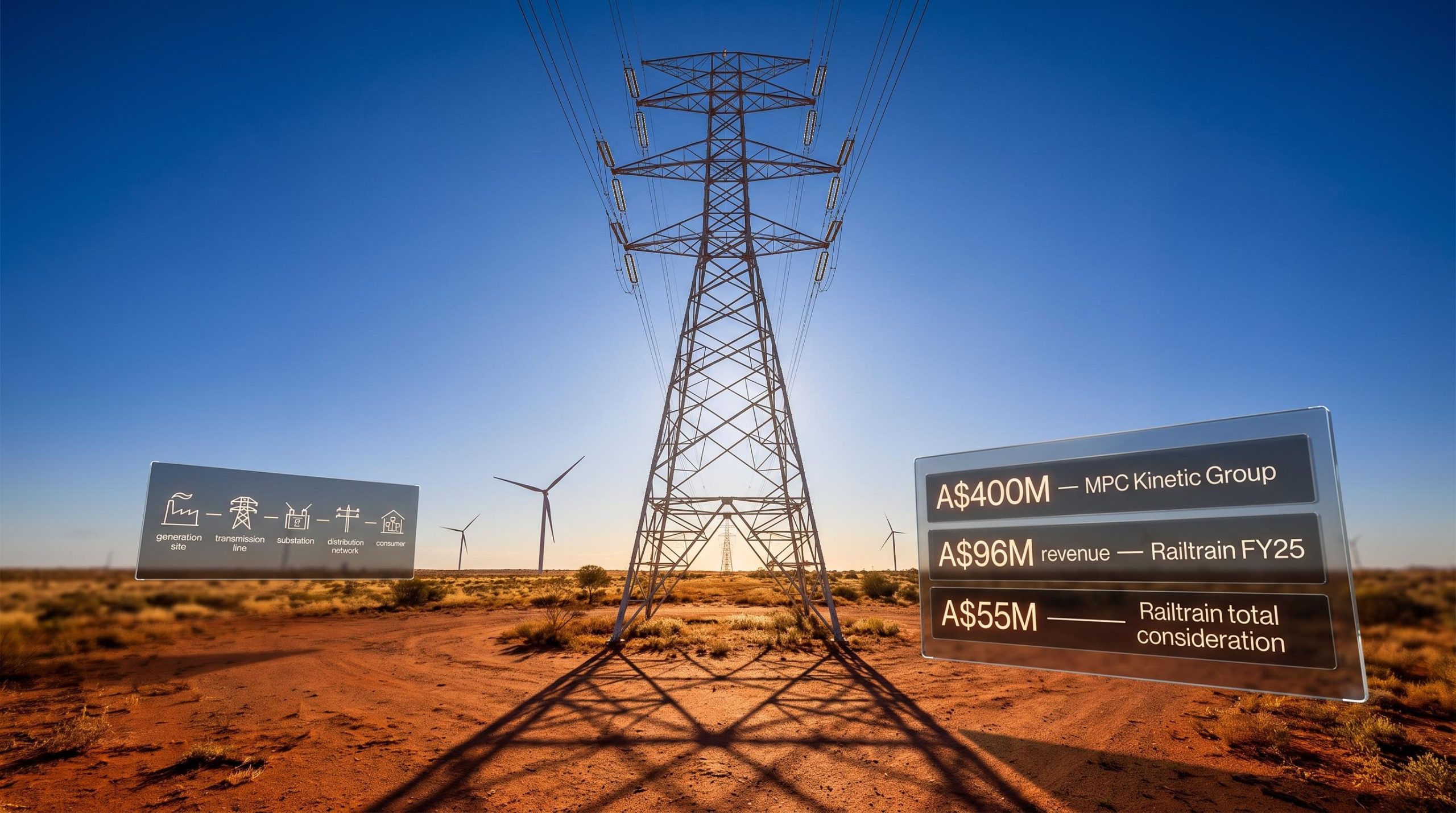
Somewhere in Australia right now, an approved wind farm is generating power that will never reach a single household. Not because the turbines have failed. Because the transmission line connecting it to the grid either does not exist yet or cannot carry the load. This is the daily operational reality of Australia’s energy transition in 2026, and it receives almost no public attention.
Public debate about clean energy focuses relentlessly on targets, policy milestones and generation announcements. What rarely gets examined is the physical layer that actually sets the pace: the grid hardware, the wiring corridors, the substation capacity and the communications infrastructure that move electricity from where it is produced to where it is needed. Ambition, capital and technology are not what is holding the transition back. The constraint is the slow, unglamorous and highly specialised work of building and maintaining that physical network.
This piece explains the layer of Australia’s energy transition that actually determines the timeline, and uses GenusPlus Group (ASX: GNP) as a concrete, ASX-listed worked example of the kind of company doing that work at national scale. After reading, you will be able to explain why grid infrastructure, not generation capacity, is the real constraint, and what that means for how you think about ASX industrial stocks in the infrastructure services space.
Why a wind farm without a wire is useless
Any renewable generator, whether a solar installation in regional Queensland or a wind farm in western Tasmania, produces electricity that has no value unless it can be moved somewhere. Generation in isolation is not enough. The power must travel through a network capable of receiving, carrying and distributing it, often across considerable distances to areas that were never engineered to handle that kind of load. Without that physical connection to the transmission and distribution system, the generator simply cannot participate in the market.
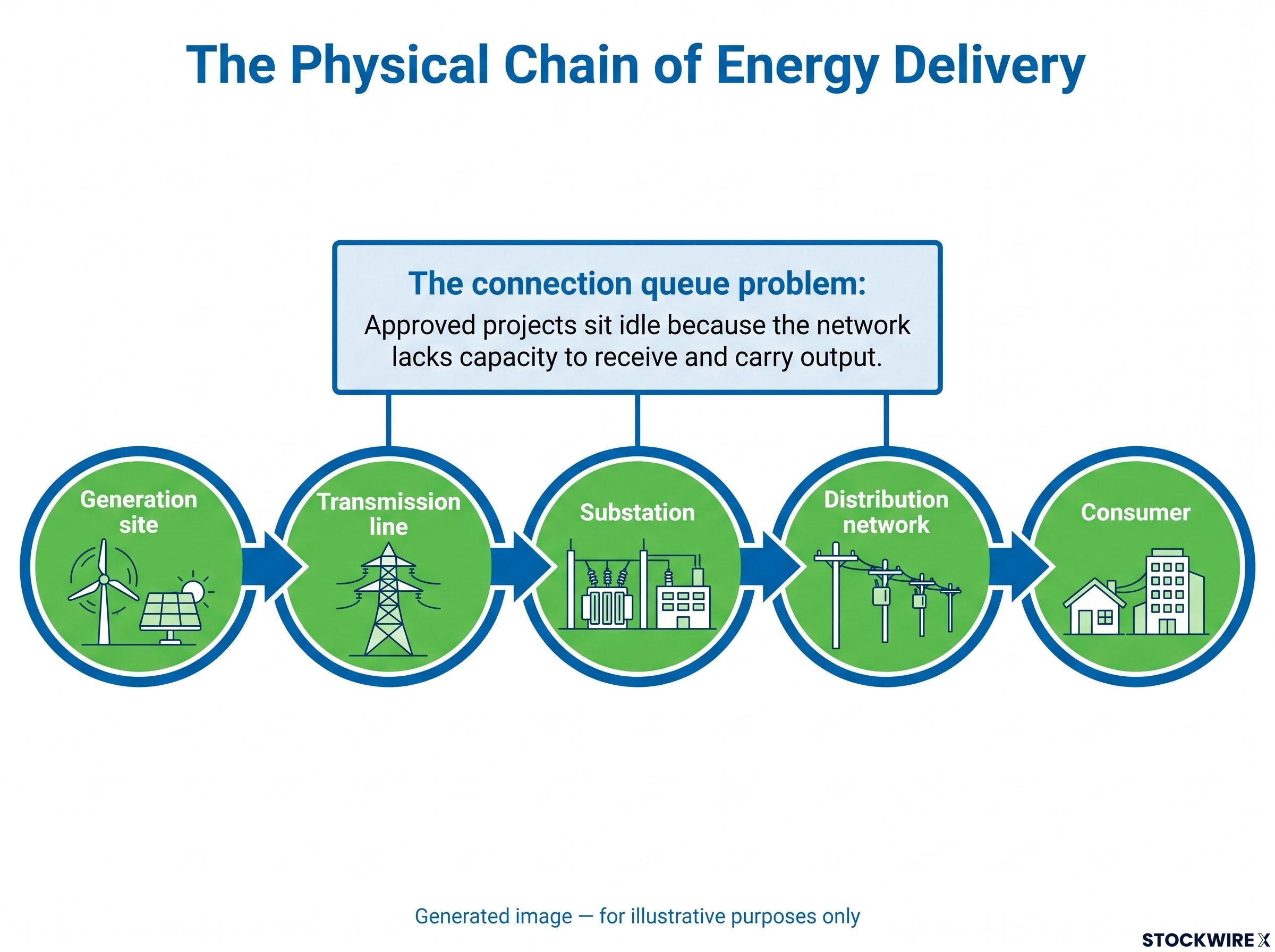
The physical chain between a generator and your power point involves more links than most people realise. Every one of them requires specialist construction and ongoing maintenance:
- Generation site: the wind farm or solar installation itself
- Transmission line: high-voltage infrastructure carrying bulk power across long distances
- Substation: the facility that steps voltage down for regional distribution
- Distribution network: the lower-voltage lines and infrastructure delivering power to suburbs, towns and businesses
- Consumer: the household or commercial end user
Each link in that chain is technically complex, geographically demanding and expensive to build. In remote or regional locations, where wind and solar resources tend to be strongest, the distances involved magnify every challenge.
The connection queue problem
Here is where the bottleneck becomes concrete. Across Australia, renewable projects with full planning approval are sitting idle because the network lacks the capacity to receive and carry their output, not because anything has gone wrong with the generation technology itself. Grid infrastructure is built on long timescales: a transmission corridor can take years to plan, permit and construct, and that development cycle runs far behind the pace at which generation approvals are being granted.
The delay between a renewable project being approved and it actually delivering electricity to consumers is, in most cases, a grid infrastructure problem, not a renewable energy problem. That distinction changes how you should read every clean energy progress claim you encounter.
Australia recorded a record $12.7 billion in clean energy investment in 2024 before a roughly 20% slump in 2025, and the cause was not deteriorating project economics but the same grid connection bottlenecks this article describes, confirming that the infrastructure constraint is already visible in the capital flow data.
When big ASX news breaks, our subscribers know first
What is wrong with the grid Australia already has
The electricity network Australia has today was engineered around assumptions that no longer hold. Its fundamental architecture reflects a world built on a handful of large, centralised coal-fired stations producing predictable, dispatchable output. Wind and solar generation is structurally different: it is distributed across many sites, variable in its output and often located far from population centres. Those two models require different kinds of networks, and the existing grid was not designed with the renewables model in mind.
The mismatch runs deeper than just adding new wires. Large parts of the network need to be substantially rebuilt or reinforced from the ground up, rather than incrementally extended.
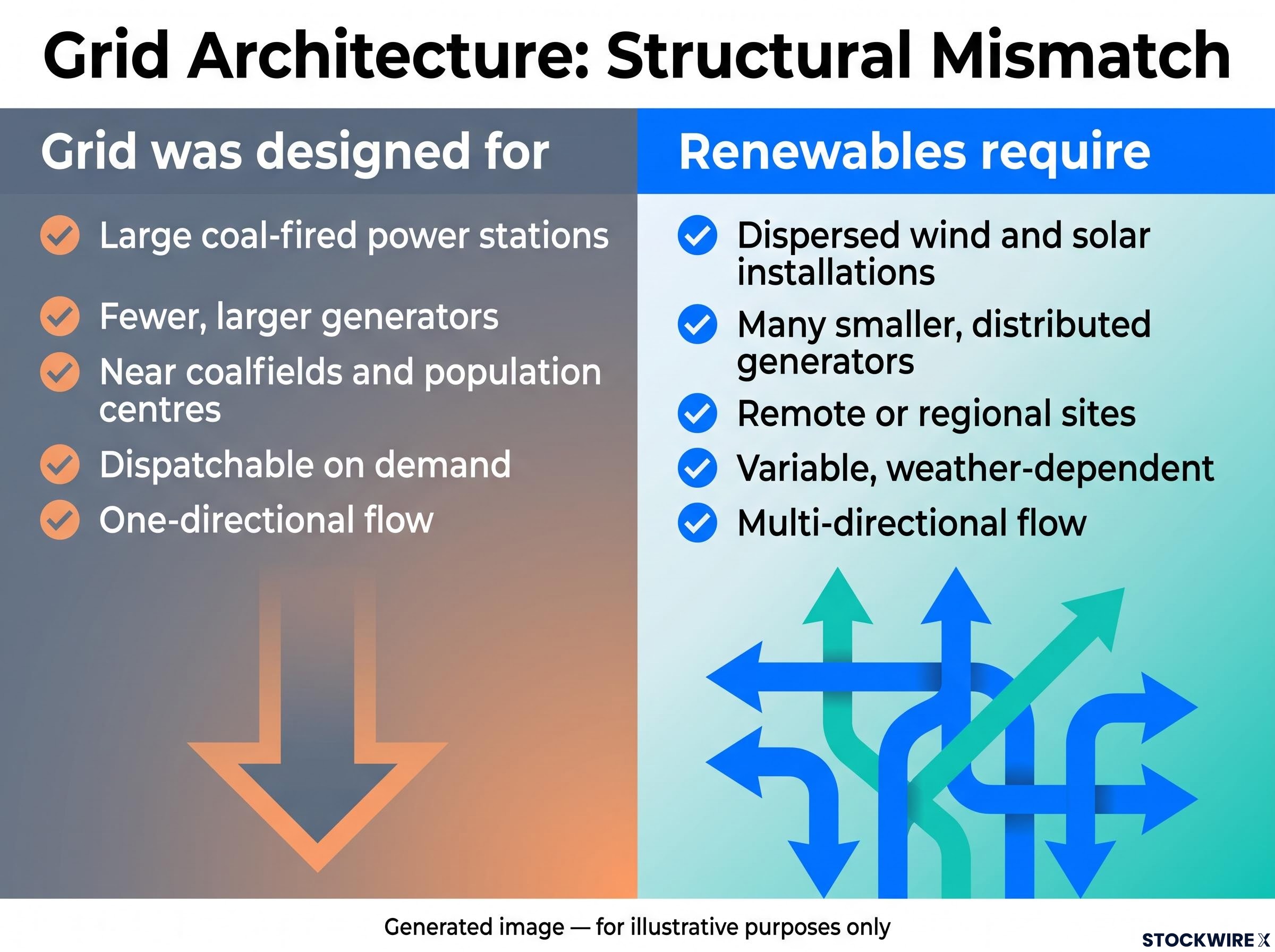
| Dimension | Grid was designed for | Renewables require |
|---|---|---|
| Generation type | Large coal-fired power stations | Dispersed wind and solar installations |
| Number of sources | Fewer, larger generators | Many smaller, distributed generators |
| Location pattern | Near coalfields and population centres | Remote or regional sites with best wind and solar resources |
| Output predictability | Dispatchable on demand | Variable, weather-dependent |
| Network design implication | One-directional flow from few large sources | Multi-directional flow from many distributed sources |
The distinction that matters: Where renewable power fails to reach consumers, the underlying cause is typically network congestion or connection backlogs rather than any shortcoming in the generation technology itself. Blaming the technology when the actual barrier is a physical infrastructure gap misidentifies both the problem and the solution.
This structural mismatch means that even a politically committed, well-funded transition programme faces a hard physical constraint. And that constraint is what drives the structural, multi-decade investment demand for grid infrastructure services. The rebuild is not a short-cycle project. It is generational work.
The pattern of physical bottlenecks constraining a technology transition is not unique to renewables: AEMO’s Draft 2026 Integrated System Plan formally identifies data centres as a structural demand driver, projecting nearly 10 TWh of additional electricity load in Australia by 2033-34, which layers an AI-driven demand surge on top of the grid rebuild already underway.
The specialist workforce that actually builds the grid
So who does this work? Firms that design, construct and service the physical grid occupy a critical position in the transition story, yet they attract only a fraction of the attention directed at renewable energy developers and project proponents.
These businesses operate across the entire service chain that keeps network assets alive:
- Planning and design of transmission and distribution routes, substations and protection systems
- Construction of new network infrastructure
- Testing and commissioning of completed assets before they enter service
- Ongoing maintenance of live network infrastructure
- Decommissioning of assets reaching end of life
That lifecycle scope matters. These are not project-based contractors who arrive for a construction phase and leave. They are embedded across the entire useful life of the infrastructure they build.
Their client base spans three regulated or semi-regulated categories, each with its own long-duration demand profile:
- Utilities: electricity transmission and distribution network operators requiring ongoing construction, reinforcement and maintenance
- Resources sector: mining and energy companies needing power and communications infrastructure for remote operations
- Government: state and federal bodies commissioning network infrastructure as part of broader energy and transport policy
The accumulated technical expertise, specialist workforces and long-term client relationships required to operate in this space create high barriers to entry. You cannot stand up a transmission line construction crew from scratch in six months.
When thinking about infrastructure-linked industrial stocks on the ASX, the key distinction is this: specialist grid services businesses derive their revenue from the network’s physical needs, which persist regardless of which generation technology is currently favoured or which party holds government. That insulates their demand profile from the political and technology cycles that affect renewable energy developers directly, and represents a meaningfully different exposure for investors evaluating the sector.
GenusPlus Group as a worked example of this infrastructure model
GenusPlus Group (ASX: GNP) illustrates concretely how the infrastructure services model described above plays out in an ASX-listed company. Founded in Western Australia as a family business built across three generations of technical expertise, GenusPlus has grown into a nationally operating infrastructure services provider through a consistent, multi-year acquisition strategy.
The core operating model covers full lifecycle services across power and communications network infrastructure. The client base spans utilities, resources and communications sectors, with operations now extending across Western Australia, Queensland, New South Wales and Tasmania.
What makes GenusPlus instructive as a worked example is the acquisition programme. Each transaction follows the same adjacency logic: extending into a structurally related category of essential network infrastructure rather than diversifying away from the core capability.
| Year | Acquisition | Strategic rationale |
|---|---|---|
| 2022 | Pole Foundations Australia (PFA) | Deepened distribution-network capabilities |
| 2023 | Prasinus / Genus Infrastructure VIC | Energy services and infrastructure engineering in Victoria |
| 2024 | Partum Engineering | In-house engineering expertise for future growth |
| April 2025 | MGC Group | Strategic entry into rail infrastructure |
| March 2026 | Railtrain Holdings | National rail infrastructure services scale |
| May-July 2026 | MPC Kinetic Group | Diversification into Queensland onshore gas and water infrastructure, adding Tier 1 gas-sector client relationships (~A$400M) |
The trajectory is clear. Power networks, then communications, then rail, then a materially larger energy infrastructure platform. Each step extends the same essential-network thesis into an adjacent category.
Railtrain deal structure: Total potential consideration of up to A$55 million, comprising A$36.5 million in upfront cash plus a contingent earn-out of up to A$18.5 million linked to CY26 and CY27 EBITDA targets (A$8.5 million contingent on CY26 performance; A$10 million contingent on CY27 performance). Railtrain generated approximately A$96 million in revenue and approximately A$16 million in EBITDA in FY25. These are historical figures; future contributions depend on contract and market conditions. Source: GenusPlus ASX disclosures, 4 March 2026.
The MPC Kinetic Group acquisition, agreed in May 2026 and completed in July 2026 at approximately A$400 million and funded in part through a $200 million equity raise, is materially larger than the Railtrain and MGC transactions combined. It brings GenusPlus into Queensland’s onshore gas gathering and well-maintenance sector, along with adjacent water infrastructure and renewable energy construction capability, positioning the company at a significantly different scale than even twelve months earlier.
The company’s share price recorded strong gains over the prior twelve months, a period of sustained investor interest in infrastructure-linked earnings growth that is best understood as historical market performance. Past performance is not a reliable indicator of future returns.
The pattern across most of GenusPlus’s acquisitions reflects a consistent adjacency logic: power, communications and rail all sit within the same essential-network category. MPC Kinetic marks a deliberate broadening beyond that core into a related but distinct essential-services sector, onshore gas and water infrastructure, that draws on the same specialist-workforce, long-duration-contract operating model. Whether this represents a disciplined expansion of the essential-infrastructure thesis or the start of a genuinely diversified platform is a distinction worth watching as integration progresses.
GenusPlus is not the only ASX-listed business capturing this structural demand: ASX electrical infrastructure stocks including Southern Cross Electrical and SKS Technologies are also reporting accelerating revenue growth from the same grid reinforcement and electrification programmes, providing investors with a broader peer set to evaluate alongside GNP.
How rail infrastructure fits the same essential-services logic
The addition of rail might look like a departure from grid infrastructure at first glance. It is not. Rail infrastructure services, specifically overhead wiring, signalling and electrical systems, sit within the same essential-network category as power transmission and distribution work.
The structural parallels are direct:
- Physical asset: Power grid services maintain transmission lines and substations. Rail services maintain overhead wiring, signalling and electrical systems. Both are specialist electrical infrastructure.
- Technical expertise required: Both demand accumulated specialist knowledge, certified workforces and long-term safety-critical operating standards that cannot be replicated quickly.
- Long-term demand driver: Australia’s electricity grid needs rebuilding for the energy transition. Australia’s rail network requires ongoing electrification, signalling upgrades and electrical systems maintenance as part of broader transport infrastructure investment. Both are multi-decade programmes.
- Independence from short-term politics: Rail electrification and signalling upgrades, like grid reinforcement, are tied to physical network requirements rather than the political calendar.
GenusPlus’s own investor communications frame both power and rail work under the same “essential infrastructure” category. The MGC Group acquisition in April 2025 provided the strategic entry into rail. The Railtrain Holdings acquisition in March 2026, with its capabilities in overhead wiring, signalling and electrical systems, added national scale in the same category.
For you as a reader evaluating ASX industrial stocks in the infrastructure services space, the rail-to-power analogy makes a broader point. The relevant investment thesis is about essential network infrastructure dependency, not about any single sector. A company with diversified exposure across power, communications and rail infrastructure is less exposed to any single sector’s policy or market cycle than one concentrated in a single network type.
What this means for how you read Australia’s energy transition news
Every announcement you read about gigawatts of renewable capacity approved, clean energy targets committed to, or generation percentage milestones reached is telling you only half the story. The other half, the one that actually determines the timeline, is whether the grid infrastructure exists to deliver that capacity to consumers.
The question to carry forward: When you read an energy transition announcement, ask where the grid connection is coming from and who is building it. That is where the actual pacing constraint lives.
The specialist companies doing this work, including ASX-listed infrastructure services providers like GenusPlus, operate largely below public awareness despite determining the pace at which renewable ambition becomes delivered electricity. Grid infrastructure investment is structural, long-duration and tied to the physical requirements of the network rather than any political calendar.
The broader shift in how capital markets are pricing this transition is captured by the evolution of climate tech investing from a speculative venture theme into a multi-decade capital expenditure cycle, a framing that aligns directly with the structural, long-duration demand profile that grid services businesses like GenusPlus occupy.
That framing gives you a practical filter. Approved capacity is not delivered capacity. The gap between the two is filled by poles, wires, substations, signalling systems and the specialist workforces that build and maintain them. Until the infrastructure story matches the ambition story, the transition’s real timeline is being written not in policy announcements but in the project pipelines of companies you have probably never heard of.
This article is for informational purposes only and should not be considered financial advice. Investors should conduct their own research and consult with financial professionals before making investment decisions. Past performance does not guarantee future results. Forward-looking statements regarding infrastructure demand, company growth trajectories and market conditions are subject to change based on market developments and company performance.
—