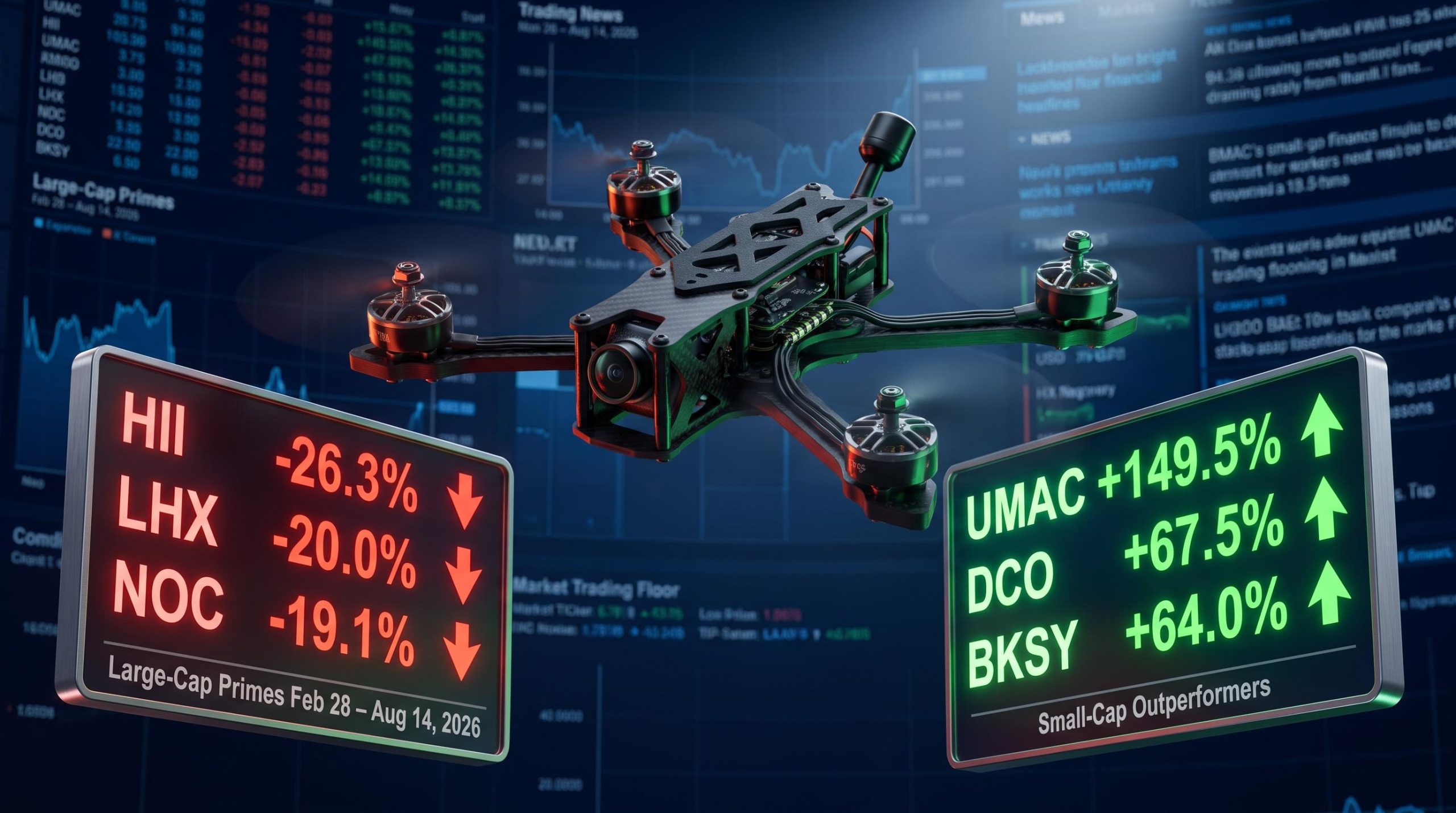
American warplanes and missiles were actively engaged in strikes against Iranian targets for nearly six months, and the companies that built them lost money for shareholders. Huntington Ingalls Industries fell 26.3% from conflict onset on 28 February 2026 through 14 August 2026. L3Harris Technologies dropped 20%. Northrop Grumman shed 19.1%. These are not peripheral suppliers. They are the backbone of the U.S. defence industrial base.
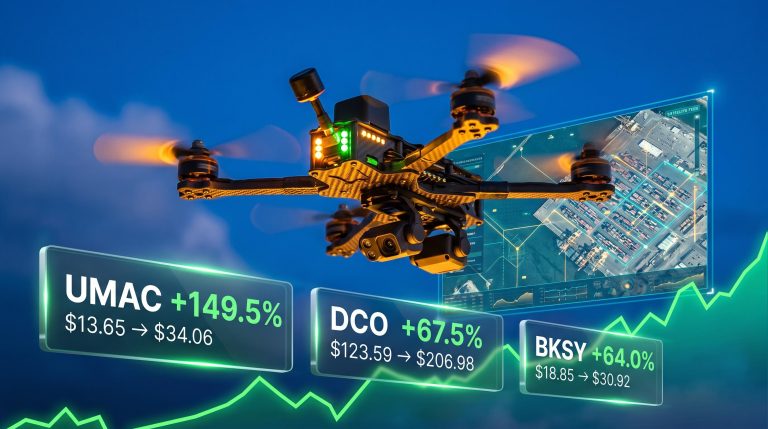
The same period told a very different story for three smaller names. Unusual Machines, a drone components maker operating well below prime-contractor scale, posted a 149.5% gain. Ducommun, a tier-two aerospace supplier, returned 67.5%. BlackSky Technology, a commercial satellite intelligence provider, advanced 64%.
The gap between those two sets of numbers is the story. If you own defence exposure through the familiar large-cap names, you may be holding the wrong layer of the stack for how this conflict is actually being fought. Here is what the price action, the structural forces, and the procurement signals tell you about where defence sector earnings leverage has migrated, and what it means for how you allocate within the sector from here.
The scoreboard that broke the wartime defence playbook
The conflict began on 28 February 2026. Within days, the primes rallied on instinct. Northrop Grumman surged approximately 5-6% in a single session. RTX gained more than 4%. Lockheed Martin finished roughly 3.3% higher. The market treated this like every prior war trade: buy the builders.
Then the trade unwound completely. By 14 August 2026, every one of those gains had been erased and then some.
| Company | Ticker | Start Price (28 Feb) | End Price (14 Aug) | Conflict-Period Return |
|---|---|---|---|---|
| Large-Cap Primes | ||||
| Lockheed Martin | LMT | $658.08 | $608.68 | -7.5% |
| Northrop Grumman | NOC | $724.38 | $585.87 | -19.1% |
| L3Harris Technologies | LHX | $364.54 | $291.82 | -20.0% |
| Huntington Ingalls | HII | $444.52 | $327.71 | -26.3% |
| Small/Mid-Cap Outperformers | ||||
| Unusual Machines | UMAC | $13.65 | $34.06 | +149.5% |
| Ducommun | DCO | $123.59 | $206.98 | +67.5% |
| BlackSky Technology | BKSY | $18.85 | $30.92 | +64.0% |
Huntington Ingalls’ 26.3% decline is the starkest figure in the prime group, a shipbuilder losing more than a quarter of its value during a period of active naval and aerial engagement.
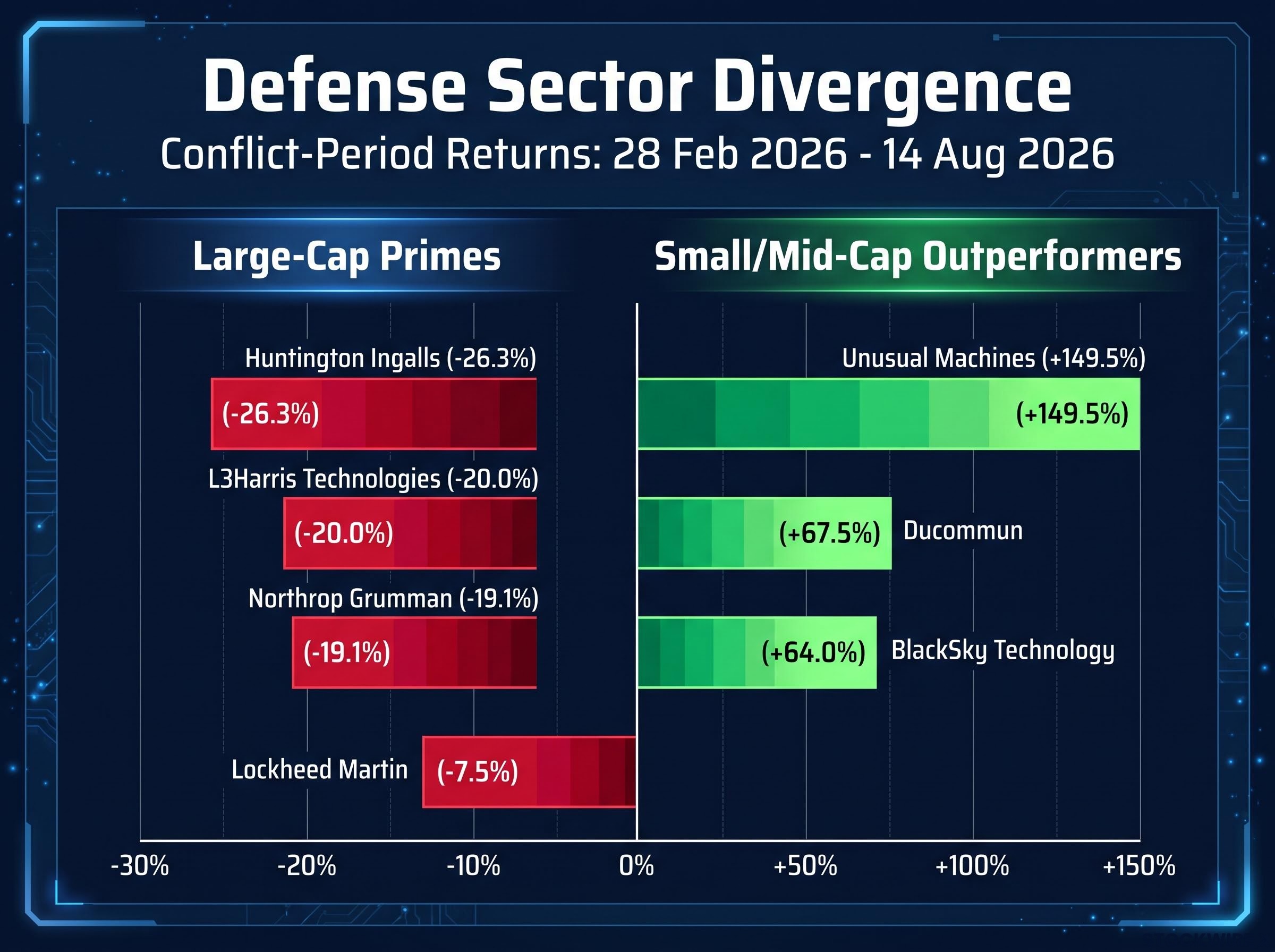
The two-phase pattern, a sharp spike followed by sustained fade, tells you that markets initially treated this conflict like every prior war trade. Then they repriced rapidly when it became clear that headline risk and actual earnings leverage had decoupled for the platform-level primes. All performance data sourced from Investing.com, reported by editor Ambar Warrick, published 17 August 2026.
When big ASX news breaks, our subscribers know first
Four structural reasons the war trade didn’t work for the giants
The underperformance was not random. Four reinforcing forces explain why the primes traded poorly even as their products were being used in combat, and each one compounds the others.
- Contract cycle lag. Near-term combat demand is being filled from existing stockpiles and contracts, not new multi-year programmes of record. Fighter jets, bombers, ships, and missile systems produced under decade-spanning contracts cannot be meaningfully accelerated in a six-month window. There is no revenue step-change to price in.
Backlog analysis reframes how contract cycle lag actually translates into equity value for the primes: a company like Lockheed can add billions in awarded contracts without moving near-term revenue recognition, which is precisely why conflict headlines fail to produce the earnings step-change investors expect.
- Rate sensitivity and starting valuations. By early 2026, many primes were trading at elevated multiples after years of outperformance. Investors have partly treated them as bond proxies, stable dividend payers with long-duration cash flows. Rising real yields raise the discount rate applied to those cash flows, compressing multiples even when geopolitical fundamentals improve.
- Political and margin overhangs. The visibility of primes as obvious conflict beneficiaries invites scrutiny. Cost-plus contract structures and wartime “profiteering” optics cap profit upside even when revenue grows. Analyst commentary has characterised the primes as offering “solid long-term moats, but not obvious near-term earnings accelerators.”
- Supply-chain complexity. Large primes sit atop sprawling, multi-tier supplier networks. Bottlenecks in materials, microelectronics, or specialty components delay deliveries and add cost, making aggressive wartime production ramps difficult to execute on a timeline that moves equity prices.
Any one of these forces would be a headwind. Running all four simultaneously explains why the gap between war headlines and prime equity returns grew wider through the period, not narrower. What this tells you is that the constraints are structural, not temporary, and that recalibrates how long you should expect to wait before primes reprice to reflect conflict-related demand.
What made the small-cap names different (and why the maths works)
The three outperformers share attributes that explain their divergence from the primes:
- Direct relevance to how this conflict is being fought. Drones, commercial satellite intelligence, and specialised electronic components are the operational tools of this war, not next-generation platforms still in development.
- Ability to monetise demand without waiting for new multi-year programmes. Existing or expedited procurement channels deliver revenue now, not in three fiscal years.
- Market caps small enough that incremental contracts drive outsized percentage moves. A few tens of millions in new revenue is a rounding error for a $60 billion prime. It is a material rerating event for a $1-2 billion company.
Unusual Machines as the defining case study
Unusual Machines is the clearest illustration of all three dynamics at work. The company supplies NDAA-compliant drone components, including motors, FPV cameras, flight controllers, and electronic speed controllers, integrated into the Blue UAS framework (the Department of Defence’s approved list for unmanned aerial systems). NDAA compliance means a product meets National Defence Authorisation Act requirements for domestic sourcing; Blue UAS inclusion means it is pre-approved for military procurement. Together, they position the company inside the U.S. effort to eliminate Chinese components from military drone supply chains.
The Blue UAS framework, maintained by the Defense Innovation Unit, establishes the cybersecurity and supply chain security criteria that unmanned aerial systems must satisfy before government agencies can procure them, giving NDAA-compliant suppliers a protected lane that competitors using foreign-sourced components cannot enter.
Unusual Machines reported revenue of $16.7 million in one quarter, representing 687% year-over-year growth, the kind of acceleration that simply does not happen at prime scale.
The catalyst sequence was specific and traceable. The company secured a $1.6 million defence order for Aura cameras and NDAA-compliant components, followed by Army orders for 3,500 drone motors with potential 2026 expansion to 20,000 components. Exposure to the Drone Dominance Programme, a roughly $1 billion federal initiative targeting procurement of over 200,000 small, lethal drones across 2026-2027, layered additional upside. In late May, a Wall Street Journal report indicated the Trump administration was exploring direct federal funding for domestic drone manufacturers and named Unusual Machines specifically, triggering a substantial pre-market surge.
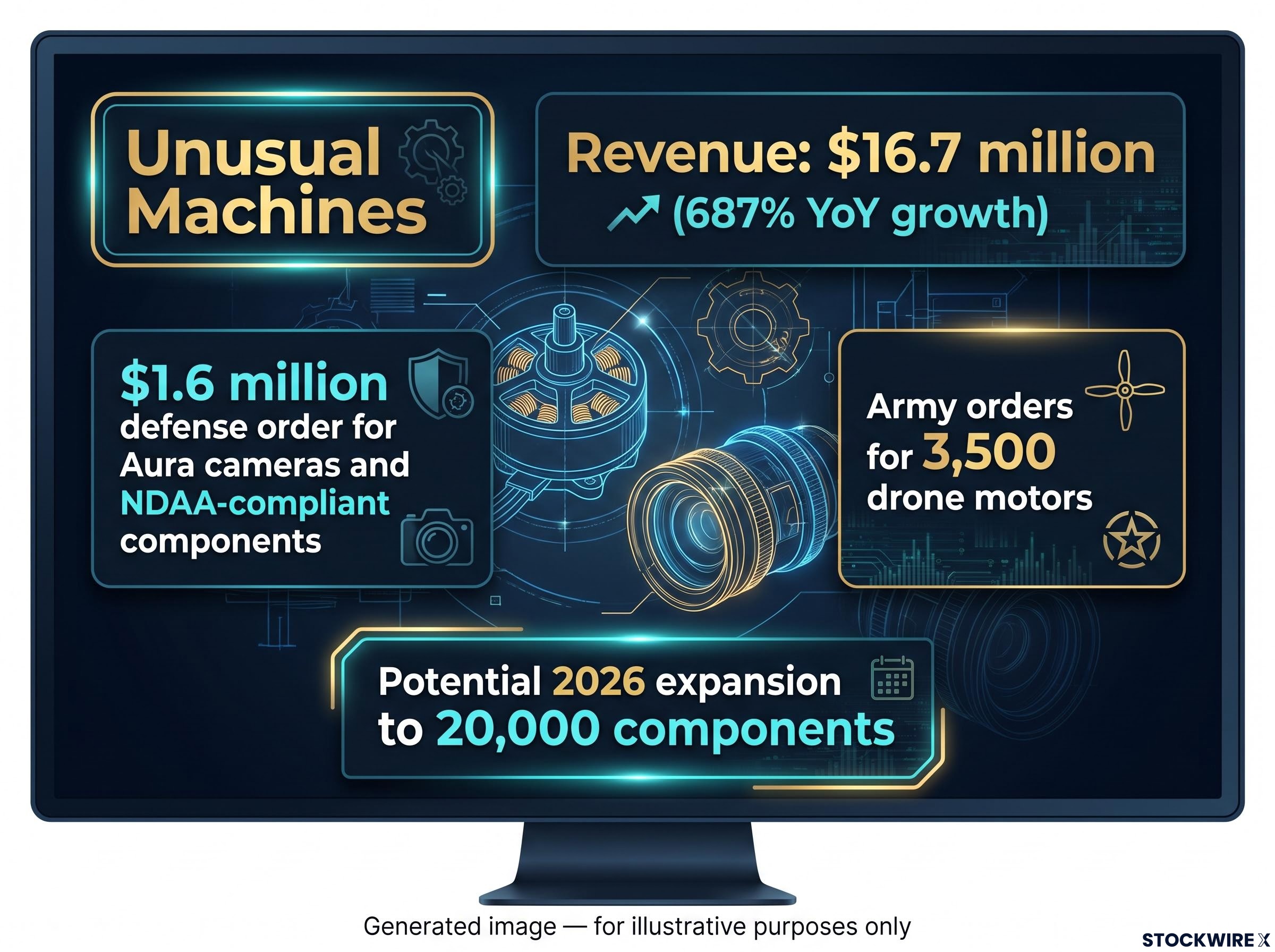
The stock also experienced sharp drawdowns around capital raises, a reminder that policy narrative and earnings leverage can coexist with high volatility and funding risk at this market cap.
Counter-drone systems represent the demand mirror image of Unusual Machines’ position: where Unusual Machines supplies attack and surveillance drone components, DroneShield secured $206 million in committed 2026 revenue providing the detection and defeat layer, with the US 2027 budget requesting $21 billion for counter-UAS and advanced capabilities.
Ducommun (market cap approximately $3.13 billion) benefits from both direct conflict orders and derivative volume as primes attempt production acceleration, without carrying the full complexity overhead of a tier-one contractor. BlackSky Technology (market cap approximately $1.27 billion) provides satellite-based geospatial intelligence and real-time imagery, capabilities that active hostilities have firmly established as core to operational planning rather than a supplementary tool. At both companies’ scale, modest contract wins drive outsized equity moves.
The structural shift underneath the price action
The divergence in defence stock performance is partly cyclical and partly structural. Separating the two is the core analytical question for how you position within the sector going forward.
What is structural in defence demand
- The shift toward unmanned systems, commercial space and ISR (intelligence, surveillance, and reconnaissance, the collection of battlefield information from satellites, aircraft, and sensors), and domestic NDAA-compliant supply chains would persist even if the U.S.-Iran conflict resolved tomorrow.
- Edge AI integration into autonomous systems and software-defined ISR represent durable changes in how the U.S. military intends to fight.
- China decoupling as a policy priority predates this conflict and will outlast it. Domestic NDAA-compliant suppliers operate in a protected and expanding addressable market regardless of near-term conflict dynamics.
- The Drone Dominance Programme, approximately $1 billion targeting 200,000+ units across 2026-2027, is a concrete near-term procurement signal embedded in a longer structural trend.
Domestic supply chain decoupling from Chinese components is the policy force driving NDAA compliance demand for Unusual Machines, and the same logic applies across the semiconductor layer: TSMC produces approximately 90% of the world’s leading-edge chips, a concentration that makes allied-nation chip independence a defence procurement priority extending well beyond drone motors and flight controllers.
What is cyclical in the current divergence
- Starting valuations for primes were elevated after years of outperformance, leaving less room for upward rerating.
- Rate sensitivity of long-duration cash flows is a function of the current yield environment, not a permanent condition.
- Policy signal intensity for small caps, including specific funding reports and named programme exposure, is heightened by the conflict but will moderate as attention shifts.
What the conflict did was compress the timeline for investors to recognise structural trends that existed before 28 February 2026. The demand for drones, commercial ISR, and domestically sourced components was already building. Active hostilities made the signal impossible to ignore.
This distinction matters for your portfolio. The structural forces tell you what you should own for the next six years. The cyclical forces tell you what is driving the next six months of relative performance, and which direction those forces may rotate.
Separating headline beta from earnings beta in a live conflict
The early-March rally in primes is the clearest diagnostic tool for understanding how markets process conflict information differently across the defence stack.
When hostilities escalated, the primes spiked mechanically. Northrop gained approximately 5-6%, RTX above 4%, Lockheed roughly 3.3%. This was headline beta, a reflexive buy response triggered by geopolitical risk. By mid-year, Northrop was down substantially year-to-date. Lockheed, RTX, and General Dynamics were only modestly positive or flat despite sustained tension.
The headline moved the stocks. The earnings leverage was not there to sustain the move.
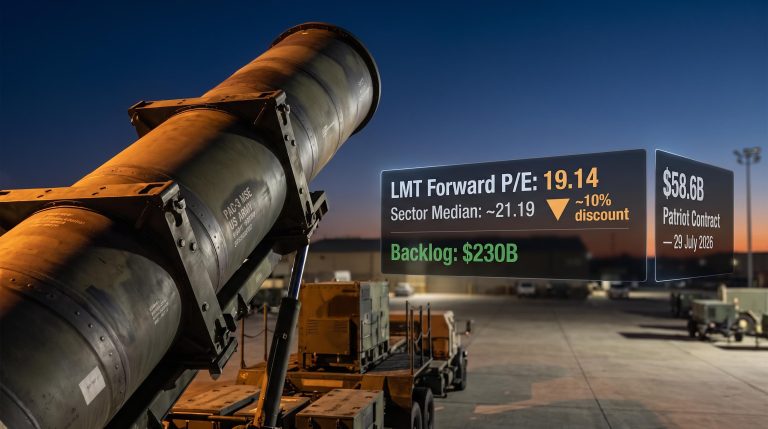
Contrast that with how catalysts behaved for the small-cap names. Each procurement announcement, each policy signal, each named programme inclusion produced a sustained move in stocks like Unusual Machines because the earnings leverage was immediate and traceable. A specific order for specific components at a specific dollar value, layered on a small revenue base, is an earnings-adjacent catalyst. A war headline applied to a company with a $60 billion backlog and cost-plus contracts is not.
Analyst commentary has characterised the primes as offering “solid long-term moats, but not obvious near-term earnings accelerators,” language that captures exactly why headline beta and earnings beta have split during this conflict.
The practical takeaway: conflict headlines move all defence stocks briefly, but only earnings-adjacent catalysts sustain the move. Identifying which tier of the defence stack has near-term earnings leverage is the actual investment question, not just in this conflict, but in any future one.
How to think about defence allocation when the war trade doesn’t look like you expected
The divergence between large-cap primes and smaller defence names is not an instruction to abandon one for the other. It is an instruction to recognise that the defence sector now has two meaningfully distinct performance layers, and owning only one leaves real exposure on the table.
- Large primes as long-cycle core exposure. Treat Lockheed, Northrop, RTX, and General Dynamics as rate-sensitive, budget-cycle-driven positions. Their value is in multi-decade backlogs and structural budget growth, not near-term conflict earnings acceleration. Size accordingly and expect bond-like sensitivity to discount rate changes.
- Smaller drone, ISR, and component names as tactical positions. Names like Unusual Machines and BlackSky express views on how the conflict is being fought, on policy direction around China decoupling, and on near-term procurement trends. Size these for the elevated volatility they carry.
- Volatility-aware sizing is non-negotiable at the small-cap tier. Unusual Machines gained 149.5% over the conflict period while experiencing sharp drawdowns around capital raises and programme announcements within that same window. The same policy narrative that drives the upside creates the conditions for violent pullbacks. Position sizing must reflect both sides of that equation.
Owning defence through primes alone is now an incomplete expression of defence sector exposure. The earnings leverage from how modern conflicts are actually fought, with cheap drones, commercial ISR, and software-defined edge systems, is increasingly captured by smaller, more focused companies. The data from this conflict period makes that case with uncomfortable clarity.
For investors wanting a framework that extends beyond the defence sector, our dedicated guide to cyclical and defensive allocation covers how to blend both stock types across economic phases, including the barbell approach institutional allocators are currently using to manage the rate sensitivity that is compressing prime valuations.
This article is for informational purposes only and should not be considered financial advice. Investors should conduct their own research and consult with financial professionals before making investment decisions. Past performance does not guarantee future results, and the forward-looking statements in this analysis are subject to change based on market developments and company performance.