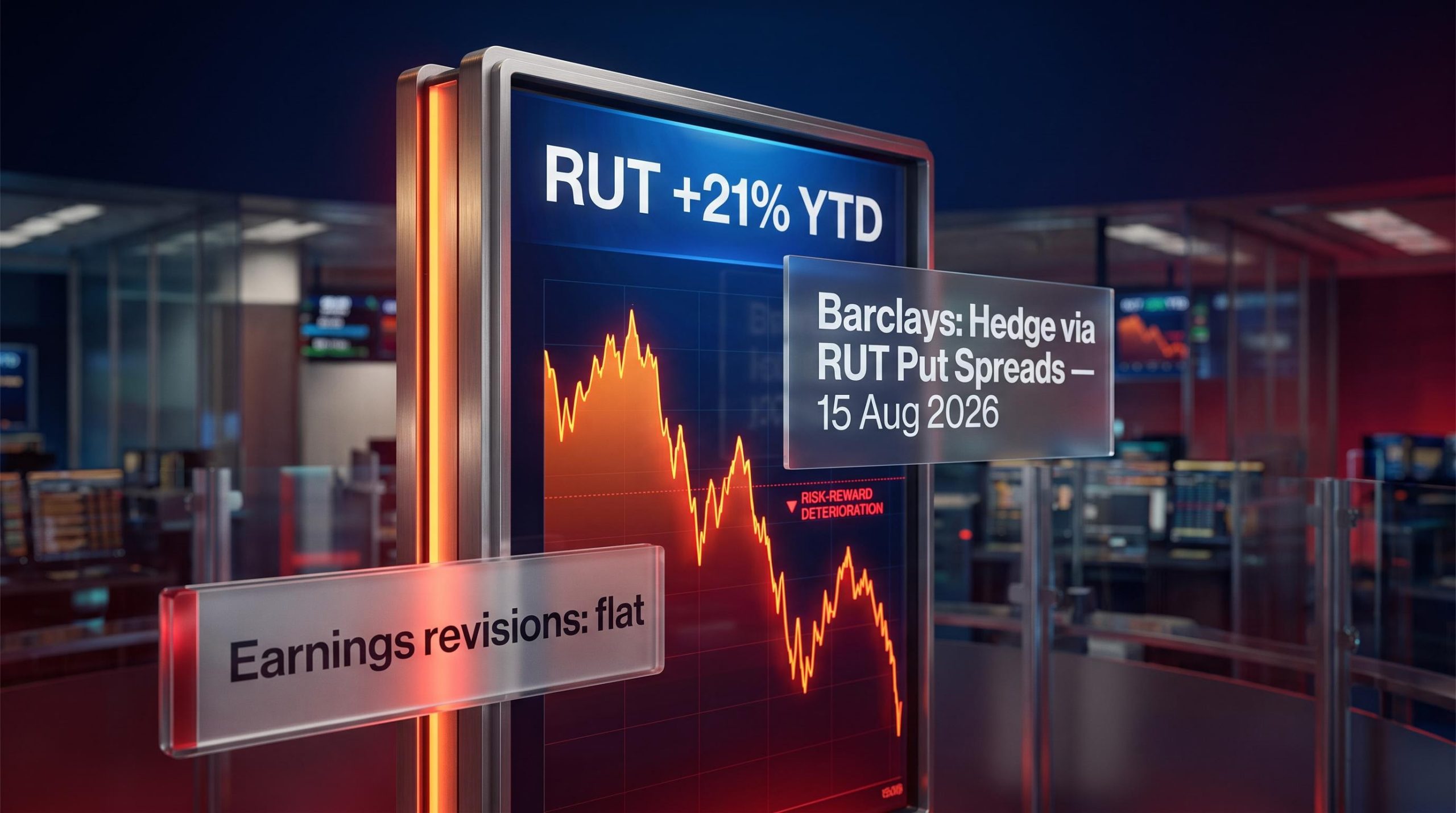
Barclays published a note on 15 August 2026 recommending that investors hedge their small-cap exposure using Russell 2000 put spreads. The call signals professional unease about a rally that has delivered 21% gains year-to-date without a commensurate improvement in earnings.
The Russell 2000 has outpaced large-cap peers by a wide margin in 2026, yet the earnings picture underneath has not kept pace with price performance. Barclays analysts see a deteriorating risk-reward profile driven by weaker earnings revisions, stretched leverage, and limited exposure to the artificial intelligence (AI) tailwinds lifting mega-cap technology stocks. Their hedge recommendation is a calibrated, cost-efficient signal, not a crash call.
Here is what Barclays is seeing in the data, how a bear put spread works and why that specific structure was chosen, and what the call means if you currently hold small-cap positions.
A 21% rally with a shaky foundation
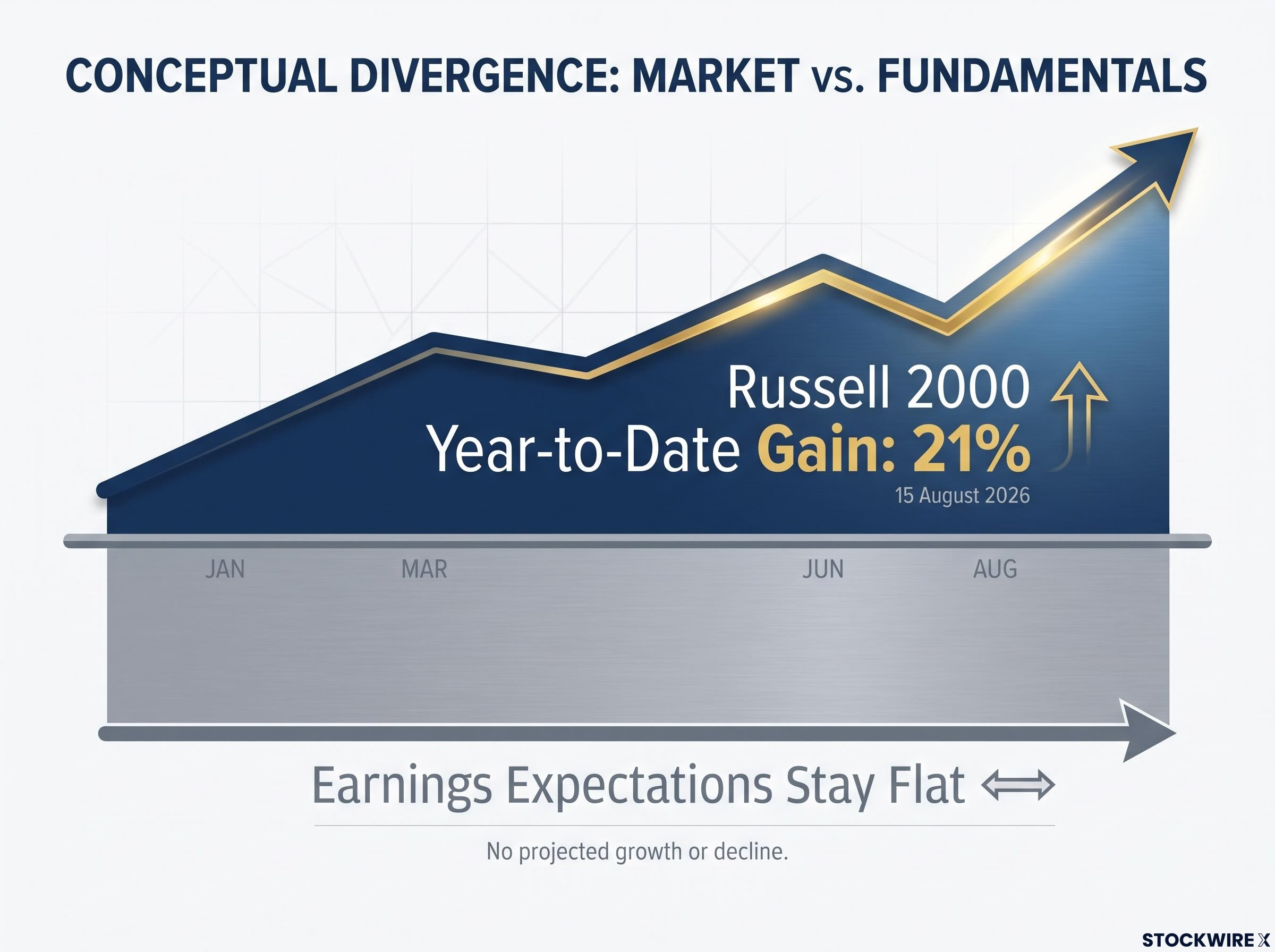
Russell 2000 year-to-date gain: 21% as of 15 August 2026
That figure is the starting point for Barclays’ scepticism, and it deserves scrutiny. A 21% advance in barely eight months would be easy to celebrate if the underlying earnings power of the index’s constituents had moved with it. It has not.
Forward earnings revisions for small-cap companies have lagged their large-cap peers meaningfully through the first half of 2026. On the other side of the market-cap divide, Amazon and Alphabet posted robust Q2 2026 earnings, with fiscal 2026 earnings-per-share estimates continuing to move higher throughout the reporting season. Small caps got the price move without the profit improvement.
When an index rises 21% and earnings expectations stay flat, investors are paying more for each dollar of future earnings than the business fundamentals justify. That is the divergence Barclays is flagging, and it is the foundation of everything else in their note.
The leverage vulnerability Barclays identifies sits on top of a longer-running structural problem: small-cap quality deterioration driven by private capital markets has left nearly half of Russell 2000 constituents unprofitable, a compositional shift that amplifies the earnings-to-price divergence the bank is flagging.
When big ASX news breaks, our subscribers know first
Small caps excluded from AI-driven gains
The most common rebuttal to scepticism about any 2026 rally is AI enthusiasm. Barclays addresses it directly.
Barclays concluded that the Russell 2000’s advance cannot be adequately accounted for by AI-related factors, pointing out that the companies capturing the direct benefits of AI infrastructure investment are the mega-cap hyperscalers rather than the index’s broad small-cap membership.
Amazon and Alphabet are the earnings anchors benefiting from AI capital spending. The typical Russell 2000 constituent is not. AI tailwinds are concentrated in large-cap tech and the handful of companies building and operating AI infrastructure at scale.
Even among the genuine AI beneficiaries, investor scrutiny of capital expenditure is rising. The bar for satisfactory AI-spending outcomes has moved higher through the Q2 reporting season. If AI enthusiasm cannot fully justify the rally for companies where the spending is real, applying it as justification for Russell 2000 gains requires an even more speculative leap. If your thesis for holding small caps involves AI spillover benefits, Barclays’ note is a direct challenge to that reasoning.
Why interest rates and leverage make small caps more exposed
The earnings divergence is one layer of risk. The balance-sheet profile is the second, and it operates independently.
Russell 2000 constituents carry higher leverage and greater floating-rate debt exposure than large-cap peers. That makes them structurally more sensitive to credit and rate conditions. Investment-grade large-cap companies can absorb a shift in rate expectations or a widening of credit spreads with relative comfort. Small caps face a disproportionate earnings and refinancing headwind in the same scenario.
Barclays frames this as a latent vulnerability, not a prediction of a specific rate move. The three risks compound:
Barclays’ leverage concern does not exist in isolation: margin debt signals published in July 2026 showed US margin debt at a record $1.416 trillion, up 54% year-over-year, a pace 2.5 times faster than S&P 500 returns and a configuration that preceded each of the three major drawdowns since 2000.
- Earnings divergence: Prices have outrun profits, stretching valuations
- Floating-rate exposure: Higher sensitivity to any deterioration in credit or rate conditions
- Limited refinancing flexibility: Smaller borrowers face tighter terms and fewer options than investment-grade large caps
For investors holding small-cap ETFs or individual Russell 2000 names, this leverage profile means that a macro development that would be a moderate headwind for a large-cap portfolio could translate into a sharper earnings and valuation hit for small-cap holdings.
What a bear put spread is and why Barclays chose this structure
A put option gives the holder the right to profit if the underlying index falls below a specified price (the strike price) by a given date. Buying a put is the simplest form of downside protection, but the premium cost can be substantial, particularly when volatility is elevated.
A bear put spread reduces that cost. The structure involves two simultaneous trades:
- Buy a put at a higher strike price (closer to where the index currently trades)
- Sell a put at a lower strike price (further below the current level), same index, same expiration
The premium received from selling the lower-strike put partially offsets the cost of buying the higher-strike put, which is the core efficiency advantage.
The bear put spread Barclays recommends belongs to the same family of two-legged options structures as credit spread mechanics used by institutional traders to generate positive theta; the key difference is that a bear put spread is a debit structure where the investor pays net premium, while a credit spread involves receiving it, giving each a distinct cost and probability profile.
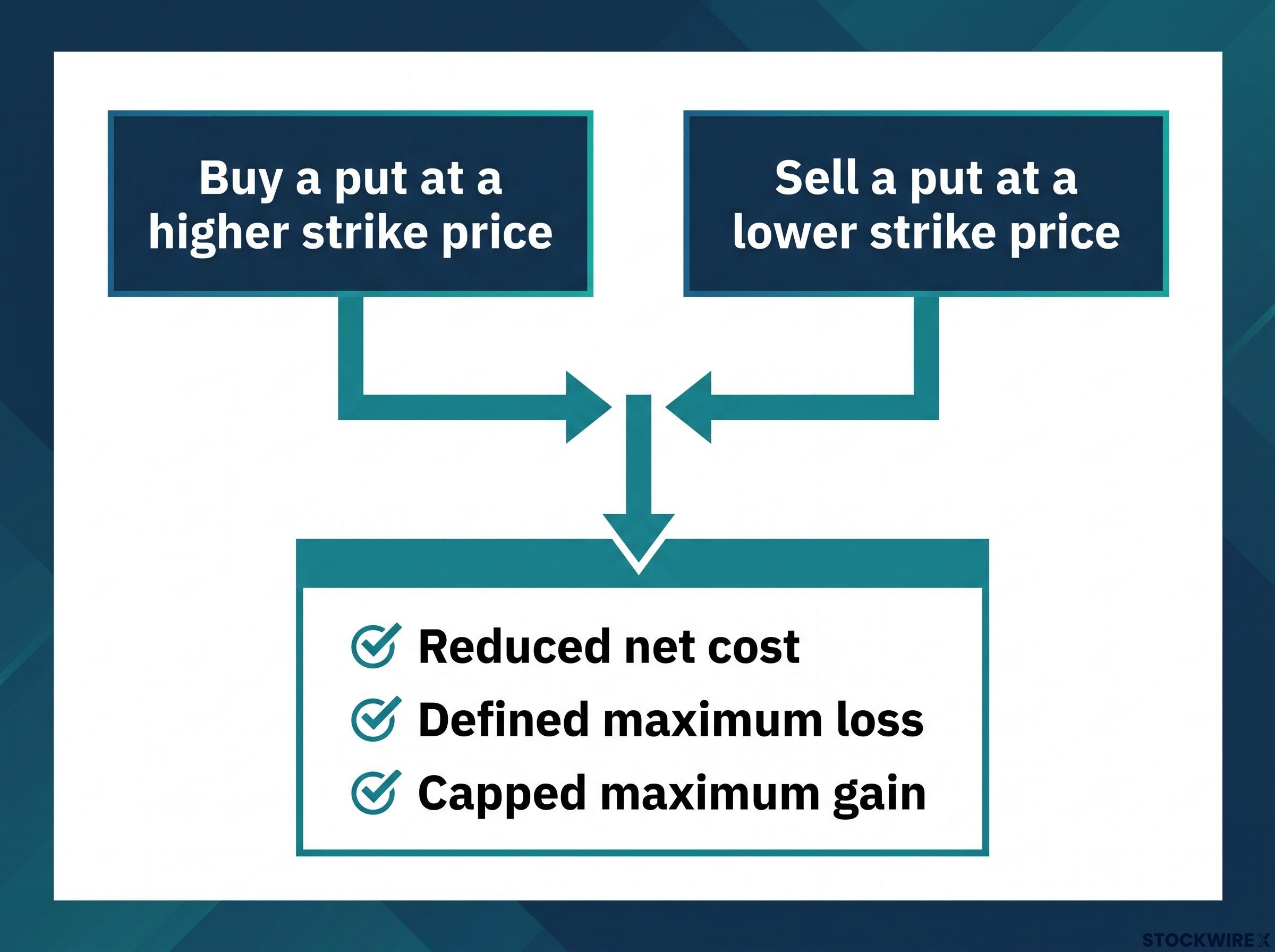
Three characteristics define the structure:
- Reduced net cost: The sold put’s premium subsidises the purchased put, making the hedge cheaper than a standalone put
- Defined maximum loss: The most the investor can lose is the net premium paid, which occurs if the index finishes above the higher strike at expiration
- Capped maximum gain: Profit is limited to the difference between the two strike prices minus the net premium, achieved if the index falls below the lower strike
| Feature | Standalone Long Put | Bear Put Spread |
|---|---|---|
| Upfront Cost | Full premium paid | Reduced (net of sold put premium) |
| Maximum Loss | Premium paid | Net premium paid |
| Maximum Gain | Substantial (index can fall to zero) | Capped (spread width minus net premium) |
| Best Use Case | High-conviction severe decline | Moderate correction, cost-efficient hedge |
How the spread targets a realistic correction
The spread’s profit zone maps onto a moderate decline scenario, typically a mid-single-digit to low-double-digit percentage fall, rather than a catastrophic collapse. That range is precisely why institutional hedgers prefer spreads when their conviction is about deteriorating risk-reward, not an imminent crash.
The capped gain is not a limitation to worry about here. It is the design feature that keeps hedging costs manageable for institutional investors who want protection against a moderate pullback rather than an outright market break.
What the structure of the trade tells you about Barclays’ conviction level
The decision to recommend a spread rather than an outright long put communicates the character of Barclays’ concern. An outright long put is the appropriate structure when an investor has high-conviction, severe downside expectations. The spread says something different: correction risk is real, but bounded.
- Standalone put: Best suited when the base case is a sharp, severe decline; the uncapped profit potential justifies the higher premium
- Bear put spread: Best suited when the base case is a moderate pullback; the reduced cost is worth accepting capped gains because a catastrophic scenario is not the primary expectation
Barclays is telling the market that the correction risk is real enough to hedge but not severe enough to require abandoning small-cap positions entirely. That is a meaningfully different message from a bear note calling for outright underweight. The spread allows investors to stay invested while defining their downside exposure, a risk-management posture rather than a directional bet.
What investors with small-cap exposure should take from this
Barclays’ note is a risk-management signal, not a blanket exit call. The investor-level implications are specific:
- Reassess position sizing: Has your small-cap allocation grown, relative to your total portfolio, to a size you would be comfortable with if the index retraced half its year-to-date gains?
- Define your downside plan: Whether through options hedges, disciplined exit levels, or position-size reduction, having a plan before a pullback arrives is what the Barclays note is pointing toward
- Demand a specific thesis for adding: Any decision to increase small-cap exposure at current levels should rest on a clear fundamental case, not momentum or AI-spillover assumptions
- Read the structure as a signal: The choice of a spread over an outright put tells you Barclays sees moderate correction risk, plausible and worth hedging, not catastrophic
For retail investors without access to options strategies, the most actionable takeaway is the position-sizing question. If a 10% retracement in the Russell 2000 would create discomfort in your portfolio, the current allocation may be larger than your risk tolerance warrants.
For investors wanting a full framework for acting on these signals, our dedicated guide to small-cap portfolio positioning for H2 2026 covers the specific allocation targets, quality screening criteria, and AI concentration risk audit steps that apply to the current market environment.
This article is for informational purposes only and should not be considered financial advice. Investors should conduct their own research and consult with financial professionals before making investment decisions. Past performance does not guarantee future results. Options and derivatives involve significant risk and may not be suitable for all investors.
When price and earnings diverge, the hedge tells the story
The Russell 2000’s 21% year-to-date advance sits on two structural vulnerabilities: an earnings-to-price divergence that the rally has not resolved, and a balance-sheet profile that amplifies downside risk if macro conditions shift. Barclays sees both.
Their choice of instrument ties the analysis together. A bear put spread is the hedge you recommend when correction risk is real, cost matters, and the base case is a moderate retracement rather than a collapse. The note’s publication one day after key earnings-season developments makes it timely directional context, not backward-looking commentary.
What Barclays is offering is not a call to sell everything. It is a professional framework for thinking about what you own, how much of it you own, and whether the price you paid still makes sense relative to the earnings those companies are actually delivering.