Cisco just reported its strongest AI-driven results in the company’s history, and the stock fell anyway. That disconnect tells you something important about where the AI rally stands right now.
The earnings release landed on 13 August 2026, with Cisco entering the print on a 60%-plus year-to-date rally, AI infrastructure orders revised upward to a $9 billion annual target, and CEO Chuck Robbins characterising portfolio-wide demand as something the company has not seen for roughly thirty years. The premarket decline is the puzzle that unlocks the real story: when expectations are priced this high, even a strong quarter can disappoint on sentiment.
Here is what the data actually tells you about where AI infrastructure spending is flowing, how the order trajectory reshapes the investment case for networking equipment, and how to read today’s price reaction without confusing short-term positioning with the longer-term structural shift underneath it.
Cisco’s AI order machine: from $2 billion to $9 billion in one year
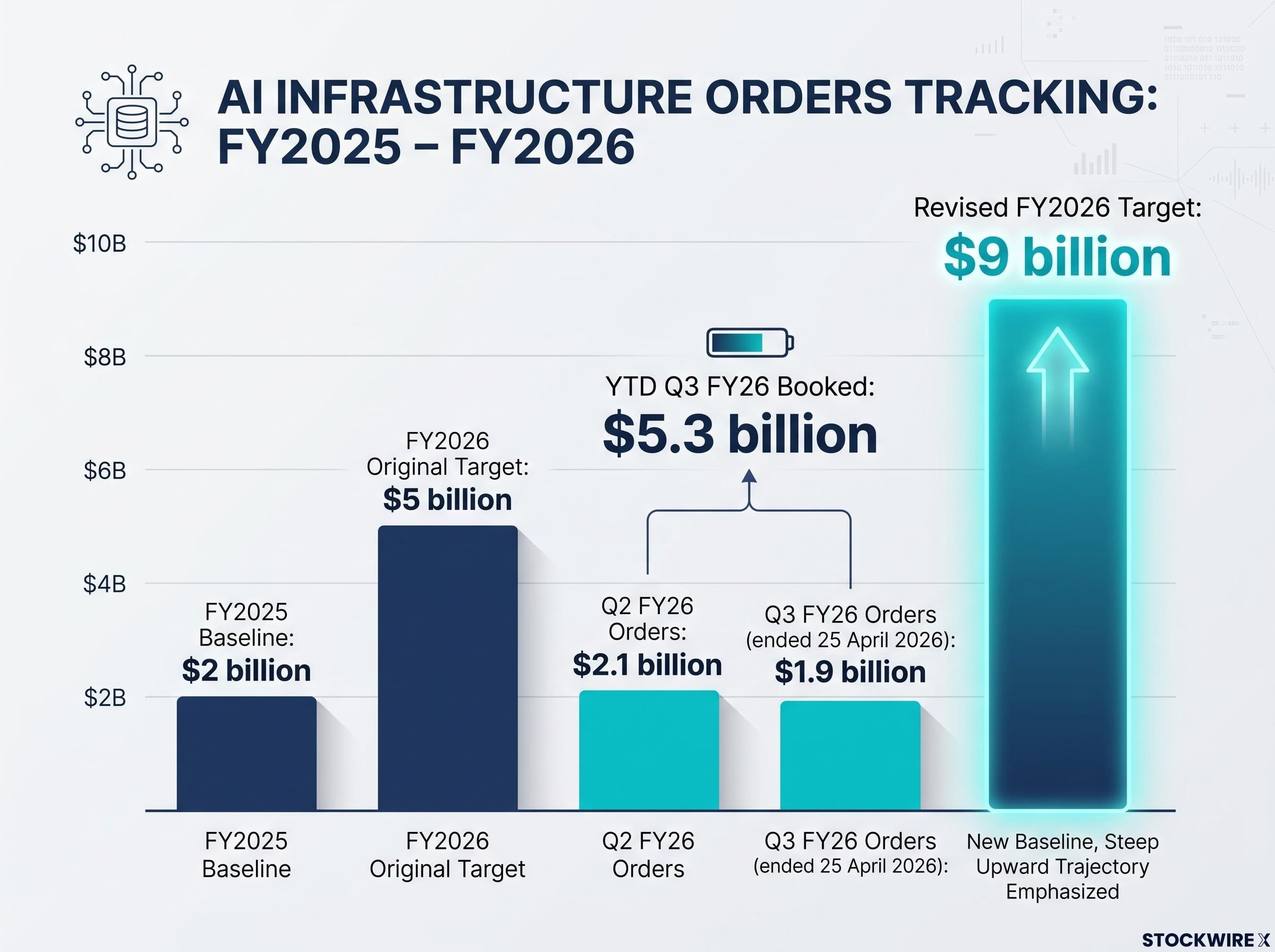
The order progression speaks for itself when you lay it out sequentially:
- FY2025 baseline: approximately $2 billion in total AI infrastructure orders across the full fiscal year
- FY2026 original target: $5 billion, set at the start of the fiscal year
- Q2 FY26 inflection: $2.1 billion in hyperscaler AI orders in a single quarter, matching the entire prior year’s total
- Q3 FY26 (quarter ended 25 April 2026): $1.9 billion in hyperscaler AI infrastructure orders
- Year-to-date through Q3 FY26: $5.3 billion already booked, surpassing the original full-year target before the fiscal year ended
- Revised FY2026 target: raised to approximately $9 billion
That Q2 figure is the structural inflection point. When a single quarter’s hyperscaler orders equal the prior full year’s total, you are no longer looking at a spike. You are looking at a new baseline.
The May 2026 print that established the $9 billion AI order forecast produced a 16.5% single-session surge, a result that now frames just how much expectation has accumulated in the months since, and why today’s premarket reaction lands so differently despite a comparably strong underlying result.
Chuck Robbins, Cisco’s CEO, indicated the company had not experienced this magnitude of broad portfolio demand in approximately 30 years, and characterised the AI expansion as the most rapidly evolving technology shift the company has ever encountered, according to the Wall Street Journal.
The order progression tells you that hyperscaler AI buildout is not a one-quarter event but a sustained capital commitment. That multi-year cadence changes the investment thesis for networking equipment suppliers, because it moves revenue visibility from quarter-to-quarter guesswork to something closer to a forward pipeline.
When big ASX news breaks, our subscribers know first
Why networking is the layer of AI infrastructure most investors are skipping
Most investor attention on AI infrastructure flows to two places: chips at the bottom of the stack and models at the top. The layer in between, networking, absorbs a substantial share of every dollar hyperscalers commit to AI data centres, and it is the layer most portfolios are underexposed to.
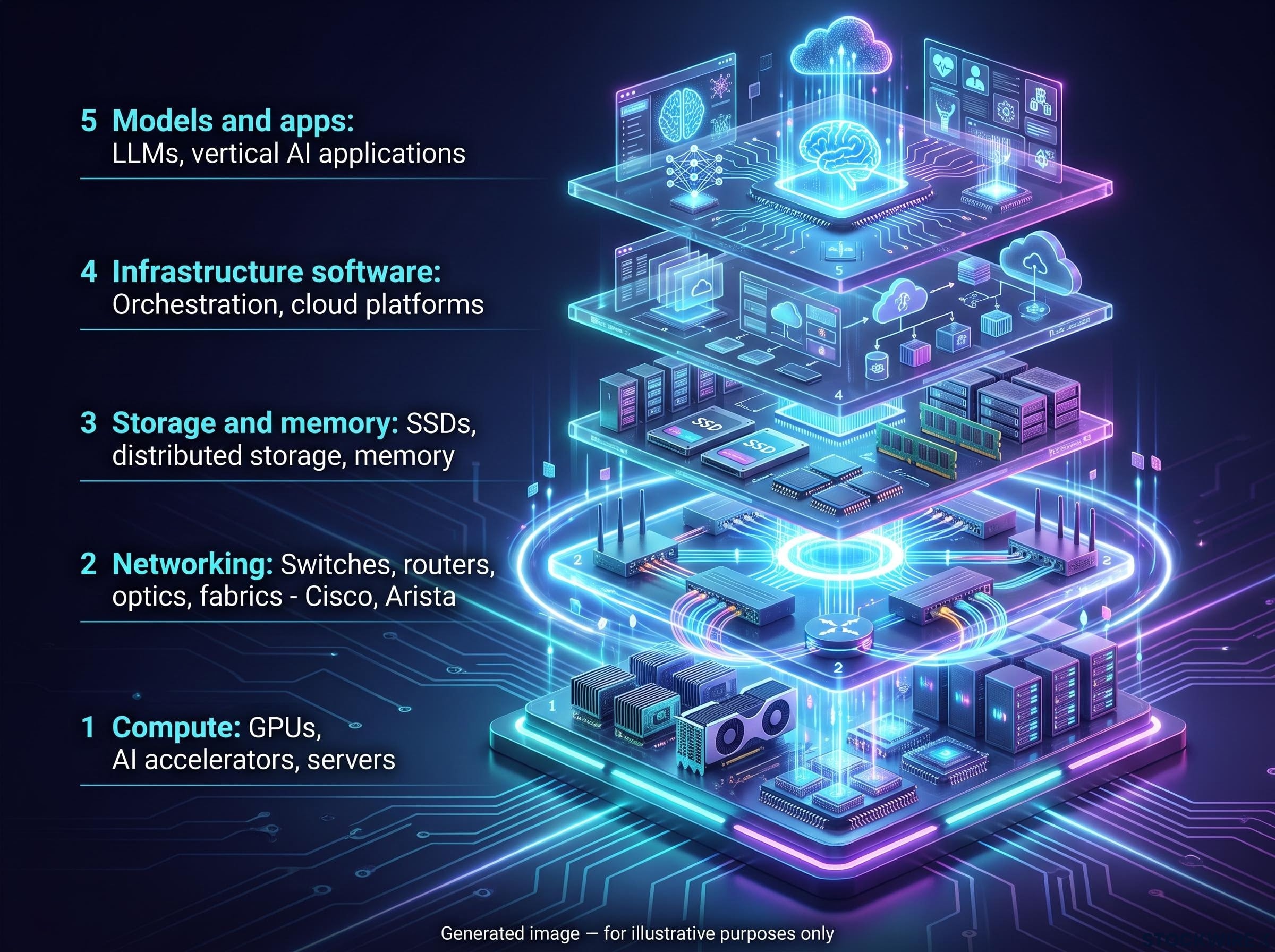
The logic is physical. Large GPU training and inference clusters need ultra-high-speed switching and routing to move data between thousands of GPUs with minimal latency. This East-West bandwidth requirement (the data traffic moving laterally between servers inside a data centre, rather than in and out to users) is a non-optional spend category. Without it, the GPUs sit idle waiting for data.
| Layer | What it includes | Key beneficiary examples |
|---|---|---|
| Compute | GPUs, AI accelerators, servers | Semiconductor companies, server OEMs |
| Networking | Switches, routers, optics, fabrics | Cisco, Arista, other networking vendors |
| Storage and memory | SSDs, distributed storage, memory | Storage vendors, memory suppliers |
| Infrastructure software | Orchestration, cloud platforms | Hyperscaler clouds, platform software |
| Models and apps | LLMs, vertical AI applications | AI model developers, SaaS companies |
Cisco sits directly in the networking spend path with specific product lines designed for this workload:
- Silicon One-powered systems built for AI networking at massive scale
- Acacia optical interconnects for high-performance data-centre and inter-data-centre connectivity
- Routing and fabric systems supporting both hyperscaler buildout and enterprise campus networking refresh for agentic AI workloads
Analysts refer to a “networking supercycle” and frame Cisco as “critical infrastructure for the AI era.” A meaningful share of every dollar hyperscalers are committing to AI data centres flows to suppliers in this layer, and that is something worth understanding before you evaluate the stock.
What a 60% rally in six months actually means for the stock today
The demand story is real. The valuation story is more complicated. Approximately 33% of Cisco’s year-to-date price surge is attributable to price-to-earnings (P/E) multiple expansion, the market assigning a higher valuation ratio to each dollar of earnings, rather than to earnings growth itself. That distinction matters because it means the stock is increasingly sensitive to the gap between expectations and results.
P/E multiple expansion is the mechanism that makes a 60% year-to-date rally possible without proportional earnings growth, but it is also the mechanism that converts a strong earnings print into a sell-off when the expansion cycle has already run and the market has moved to pricing only earnings surprises.
Q3 FY26 revenue came in at $15.84 billion, up 12% year over year, reported on 13 May 2026. Strong by any historical standard. But when a stock enters an earnings print up 60% on the year and trading near record highs, “strong” is not enough to move the price higher. Only “spectacular” creates room for further re-rating.
Three mechanisms drove today’s premarket sell-off:
- Multiple expansion risk: with a 33% P/E expansion already baked in, incremental positive surprises need to be large to justify further re-rating
- Profit-taking after crowded positioning: investors who crowded into the AI narrative ahead of the catalyst take profits on the print, regardless of whether the underlying results were good
- Expectation gap: the wider U.S. futures market was in positive territory on 13 August, with the Dow, S&P 500, and Nasdaq 100 contracts each advancing by around 0.1%-0.2%, confirming that Cisco’s decline was company-specific rather than market-driven
Near-term volatility around an earnings print tells you more about positioning and sentiment than about whether the AI infrastructure thesis is intact.
The premarket decline after a strong print does not invalidate the networking thesis. It tells you that near-term stock risk is now about positioning and expectations, not about whether Cisco is actually winning in AI infrastructure.
The risks that come with Cisco’s new AI identity
The same forces that produced the rally also produced the risks. They are not external threats; they are structurally embedded in the thesis.
- Competitive pressure: Arista Networks and Juniper are specific, named competitors fighting for the same hyperscaler design wins. Cisco’s ability to hold and grow those relationships is not guaranteed.
- AI capex cyclicality: current spending is extraordinary, but it is ultimately sensitive to macro conditions, ROI reassessments by hyperscalers, and architectural shifts such as more efficient models requiring less infrastructure.
- Software and recurring revenue transition: management is pushing a strategic pivot toward software and recurring revenue. Failure to shift the revenue mix could cap valuation multiples even if AI order growth continues.
- High expectations embedded in the multiple: with a 60% year-to-date rally and a 33% P/E expansion, any deceleration in AI order growth carries outsized stock-price risk relative to its impact on underlying fundamentals.
AI capex sustainability is the variable that will determine whether the $9 billion order trajectory extends into FY2027 or stalls, and Goldman Sachs data showing hyperscaler AI spending now absorbs 93-94% of operating cash flow raises the question of how long that pace holds before ROI reassessments force a reallocation.
On the margin front, one recent analysis noted a 4% year-over-year decline in security segment revenue and a nearly 19% drop in operating cash flow, though these figures have not been independently confirmed and should be treated with appropriate caution.
Cisco has set FY2027 AI-related revenue guidance at a minimum of $6 billion, which establishes the baseline against which execution will be judged. Each of these risks is an active variable worth monitoring in subsequent quarters, not a reason to dismiss the thesis. The question is knowing specifically what to watch for, rather than reacting to price moves alone.
This article is for informational purposes only and should not be considered financial advice. Investors should conduct their own research and consult with financial professionals before making investment decisions.
How Cisco fits into an AI infrastructure portfolio alongside chips and cloud
Cisco functions as a “picks-and-shovels” infrastructure complement, capturing the networking and data-centre fabric spend that is necessary for GPU and cloud investments to generate returns. If you already hold semiconductor and cloud names, the networking layer is where a meaningful share of AI capex flows that those positions do not capture.
Two independent demand vectors reduce single-source concentration risk:
- Hyperscaler buildout: the primary driver, with multiple new AI design wins reported, including systems built around Silicon One and Acacia optics
- Enterprise campus refresh: Cisco’s large installed base is upgrading networks for agentic AI workloads, providing a second demand stream that operates on a different cycle to hyperscaler spending
Cisco guides for at least $6 billion in AI-related revenues in FY2027, providing multi-year revenue visibility unusual in a sector often characterised by lumpy, project-based spending.
That guidance figure tells you Cisco’s AI revenue is not a one-cycle event but an expected multi-year flow. That changes how it should be evaluated relative to more cyclical technology hardware names, where revenue visibility rarely extends more than a quarter or two.
Past performance does not guarantee future results. Financial projections are subject to market conditions and various risk factors.
What today’s earnings reaction changes, and what it does not
What today confirmed:
- The AI networking demand story is real, multi-year, and accelerating by the company’s own guidance and order data
- Hyperscaler AI infrastructure orders are running at a pace that supports the revised $9 billion FY2026 target
- Cisco’s product positioning in the networking layer, through Silicon One and Acacia, continues to win design slots
What remains open:
- Whether the stock’s current multiple already prices in the best-case scenario for AI order growth
- Whether AI capex spending will remain at current intensity through FY2027 and beyond, or whether efficiency gains and ROI reassessments slow the pace
- Whether the software and recurring revenue transition shows meaningful progress in margin data over the next two to three quarters
The two variables most worth watching are the pace of AI infrastructure order growth relative to the $9 billion revised target, and whether Cisco’s margin profile improves as the revenue mix shifts. Today’s premarket decline is a live illustration of expectations risk already embedded in the stock. The health of the AI networking thesis remains strong and confirmed. Whether the stock is a buy at current levels is a genuinely separate question, and one that depends on your view of how long this spending cycle runs.
For investors wanting to work through the mechanics in more depth, our dedicated guide to valuation and entry price discipline examines how Intel and Cisco’s post-peak histories show that dominant competitive positions do not protect against decades of underperformance when the entry price embeds excessive expectations.
—