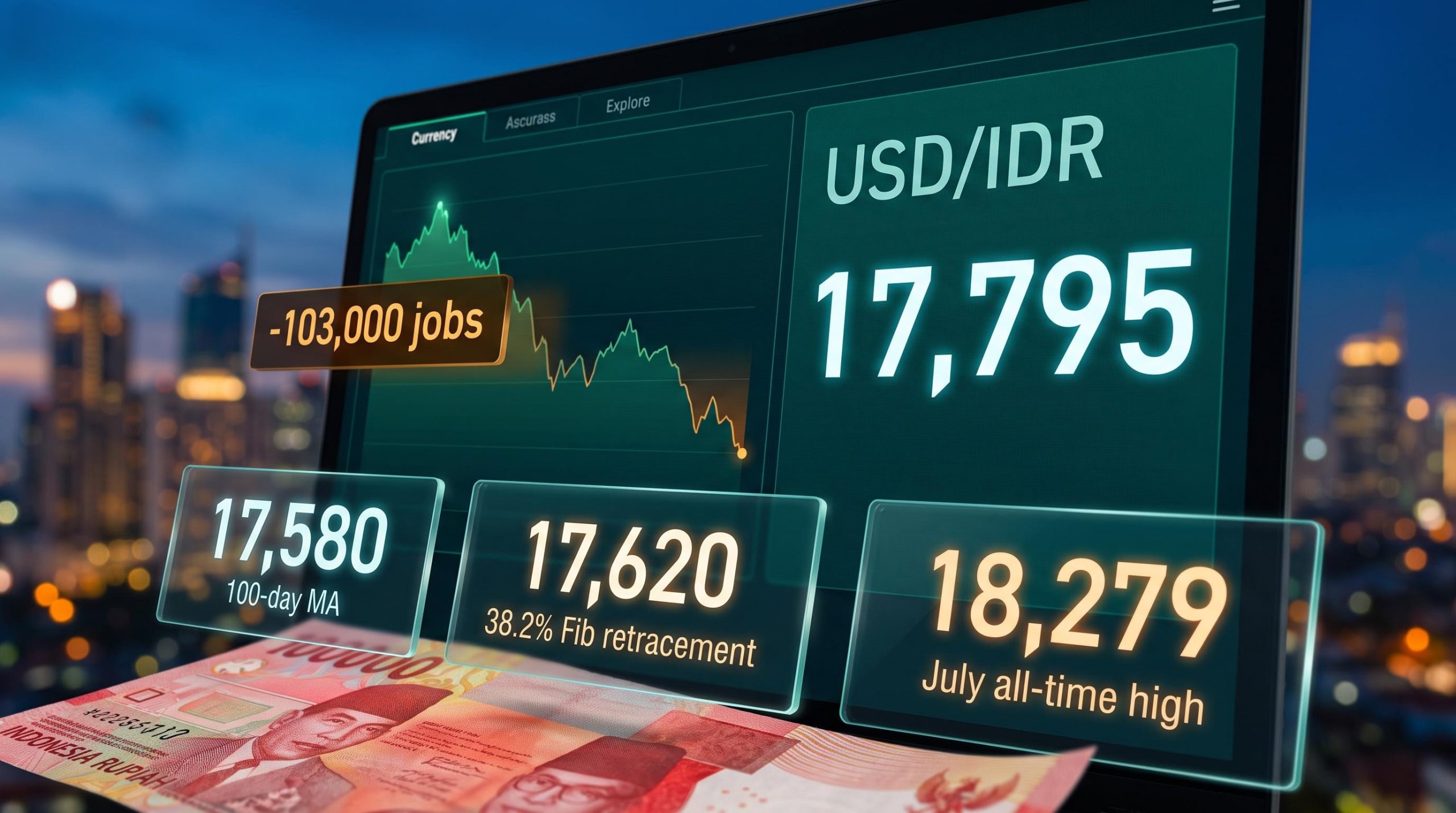
Two catalysts arrived in the same week, and the combination is rare. A clean central bank succession at Bank Indonesia removed the leadership uncertainty that had been priced into the Rupiah since late July, while a US payroll print that missed consensus by more than 100,000 jobs pulled the Dollar lower across the board. USD/IDR has retreated from its July all-time high of 18,279 to a range of 17,760-17,803, the best Rupiah reading in seven weeks.
That move matters because it is not a single-catalyst bounce. The interaction between external Dollar weakness and a domestic policy continuity signal is what separates a durable currency recovery from a short-lived squeeze, and understanding how both forces are operating simultaneously is what gives you an edge in reading what comes next.
Here is where the directional bias sits right now, where the technical levels define the road map, and which two events over the next two weeks will determine whether this Rupiah recovery holds or stalls. The goal is a clear framework: trend or trade.
How a leadership change at Bank Indonesia shifted the Rupiah’s risk premium
Central bank transitions carry a cost for emerging market currencies. Markets cannot price future monetary policy without knowing who will set it, what their framework priorities are, and whether they will defend the currency or prioritise growth. That uncertainty shows up directly in the exchange rate as a risk premium.
President Prabowo Subianto removed that premium in one move. With Destry Damayanti put forward as the only name to take the permanent governorship following Perry Warjiyo’s exit in late July 2026, the transition concluded without the drawn-out uncertainty markets had feared. Damayanti brings deep institutional roots rather than an outsider’s agenda, having built her career within Bank Indonesia itself, and her track record points clearly toward continued prioritisation of exchange-rate stability.
OCBC strategists Sim Moh Siong and Christopher Wong noted that the nomination effectively eliminated the uncertainty discount, because markets can now treat three policy dimensions as preserved:
- Inflation targeting: BI’s framework remains anchored to the same mandate.
- Currency stability emphasis: The institutional priority that kept BI intervening through the July weakness is intact.
- Macro-prudential tool preference: BI’s approach of using rates and balance-sheet tools as FX anchors continues under the same institutional philosophy.
What this changes for you is the carry calculus. Without leadership uncertainty clouding the outlook, Indonesia’s relatively high nominal yields versus developed markets become more attractive on a risk-adjusted basis. That supports capital inflows into IDR bonds and money-market instruments, giving the Rupiah’s recovery a structural support layer, not just a sentiment pop.
When big ASX news breaks, our subscribers know first
What the July payroll shock did to the Dollar, and why it matters for IDR
-23,000 versus +80,000 expected
That was the July 2026 nonfarm payrolls print, released on 7 August 2026. Not a modest miss. A 103,000-job swing from consensus, and the first outright decline the US labour market has posted in this cycle.
A number that large is not noise. It reprices expectations. Here is how it transmits from a US jobs report to an Indonesian exchange rate, link by link:
The July payroll miss did not emerge in isolation; four consecutive months of labour market deceleration had already shifted Fed rate-cut pricing before the August print landed, meaning the Dollar was entering the week structurally vulnerable rather than merely reacting to a one-off surprise.
- Softer labour data reduces the perceived need for prolonged Fed tightening. If the US economy is shedding jobs rather than adding them, the case for holding rates higher for longer weakens materially.
- Lower rate expectations compress US yields, which diminishes the relative carry advantage of holding Dollar-denominated assets versus emerging market alternatives.
- A weaker Dollar follows broadly, because the yield differential that supported USD demand is narrowing.
- Portfolio capital rotates toward higher-yielding EM instruments, including IDR bonds and money-market products, supporting the Rupiah.
- Bank Indonesia gains breathing room. A softer USD backdrop reduces the pressure on BI to maintain ultra-defensive policy purely to protect the currency, creating a secondary domestic benefit.
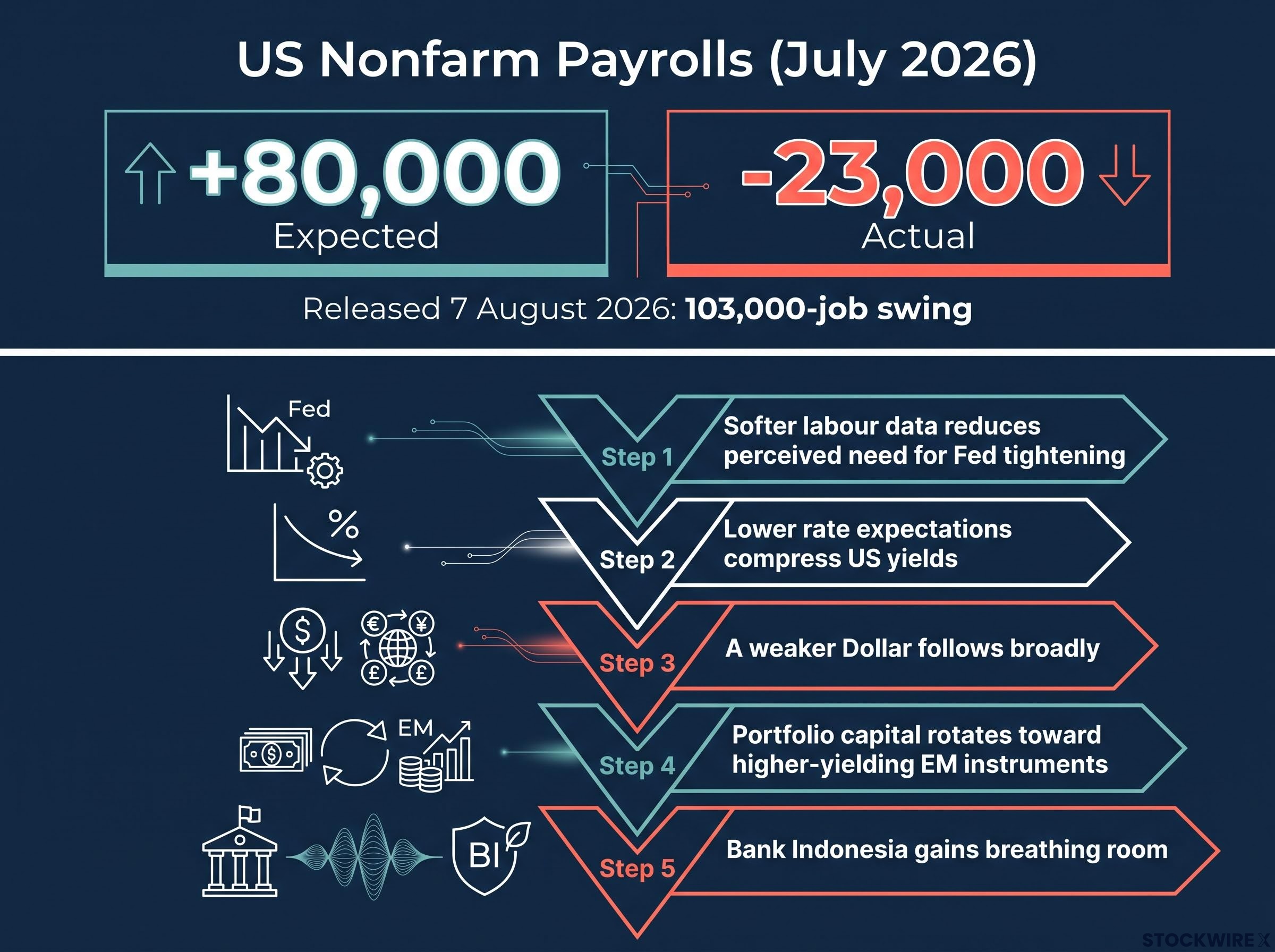
The result is visible in the chart. USD/IDR has pulled back from its July all-time high of 18,279 to the current range of 17,760-17,803, the best Rupiah reading since late June 2026. For anyone holding IDR-denominated assets or tracking this pair directionally, the external headwind that drove the record highs in July has materially softened.
If you attributed all of July’s Rupiah weakness to domestic factors, the payroll data forces a recalibration. The USD driver is now moving in the opposite direction.
Reading the technical map on USD/IDR
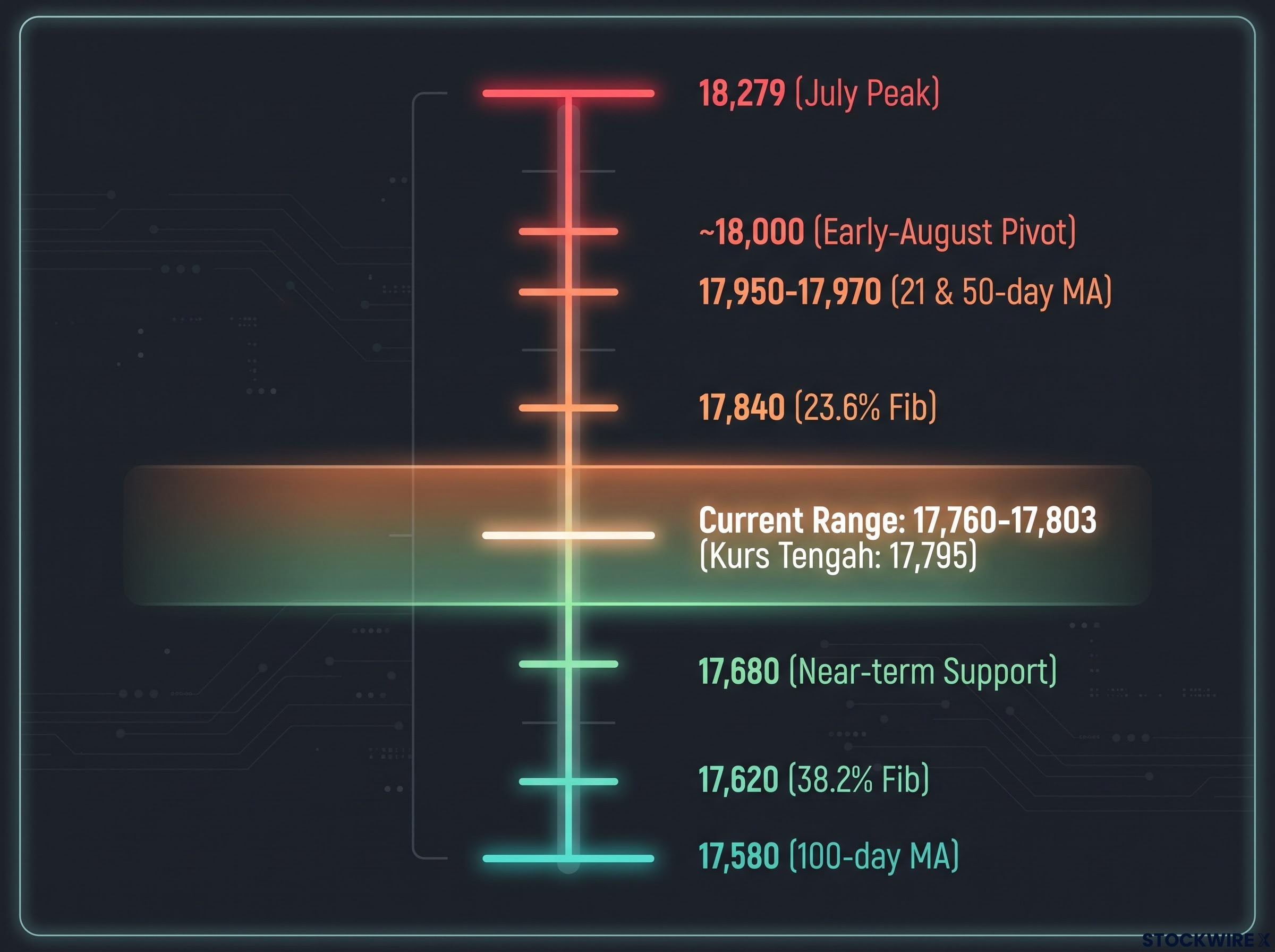
The pair sits at 17,760-17,803, with the Bank Indonesia Kurs Tengah (the official mid-rate, the central bank’s daily reference price for the exchange rate) at 17,795. That puts spot squarely in the middle of the official reference corridor and well below the July peak of 18,279.
OCBC strategists Sim Moh Siong and Christopher Wong identified six levels that frame the near-term trading range. Three define downside targets if the Rupiah continues to strengthen; three mark the resistance zones where a reversal could stall.
| Level | Significance |
|---|---|
| 17,680 (support) | Near-term downside target |
| 17,620 (support) | 38.2% Fibonacci retracement of the 2026 low-to-high range |
| 17,580 (support) | Aligned with the 100-day moving average |
| 17,840 (resistance) | 23.6% Fibonacci retracement |
| 17,950-17,970 (resistance) | 21-day and 50-day moving average convergence zone |
| ~18,000 (resistance) | Early-August pivot; primary directional threshold |
A Fibonacci retracement measures how far a price has pulled back from a prior move; the 38.2% and 23.6% levels are standard thresholds where traders watch for the pullback to pause or reverse. A moving average smooths daily price action over a set period to show the underlying trend direction.
What momentum indicators say about the quality of the move
On the daily chart, the 21-day moving average has moved below the 50-day moving average, a bearish configuration that aligns with the broader short-term downtrend running from the July peak and keeps the directional bias pointed toward further IDR gains.
But the RSI (relative strength index, a momentum gauge that measures whether a move is becoming overextended) is approaching oversold territory on the daily chart. That is a warning, not a contradiction. It means the pair is unlikely to fall in a clean, straight line from here. Further downside is more likely to be choppy, with intermittent bounces, rather than smooth trending.
The threshold to watch: a clean break back above approximately 18,000 on strong volume, combined with a firmer USD backdrop, would signal that the current IDR recovery is stalling. Below that level, the path of least resistance remains modestly lower.
Why Indonesia’s status as a net oil importer is a structural wildcard
If you are tracking USD/IDR through the lens of central bank policy and US data alone, there is a variable you are likely underweighting.
Indonesia is a net oil importer. That is not a cyclical condition; it is a structural feature of the current account. When global oil prices rise sustainably over weeks or months, the trade and current-account balance deteriorates, which is fundamentally negative for the Rupiah regardless of what the Fed or BI are doing. This is a macro-fundamental override that can invalidate otherwise constructive setups without warning.
The current-account pressure Indonesia faces from rising oil import costs is not a new or isolated risk; global oil supply disruption through the Hormuz corridor reduced seaborne flows by an estimated 12-13 million barrels per day, a shock that continues to feed through to delivered crude costs for Asian importers months after the initial disruption.
Two structural wildcards sit outside the event calendar:
- Oil prices: A sustained move higher worsens Indonesia’s current account and pressures IDR even in a soft-Dollar environment. The transmission is slow but persistent, and it does not announce itself the way a rate decision does.
- Global risk sentiment: Appetite for IDR carry trades is modulated by global equity markets, credit spreads, and geopolitical developments. A sharp deterioration in risk appetite reduces EM carry appeal broadly and can amplify USD/IDR sensitivity to any negative shock.
Carry trade unwind risk adds a cross-market dimension to the USD/IDR setup that operates independently of BI policy or US data: at 1.0% yen funding costs, the margin of safety on yen-funded EM positions has narrowed materially, and a rapid yen appreciation shock similar to August 2024 could pressure IDR alongside all high-yielding EM currencies regardless of Indonesia’s domestic fundamentals.
These are the two risks that can flip the setup silently. They operate on a different frequency to scheduled events, which is precisely what makes them the most important variables to monitor continuously.
The two events that will define the next directional move in USD/IDR
Two catalysts in the next two weeks will either reinforce the current IDR-constructive bias or reverse it. They function as a genuine fork in the road, not routine calendar events.
The first is the upcoming US CPI release. A cooling print, stacked alongside the soft labour data, would push markets to price earlier or deeper Fed rate cuts, keeping the Dollar under pressure and supporting continued USD/IDR drift lower. A hot print re-ignites higher-for-longer expectations, lifts US yields and the Dollar, and bounces the pair off current levels.
The second is the Bank Indonesia rate decision on 19 August 2026. BI has form here: surprise hikes earlier in 2026 produced the strongest weekly IDR gain since October 2025.
BI’s pre-emptive rate hikes earlier in 2026 were driven by rupiah defence rather than domestic inflation, a distinction that matters because it signals the central bank is willing to absorb growth costs to protect the exchange rate, exactly the institutional philosophy Damayanti is expected to continue.
BI’s earlier pre-emptive hikes in 2026 produced the strongest weekly Rupiah gain since October 2025, demonstrating the central bank’s willingness to use rates aggressively to defend the currency.
Markets will focus on whether BI reaffirms its FX-stability bias and how it frames the tension between growth risks and external-balance risks under Damayanti’s leadership.
| Event | Outcome | USD impact | USD/IDR direction |
|---|---|---|---|
| US CPI | Cooling print | Weaker USD | Lower (IDR strengthens) |
| US CPI | Hot print | Stronger USD | Higher (IDR weakens) |
| BI meeting (19 Aug) | Steady / hawkish tone | Neutral | Lower (IDR strengthens) |
| BI meeting (19 Aug) | Dovish surprise | Neutral | Higher (IDR weakens) |
The asymmetry you should notice is that a dovish BI surprise is the single most dangerous scenario. It removes the domestic policy anchor at the same moment US CPI could be providing an external headwind, creating a double negative that could push USD/IDR back toward 18,000 quickly. Having this scenario matrix before the events arrive allows you to pre-position your interpretation rather than react after the fact.
How to read USD/IDR right now: what the data says versus what it does not
The base case is straightforward. Both catalysts, softer USD and the Damayanti continuity signal, are genuinely supportive of the Rupiah in the near term. The technical structure confirms a short-term downtrend from the July peak. The pair has moved from 18,279 to a range of 17,760-17,803, and momentum indicators back the directional read.
What supports IDR now:
- Softer US labour data compressing Dollar strength
- Damayanti nomination removing leadership uncertainty premium
- BI’s demonstrated willingness to hike pre-emptively to defend the currency
- Bearish technical crossover with downtrend from July peak intact
What could reverse it:
- A hot US CPI print re-energising Dollar strength
- A dovish BI surprise on 19 August signalling reduced FX defence commitment
- Sustained rise in global oil prices worsening Indonesia’s current account
- A broad risk-off shock reducing EM carry appeal
What the setup does not resolve is the quality of further downside. The RSI warning, the oil and risk-sentiment wildcards, and the binary risk from both upcoming events mean the current bias should be held with appropriate conviction, not certainty.
The single most actionable reference point is the 18,000 level. As long as USD/IDR holds below it, the path of least resistance remains modestly lower. A sustained break back above 18,000 on strong volume is the primary signal that this IDR recovery is stalling.
This article is for informational purposes only and should not be considered financial advice. Investors should conduct their own research and consult with financial professionals before making investment decisions. These statements are speculative and subject to change based on market developments and company performance.