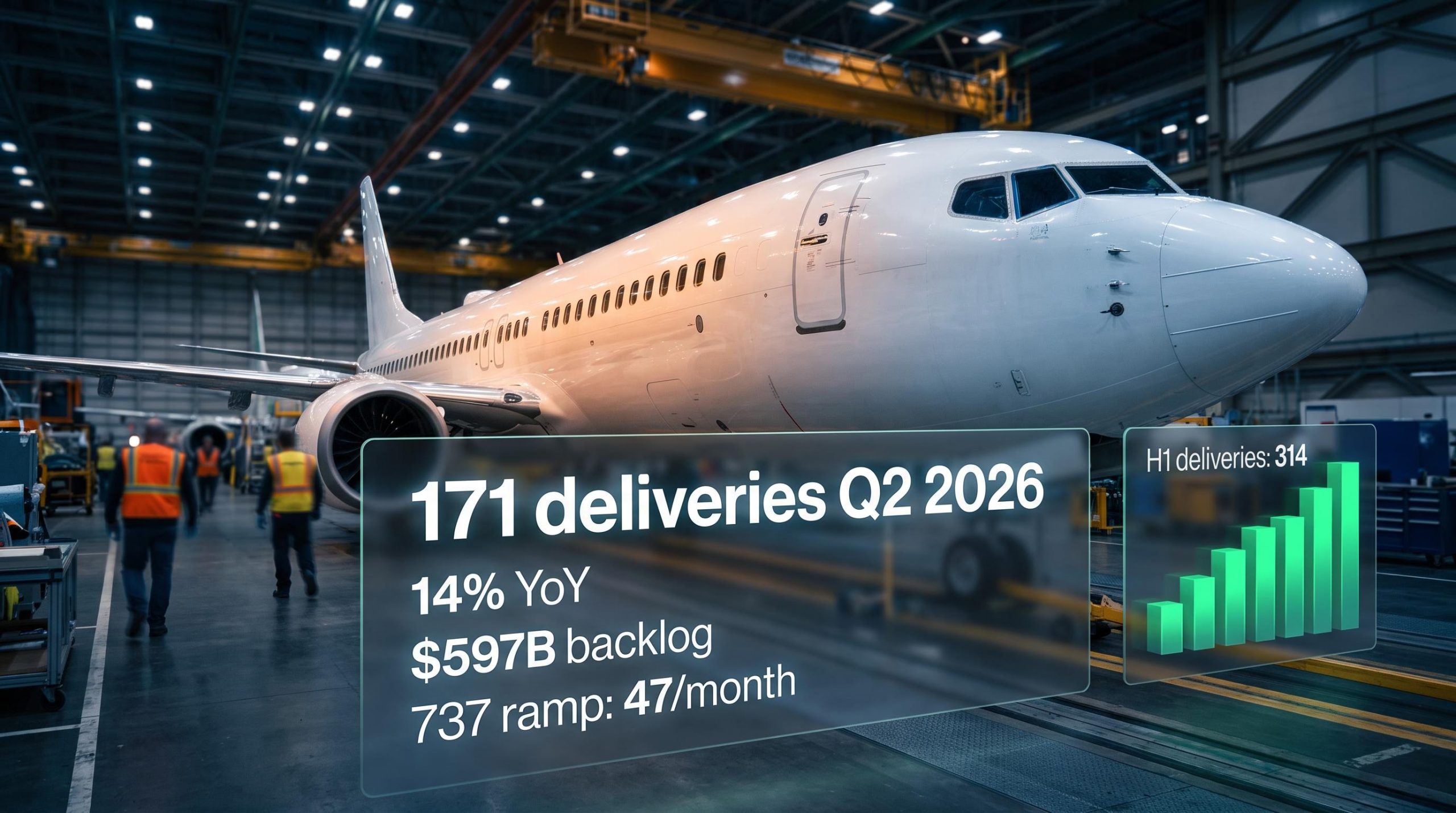
Boeing recorded 171 commercial aircraft deliveries in Q2 2026, its best quarterly output in roughly eight years. For a company that was a byword for industrial dysfunction eighteen months ago, that number is a legitimate signal. The question is whether it signals durable recovery or a strong quarter at the beginning of a still-unproven ramp.
The Q2 2026 print lands against a backdrop that includes a completed eight-month parallel inspection process with the Federal Aviation Administration (FAA), restored 787 delivery authority, a $597 billion commercial backlog, and a CEO whose messaging centres on quality culture rather than volume targets. Each of those facts matters. So does what is not in the data: Commercial Airplanes is still unprofitable, the 737 line is mid-ramp toward 47 per month, and analyst consensus clusters around six to eight more quarters of monitoring before any durable conclusions can be drawn.
Here is a structured framework for separating what Boeing has actually de-risked from what remains an open question, so you can form a grounded view on where the recovery thesis stands in August 2026.
What 171 deliveries actually confirms about Boeing’s industrial state
Boeing delivered 171 commercial aircraft in Q2 2026, a 14% increase from 150 in Q2 2025. First-half deliveries reached 314, up 12% from 280 in the same period last year. The delivery mix breaks down as follows:
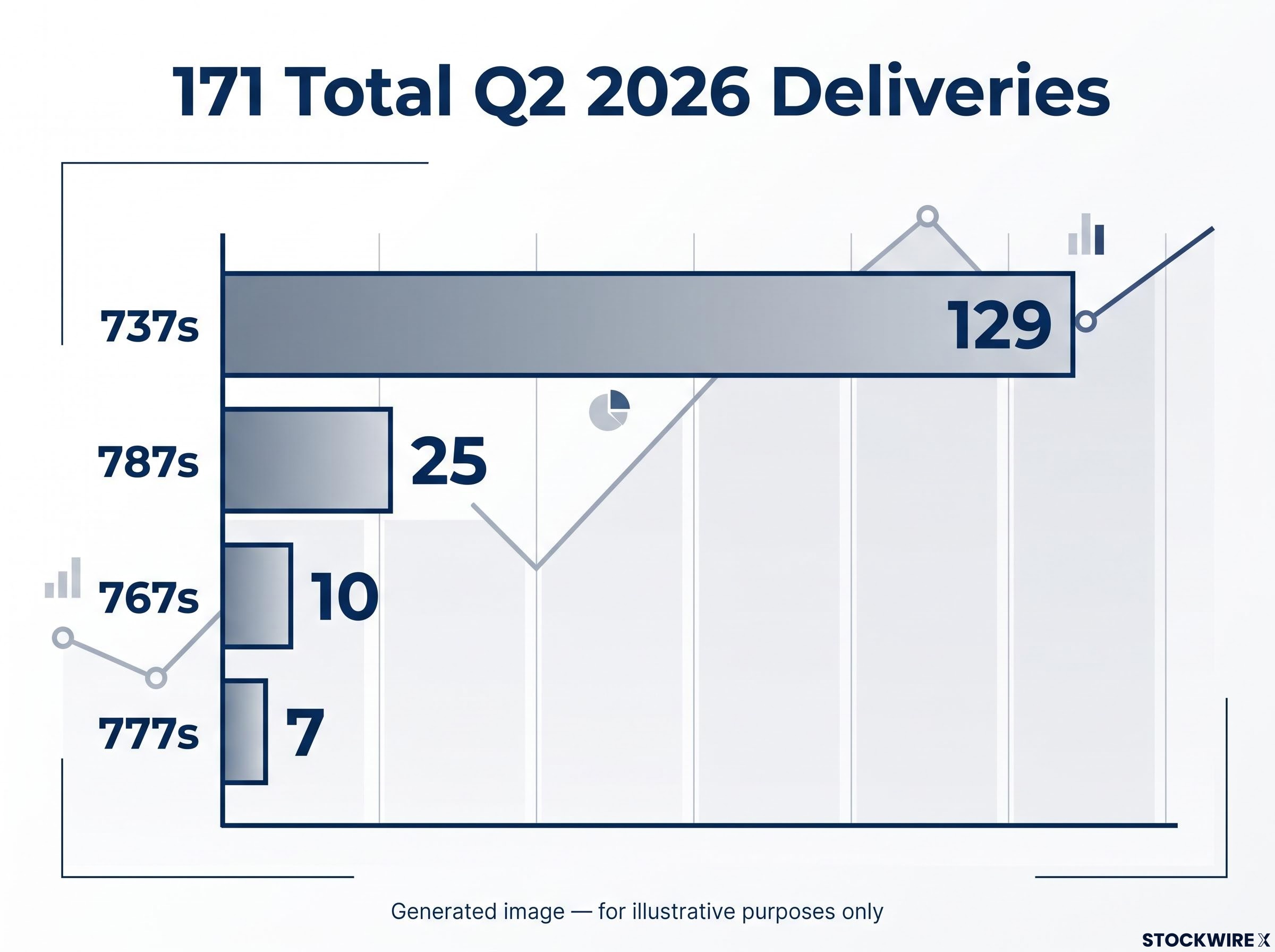
- 129 737s
- 10 767s
- 7 777s
- 25 787s
That is a functioning large-scale production system. It is not, however, the production system Boeing had before the first MAX crash.
The 2018 benchmark is the right ruler. Boeing delivered 806 aircraft that year, the last full year before the grounding rewrote the company’s trajectory. The current annualised pace, roughly 684 aircraft, represents meaningful progress toward that level but falls 15% short. With roughly 6,200 aircraft and $597 billion in committed commercial backlog, the order book makes clear that insufficient demand is not the problem Boeing is solving. Closing the gap between intake and output is. Execution is.
The commercial backlog’s geographic composition matters here: Boeing carries the most direct confirmed exposure from the May 2026 US-China summit, where the aircraft procurement deal was the only sectoral commitment with specific language from Beijing, though order volumes and delivery timelines remain undisclosed.
Boeing’s Q2 2026 annualised delivery pace of approximately 684 aircraft represents meaningful progress toward the pre-grounding 2018 benchmark of 806, but has not yet matched it.
The gap between 684 and 806 is the precise distance the company still needs to close, and that distance is where most of the remaining execution risk lives.
The 787’s return as a cash-generating programme
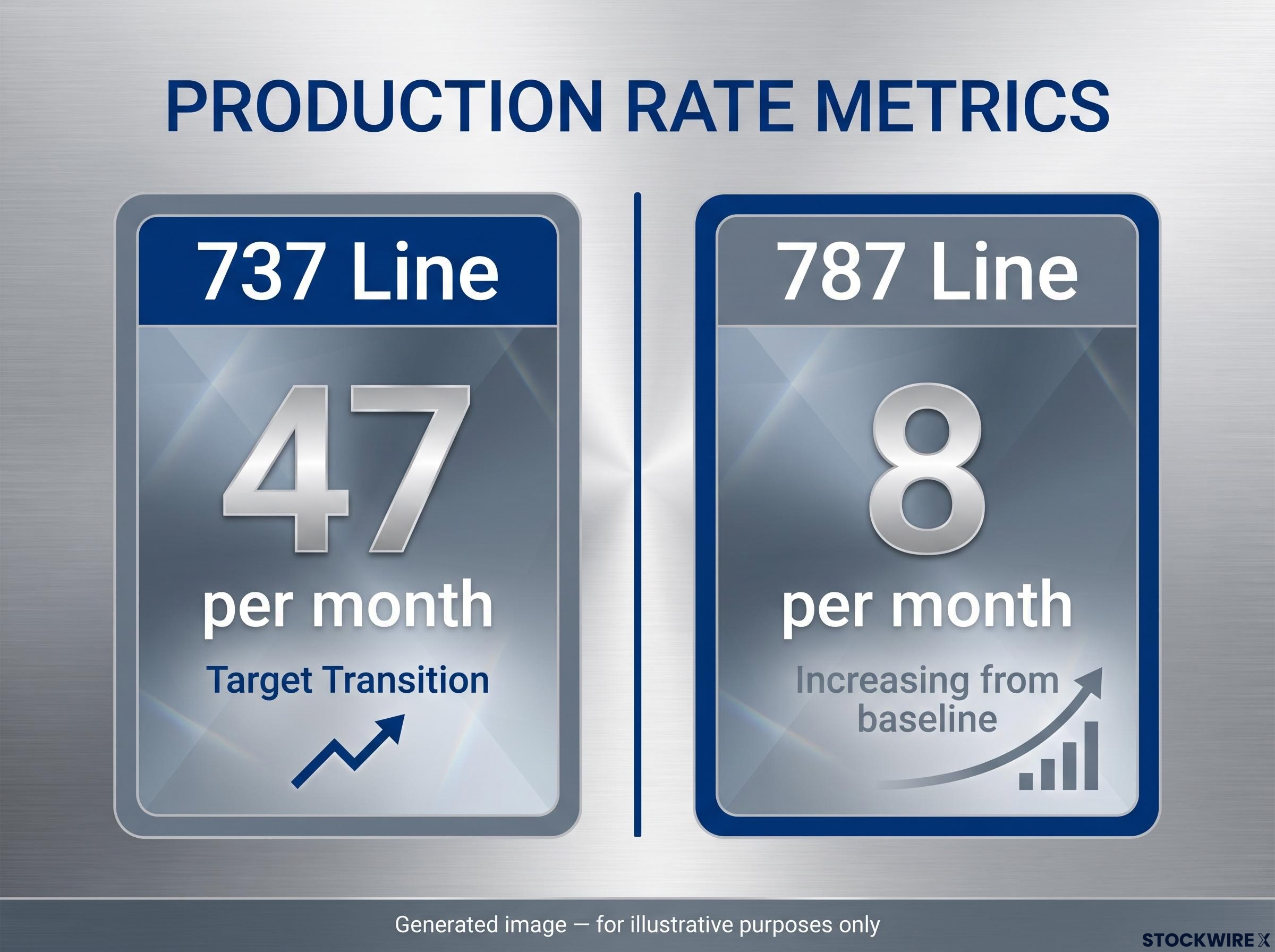
The 787 programme delivered 25 aircraft in Q2 and 40 in the first half of 2026, settling at a baseline of approximately 8 per month. That run rate confirms the regulatory blockages that had frozen widebody output have been cleared.
The clearance came through a structured eight-month dual-inspection regime in which Boeing’s own quality teams and FAA reviewers conducted separate, alternating weekly assessments of the same aircraft, with both parties subsequently cross-checking their respective findings for consistency. That process represents conditional regulatory acceptance demonstrated over time, not a one-off audit pass. It carries more analytical weight precisely because it was sustained and adversarial. Backlog monetisation on Boeing’s highest-margin widebody product is now commercially active.
When big ASX news breaks, our subscribers know first
How Boeing’s regulatory standing has actually changed since January 2024
Start with the worst version of this story. Early 2024 brought a door-plug blowout aboard an Alaska Airlines 737 MAX 9 during flight, an incident with no fatalities but with causes traced squarely to deficiencies in Boeing’s manufacturing processes and workforce training. That event renewed the intense regulatory scrutiny that had persisted since the two fatal MAX crashes of 2018 and 2019, which together claimed close to 350 lives and were attributed to Boeing-related engineering and oversight failures. The FAA imposed a production cap on the 737 line, embedded inspectors on factory floors, and tightened oversight to its most aggressive posture in decades.
Then the legislative layer landed. The 2024 FAA reauthorisation brought three specific changes:
- Tighter rules and more direct FAA control over Organisation Designation Authorisation (ODA), the framework under which Boeing employees perform certain certification tasks on the FAA’s behalf
- Enhanced reporting requirements and mandatory data-sharing obligations between Boeing and the regulator
- Strengthened whistleblower protections for employees raising safety concerns
These are not temporary enforcement postures. They are statutory.
What has genuinely changed since then is that Boeing has demonstrated, through sustained operation under this regime, that it can produce and deliver aircraft within tighter constraints. The approximately eight-month 787 dual-inspection programme, in which Boeing’s and the FAA’s teams each conducted independent weekly reviews and then reconciled their findings, stands as the most substantive single data point supporting that conclusion. The 777X remains under enhanced certification scrutiny, with first deliveries guided to 2027 onward.
| What changed post-January 2024 | What remains probationary |
|---|---|
| ODA authority tightened by statute; FAA has direct control | Full ODA restoration depends on sustained performance |
| On-site FAA inspectors embedded at production facilities | Withdrawal of extraordinary oversight not yet signalled |
| 787 delivery authority restored after parallel inspection | A single serious lapse could reinstate production caps |
| Working regulatory relationship confirmed by ongoing deliveries | 777X certification under enhanced scrutiny; timeline uncertain |
The FAA’s willingness to restore 787 delivery authority after sustained independent scrutiny signals a degree of restored confidence in Boeing’s production controls. But the regulatory environment is now structurally less forgiving than it was pre-2024, and the FAA is politically and legally constrained from leniency under the post-reauthorisation regime. That is the margin for error Boeing is working with as it ramps rates.
The federal regulatory environment shaping Boeing’s oversight regime exists within a broader deregulatory agenda that has targeted over 700 rules for elimination since early 2026; for aerospace manufacturing specifically, the durability of the post-reauthorisation FAA oversight framework matters more than any general deregulatory headline, because the 2024 statutory changes to ODA authority are legislative rather than administrative and cannot be unwound by executive action alone.
What Kelly Ortberg’s leadership has changed, and what requires more time to assess
Kelly Ortberg assumed the CEO position in 2024, taking over from a predecessor who had departed as operational and safety crises compounded. His three stated priorities, securing certification for additional aircraft variants, cutting the debt load accumulated during the crisis years, and rebuilding a genuine quality-first culture across the business, mark a clear departure from the prior leadership approach, which had oriented the organisation around output volume and cost efficiency.
The observable evidence sits in the guidance structure itself. Boeing’s full-year 2026 targets of approximately 500 737s and 90-100 787s are intentionally set below theoretical infrastructure capacity. A management team optimising for volume would not leave capacity on the table. The deliberate staging of the ramp is the clearest observable proxy for whether the quality-first messaging is operational rather than rhetorical.
Boeing’s 2026 targets are intentionally set below theoretical capacity, which is the most observable proxy for whether the quality-first posture is operational rather than rhetorical.
Q2 2026 revenue reached $24.6 billion, up 8% year-over-year. Internal management messaging emphasises defect rates and rework as key performance indicators, though detailed quality metrics are not publicly disclosed.
Here is where honest assessment requires separating two categories:
- Verifiable leadership changes: Guidance set below capacity; rate ramp conditioned on quality milestones; internal KPIs reoriented around defect discovery; regulatory cooperation prioritised over adversarial posturing
- Cultural hypotheses requiring multi-year evidence: Whether speak-up norms have genuinely changed on the shop floor; whether middle-management incentives align with quality over throughput; whether behaviour under production pressure differs from behaviour at current cadence
One strong quarter supports the hypothesis. It does not confirm it. Cultural repair is a multi-year data set, and pretending otherwise is where most recovery narratives get ahead of themselves.
For readers wanting a structured cross-sector framework for evaluating turnaround credibility, our dedicated guide to corporate turnaround frameworks examines how Starbucks separated verifiable operational changes from cultural hypotheses requiring multi-year evidence, a distinction that applies directly to any recovery thesis still in its early quarters.
Understanding what production rate inflection means for the recovery timeline
Production rate inflection is the point where a manufacturer moves from one sustained output level to a higher one. Each step up is a separate stress test, because the quality systems, workforce, and supplier base that performed well at one cadence face materially different pressures at the next.
Boeing is transitioning the 737 line toward 47 aircraft per month. The 787 is increasing from approximately 8 per month. In aerospace manufacturing, quality failures have a well-documented tendency to emerge at rate-change inflection points, precisely because faster throughput narrows inspection windows, reduces rework capacity, and places upstream suppliers under accelerated delivery pressure that their own systems may not absorb cleanly.
The six-to-eight-quarter monitoring window that analyst consensus has coalesced around is not a conservative posture adopted for its own sake. It reflects the number of successive rate-ramp transitions Boeing must navigate without a material quality failure before its production controls can be considered genuinely validated under real operating pressure, rather than only at the cadences it has already demonstrated.
The four indicators that matter more than quarterly delivery counts
If you are monitoring this recovery, headline delivery numbers are the output. These four leading indicators tell you more about whether the process underneath is holding:
- Internal defect discovery rates: A higher internal find rate can initially be constructive, indicating more rigorous inspection. What matters is that defects are caught early and that Boeing’s own findings converge with what the FAA and airline customers detect independently.
- Supplier delivery performance: Changes in delivery schedules, service bulletins, or field retrofit requirements often point back to upstream quality issues that may not register as Boeing defects until later in the process.
- Skilled-trades turnover and labour relations: Workforce stability in skilled manufacturing trades is a leading indicator. Recurring strikes or high attrition would be a red flag; Q2 2026 commentary stresses improving stability but does not claim that risk is eliminated.
- FAA language and enforcement actions: Statements from the FAA Administrator, newly imposed audits, or enforcement activity are the most powerful leading indicator of whether Boeing is on a glide path to normalised oversight or remains under de facto probation.
These are the variables that will distinguish a durable recovery from a promising start over the next six to eight quarters.
Boeing’s financial position: what the balance sheet confirms and what it cannot yet show
The revenue line is moving in the right direction. Q2 2026 came in at $24.6 billion, up 8% year-over-year. Free cash flow was positive. The $597 billion commercial backlog provides revenue visibility that most industrial companies would envy.
That is the confirmed side of the ledger.
The unresolved side is harder to look past. Commercial Airplanes remained unprofitable as of Q2 2026 despite higher revenue, which is an unresolved contradiction at the core of the financial thesis, not a minor footnote. Legacy fixed-price defence contracts continue to sap earnings; the VC-25B Air Force One programme alone absorbed a $280 million charge in Q2. That cash competes directly with debt reduction capacity.
| What the financials confirm | What remains unresolved |
|---|---|
| Revenue growing (up 8% YoY to $24.6B) | Commercial Airplanes still unprofitable |
| Free cash flow positive in Q2 2026 | Heavy debt load from crisis years; material reduction requires years |
| $597B commercial backlog (6,200+ aircraft) | Defence charges (e.g., $280M VC-25B) competing with debt reduction |
Positive free cash flow and a $597 billion backlog tell you Boeing is no longer a distressed asset. Unprofitable Commercial Airplanes combined with ongoing defence charges tells you material balance-sheet repair is a three-to-five-year thesis, not a 2026 story. Airbus has spent the crisis years gaining share with the A320neo and A321neo families deeply entrenched at major airlines, and nothing in Q2 changes that structural competitive reality.
Airline consolidation dynamics shape the order pipeline in ways that delivery counts do not capture: a merged United-American entity would have represented one of Boeing’s largest single customers, and the collapse of that proposed combination before formal review leaves the big-four carrier structure intact, with each airline managing its own fleet renewal timeline independently.
This article is for informational purposes only and should not be considered financial advice. Investors should conduct their own research and consult with financial professionals before making investment decisions.
The recovery scorecard: three thesis legs de-risked, three still open
Q2 2026 provides the strongest evidence of an operational turnaround since before the first MAX crash. The question is how much confidence that warrants relative to where the equity is priced. Here is a structured assessment across the six dimensions that matter.
| Thesis Leg | Status | Key Evidence |
|---|---|---|
| Industrial operations | Fully de-risked | 171 Q2 deliveries; 314 H1; functioning large-scale OEM |
| 787 programme | Partially de-risked | Regulatory blockages cleared; 8/month baseline; long-term rate durability unproven |
| Regulatory standing | Partially de-risked | Working relationship confirmed; probationary posture remains; 777X under scrutiny |
| Culture and safety | Still open risk | Improved execution supports hypothesis; multi-year evidence required |
| Financial health | Still open risk | Positive FCF; $597B backlog; Commercial Airplanes unprofitable; defence drag |
| Competitive position | Still open risk | Airbus entrenched in single-aisles; recovery depends on flawless execution |
The recovery thesis is not binary. It is a de-risking process with measurable milestones, and knowing which milestones have been passed and which remain tells you exactly how much confidence is warranted. The outcome over the coming six to eight quarters will hinge on three specific variables:
- Sustained rate-ramp performance: Whether Boeing can operate at or near 47 737s per month and increasing 787 output without a material quality incident
- FAA oversight normalisation: Whether the regulator begins signalling a transition from extraordinary oversight to routine monitoring
- Commercial Airplanes profitability: Whether higher delivery volumes translate into segment-level profits, which is the prerequisite for meaningful debt reduction
Boeing’s 171-delivery quarter and the six-to-eight-quarter monitoring window are the bookends of the current assessment. The de-risking clock has started. It has not finished.
Past performance does not guarantee future results. Financial projections are subject to market conditions and various risk factors.