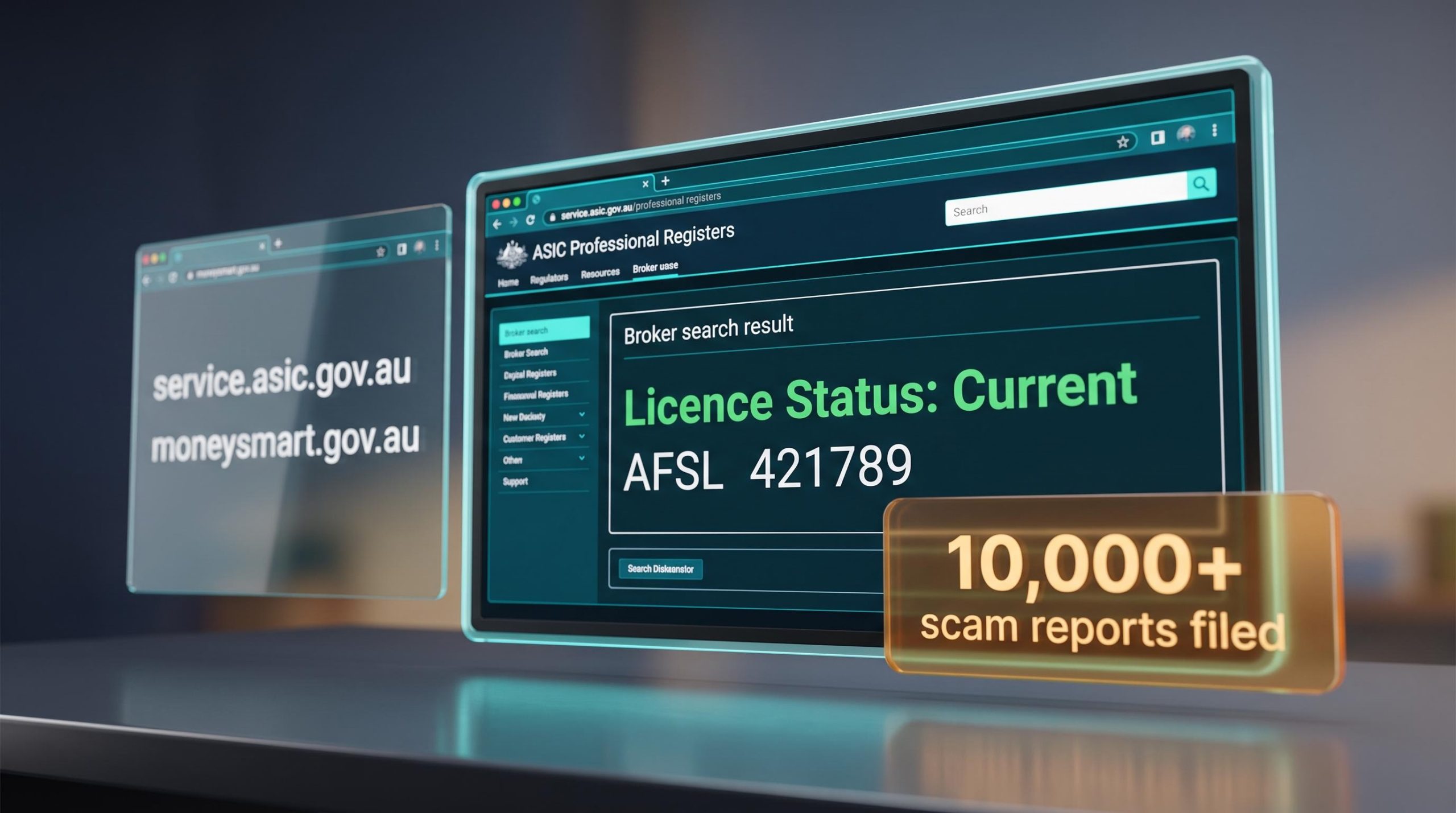
The Australian Securities and Investments Commission (ASIC) received more than 10,000 reports of investment scams in a single recent year, with losses running into hundreds of millions of dollars. Behind every one of those reports is an investor who transferred money before checking whether the entity receiving it was real.
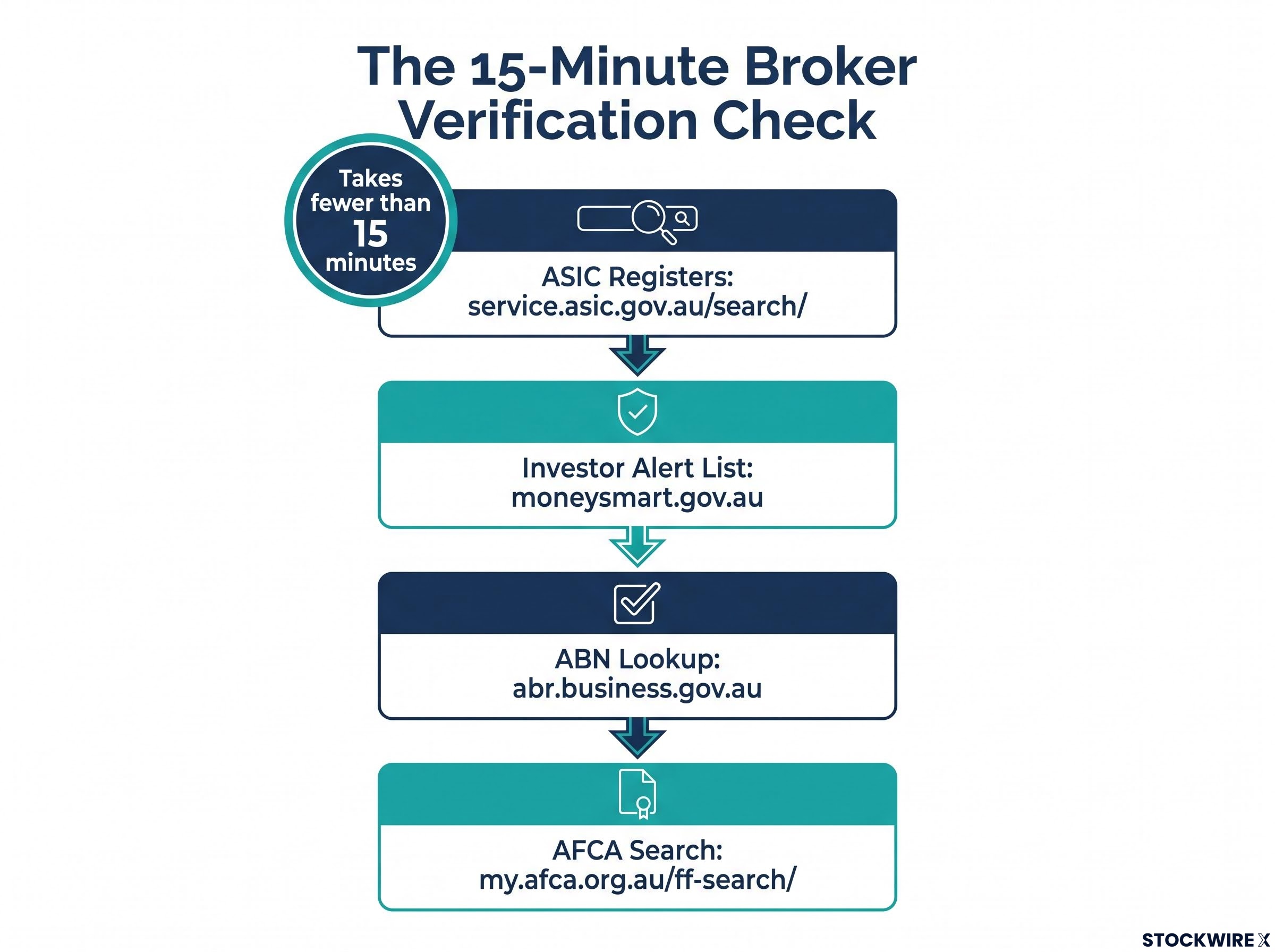
The tools you need to verify a broker in Australia are free, publicly available, and take fewer than 15 minutes to use. The problem is not that the tools are hidden. The problem is that most investors do not know they exist, or do not know exactly how to use them.
Here is the exact sequence of checks you can run before sending a single dollar to a new broker or platform. You will finish with a replicable method you can apply to every new opportunity that reaches you, not a list of vague cautions but a step-by-step process with clear pass-or-fail outcomes at each stage.
Why ASIC licensing is the foundation of any broker check
Every entity offering financial services to Australian retail investors is generally required to hold an Australian Financial Services Licence (AFSL). An AFSL is a licence issued by ASIC that authorises a firm to provide specific financial services, such as dealing in shares, offering derivatives, or giving financial advice. Without one, a firm has no legal authority to offer you those services.
This is the check that matters most. If a platform claims to be regulated overseas, or says it operates under a foreign exemption, that does not substitute for an AFSL when it is dealing with Australian investors. Offshore registration is not the same as Australian licensing.
ASIC maintains a free, publicly searchable register of every entity that holds or has held an AFSL. You can access it at service.asic.gov.au/search/. When you find the broker’s entry, you need to confirm three things:
- Licence status is listed as “Current”, not cancelled, suspended, or surrendered
- Licence number and legal name match exactly what the broker displays on its own website, Product Disclosure Statement (PDS), and documents
- Authorisations cover the specific services being offered to you, such as “deal in securities” or “deal in derivatives”
An entity that lacks a current AFSL covering the services it offers has no legal right to provide those services to Australian investors. This is not a technicality. It is a legal disqualification.
As a reference point, Selfwealth holds AFSL 421789 and appears on the register with a “Current” status and authorisations matching the services it provides. This is cited as an illustration of what a valid entry looks like, not as an endorsement.
The Capital Guard case demonstrates how investment scams within the regulatory framework can operate using genuine ASIC credentials, with the firm holding a current AFS licence throughout the period it allegedly defrauded approximately 80 investors of $17.4 million using a fake Macquarie Bank bond prospectus.
If the AFSL status is anything other than “Current”, or the authorisations do not cover what you are being pitched, stop. That single finding ends the evaluation.
How to search the ASIC Professional Registers
- Go to service.asic.gov.au/search/
- Select “Australian financial services licensee” from the register options
- Search using the broker’s full legal name, taken from their PDS or website footer, not their marketing brand. Alternatively, search by the AFSL number they claim to hold.
- Cross-check both the legal name and the trading brand. They often differ, and a mismatch between what the broker calls itself and what ASIC records show warrants immediate scrutiny.
When big ASX news breaks, our subscribers know first
Cross-referencing ASIC warning lists and banned persons
A current AFSL is your starting point. The next step catches entities that ASIC has already flagged, and individuals who have been legally prohibited from operating in financial services.
Start with the Investor Alert List, maintained on moneysmart.gov.au. This is ASIC’s explicit public record of entities it warns consumers against. Search using all three identifiers:
- The broker’s company name
- Its trading name (which may differ)
- Its website URL
If the broker appears on this list, ASIC is telling you directly not to deal with them. That is as clear a signal as you will get from a regulator.
Then run a separate check most investors never think to do. ASIC’s Banned and Disqualified Registers, accessible via the ASIC website, let you search for individuals, not just companies. Search the names of any directors, account managers, or public-facing staff you have encountered.
This matters because a company can be newly registered and technically not yet on the alert list, but staffed by people who have been banned from managing financial services businesses. If a director or account manager appears on the Banned and Disqualified register, you would be putting money into the hands of someone legally prohibited from holding that role.
One important caveat: absence from both lists does not confirm the entity is legitimate. It simply means ASIC has not yet acted against it. These checks catch known threats. The AFSL check in the previous section is what confirms regulatory standing.
Verifying business registration, ABN, and AFCA membership
You have checked the regulator. Now check whether the firm exists as a real, registered Australian business with traceable obligations.
Complete these three checks in sequence:
- ABN Lookup at abr.business.gov.au: Search the broker’s stated Australian Business Number (ABN). Confirm the ABN is active and belongs to the same legal name and registered address the broker displays.
- ASIC Organisations and Business Names search: Confirm the entity is properly registered as a company with ASIC, and that the registration details match.
- AFCA member search at my.afca.org.au/ff-search/: Search the broker’s legal name. Confirm it holds current membership with the Australian Financial Complaints Authority (AFCA), an external dispute resolution body. AFCA membership is generally required for firms dealing with retail clients and gives you a pathway to resolve complaints outside the courts.
Any mismatch between what the broker claims and what these official records show is itself a warning signal.
What to do when details do not match
If the broker’s stated name, address, or ABN does not match what appears in official registers, do not give it the benefit of the doubt. A discrepancy does not always mean fraud, but it always means you should pause before proceeding.
You can contact ASIC’s consumer information line to clarify any ambiguity before investing. The cost of a phone call is negligible compared to the cost of sending money to the wrong entity.
A firm with no AFCA membership that claims to serve retail investors has removed your primary avenue for independent complaint resolution. If anything goes wrong, your only recourse would be direct legal action.
ASIC’s dispute resolution framework sets out which financial firms are required to hold AFCA membership and how that obligation interacts with their licence conditions, making AFCA membership a regulatory requirement rather than a voluntary signal of good practice.
Key operational traits of regulated brokers in Australia
Licensing confirms regulatory standing. Operational behaviour reveals whether the platform is real. Understanding how legitimate Australian brokers actually operate gives you an intuitive layer of protection beyond the paperwork.
For ASX-listed shares, brokers use one of two holding structures. The difference matters for your legal ownership and your protection if the broker collapses.
| Attribute | CHESS sponsorship | Custodial model |
|---|---|---|
| Legal ownership structure | Shares held under your Holder Identification Number (HIN) in ASX’s CHESS system | A licensed custodian holds shares on your behalf |
| Protection if broker collapses | Shares remain in your name, independent of the broker | Relies on the custodian’s integrity and trust arrangements |
| Ability to independently verify holdings | Verifiable against CHESS statements independent of the broker | Dependent on custodian reporting |
| Who holds the assets | You, directly via CHESS | The custodian, on your behalf |
A HIN is a unique number assigned to you by the ASX settlement system. It is your direct ownership record. If a broker claims CHESS sponsorship, your trade confirmations should be verifiable against independent CHESS statements.
The custodial model is common and not inherently fraudulent, but it does rely on an intermediary. Both models are legitimate, and the right one for you depends on your priorities.
For ETF investors, the distinction between CHESS and custodial ownership models carries additional complexity because ETF units on the ASX register behave differently to individual share holdings, and switching between models after purchase may trigger a CGT event via in-specie transfer.
Segregation of client funds is another transparency signal. A legitimate broker discloses in its PDS how your cash is held, specifically that client money sits in segregated trust accounts, separate from the firm’s operating capital.
Fee transparency matters too. You should see a complete fee schedule before opening an account. As a reference point, Selfwealth applies a fixed brokerage rate of $9.50 per trade, with its full cost structure disclosed upfront and no additional account-keeping charges. This is illustrative of what unconditional fee transparency looks like, not an endorsement.
Finally, consider a small withdrawal test early in the relationship. Deposit a modest amount, execute a basic trade if needed, then request a withdrawal. Confirm the funds arrive within the broker’s stated processing timeframe. A platform that cannot explain how client funds are held, delays withdrawals with shifting justifications, or introduces unexpected fees when you try to cash out is showing you operationally that something is wrong, regardless of what its documentation says.
Recognising fraudulent investment schemes
Scam operators follow repeatable scripts. Once you know the patterns, you can recognise them quickly, often within the first interaction.
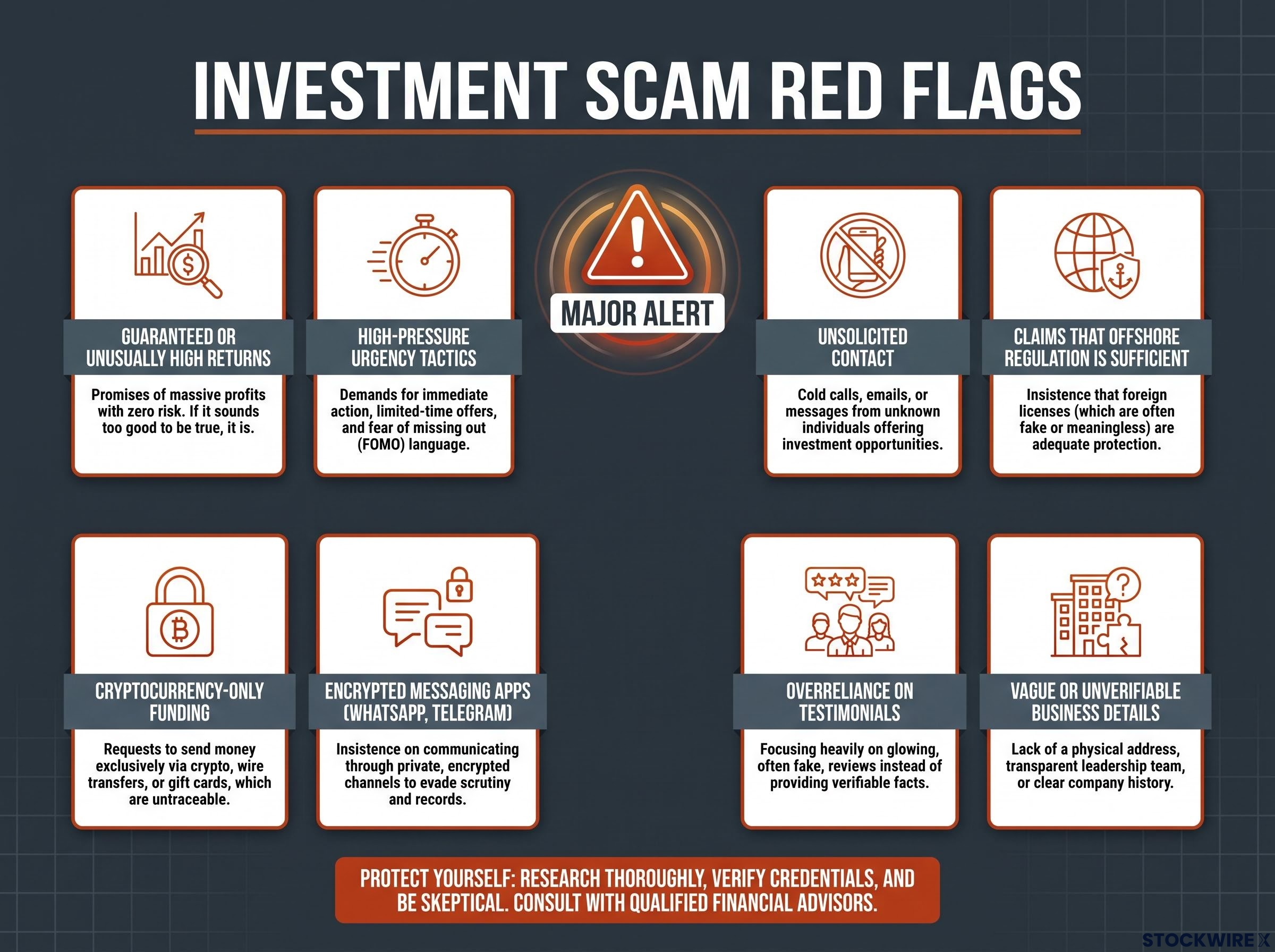
The single most important signal is guaranteed or unusually high returns. No legitimate investment can guarantee profits. Markets carry inherent risk, and any entity promising fixed high returns or “low risk, high return” outcomes is making a claim inconsistent with how investing actually works. This is the flag that underpins almost every investment fraud.
AI-generated investment fraud has introduced a new layer of deception to the patterns described above, with fraudsters now producing deepfake celebrity endorsements and fake ASIC licensing documents that can pass platform moderation and surface-level checks, contributing to A$837.7 million in reported investor losses in 2025 alone.
The remaining red flags are operational. Each one exists because it serves the scam’s mechanics:
- High-pressure urgency tactics: you are told to “act now” or “miss out.” The pressure exists to stop you from running verification checks.
- Unsolicited contact: cold calls, unexpected emails, social media messages, or new online relationships that quickly pivot to investment pitches.
- Claims that offshore regulation is sufficient: entities offering financial services in Australia generally must hold an AFSL, and foreign registration does not replace this obligation.
- Cryptocurrency-only funding: crypto transfers are difficult to trace and effectively irreversible, which is precisely why scam operators prefer them.
- Communication confined to encrypted messaging apps: if the “broker” insists on WhatsApp or Telegram and avoids traceable company channels, this is a serious warning.
- Overreliance on testimonials or celebrity endorsements: genuine firms lead with licence details and regulatory information, not social proof in place of verifiable credentials.
- Vague or unverifiable business details: no clear physical address, staff who cannot explain who regulates them, or addresses that resolve to mail drops.
A genuine investment opportunity will still be there after you spend 15 minutes running the checks in this guide. The moment someone pushes you to commit funds before verifying anything, that pressure is the warning signal.
If you encounter any single flag from this list, go back and re-run every formal check from the earlier sections before proceeding. These patterns are not coincidences or individual quirks. They are consistently recurring features of fraudulent operations.
Your complete pre-investment verification checklist
Everything above distils into a single, reusable checklist. Complete every item before transferring funds to a new broker or platform. These are not options to pick from. They are sequential checks, and failure on any single item warrants disengagement or substantial further investigation.
- Found the entity on ASIC’s Professional Registers (service.asic.gov.au/search/) and confirmed the AFSL status is “Current”, with the licence number and legal name matching the broker’s website.
- Confirmed the licence authorisations cover the specific services being offered (shares, derivatives, advice, or other products).
- Checked ASIC’s Banned and Disqualified Registers for the firm and for individual directors or staff you have interacted with.
- Searched the Investor Alert List on moneysmart.gov.au for the entity’s company name, trading name, and website URL.
- Verified the business via ABN Lookup (abr.business.gov.au) and confirmed the ABN is active with matching legal name and address.
- Confirmed ASIC business registration via the Organisations and Business Names search, with details matching the broker’s claims.
- Confirmed current AFCA membership (my.afca.org.au/ff-search/) with contact details matching ASIC records.
- Independently navigated to the official website and cross-checked contact details (address, phone, email, domain) against ASIC and AFCA records.
- Searched the broker’s name and URL with “scam” and reviewed any credible, specific, and repeated reports.
- Reviewed the PDS to confirm how client funds and assets are held (segregated trust accounts, CHESS versus custody, and by whom).
- Confirmed the fee structure is fully disclosed and understandable before any deposit.
- Confirmed there are no guarantees of returns and no high-pressure tactics in any communications received.
(Optional but recommended): Tested a small withdrawal successfully before increasing exposure.
The value of this checklist is not just what it finds. It is the discipline it builds. You are operating with a fundamentally different risk profile when you run every item on this list before depositing funds, compared to relying on a platform’s self-presentation.
If you have already sent money to a suspicious platform
If you have already transferred funds to a platform you now have reason to doubt, the priority is to move without delay. Every hour counts.
- Get in touch with your bank or card provider straight away. Describe what has happened and ask whether the transaction can be recalled, stopped, or formally disputed.
- Report to ASIC using their online reporting tools. Provide the firm’s names, website, contact details, and any documents you received.
- Submit a report to Scamwatch at scamwatch.gov.au. Filing a report contributes to a national database that regulators, including ASIC, draw on when identifying threats and issuing public alerts.
- Do not send additional funds under any circumstances. Scam operators frequently demand further payments described as “taxes”, “unlock fees”, or “verification deposits” as a condition of releasing your money. These are not genuine requirements. They are a continuation of the scam. No legitimate regulatory or tax obligation requires you to pay a broker in order to access your own funds.
Making verification a habit, not a one-time event
The process you have just worked through is not a one-off task. It is a transferable skill. The same ASIC, AFCA, and ABN tools apply to every new broker, financial adviser, or investment platform you encounter in future. The next time an opportunity reaches you, whether through a friend’s recommendation, social media, or an unsolicited message, the same 15-minute sequence applies.
One important distinction to carry with you: ASIC licensing does not guarantee investment performance. A fully licensed, properly registered broker can still offer products that lose money. The checks described in this guide confirm regulatory standing, not investment suitability. Every investment carries inherent risk, and verification cannot eliminate that.
Holding an AFSL tells you a provider is regulated and accountable to ASIC. It does not tell you whether a specific product will perform, or protect you from losing money. Investing always carries risk, and no verification process removes that reality.
If you want advice on whether a specific investment is appropriate for your personal circumstances, seek a licensed financial adviser, and apply the same ASIC Professional Registers search to verify their credentials.
For readers who have completed the verification sequence and are ready to take their first steps with a confirmed legitimate broker, our dedicated guide to starting investing in Australia covers what realistic first-year expectations look like and how to build the disciplined habits that compound over decades.
For ongoing resources, moneysmart.gov.au provides consumer guidance on investing and financial products, and ASIC’s consumer helpline can clarify questions about specific entities.
This article is for informational purposes only and should not be considered financial advice. Investors should conduct their own research and consult with financial professionals before making investment decisions.