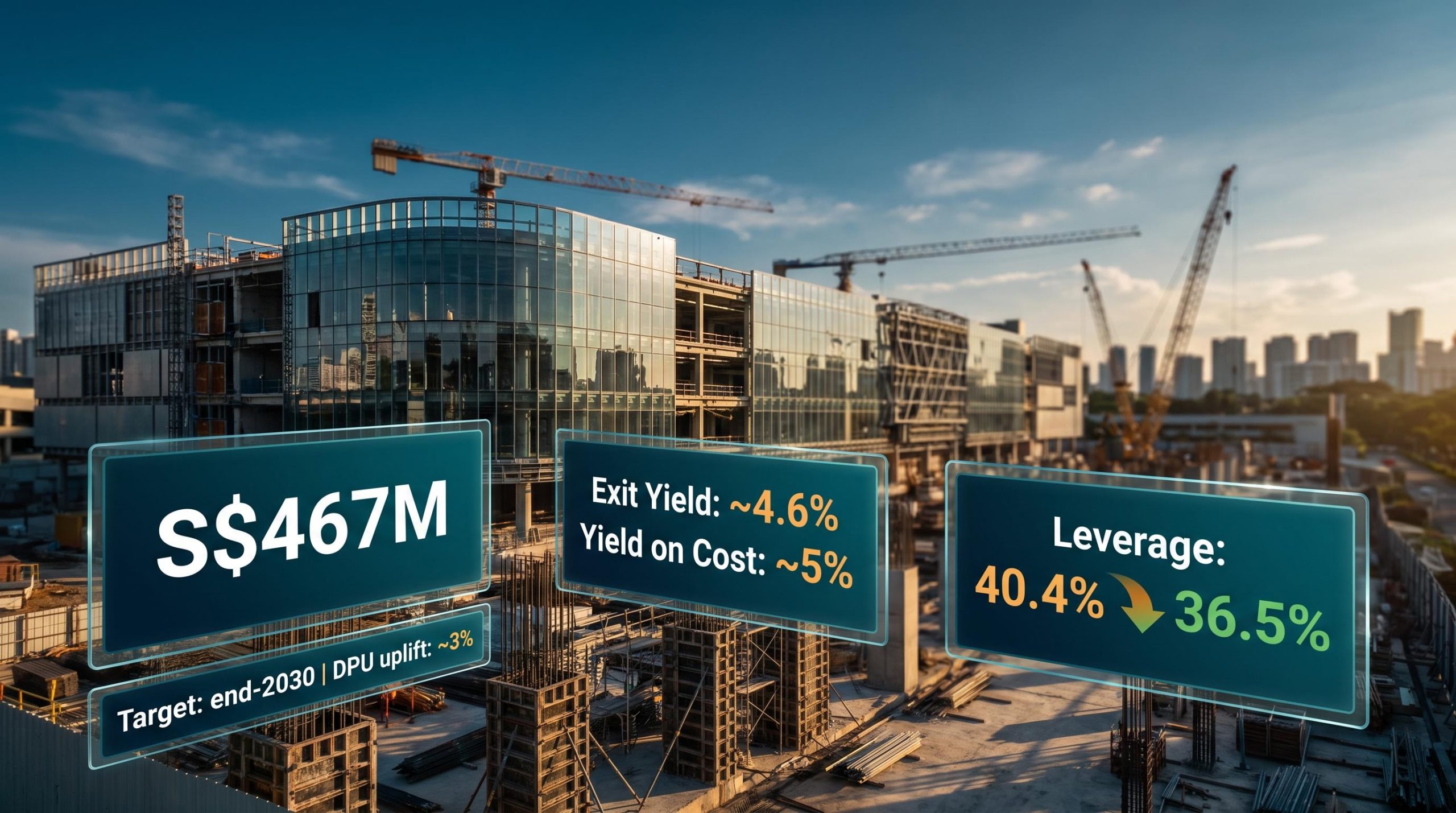
Frasers Centrepoint Trust is selling income today to buy growth for 2030. The White Sands divestment at S$467 million and the Bayshore Drive acquisition represent a single capital recycling decision, not two separate events, and the question for investors is whether the exchange rate between current yield and future upside makes sense once you look past the headline numbers.
The timing matters. White Sands’ income disappears from FCT’s distribution pool immediately upon sale. Bayshore’s income does not arrive until end-2030 at the earliest, and only then if construction, leasing, and tenant ramp-up all execute on schedule. For income-focused investors, the gap between those two dates is the central tension of this trade.
Here is what the deal structure actually means for near-term distributions per unit (DPU), how much balance sheet headroom has been created, and the specific signals worth tracking before concluding this strategy has delivered.
What FCT is giving up: the White Sands sale at a glance
The premium does the talking first. Frasers Centrepoint Trust is divesting White Sands at an 8.4% premium to independent valuation as at 31 May 2026, a spread that validates not just this asset’s carrying value but the broader portfolio’s balance sheet marks.
8.4% premium to independent valuation confirms ongoing market demand for quality suburban Singapore retail, signalling that FCT’s remaining assets are not overcooked on the books.
Here are the core transaction terms:
- Sale price: S$467 million
- Premium to valuation: 8.4% (as at 31 May 2026)
- Net proceeds: approximately S$454.1 million
- Net gain: S$32.4 million
- Exit yield: approximately 4.6%
Among FCT’s holdings, White Sands ranked as the trust’s most compact mall by size, and it was being sold from a commercially strong footing. Portfolio occupancy stood at approximately 99.6% in Q3 FY2026. This is a sale from a position of strength, not a forced exit from a softening asset.
That said, a 4.6% exit yield is not trivial. It tells you how much recurring income is leaving the portfolio, and it is the essential denominator when evaluating whether the Bayshore swap justifies the trade.
That 4.6% exit yield figure is precisely the kind of metric that looks straightforward in isolation but requires a full S-REIT evaluation framework to contextualise properly, one that weights gearing, income durability, and sponsorship quality alongside the headline number.
When big ASX news breaks, our subscribers know first
What FCT is buying: the Bayshore Drive stake and its growth logic
The Bayshore Drive transaction gives FCT a 50% ownership interest in the retail portion of a mixed residential-commercial integrated development in eastern Singapore. Measured on a 100% basis, the retail space covers roughly 170,000 sq ft of net lettable area (NLA), the total floor space available for tenants. The full development carries a total project cost of approximately S$613 million on a 100% basis.
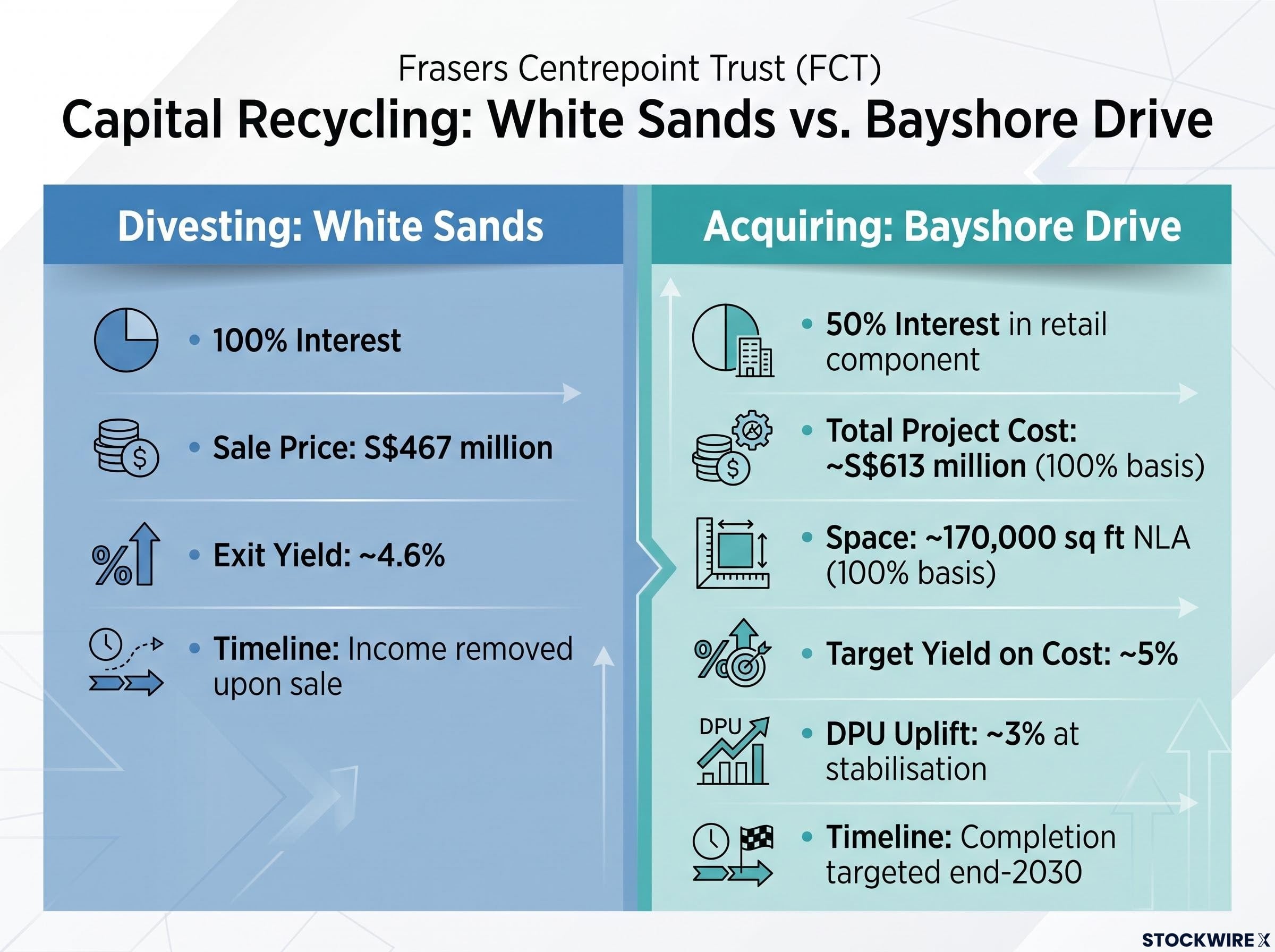
The strategic case is straightforward. Bayshore is the only mixed-use commercial and residential site in a new precinct, supported by transport links, planned population growth, and a thin retail supply base in the nearby Bedok catchment. By participating from the development phase, FCT is positioned to achieve a yield on cost of around 5%, a return that exceeds what acquiring a fully stabilised suburban mall would typically generate in today’s market.
| Asset | FCT’s Interest | Key Financial Metric | Timeline |
|---|---|---|---|
| White Sands (divested) | 100% | Exit yield: ~4.6% | Income removed upon sale |
| Bayshore Drive (acquired) | 50% of retail component | Target yield on cost: ~5%; ~3% DPU uplift at stabilisation | Completion targeted end-2030 |
Where the execution risk sits
Three layers of development risk sit between the acquisition and the income uplift. First, construction timeline risk: end-2030 is more than four years away, and delays in a prolonged construction environment are not unusual. Second, leasing risk: a new precinct needs anchor tenants before the residential catchment fully matures, and pre-leasing momentum will be the earliest signal of demand. Third, cost overrun risk: the approximately S$613 million total project cost could shift upward if material or labour costs escalate.
The 5% yield on cost is precisely why investors are compensated for bearing these risks. A stabilised suburban mall would not offer that return today. The question is whether the premium justifies the wait.
How Singapore’s suburban retail fundamentals support the underlying thesis
To assess whether Bayshore’s growth assumptions are realistic, you need to understand what makes suburban Singapore retail structurally different from CBD or discretionary retail. These malls serve captive residential catchments with necessity-based tenants: supermarkets, food and beverage outlets, healthcare clinics, and education providers. Footfall is driven by daily needs rather than tourism or luxury spending, which gives suburban retail a defensive income profile that holds up through economic slowdowns.
The Q3 FY2026 operating metrics show how that profile is performing right now:
- Portfolio occupancy: approximately 99.6% (excluding Hougang Mall and NEX, both undergoing asset enhancement initiatives, or AEIs, which are targeted refurbishment and upgrade programmes)
- Shopper traffic: 2.4% higher than the same period a year earlier
- Tenant sales: broadly flat, at roughly +0.2% compared with the prior year
- New-to-portfolio tenants: approximately 69 welcomed year-to-date
99.6% occupancy at portfolio level tells you FCT is selling White Sands from a position of commercial strength, not because suburban retail is weakening.
The divergence between rising foot traffic and near-flat tenant sales requires context. FCT has been actively turning over its tenant roster, bringing in around 69 new occupiers so far this year. Newly installed tenants typically take several quarters to build their customer base and reach full trading volume, so the lag in the sales figure reflects a portfolio in transition rather than any genuine softness in consumer demand. Once these tenants reach maturity, their sales contributions should close the gap with what the traffic numbers are already indicating.
For investors weighing Bayshore’s assumptions, these metrics matter. A portfolio operating at near-full occupancy with growing footfall suggests the suburban retail model FCT is extending into Bayshore has a solid structural foundation.
S-REIT sub-sector divergence in June 2026 was stark enough to produce a 9.5-percentage-point return gap within a single month, a reminder that asset geography, debt structure, and tenant mix carry as much consequence for total return as any individual trust’s capital recycling decision.
The balance sheet case for capital recycling now
Start with the leverage improvement. Current aggregate leverage stands at roughly 40.4%, and applying the White Sands sale proceeds to debt repayment is forecast to bring that figure down to around 36.5% on a pro-forma basis, comfortably below the regulatory cap of 50%. That 3.5-percentage-point reduction, at FCT’s asset base, translates into meaningful additional debt capacity for future acquisitions without breaching prudent leverage thresholds.
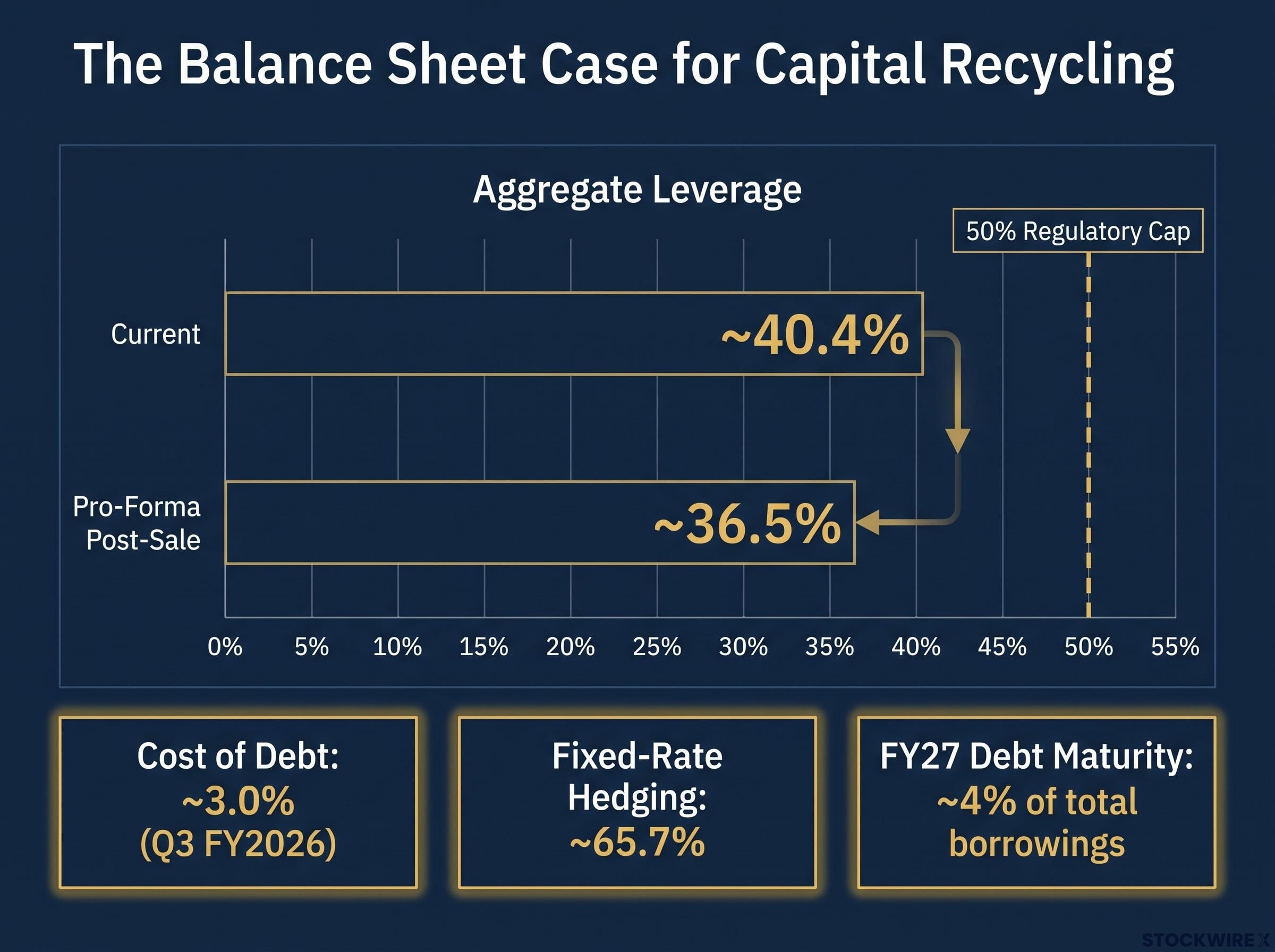
The cost of debt is moving in the right direction. Driven by the roll-off of more expensive interest-rate swap contracts, the weighted average all-in borrowing cost came in at roughly 3.0% in Q3 FY2026, a reduction of around 20 basis points from the prior quarter. With approximately 65.7% of borrowings locked in at fixed rates, the portfolio has limited exposure to near-term rate movements.
The maturity profile adds further comfort. The trust carries no debt falling due across FY2026, and the proportion maturing in FY2027 amounts to only around 4% of total borrowings.
| Metric | Current Position | Pro-Forma (Post-Sale) |
|---|---|---|
| Aggregate Leverage | ~40.4% | ~36.5% |
| Cost of Debt | ~3.0% (3QFY26) | Expected to decline further as swaps roll off |
| Fixed-Rate Hedging | ~65.7% | ~65.7% |
| FY27 Debt Maturity | ~4% of total borrowings | ~4% of total borrowings |
For income-focused investors, a cleaner balance sheet with a falling cost of debt and minimal near-term refinancing risk directly reduces the probability of a DPU cut driven by financial stress rather than operational performance. That is a material distinction in the current rate environment.
The leverage between cost-of-debt improvement and DPU amplification is not unique to FCT: OUE REIT’s 1H 2026 results showed how a 16.6% finance cost reduction converted just 3.8% revenue growth into a 28.6% DPU surge, illustrating how much distributable income leverage sits inside a REIT’s debt line.
Capital recycling as a repeatable management discipline
The White Sands and Bayshore pairing is not FCT’s first recycling cycle. It follows a documented pattern of divesting mature, smaller assets, using proceeds to reduce debt, and redeploying capital into higher-return opportunities:
- Bedok Point divestment, with proceeds directed to debt reduction and portfolio reshaping
- Changi City Point divestment, followed by consolidation into dominant suburban centres
- Hektar REIT stake exit, again paired with leverage reduction
- Waterway Point and NEX acquisitions, adding dominant suburban positions as peripheral assets were exited
- Yishun 10 strata lot divestment (reported as occurring in 2025; precise timing not independently verified), with proceeds used primarily to reduce debt
At the sponsor level, Frasers Property operates with a consistent philosophy: divest mature, lower-yield assets and reinvest in higher-return or value-add opportunities. FCT’s capital recycling sits within that broader framework.
A management team with three-to-four prior recycling cycles executed successfully is a meaningfully different risk proposition than one attempting its first development-stage acquisition. When assessing Bayshore’s execution risk, investors should weight that track record explicitly. The pattern does not eliminate development risk, but it does suggest a team accustomed to managing complex buy-sell sequences and the balance sheet consequences that follow.
What the Phillip Securities BUY call implies, and what it does not
As of its report dated 4 August 2026, Phillip Securities Research rates FCT a BUY, carrying forward an unchanged target price of S$2.70 and identifying no negative factors in its current assessment.
The research team identified no negative factors in their current assessment. The BUY call is grounded in two layers: defensive current income from the existing suburban portfolio plus a medium-term growth catalyst from Bayshore. The S$2.70 target price embeds a multi-year thesis rather than a near-term catalyst, which means the margin of safety for a buyer today depends heavily on whether they are prepared to hold through the Bayshore construction and lease-up period without requiring DPU growth in the interim.
Near-term DPU is expected to be stable to slightly softer as White Sands income is removed. Once Bayshore reaches stabilisation in the early 2030s, the project is projected to add roughly 3% to FCT’s distributable income on an annualised basis.
Five monitoring items will determine whether the thesis remains intact:
- Bayshore construction progress relative to the end-2030 target
- Lease-up pace and achieved rents versus underwriting assumptions at the retail component
- White Sands sale closure confirming the leverage drop to approximately 36.5%
- Tenant sales recovery at existing malls as new-to-portfolio tenants mature and ramp
- Interest-rate trajectory and its effect on the remaining floating-rate debt exposure (approximately 34% of borrowings)
The BUY call gives you a professional assessment of fair value. It does not give you certainty on the four-year development timeline that underpins it. Tracking these five items is how you assess, quarter by quarter, whether the conditions supporting that target price remain in place.
Patient capital or income gap: making the call on FCT’s current risk-reward
The two transactions compress to a simple exchange. The White Sands sale delivers balance sheet improvement and premium validation now. The Bayshore stake delivers income growth only if construction and lease-up execute on schedule over a four-plus year horizon. In between, investors accept a modest DPU softness offset partially by a falling cost of debt.
The investor profile this trade suits is specific: income-focused holders with a medium-to-long horizon who are comfortable absorbing a near-term distribution drag in exchange for a stronger financial position and a single, trackable growth catalyst. If your investment horizon does not extend to the early 2030s, the growth upside is someone else’s to capture.
Three variables determine the outcome: Bayshore completion timing, achieved rents at lease-up, and the trajectory of FCT’s cost of debt as existing swaps roll off. Track those, and you have the framework for an ongoing, evidence-based assessment of whether this capital recycling cycle delivers.
For investors wanting a structured comparison of where suburban retail sits relative to industrial, data centre, and office exposure, our deep-dive into S-REIT sub-sector rankings for 2026 maps the structural tailwinds and headwinds across every major category with directly comparable metrics.
This article is for informational purposes only and should not be considered financial advice. Investors should conduct their own research and consult with financial professionals before making investment decisions. Financial projections referenced are subject to market conditions and various risk factors. Past performance does not guarantee future results.