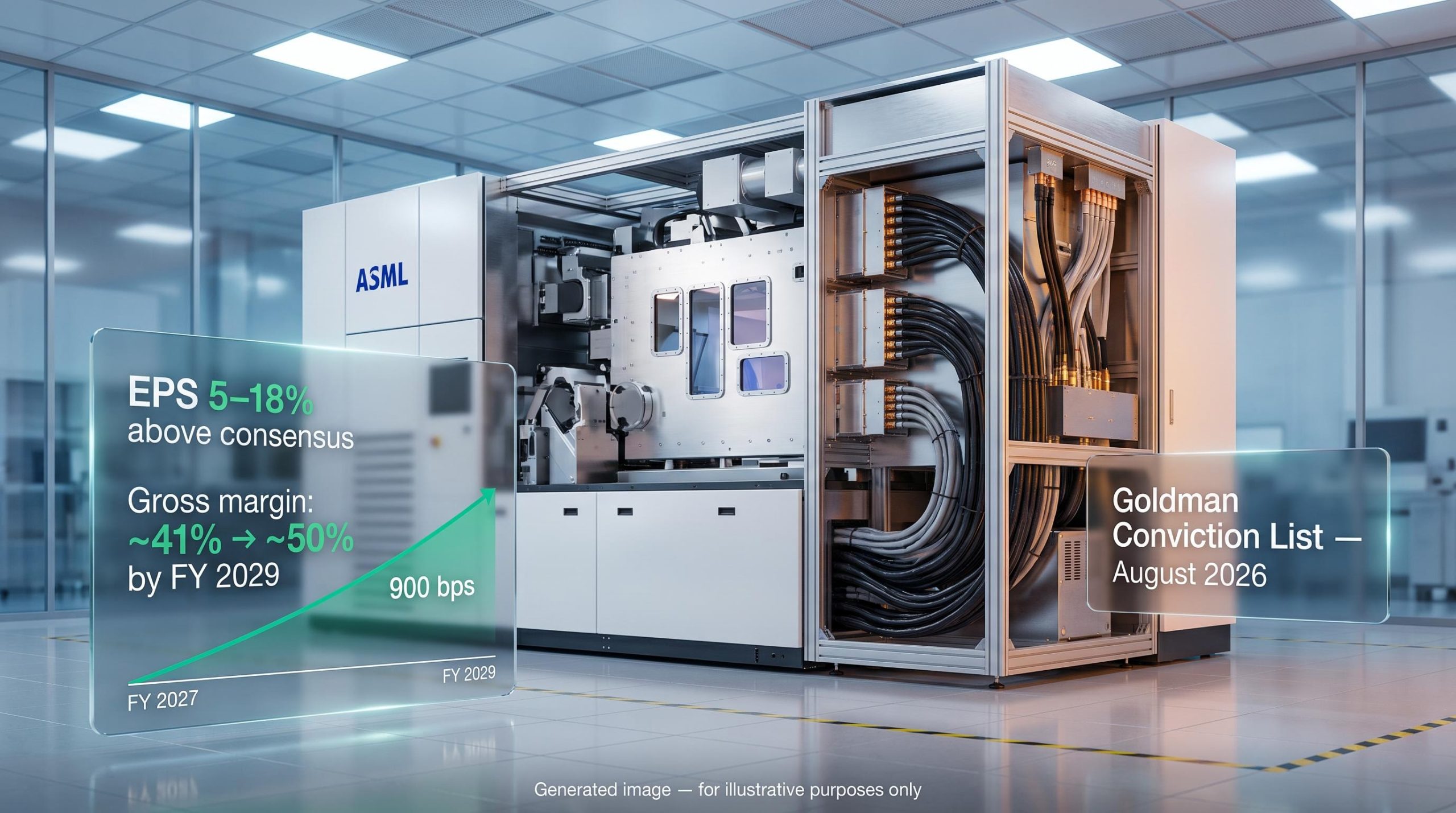
Goldman Sachs added ASML to its European Conviction List in August 2026, and the most striking element of analyst Alex Duval’s rationale is not the bullish earnings forecasts. It is the direct challenge to how the market has been thinking about ASML entirely.
For most investors, ASML has become shorthand for AI infrastructure exposure. Goldman’s thesis cuts against that framing: Duval’s modelling attributes the majority of ASML’s projected revenue growth to drivers entirely outside the AI cycle. That reframing is the heart of why Conviction List inclusion matters here. The market may be pricing ASML against the wrong narrative.
Here is what Goldman actually sees, what the numbers look like relative to consensus, where the margin expansion is supposed to come from, and what risks could disrupt the thesis. By the time you finish, you should have a clear picture of why Goldman thinks the Street has this one wrong and what it would take for them to be right.
What the Conviction List addition actually signals
Goldman’s European Conviction List is not a standard Buy rating with a new price target. It is a structurally different designation, and the distinction matters before you evaluate any of the numbers attached to it.
What separates a Conviction List addition from a regular upgrade:
- It is reserved for the firm’s highest-conviction ideas where analyst forecasts diverge materially from Street consensus
- The list is dynamic, with additions and removals driven by where analysts hold the strongest differentiated view at any given time
- Inclusion signals that identifiable catalysts for re-rating exist, not just that the stock looks undervalued on a screen
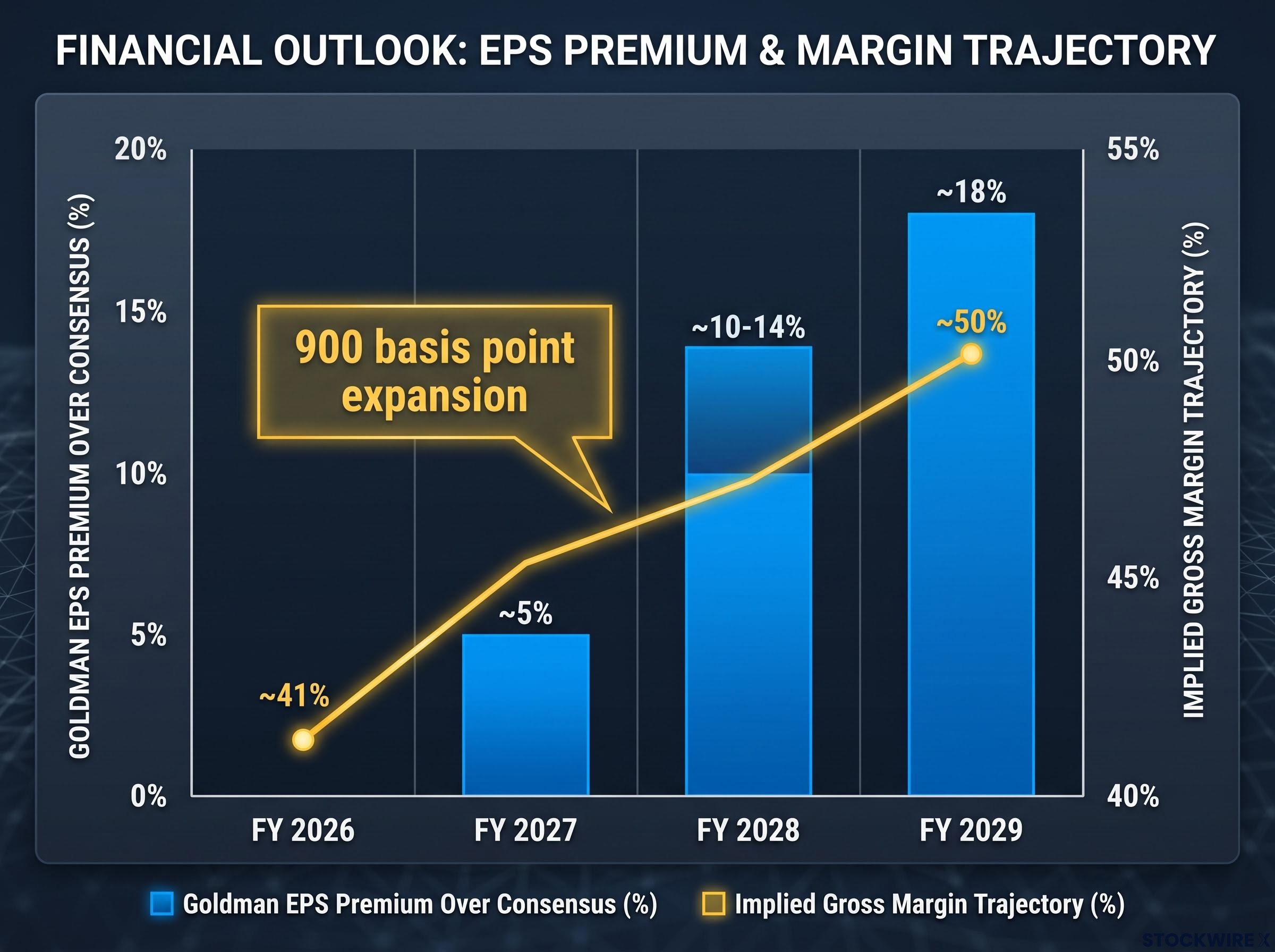
Goldman’s earnings per share (EPS) forecasts for ASML across FY 2027-2029 sit 5-18% above Street consensus. That is not a rounding error. It is a direct claim that the Street’s earnings model for ASML is materially wrong over a multi-year horizon, and that the gap will widen as the cycle matures. The ASML addition specifically signals Goldman believes the market has fundamentally misframed the investment thesis, not just underestimated near-term earnings.
When big ASX news breaks, our subscribers know first
The AI narrative Goldman thinks investors have wrong
The dominant market narrative around ASML is straightforward: it is an AI infrastructure play. Investor sentiment has tracked AI capital expenditure cycles closely, and ASML’s share price has moved with them.
Goldman’s Alex Duval sees a different company.
Goldman’s reframing of ASML as a broad semiconductor scaling story rather than an AI infrastructure play sits within a wider analytical posture the firm published in July 2026, identifying the crowded AI trade as a structural blind spot that is leaving money on the table across consumer, quality compounder, and M&A-adjacent positions.
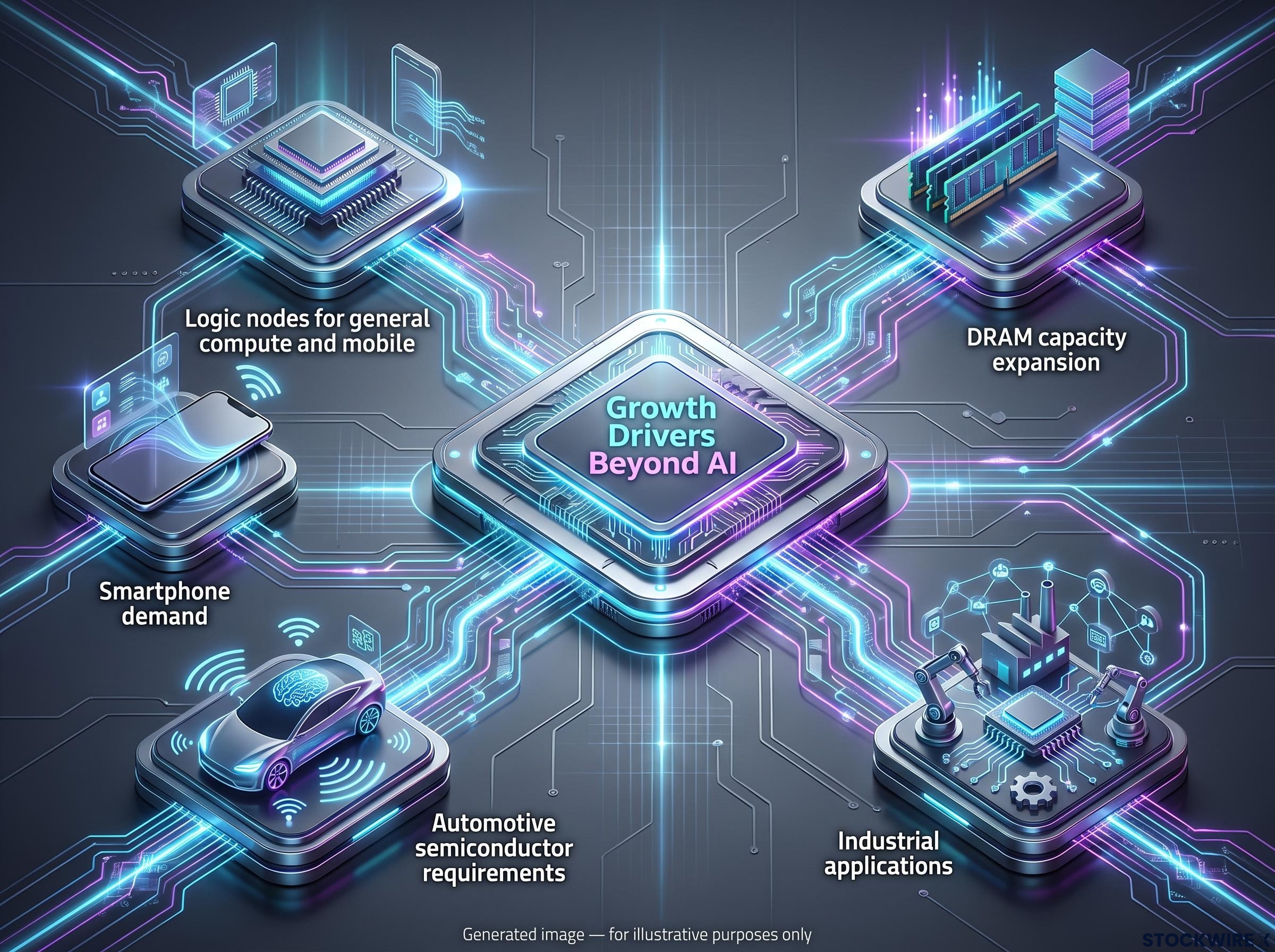
According to Duval’s research, the bulk of ASML’s forecast revenue growth in Goldman’s modelling is attributable to segments with no direct connection to AI spending.
The growth drivers Goldman identifies beyond AI include:
- Logic nodes for general compute and mobile
- DRAM capacity expansion
- Smartphone demand
- Automotive semiconductor requirements
- Industrial applications
Goldman’s broader extreme ultraviolet (EUV) research frames ASML’s lithography tools as central to broad semiconductor scaling, not only AI accelerator production. EUV lithography is the process used to print the finest circuit patterns on advanced chips; ASML is the sole supplier of these machines.
For investors who have sized ASML purely as an AI trade, this thesis implies they may be tracking the wrong variable. The question is not just what happens to AI capex. It is whether the broader semiconductor scaling cycle holds.
What Goldman’s numbers look like versus the Street
The quantitative gap between Goldman and consensus is where the thesis becomes testable.
| Fiscal Year | Goldman EPS Premium Over Consensus | Implied Gross Margin Trajectory |
|---|---|---|
| FY 2027 | ~5% | Expanding from ~41% base |
| FY 2028 | ~10-14% | Mid-range progression |
| FY 2029 | ~18% | ~50% |
The premium grows in the outer years, which tells you something important about the shape of Goldman’s thesis. This is not a short-cycle call. Duval is betting the market will have to revise its earnings model repeatedly as ASML’s product and revenue mix improves.
Duval’s modelling maps a gross margin trajectory that climbs from around 41% in FY 2026 to close to 50% by FY 2029, a gain of roughly 900 basis points across the forecast window.
That margin trajectory is the structural backbone of Goldman’s above-consensus earnings forecasts, and it is not yet reflected in Street estimates, according to Goldman’s research as recapped by Investing.com. If the margin expansion materialises, the re-rating thesis has a long runway.
Where the margin expansion is actually supposed to come from
A 900 basis point margin expansion claim needs mechanical support. Goldman identifies three structural forces driving it:
- Pricing power from a near-monopoly position. ASML is effectively the sole supplier of EUV lithography tools for leading-edge chips, including the emerging high-NA EUV generation (next-generation machines with a wider lens aperture that prints even finer chip features). That position confers structural pricing power, allowing ASML to raise tool prices and protect premium margins as semiconductor nodes advance.
- Revenue mix rotation toward advanced platforms. As customers migrate to high-NA EUV and higher-specification systems, revenue per tool and gross margin per system increase materially. A portfolio tilt toward more advanced EUV platforms represents a sustained margin tailwind rather than a one-off benefit.
High NA EUV adoption is projected to deliver 20-40% cost savings per critical layer versus triple-patterned flows at advanced logic nodes, a structural efficiency gain that makes deferral increasingly costly for chipmakers and underpins the product mix shift at the centre of Goldman’s margin expansion thesis.
- Operating leverage on an expanding installed base. ASML’s fixed cost base, covering research and development, manufacturing infrastructure, and its global service network, does not scale linearly with revenue. As volumes rise, more revenue flows through at incrementally higher margins.
Why the installed base matters as much as new tool sales
Service revenue from ASML’s growing installed base of lithography tools typically carries higher margins than new tool sales. As the global fleet of EUV machines expands, this recurring revenue stream compounds, creating operating leverage across the 2026-2029 window that Goldman’s modelling captures.
The monopoly position in EUV is not just a competitive moat. For investors evaluating this thesis, it means ASML has a structural ability to raise prices and protect margins even if unit volumes slow, which makes the margin expansion story less cycle-dependent than it might first appear.
The risks that could break the thesis
Three categories of risk deserve the same analytical weight as the bull case.
- Export controls on advanced EUV tools to China. U.S. and Dutch restrictions on selling advanced EUV systems to Chinese customers remain in force as of August 2026, with continued tightening also applied to related deep ultraviolet (DUV) equipment. This constrains ASML’s addressable demand for leading-edge tools and introduces geopolitical uncertainty into the growth path.
China export risk for ASML extended beyond the standing DUV and EUV restrictions in June 2026, when U.S. Commerce Secretary Howard Lutnick raised concerns about an advanced EUV system potentially reaching China, an episode that added a fourth investor risk channel, potential BIS investigation, to the geopolitical uncertainty already embedded in any ASML position.
- Semiconductor capex cyclicality. Despite diversified demand drivers, ASML remains tied to foundry and memory capital expenditure cycles. A broad slowdown across PCs, smartphones, cloud, or AI infrastructure could compress order flows regardless of mix diversification.
- Execution risk against elevated expectations. Because Goldman’s estimates sit 5-18% above consensus, any shortfall carries amplified consequences. Potential sources include delays in the high-NA EUV ramp, pricing pushback from customers, or order timing slippage.
A miss against Goldman’s above-consensus numbers carries sharper downside than a miss against a consensus-aligned forecast. That asymmetry is worth sitting with.
If Goldman is right, the re-rating opportunity is substantial. If Goldman is wrong, the stock has further to fall than it would if the Street were already aligned with those projections.
What the Goldman thesis requires investors to believe
The bull case is clear enough: ASML’s growth is diversified across the semiconductor ecosystem, its monopoly position enables durable pricing power, and the margin expansion path to approximately 50% by 2029 is underpinned by mix shift and operating leverage the Street has not yet priced in.
But Conviction List inclusion is not a guarantee. It is a differentiated bet, and the thesis requires believing three structural conditions hold:
- The broad semiconductor scaling cycle (Logic, DRAM, mobile, automotive, industrial) sustains multi-year demand growth for EUV tools
- High-NA EUV adoption accelerates on schedule, driving the product mix shift that lifts margins
- Installed base service revenues compound as the global fleet of EUV machines expands
Goldman intends to track this thesis actively. The 5-18% EPS premium over consensus for FY 2027-2029 provides a specific, trackable benchmark. The question for investors is not whether they trust Goldman. It is whether those three conditions are durable enough to drive the re-rating Goldman is forecasting.
For investors wanting to benchmark Goldman’s differentiated call against the broader analyst landscape, our full explainer on UBS’s €1,900 ASML price target examines how UBS constructs a case that stands more than €600 above the next-highest major analyst, using EUV capacity, memory cycle duration, and High NA adoption as three independently bullish pillars.
This article is for informational purposes only and should not be considered financial advice. Investors should conduct their own research and consult with financial professionals before making investment decisions. Goldman Sachs’ forecasts and margin projections are forward-looking statements subject to change based on market developments and company performance.